 by
by 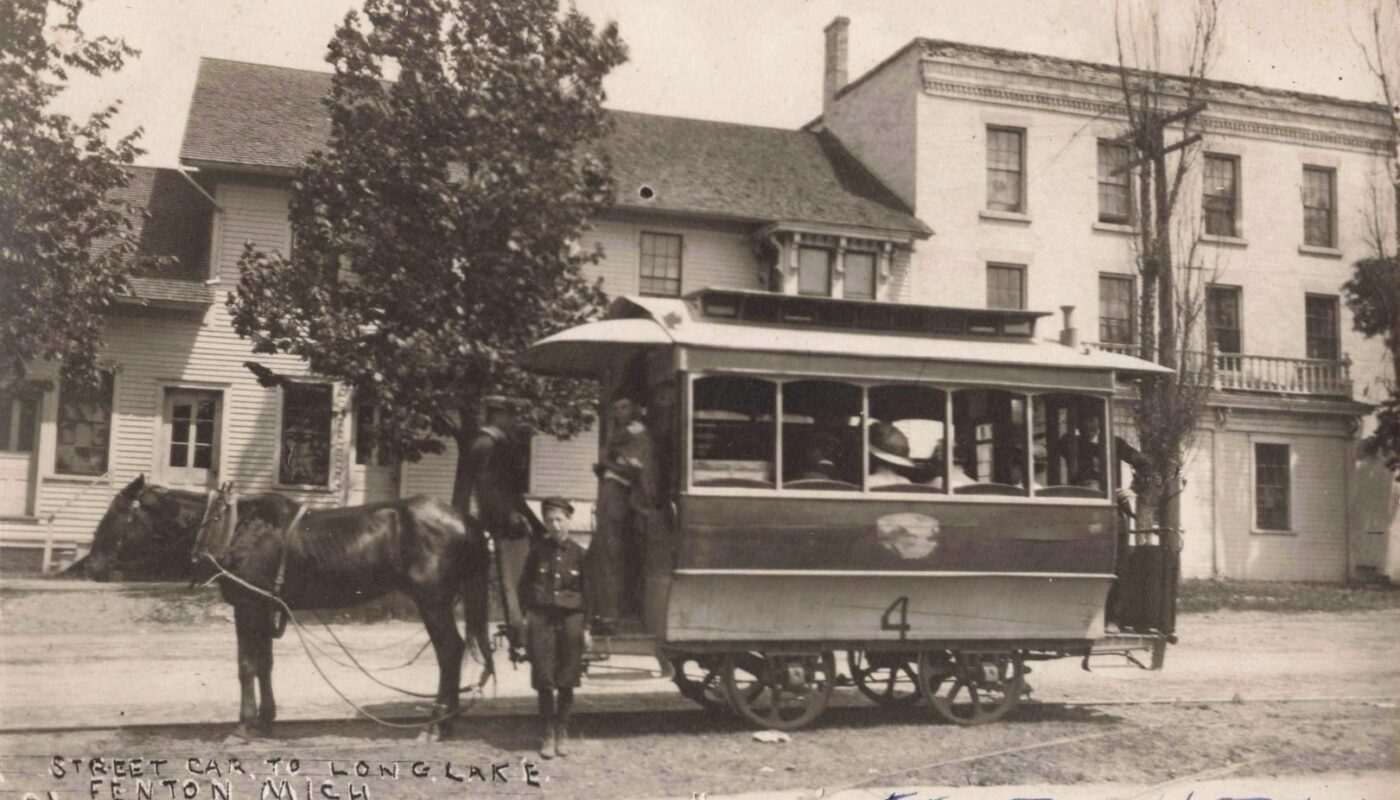
The History of Fenton Michigan is often told like a lake story—boats, camps, and warm evenings near the water. That is true, but it is not the whole truth. In the early 1900s, Fenton also had smokestacks, factory payrolls, and the kind of industrial ambition that could rise fast and fall fast.
This post looks at the History of Fenton Michigan, through a set of postcard-era views and the public records that back them up. The result is a town with two identities that run side by side: workday industry and weekend leisure.
Video- Fenton’s Past: Smoke, Cement, and a Lake Full of Postcards
Fenton – A river town with a plan
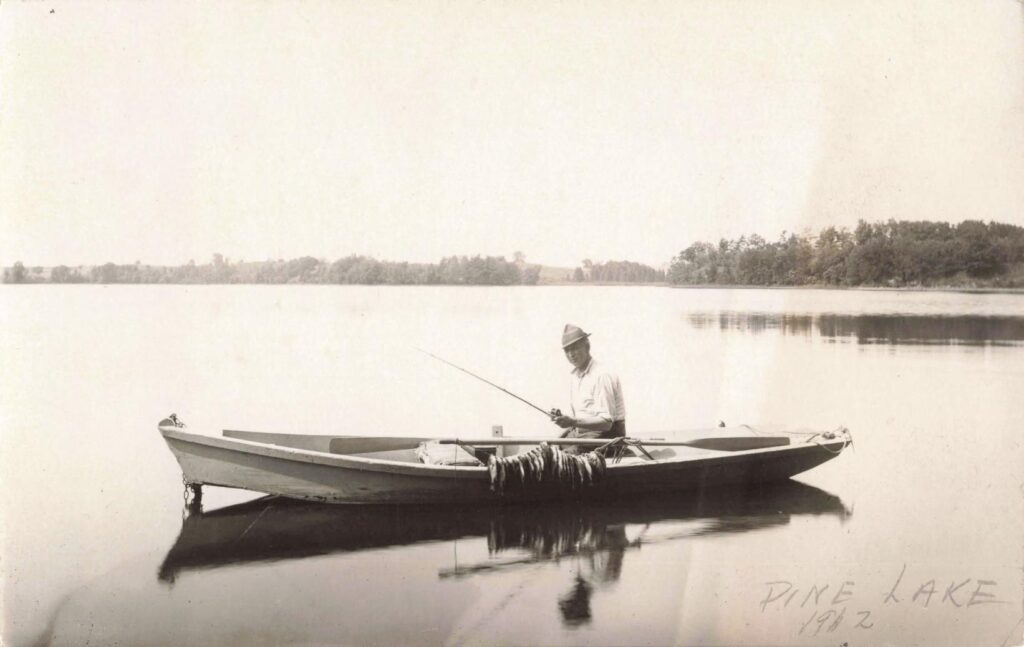
Fenton’s own local history describes its early draw as a meeting place—river access and intersecting trails. It also retells a naming story tied to a card game between William M. Fenton and Robert LeRoy, with streets named for family members. Whether every detail is literal, the point is clear: early on, the people shaping this place were thinking in maps and routes.
Rails made it real
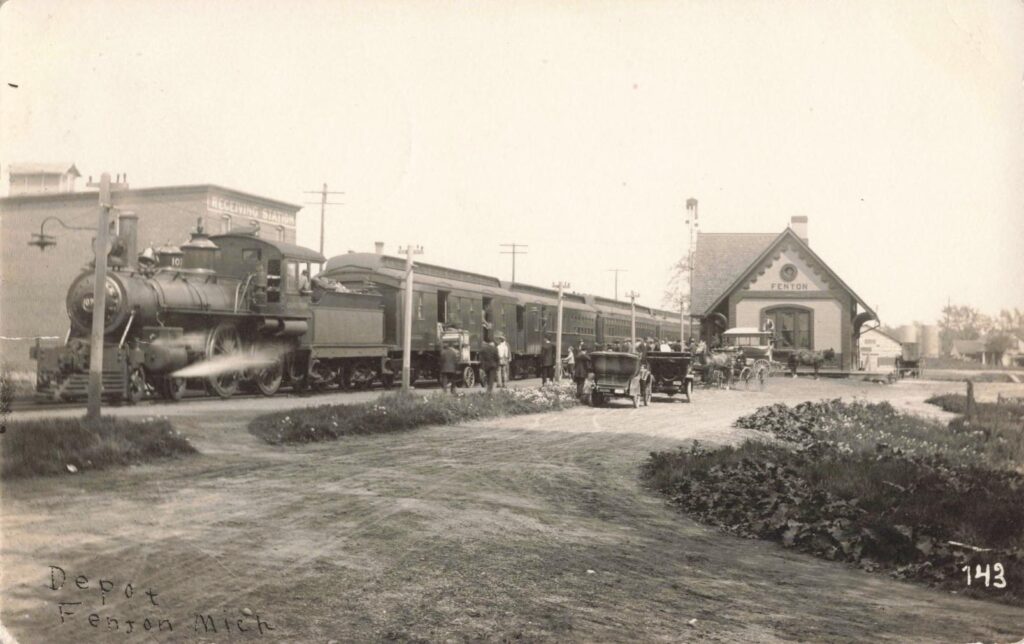
A depot-era view that reflects how rail travel anchored Fenton’s public life and local commerce.
Rail service turned Fenton into a practical destination. A federal nomination for the Fenton Railroad Depot explains how the founders expected the railroad, how a line arrived in the 1850s, and how the depot zone became a center of commerce near the tracks. The surviving brick depot dates to 1882 and was built to replace an earlier frame structure.
Main Street, everyday life
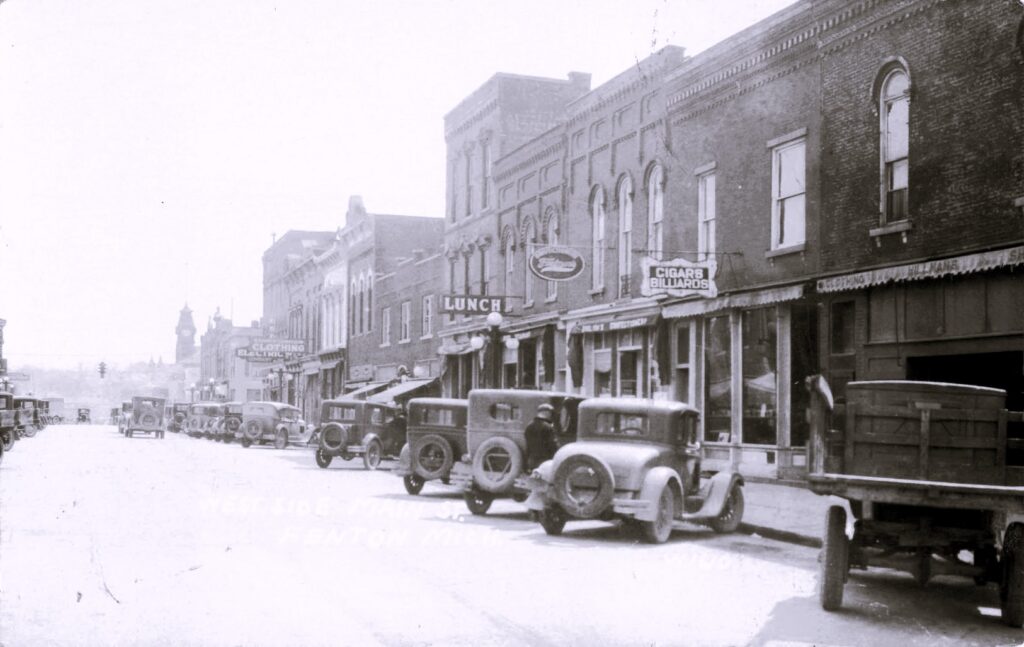
A Main Street scene with automobiles and storefronts—daily commerce in an early twentieth-century small town.
Downtown views from the early auto era show Fenton doing what small towns do best: putting daily life on display. Cars, storefronts, and street signage tell you this was not a place that existed only for visitors. People worked, shopped, and watched the day go by right here.
The counterintuitive part: Cement
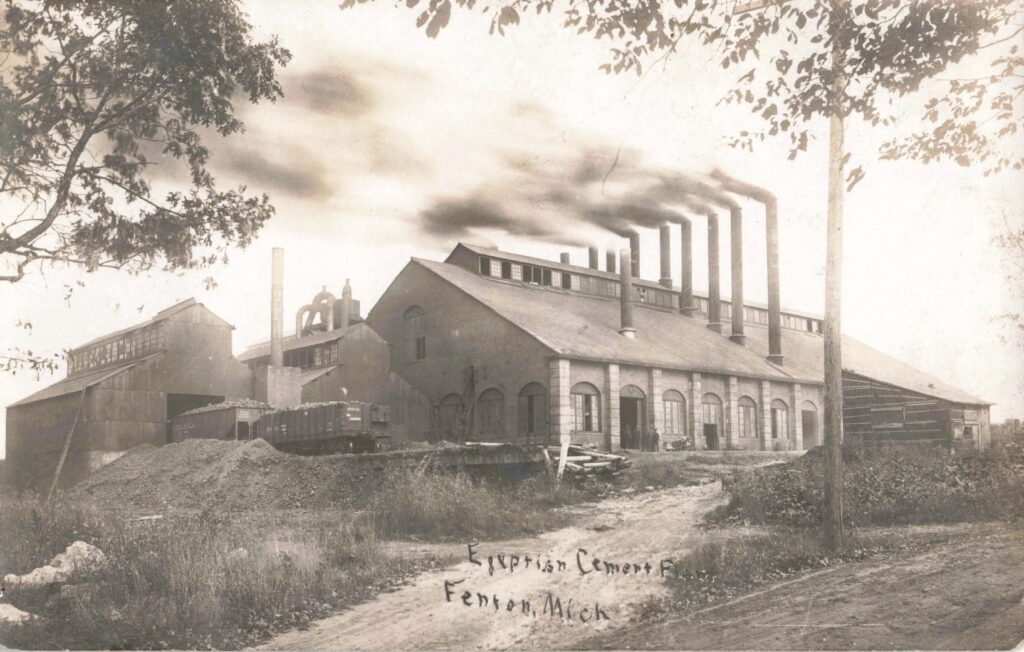
An industrial view that matches state-era reporting that cement operations were active in and near Fenton.
Here is the detail that surprises many readers of the History of Fenton Michigan. In 1903, a state geological survey report described the Portland cement industry and explicitly named the “Fenton plant” of the Egyptian Portland Cement Company as operating, while also noting Aetna’s presence near town. That is a big clue about what paid wages and moved freight.
Local historians credit Fenton as supplying the materials to pave one mile of Woodward Avenue. This was hailed as the first concrete road in the US.
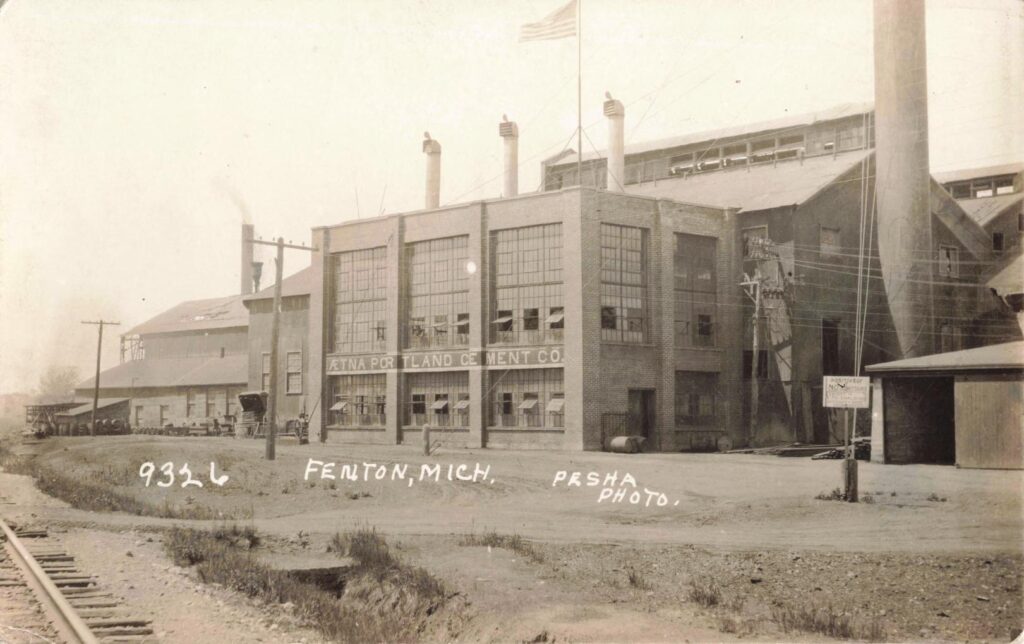
A postcard-era office scene tied to the cement business, showing how industrial life sat close to town life.
A factory town, not just a lake town
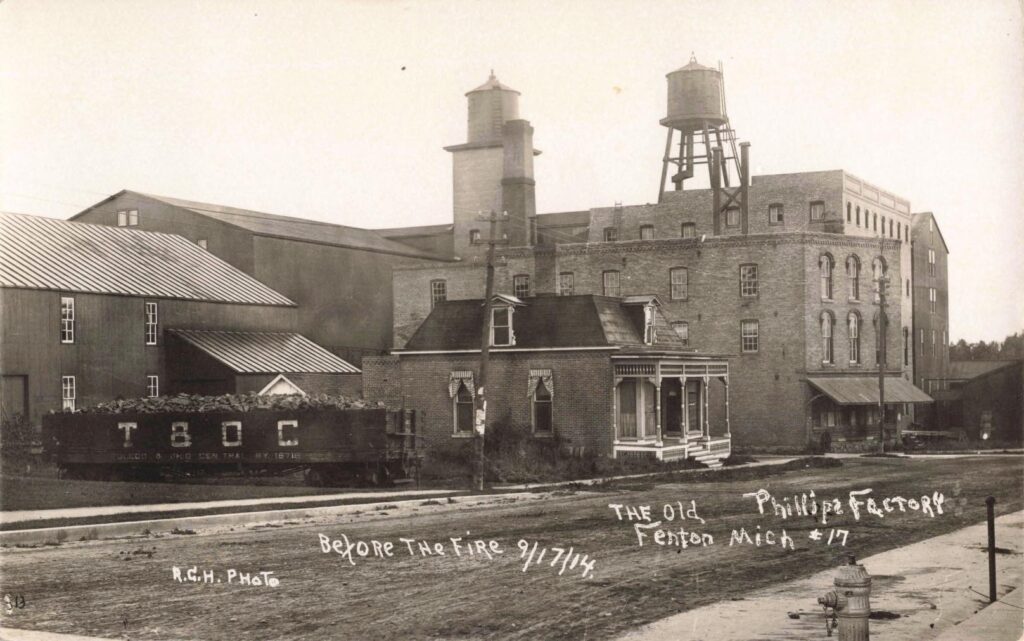
An industrial-era view associated with the Phillips/Koppin site, representing a major employer footprint in town.
Andrew J. Phillips sits at the center of Fenton’s manufacturing story. A Michigan marker account credits Phillips with inventing a sliding window screen and describes how demand drove the growth of a large factory complex producing wood goods. That kind of enterprise is easy to overlook today because so much of modern Fenton’s brand is residential and recreational. But in the early 1900s, manufacturing was a major part of the town’s identity.
The 1914 fire that reset the town
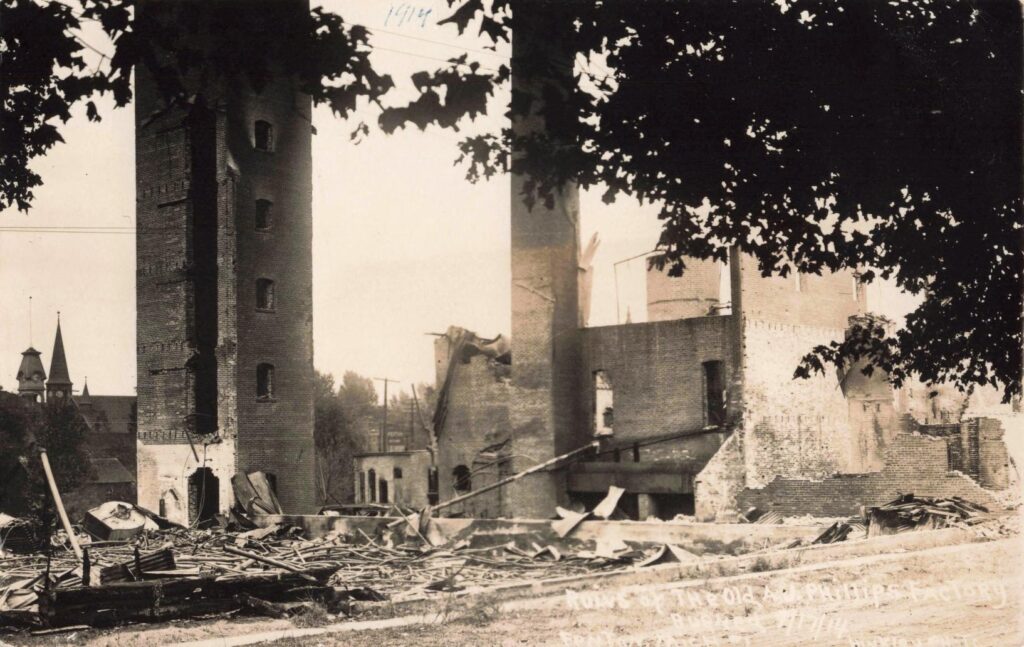
A postcard record that names the date of the fire and shows how the town memorialized the event.
On Sept. 17, 1914, the Phillips/Koppin factory site burned. A local newspaper feature on Fenton-area fires describes the plant’s size and location and ties the period to vehicle manufacturing associated with Henry Koppin’s takeover of the property. Postcard-era records also fixed that date into local memory, showing the ruins and naming the day.
It is hard to overstate what a fire like that could do in a small community. It changed jobs, changed land use, and changed what people believed was possible next.
Lakes, islands, and the weekend economy
Now return to the side of the History of Fenton Michigan that people remember most easily: water.
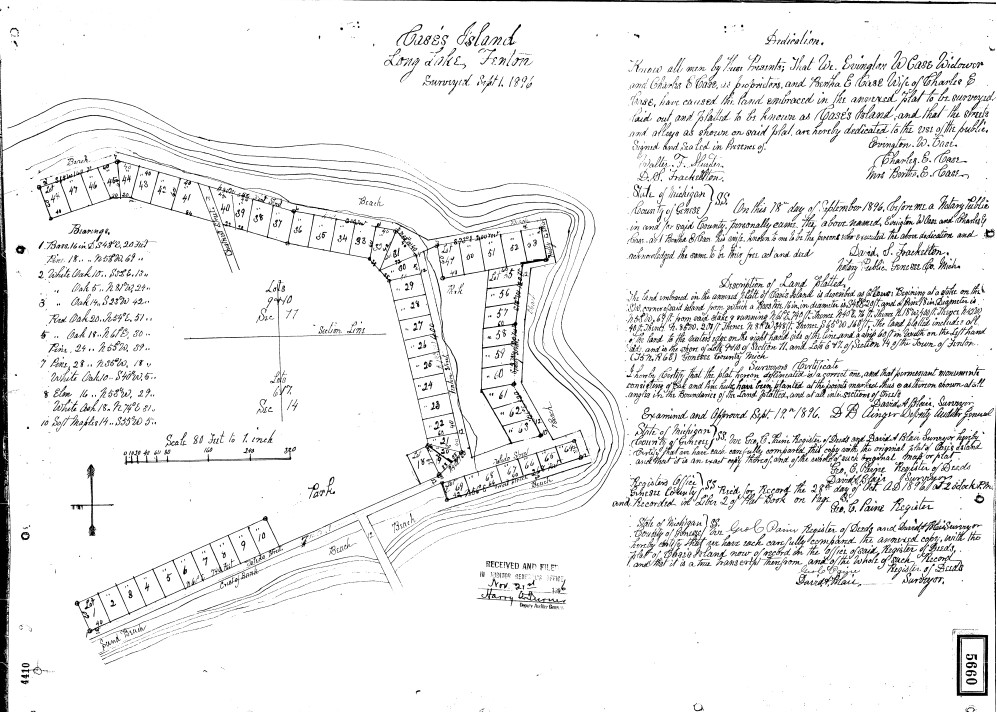
A late-1800s document showing planned lots on Case’s Island on Long Lake.
Case’s Island was being formally organized by the late 1800s. A plat map surveyed in 1896 shows the island laid out on Long Lake, Fenton, with lots and shoreline curves. Another postcard description preserved by the Detroit Public Library describes wooden-frame vacation houses on the island. And a Tinder collection record captures “passenger launches” serving Case’s Island—boats moving people like a regular route.
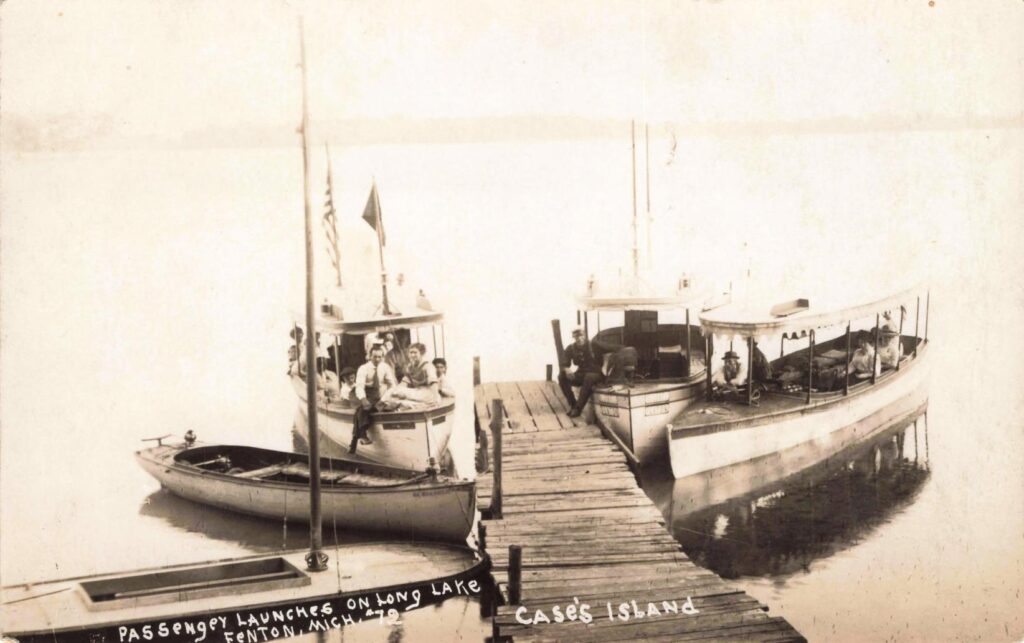
A lake-traffic view showing excursion-style movement between shore, island, and open water.
That is not just leisure. That is business. It means someone built docks, ran schedules, collected fares, and sold the idea of Fenton as a summer destination.
From rail passengers to auto travelers
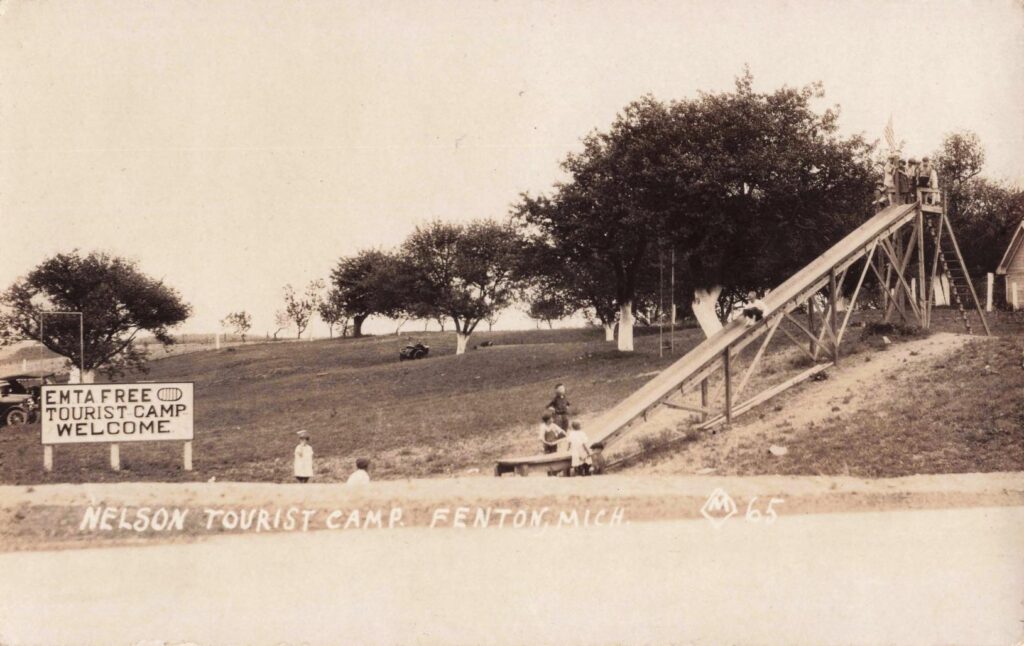
A roadside-era view of traveler lodging in the auto age, built for motorists who needed a stopover.
By the 1920s, the town adapted again. Auto travel created a new kind of visitor, and the supports had to change with it.
A postcard view labeled “Nelson Tourist Camp” shows how travelers were served before modern roadside lodging became common. State historic context writing on Michigan’s auto-travel corridors describes how accommodations evolved across the twentieth century, from camping to cabins and later forms. A Henry Ford Museum artifact description of a 1928 auto-camp guide makes the logic plain: better roads and cars produced road trips, and camps rose to meet the demand.
A town that kept reusing its landmarks
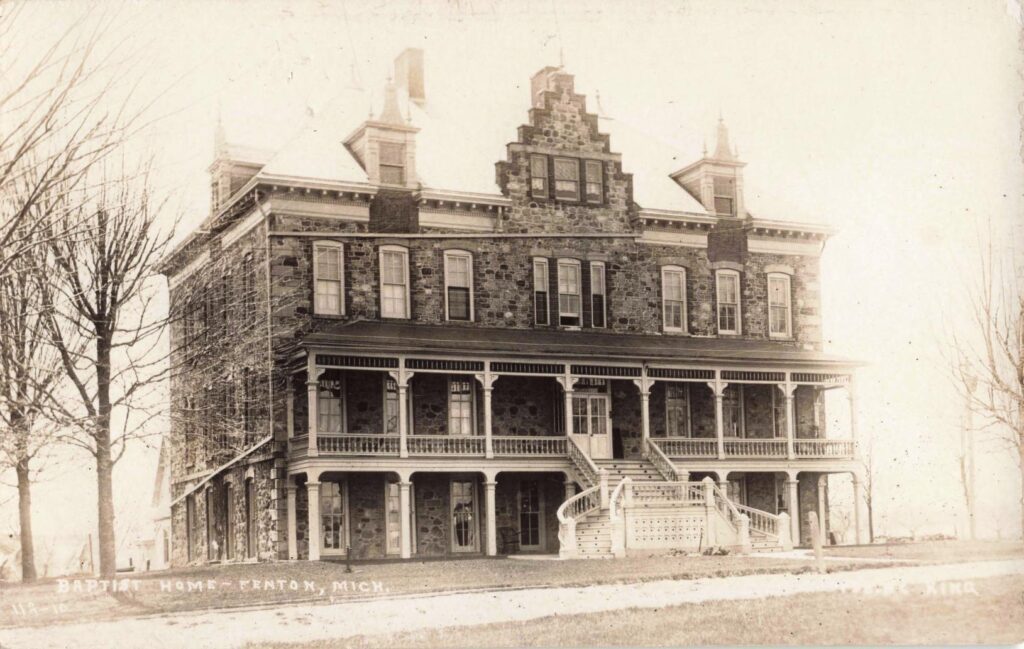
A 1910-era view of the building associated with the seminary-to-retirement-home transition described in public records.
The History of Fenton Michigan is also a story of institutions taking on new roles. The National Register nomination for the Fenton Seminary explains how the town built up a strong school culture, how a private seminary operated as a preparatory institution, and how the building later became a Baptist retirement home for clergy. That pivot—from education to care—fits a broader pattern in small-town history: communities rarely throw away a solid building; they change what it is for.
History of Fenton Michigan, in plain terms
So, what is the History of Fenton, Michigan, when you strip away the postcard gloss and keep the facts?
It is a transport town that learned to live through multiple eras: trails to rails, rails to autos. It is a town that paired lake leisure with industrial work in the same decades. And it is a place where a single fire in 1914 could change the next half-century of local land, jobs, and memory.
If your family remembers Fenton as a summer place, that memory is real. But early-twentieth-century records show another side: cement production and the hard schedules of industrial life. The full story is better—and truer—when you hold both at once.
Works Cited for the Histroy of Fenton Michigan
“Bulletin 65. Population of Incorporated Places in 1900.” U.S. Census Office, 8 June 1901. Accessed 8 Mar. 2026.“History of Fenton.” City of Fenton. Accessed 8 Mar. 2026.
“Fenton Railroad Depot.” National Register of Historic Places Inventory–Nomination Form, National Park Service, 20 June 1983. Accessed 8 Mar. 2026.
“Fenton Seminary.” National Register of Historic Places Inventory–Nomination Form, National Park Service, 26 Nov. 1982. Accessed 8 Mar. 2026.
“Annual Report for 1903.” Board of Geological Survey (Michigan), State of Michigan. Accessed 8 Mar. 2026.
“Paving the Way: The First Mile of Concrete Road.” Federal Highway Administration, U.S. Department of Transportation. Accessed 8 Mar. 2026.
“1889 A.J. Phillips Work Office.” The Historical Marker Database. Accessed 8 Mar. 2026.
“Cases’s Island Passenger Launches on Long Lake Fenton, Mich..” David V. Tinder Collection of Michigan Photography, William L. Clements Library, University of Michigan Library Digital Collections. Accessed 8 Mar. 2026.
“West Side Main St. Fenton Mich..” David V. Tinder Collection of Michigan Photography, William L. Clements Library, University of Michigan Library Digital Collections. Accessed 8 Mar. 2026.
“Nelson Tourist Camp, Fenton, Mich.” David V. Tinder Collection of Michigan Photography, William L. Clements Library, University of Michigan Library Digital Collections. Accessed 8 Mar. 2026.
“Baptist Home – Fenton, Mich..” David V. Tinder Collection of Michigan Photography, William L. Clements Library, University of Michigan Library Digital Collections. Accessed 8 Mar. 2026.
“Office of the New Aetna Portland Cement Co. Fenton, Mich..” David V. Tinder Collection of Michigan Photography, William L. Clements Library, University of Michigan Library Digital Collections. Accessed 8 Mar. 2026.
“Ruins of the Old A. J. Phillips Factory Burned 9/17/14 Fenton, Mich..” David V. Tinder Collection of Michigan Photography, William L. Clements Library, University of Michigan Library Digital Collections. Accessed 8 Mar. 2026.
“Case’s Island Plat Map.” Fenton Township. Accessed 8 Mar. 2026.
“Wooden-frame houses on Case’s Island, Fenton, Michigan.” Detroit Public Library Digital Collections, Burton Historical Collection. Accessed 8 Mar. 2026.
“Eddy’s Landing & Horse Drawn Railcar.” Fenton Historical Society. Accessed 8 Mar. 2026.
“Fires that shaped Fenton’s history — the A.J. Phillips / Koppin Factory fire.” Tri-County Times, 27 Aug. 2023. Accessed 8 Mar. 2026.
“Auto Camp Guide for Transcontinental Travel.” The Henry Ford Digital Collections. Accessed 8 Mar. 2026.
“West Michigan Pike Project Report, Volume II.” Michigan State Historic Preservation Office. Accessed 8 Mar. 2026.