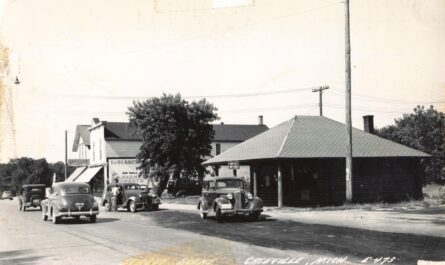
 by
by 
The History of Farmington Michigan between 1890 and 1940 is a story of a small town that grew from quiet dirt roads into a thriving community while cautiously embracing the modern age. Tucked in Oakland County, Farmington began as a Quaker farming settlement in the 1820s. By the 1890s, it was a modest village where agriculture reigned supreme, yet change was on the horizon.

This article explores Farmington’s industries, civic development, notable events, and important residents during that transformative half-century. From the arrival of interurban trains and the glow of electric lights to the endurance of local traditions, Farmington’s journey offers a fascinating slice of Michigan history.
Table of Contents
Video – Dirt Roads & Trolleys -When Farmington Was Still Farm Country
A Farming Village on the Eve of Change

In 1890, Farmington was still every bit the rural village. The 1870 census had recorded over 16,000 acres of farmland in Farmington Township. Fields of corn, wheat, and orchard fruits surrounded the town, and dairy farming was especially prominent. In fact, the early history of Farmington, Michigan, was built on butter and cheese – by the 1870s, the township boasted several dairies and cheese factories serving local farms.

Every morning, farmers loaded horse-drawn wagons with milk cans to deliver to the nearest creamery. One central hub was Warner’s Creamery, established around the turn of the century by local entrepreneur Fred M. Warner. Warner’s Creamery sold pasteurized and packaged milk and butter, illustrating how the agricultural bounty of the surrounding countryside drove the local economy.

Aside from farming, late 19th-century Farmington supported the typical small-town trades. There were blacksmiths and carriage shops to shoe horses and repair wagons, a sawmill providing lumber, and a grist mill grinding grain to flour. In 1888, an impressive new roller flour mill was constructed by Louis Gildemeister, an immigrant miller. Funded in part by local citizens who invested $1,000, Gildemeister’s Farmington Roller Mills stood four stories tall and became a source of hometown pride.
The mill’s heavy grindstones turned the wheat from Farmington’s fields into fine flour branded as “Peerless Flour,” which was sold in neighboring towns. This era also saw the birth of Farmington’s first newspaper – The Farmington Enterprise debuted in November 1888. Having a local newspaper was a sign of maturity; it meant the community was large and literate enough to support regular news and advertising. The Enterprise chronicled everything from crop prices to social events and remains the ancestor of today’s Farmington Observer.
The Coming of the Interurban and Civic Growth

As the 1890s gave way to the new century, technology and transportation began to reshape Farmington. The single most transformative development was the arrival of the Detroit United Railway (DUR) interurban in 1901. The interurban was an electric railway – essentially a streetcar line that ran between cities and towns.

Suddenly, Farmington was linked by rail directly to Detroit and other communities. The main line ran along Grand River Avenue, with a key junction at Orchard Lake Road in Farmington, where one could transfer to northbound cars to Pontiac. At this Farmington Junction, a large electric power house was built in 1898 to supply power to the DUR line.

The coming of the interurban had immediate effects on Farmington’s development. Commuters could live in Farmington and ride to jobs in Detroit. City dwellers visited Farmington on weekends, enjoying its rural charms – some even nicknamed it the “fresh air camp” for urbanites. Farm produce also found a new route to market: local dairy farmers shipped milk and butter to Detroit each morning on special interurban freight runs. Farmington became an early example of a “commuter town,” though it remained small and rooted in farming.
Farmington Grows from Village to City

Civic improvements soon followed. In 1896, Farmington got its first telephone exchange; by the early 1900s several shops had telephones installed for public use. Streets that had been lit by dim oil lamps saw electric lights after the power lines went up, thanks in part to the interurban’s power supply. In 1926, reflecting its growing population and complexity, Farmington voted to incorporate as a city (having been a village since 1867).
Becoming the City of Farmington meant establishing a city council, police department, and other institutions of local government. They initially met in the existing Township Hall – a brick Victorian-style building erected in 1876 after the old hall burned in a fire – which now served as Farmington City Hall. This building (which doubled as a Masonic Lodge on its upper floor) became the center of civic life.
Throughout the early 20th century, Farmington’s civic development kept pace with its modest growth. A waterworks and sewer system was gradually introduced, especially after the 1910s, when public health reforms encouraged better sanitation even in small towns. Roads were improved, too.
Grand River Avenue, once a rutted wagon trail (and even a plank road in the mid-1800s), was gradually graded and graveled. By the late 1920s, parts of Grand River were paved, reflecting the rise of automobile traffic. Indeed, as early as 1915, Farmington had an automobile dealership – a Ford sales and service garage on Grand River – signaling that the age of the automobile had arrived.
Notable Events and Milestones (1890–1940)

Farmington’s history during this era is marked by several notable events – some tragic, some triumphant:
1872 Downtown Fire
In October 1872, just before our 1890–1940 focus, a catastrophic fire destroyed many buildings on Farmington’s main street. This event shaped the rebuilding of downtown in the 1870s, with the construction of more fire-resistant brick structures. The current Masonic Hall (the old town hall) was built in 1876 as part of that rebuilding. By 1890, the memory of the “Great Fire” still loomed in local lore, a cautionary tale that influenced the installation of the village’s first fire hydrants and the organization of a volunteer fire brigade.
Building of Gildemeister’s Mill (1888)
The construction of the Farmington Roller Mills in 1888 was a community milestone. It symbolized Farmington’s transition from purely local grist milling to a more ambitious industrial capacity. The mill was one of the tallest structures in town and even into the early 1900s, its success (and eventual closure in the mid-20th century) was a common reference point in local histories.
Interurban Service Begins (1901)
The inaugural run of the Detroit United Railway interurban to Farmington in 1901 was celebrated by townspeople. Newspapers reported on the shiny new trolley cars and the low fares. The Farmington Junction Powerhouse, completed in 1898–1899, was touted as one of the finest electric plants of its kind. For a rural town, having direct rapid transit to Detroit was almost revolutionary. This service continued for roughly 30 years. An interesting historical footnote: Farmington’s interurban service ended in the early 1930s (around 1931–1932) when the DUR went bankrupt during the Great Depression and as automobiles took over.
School Fire and Rebuild (1918)

In February 1918, the Farmington Union School (built 1888) caught fire and burned down, reportedly due to a furnace malfunction. Despite World War I and the flu pandemic challenges that year, the town rallied to build a new Farmington High School on the same site by the end of 1918. This new high school building was a source of community pride and represented a commitment to education even in hard times. It served as Farmington’s main school until the 1950s.
Images on this page may contain affiliate links in which we may receive a commission. See our affiliate disclosure for details.
Historic Photos of Detroit in the 50s, 60s, and 70s
Historic Photos of Detroit in the 50s, 60s, and 70s documents what a Metro Detroiter would have experienced through those decades, from the commonplace to a visit from John F. Kennedy.
Methodist Church Fire (1920)
Another fire struck on February 7, 1920, when the long-standing wooden Methodist Church on Shiawassee Street burned to the ground. This was a blow to the community, as the church was one of Farmington’s oldest (built in 1844). The congregation, however, rebuilt a larger brick Farmington Methodist Church on the same site by 1922. The new church not only restored a place of worship but also provided a safe auditorium space for public events. This episode reinforced Farmington’s pattern of overcoming disasters with quick rebuilding – a testament to its residents’ resilience.
Farmington’s Economic Ups and Downs
Farmington experienced the general prosperity of the 1920s and the hardships of the 1930s, but with a twist. Being an agricultural town, Farmington did not suffer as severely during the Great Depression as heavily industrialized cities did. Contemporary accounts in the local paper noted that Farmington’s economy, “being basically rural, was more dependent on the earth than on factories” and thus was somewhat insulated. Farm families could feed themselves and even supply food to the needy.
One local bank (Peoples State Bank) did fail during the banking crisis, but another (Farmington State Bank) survived and reopened in 1934. By 1935, there were signs of recovery – car dealerships reported rising sales, and new businesses, like a Kroger grocery store and the Civic Theatre (opened 1936), invested in the town. The Civic Theater’s opening was a major community event, giving Farmington a modern movie palace during the depths of the Depression.
Key Industries and Businesses in Farmington

During 1890–1940, Farmington’s key industries evolved from purely agricultural to a mix of agriculture and light industry/retail, while still maintaining a small-town economy:
Agriculture and Dairy
Farming remained central. Notably, Warner Dairy and Creamery exemplified local vertical integration: farmers produced the milk, and the Warners’ facility processed it for market. The Farmington and Franklin Cheese Co., managed by Fred M. Warner in the 1890s, produced cheese sold regionally. The “milk run” trains of the interurban and later trucks allowed daily shipment of dairy products to Detroit, which became a big business. Farmington was known for high-quality dairy; a visitor in the 1900s would notice the smell of fresh hay and hear the lowing of cows on the outskirts every morning and evening.
Flour Milling
Gildemeister’s Farmington Roller Mills (also known as Gildemeister’s Mill) was the flagship of local milling. It operated from 1888 through the early 20th century. The mill not only served local needs but also sold flour under brands like “Peerless” to neighboring towns. Many farmers grew wheat and took it to the mill; in exchange, they might receive flour or cash. Milling, however, declined by the 1920s as larger regional mills outcompeted local ones. Farmington’s mill continued in reduced capacity, and the building stood until the early 1960s, when it was torn down – later replaced by the Farmington branch library at State and Liberty Streets, which notably acknowledges the site’s heritage.
Farmington’s Retail Trade

General stores and specialty shops expanded in the early 1900s. Fred Cook’s Dry Goods store is a good example – by the 1890s, he sold everything from clothing (“Black Cat” hosiery) to groceries and firearms. In this era, downtown Farmington had multiple grocers, butchers, blacksmiths-turned-auto mechanics, and even early department stores. By the 1930s, chain stores like Kroger grocery stores appeared. There was also Dancer’s Department Store and a couple of pharmacies serving the community. These businesses indicate that Farmington, while small, was self-sufficient – locals didn’t have to go to Detroit for everyday goods.
Hospitality In Farmington

Given Farmington’s location along the Grand River (a well-traveled route), hospitality was a surprisingly important industry. The Owen House (originally established in 1850) and Grace House (established in 1915) were prominent hotels/inns. They provided lodging for travelers, long-term boarders (like teachers or workmen), and hosted local events. The Grace House, in particular, was a modern brick hotel that showed Farmington’s attempt to cater to automobile tourists in the 1920s. It stood on Grand River Avenue from 1915 until it was demolished in 1965. The presence of these hotels underscores Farmington’s role as a convenient stopping point roughly 20 miles out from Detroit – “Sixteen Mile House” (an earlier inn) and the Botsford Inn had been there since stagecoach days, and the tradition continued.
Transportation Services in Farmington

While Farmington never had a steam railroad line running through it (unlike many Michigan towns), it became a small hub for the interurban railway and related services. There were car barns (maintenance garages for the trolleys) and a water tower at Farmington Junction to service the trains.
Some locals found employment with the DUR as motormen, conductors, or maintenance workers. Additionally, with the rise of cars, new businesses like auto repair shops, gas stations, and dealerships emerged. By the late 1930s, one could buy a new Ford or get a tractor repaired in Farmington’s downtown – evidence of adaptation to the automobile era.
Important Residents and Personalities

Several notable individuals left their mark on Farmington’s history between 1890 and 1940:
Fred M. Warner (1865–1923)

The most famous Farmington resident of this era, Fred Warner was the adopted son of P. D. Warner, a local businessman and banker. Fred Warner became a successful merchant in Farmington – managing a hardware store, dairy and cheese enterprises, and a bank – before entering politics. He served as Michigan’s Secretary of State and then was elected Governor of Michigan for three terms (1905–1911). As governor, he was known for supporting good roads and establishing the state’s juvenile court system. Despite his high office, Warner never forgot his hometown; he returned often to his Victorian mansion on Grand River (built in 1867 by his father). That home, known as Governor Warner’s Mansion, is now a museum and one of Farmington’s key historic landmarks. Warner’s legacy in Farmington is evident: a local school (Warner Middle School) and streets bear his name. His story – from farm boy to Governor – embodied the opportunities Michigan offered in that era.
The Grace Family

Eugene and B. F. Grace were influential through their business ventures. B. F. (Benjamin) Grace opened the Grace Hotel in 1915, expanding the family’s prominence in town. Eugene Grace, interestingly, married Minnie Warner Owen (the widow of Bruce Owen, who had run the Owen House). Through that marriage and his own enterprises, Eugene Grace operated the Owen House for a time and was a major local investor. The Grace family also ran a dry goods store where a barber shop stands today, until a devastating fire in 1914 destroyed a chunk of that block (one of several downtown fires). The Grace surname lives on in Farmington – Grace Insurance Agency, for example, is a modern business that occupies the site of the old Grace Hotel, reflecting continuity in the town’s commercial core.
Lucius D. “Daff” Owen

L. D. Owen purchased the Farmington Hotel in the 1870s and transformed it into the Owen House. He and his family ran the hotel for decades. The Owens were community leaders; they hosted events at the hotel and reportedly even built a small bowling alley there for guests. Bruce Owen, Daff’s son, continued the operation into the 1890s until personal troubles intervened (as local lore tells, Bruce left town abruptly around 1891, leaving his wife Minnie to manage the hotel and care for their children and her blind father-in-law). Minnie Owen later married Eugene Grace, merging two local family legacies. The Owens’ story is part of Farmington’s folklore and is tied to the rise and fall of the Owen House itself.
Louis Gildemeister

A German-born miller, Gildemeister might not be a household name statewide, but in Farmington, he’s remembered for building the big flour mill. Arriving in the late 19th century, he not only established the mill in 1888 but also raised a family that worked alongside him. The community’s support of Gildemeister (through investment) shows his standing. His enterprise contributed to Farmington’s economy for over 30 years. Gildemeister’s impact is noted in preservation columns and local histories, especially since his mill’s silhouette dominated the town’s skyline until 1962.
Educators and Civic Leaders
People like Nathan Power (an early school teacher, son of founder Arthur Power) and later school principals are part of the narrative, though less celebrated individually. By 1920, a man named George V. Harrison was superintendent of schools and pushed for consolidating rural one-room schoolhouses into the central school – an effort that bore fruit with the new high school. On the civic side, longtime town clerks, doctors, and merchants such as Dr. Augustus C. Fish (a prominent physician in early 1900s Farmington) were highly respected. Their influence was local but important – for instance, Dr. Fish led health initiatives during the 1918 flu pandemic and treated many sick residents, leaving behind diaries that give insights into daily life.
Farmington Social Life and Community Culture

Between 1890 and 1940, Farmington balanced tradition and change in its social life. Church gatherings were a cornerstone: nearly everyone in town was involved with a church, whether the historic Baptist Church (est. 1826), the Methodist Church (est. 1829), the St. Mary’s Catholic mission (later Our Lady of Sorrows, est. 1927), or others. These churches not only held services but hosted charity bazaars, ice cream socials, and holiday pageants that brought the whole community together.
Music and entertainment often revolved around community halls and hotels. We’ve mentioned the dance parties at the Grace House ballroom – these were popular during the 1910s and 1920s. The Owen House also had a reputation for hosting New Year’s Eve celebrations and Fourth of July festivities in its heyday. As Farmington grew, it formed clubs like the Women’s Literary Society (where ladies met to discuss books and sometimes suffrage ideas) and a local Kiwanis chapter in the 1930s devoted to civic improvement.
Sports were emerging too. Farmington High School started fielding baseball and football teams in the 1920s after the high school was built. They played other small schools, and games became community events, often recounted in the newspaper. In summertime, the farmers might organize baseball games in a pasture – local business owners vs. the farmhands, for instance – drawing spectators who arrived by wagon or Model T.

By the late 1930s, as the Depression eased, Farmington even had a movie theater (the Civic Theater) which provided a new kind of social space: a Saturday matinee for kids or a date-night movie for couples. The theater was one of the few air-conditioned places in town, making it an attractive summer hangout after it opened in 1936.
Final Thoughts about the History of Farmington, Michigan

The history of Farmington Michigan from 1890 to 1940 is a microcosm of America’s journey from the 19th century into the modern era. In the span of fifty years, Farmington saw the end of its frontier innocence and the beginning of its suburban future. It evolved from a farming hamlet into an incorporated city with electric transit, automobiles, new schools, and brick-and-mortar businesses. But amid evolution, the town retained its communal spirit and skepticism of anything too flashy or unproven. Farmington met fires and economic hardship with resilience and rebuilt stronger each time – whether replacing a burned church with a new one or enduring the Depression with its farms intact.
By 1940, someone standing at the corner of Grand River and Farmington Road would see elements of both past and future. On one side, perhaps an old timer in overalls leading a horse-drawn wagon full of milk cans to the creamery; on the other side, a young man in a shiny car stopping at the new traffic light. This coexistence of eras was uniquely Farmington. Even as World War II loomed and post-war suburban expansion was on the horizon, Farmington’s early history continued to guide it. The foundations laid by those 1890–1940 decades – strong local institutions, cherished landmarks, and a culture of caring – ensured that the city could grow without losing its soul.