
 by
by 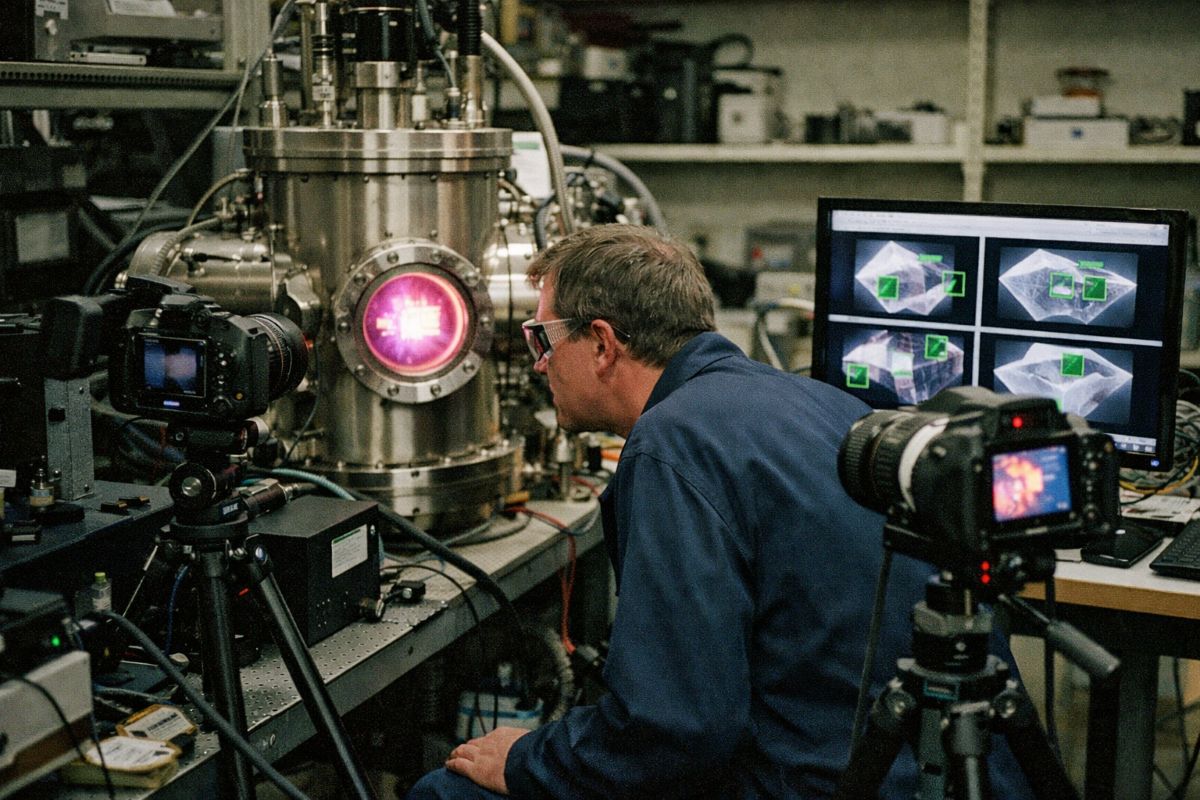
AI-grown diamonds are being researched at MSU using machine learning to spot defects during growth, aiming for tougher chips for EVs and a stronger Michigan workforce training.
EAST LANSING, Mich. — Michigan State University has received a $3 million National Science Foundation award to test whether AI-grown diamond can be manufactured with fewer defects and used to improve semiconductors, the materials that power phones, data centers, electric vehicles and many clean-energy systems.
The project, backed by the NSF’s Future Manufacturing program, pairs MSU engineers with the Fraunhofer USA Center Midwest and the Fraunhofer USA Center Mid-Atlantic. The teams say they will use cameras and artificial intelligence to watch diamond form in real time, then adjust the process before flaws spread through the material. (Source: Michigan State University College of Engineering announcement.)
AI-grown diamonds aim to catch defects before it’s too late
In the MSU announcement, John Papapolymerou, interim dean of the College of Engineering, said the grant offers a path to improve manufacturing methods while building training routes tied to “Industry 4.0” jobs that blend digital tools with hands-on production. (Source: MSU College of Engineering.)
Rebecca Anthony, an MSU associate professor, described the core challenge: diamond growth is slow, and defects can show up after hours or days of work—often too late to restart. She also made a counterintuitive point that matters for anyone who thinks of jewelry first: gemstone diamonds are not automatically the “best” diamonds. She said research-grade diamond can be higher quality than what ends up in a ring. (Source: MSU College of Engineering.)
The process described relies on microwave plasma growth, building diamond layer by layer. MSU said it will feed images from a digital single-lens reflex camera, a hyperspectral imaging system and a forward-looking infrared camera into AI models supported by the Mid-Atlantic Fraunhofer team, looking for early signs of defects. The goal is to tune the process during growth, instead of finding problems after the material is already compromised. (Source: MSU College of Engineering.)
Why diamond matters for semiconductors beyond the hype
Diamond has been studied for years as an “ultra-wide bandgap” semiconductor candidate. Researchers point to its unusual electrical breakdown strength and exceptional heat flow—traits that could matter as chips run hotter and power electronics get pushed harder in EVs and grid equipment. A 2024 peer-reviewed review summarized diamond’s standout material properties compared with other semiconductor options. (Source: “A Review of Diamond Materials and Applications in Power Electronics,” Micromachines (2024).)
That does not mean diamond is about to replace silicon, and the MSU project does not claim it will. The manufacturing hurdle is the real story: if AI can reduce defects and tighten process control, lab-grown diamonds could become more practical for specialized chip components and advanced power devices—areas where reliability and heat management can matter as much as raw speed. (Sources: Micromachines review (2024); NSF Future Manufacturing program page.)
Michigan workforce training is built into the NSF plan
MSU said the grant includes a training pipeline: summer opportunities for K-12 students, training support tied to Washtenaw Community College in Ann Arbor, outreach to adults weighing career shifts, and education opportunities for MSU undergraduate and graduate students. (Source: MSU College of Engineering.)
That workforce angle fits a broader push in Michigan to strengthen semiconductor talent. In 2024, Gov. Gretchen Whitmer announced a $10 million state investment in Michigan Semiconductor Talent and Technology for Automotive Research (MSTAR), describing it as a public-private effort to build skills and support mobility-focused semiconductor applications. (Source: State of Michigan press release.)
Michigan’s business development agency has also highlighted semiconductor momentum and talent-building tied to MSTAR. (Source: Michigan Business / MEDC overview.)
What to watch next for AI-grown diamond in Michigan
The near-term test for the MSU–Fraunhofer team is not whether diamond becomes “the next silicon,” but whether AI-grown diamond can be produced with consistent quality and fewer hidden defects—at a pace and cost that makes sense for real manufacturing.
For Michigan readers, the second test is whether the training commitments translate into credentials and job placement, especially through community-college pathways already being built around semiconductor and advanced manufacturing programs. (Source: Washtenaw Community College program listing.)
Read More Interesting Feature Stories From ThumbWind
- Michigan Feature News Stories – Unveiling the diverse and vibrant people, captivating places, and remarkable events that come together to make the Great Lake State unique.
- Strange Political News – A sarcastic take on official news from around the U.S., covering the absurdities that often arise in politics while keeping a humorous edge.
- Michigan Hometown News – News and events from Michigan’s Upper Thumb region worth knowing, including local stories, interviews, and updates on community happenings.
Your Turn – Like This, or Hate it – We Want To Hear From You
Please offer an insightful and thoughtful comment. We review each response. Follow us to have other feature stories fill up your email box, or check us out at ThumbWind News.
Works Cited
“AI Is a Lab Diamond’s Best Friend for Semiconductors.” Michigan State University College of Engineering, Michigan State University, Feb. 2026, https://engineering.msu.edu/news/ai-lab-diamonds-best-friend-semiconductors.
“Future Manufacturing (FM).” National Science Foundation, updated Jan. 9, 2024, https://www.nsf.gov/funding/opportunities/fm-future-manufacturing.
Zhao, F., et al. “A Review of Diamond Materials and Applications in Power Electronics.” Micromachines, 2024, https://pmc.ncbi.nlm.nih.gov/articles/PMC11278176/.
Wort, Chris J. H., and Richard S. Balmer. “Diamond as an Electronic Material.” Materials Today, vol. 11, no. 1–2, 2008, https://doi.org/10.1016/S1369-7021(07)70349-8.
“Fraunhofer USA Center Midwest.” Fraunhofer USA, https://www.cmw.fraunhofer.org/.
“Fraunhofer USA Center Mid-Atlantic.” Fraunhofer USA, https://www.cma.fraunhofer.org/.
“Semiconductor and Battery Manufacturing (Advanced Certificate).” Washtenaw Community College Course Catalog, https://coursecatalog.wccnet.edu/programs/semiconductor-and-battery-manufacturing-advanced-certificate/.
Whitmer, Gretchen. “Gov. Whitmer Announces $10 Million Investment to Help Michigan Lead in Automotive Semiconductor Technology and Talent.” State of Michigan, June 5, 2024, https://www.michigan.gov/whitmer/news/press-releases/2024/06/05/gov-whitmer-announces-10-million-investment-to-help-michigan.
“The State of Semiconductors.” Michigan Business (MEDC), July 25, 2025, https://www.michiganbusiness.org/news/2025/07/the-state-of-semiconductors/.
“Automation Alley.” Automation Alley, https://automationalley.com/.