 by
by 
Saginaw grew up on a river that never stopped working. The Saginaw River carried people, logs, bricks, and ideas. It also set the line between two towns that argued for years and then joined to become one city. The photos from 1890 to 1930 show a clear turn: bridges tying banks together, a downtown wired for telephones, and factories shifting from rough lumber to precise parts. This is the History of Saginaw Michigan told at street level.
Video – Saginaw – The River City
Why the River Matters in the History of Saginaw Michigan
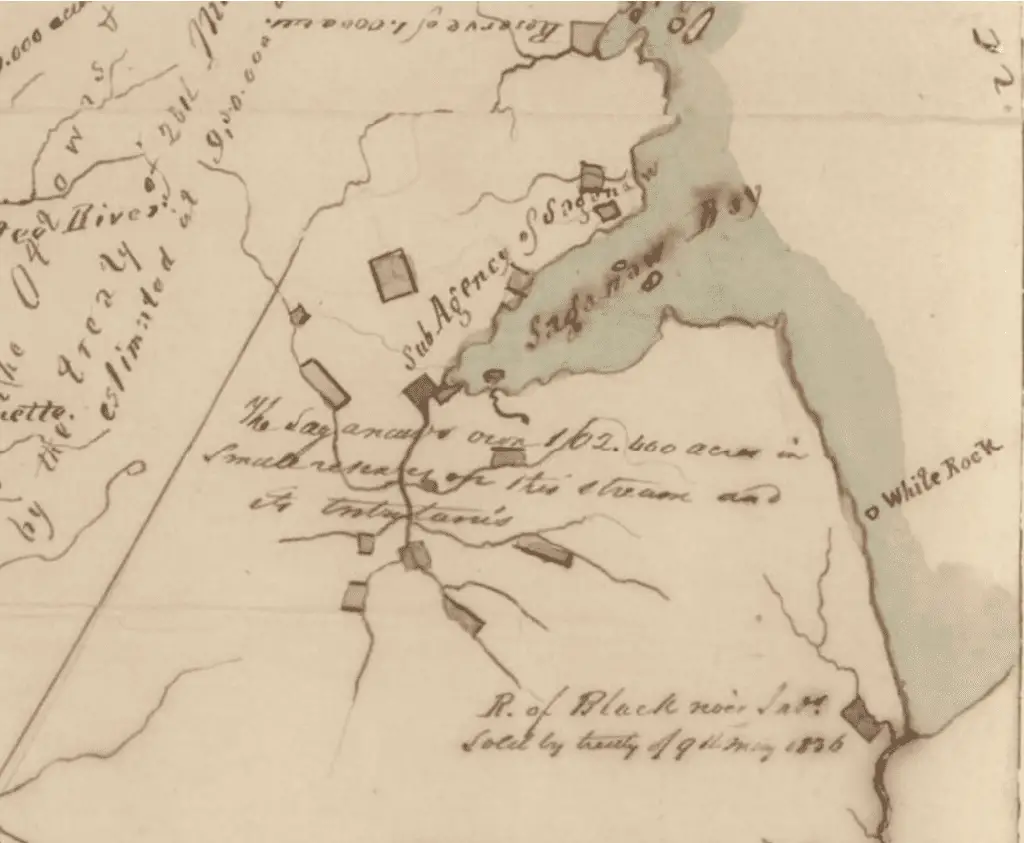
The river was the first road. Long before survey lines, Anishinaabe families used these waters for travel and trade. In 1816, French-Canadian trader Louis Campau opened a post on the west bank. In 1819, a council house near the river hosted the Treaty of Saginaw. That agreement set terms for U.S. settlement and redirected the region’s future. From that moment, the current of events matched the current of the river. Bridges, docks, and rail sidings spread from the water’s edge, and a town took shape.
Treaty and Settlement
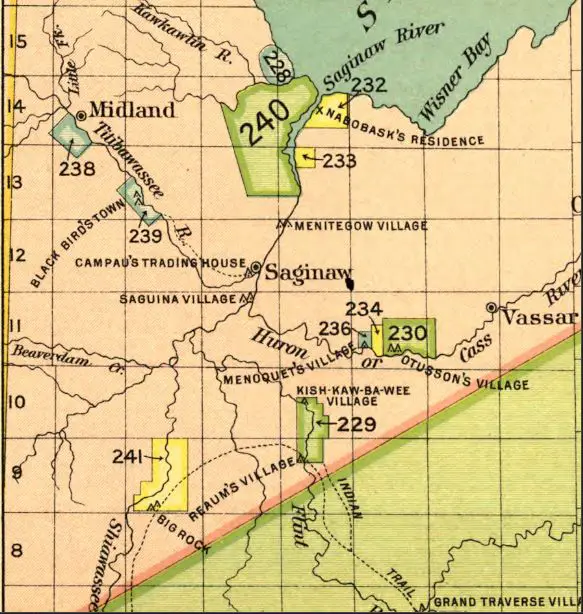
The treaty cleared the way for mills, yards, and shops. Settlement rose quickly along the banks with warehouses and piers edging the channel. Small firms stacked beside larger ones, each using the river as a conveyor. Politics and land control changed with it, and those decisions set patterns that lasted for decades. The History of Saginaw Michigan begins with that shift, because it explains the city’s map, the shape of its neighborhoods, and the location of its industries.
From Timber to Salt: An Engine of Growth
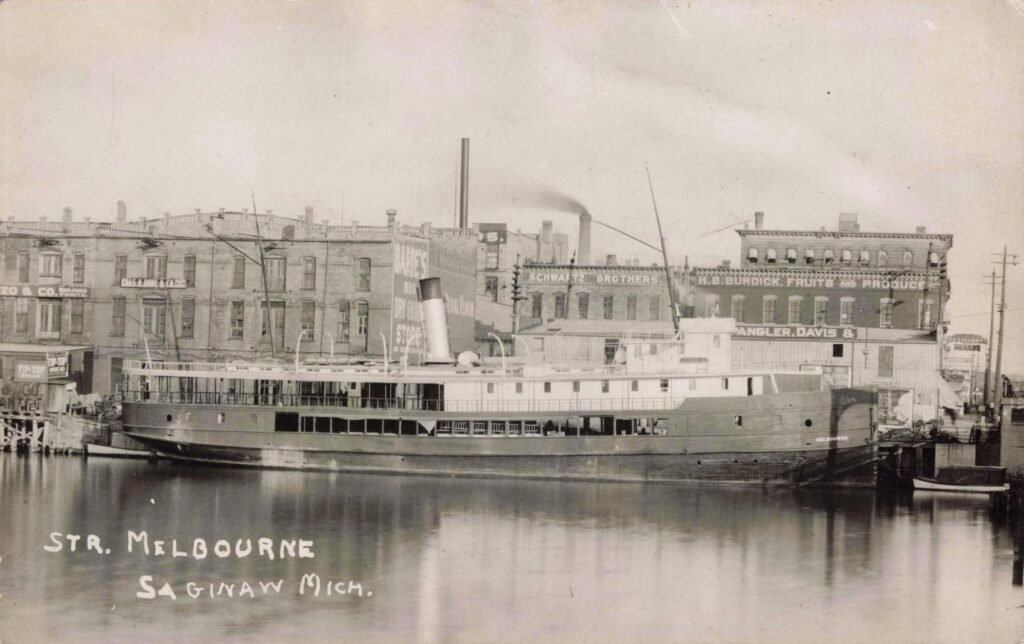
By the mid-nineteenth century, the Saginaw Valley became a lumber engine. Rafts of pine moved downriver to saws that ran day and night. Waste wood from those mills fired brine kettles and launched the valley’s salt industry. Wood heat and brine worked together. The pairing stabilized payrolls as logging entered its last years and encouraged new investment along the docks. The Eskwin Chair Company marks the next step. Furniture and related trades put people to work after the forest boom faded. A city that started with logs now added upholstery, finishing, and shipping to distant markets.
Two Towns Become One City
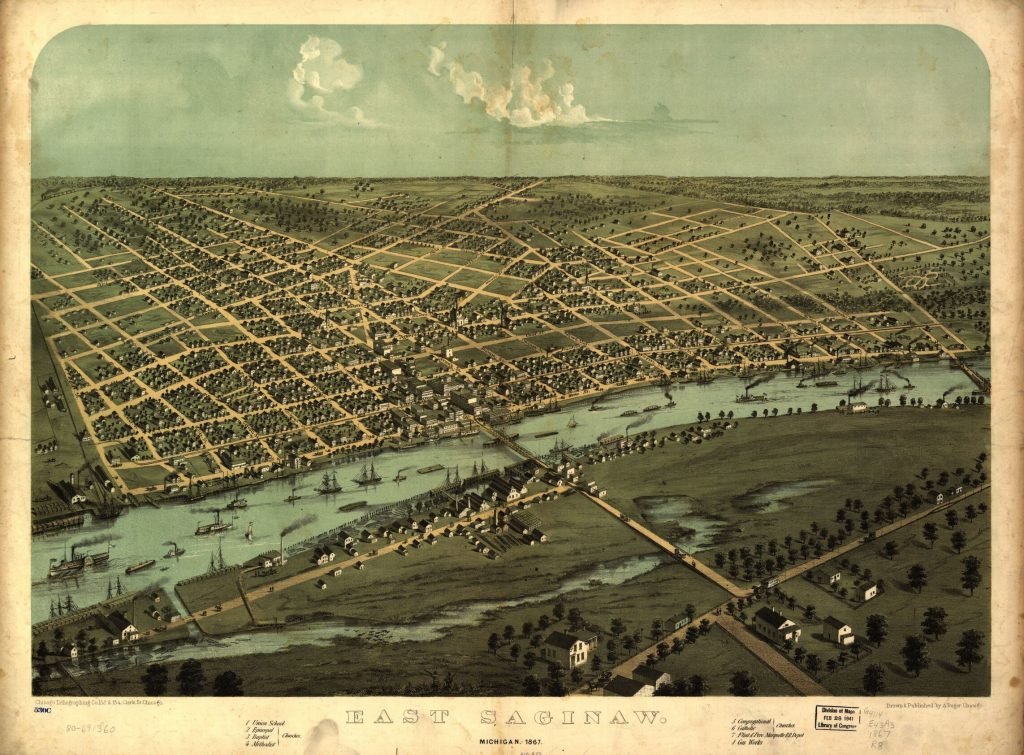
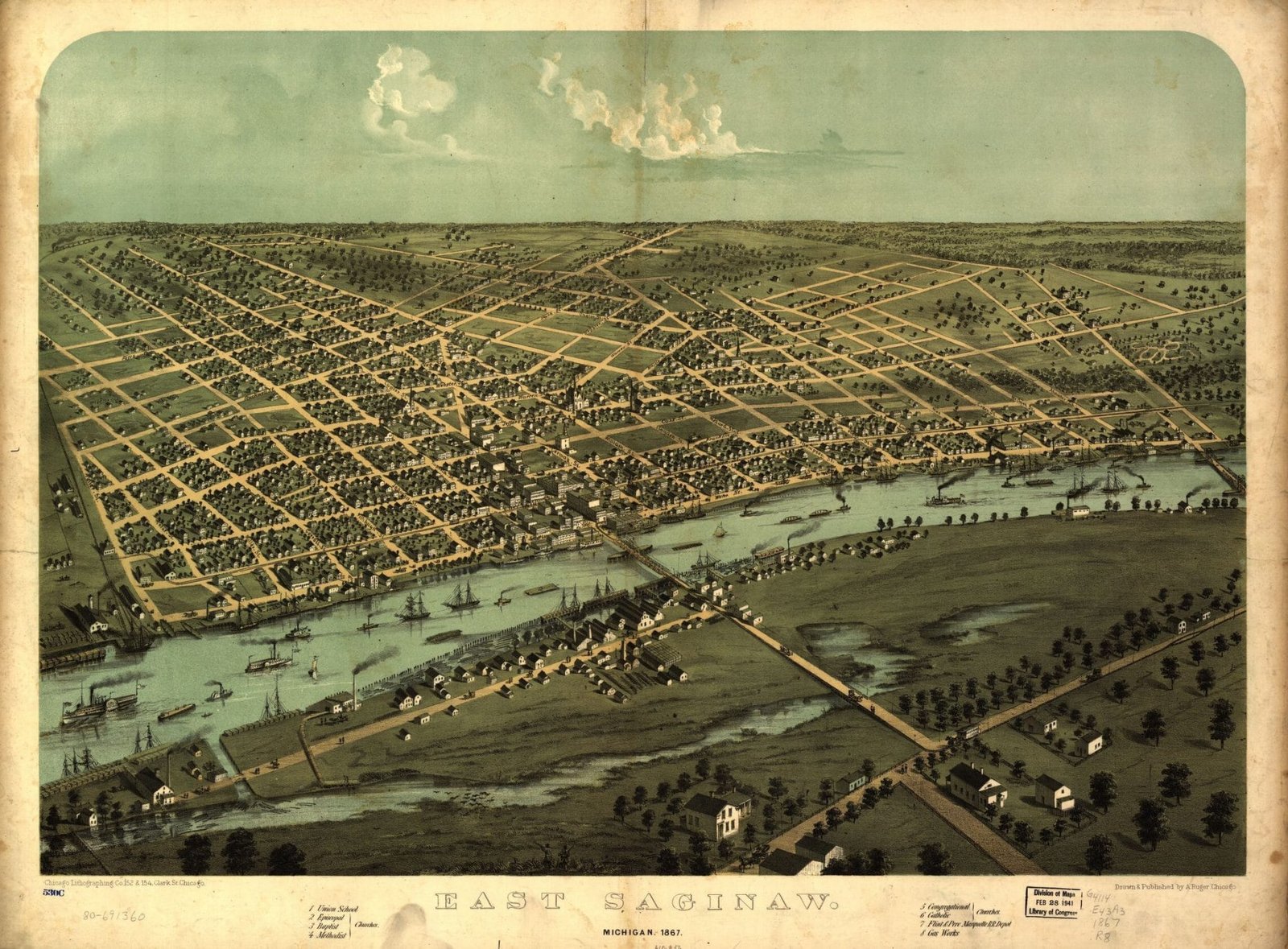
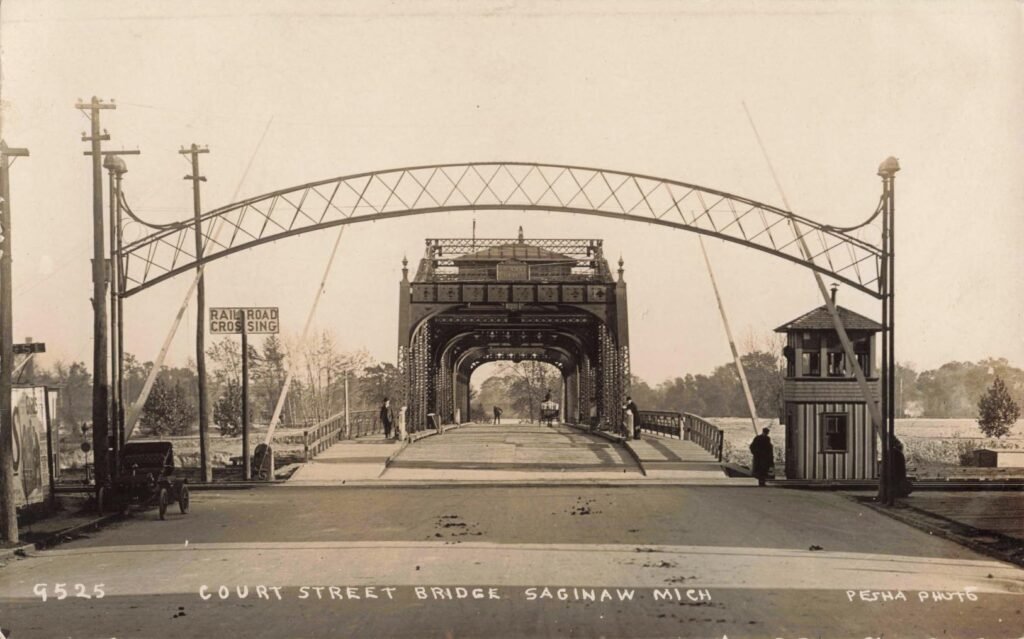
For years, Saginaw City stood on the west bank and East Saginaw stood on the east. They competed for depots, docks, banks, and civic standing. Bridges carried both freight and pride. The Court Street Bridge—a regular subject in period postcards—sat in the middle of that daily contest. In 1889, the Legislature approved consolidation. In March 1890, a single city council met. That act ended duplication and pushed a shared plan for streets, water, bridges, and public works. After that, the Court Street span read less like a border and more like a main street.
Downtown on the Rise
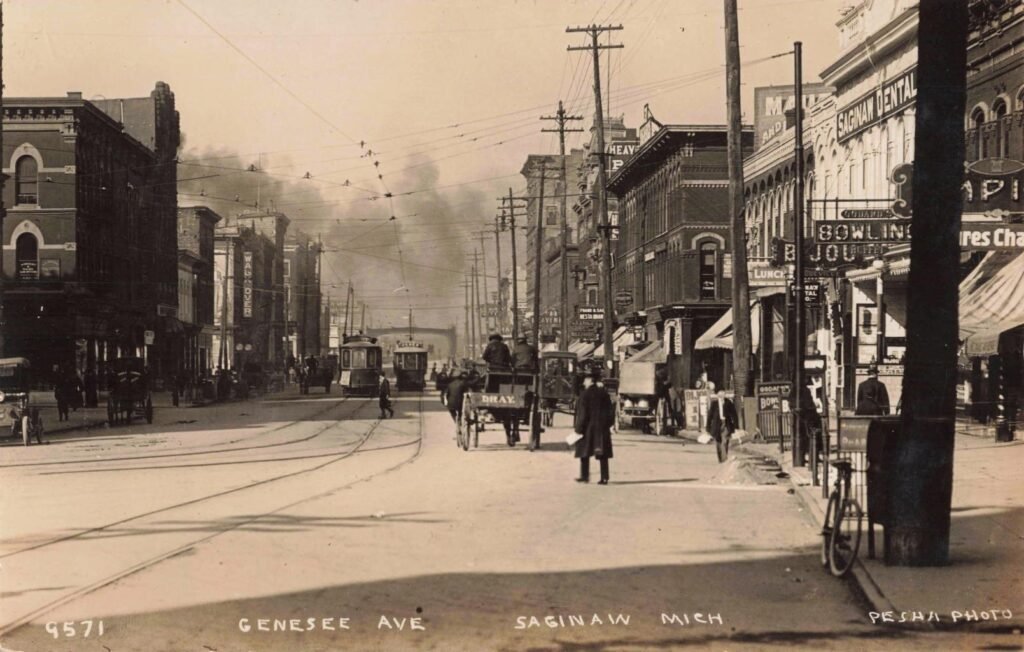
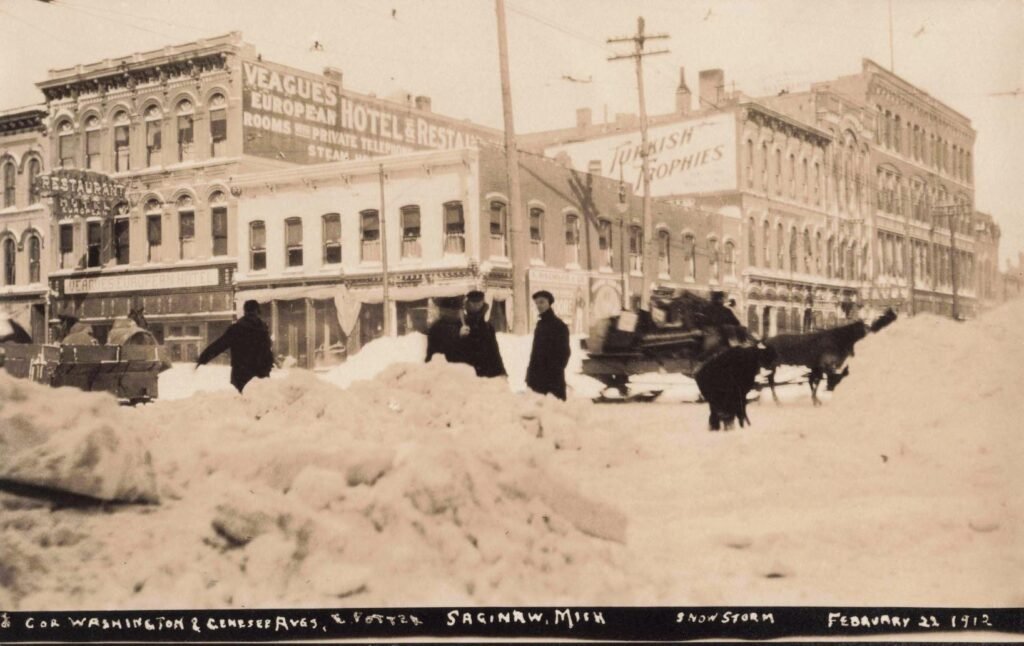
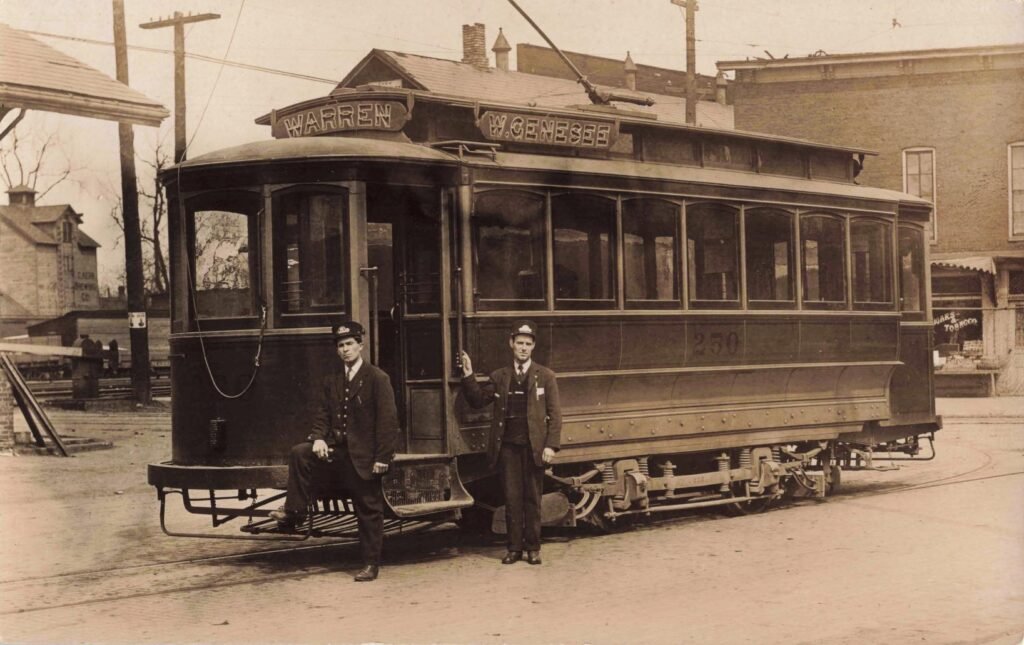
The 1912 Genesee and Baum postcard and the 1918 South Washington Avenue view marked “Mich. Bell” show Saginaw in motion. Shop windows face a busy curb. A lineman climbs a pole while streetcars and delivery rigs squeeze past. Telephones knit homes to storefronts. In 1890, the Hoyt Library opened in strong Romanesque stone, turning learning into a public service with lectures, reading rooms, and local archives. By 1930, the Art Deco Michigan Bell Building arrived to house dial equipment. The photos catch the change just as wires reach farther each month.
Lessons from the Floods
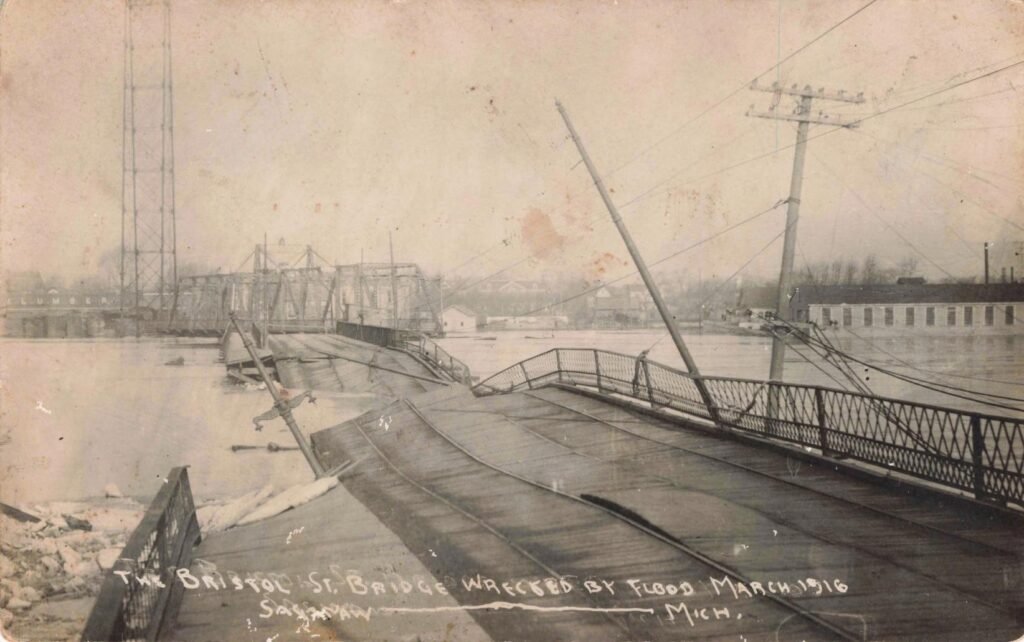
The river gave, and the river tested. In 1904, high water swamped blocks near the waterfront. In 1916, the Bristol Street Bridge buckled under flood pressure. The wrecked span appears in your set with twisted members and broken decking. Cleanup followed as crews hauled debris, reset footings, and reopened crossings. Flood seasons shaped memory and policy. Bridge designs changed. River control moved up the list. In the History of Saginaw Michigan, those hard weeks matter because they drove better engineering and steadier planning.
Factories After Timber
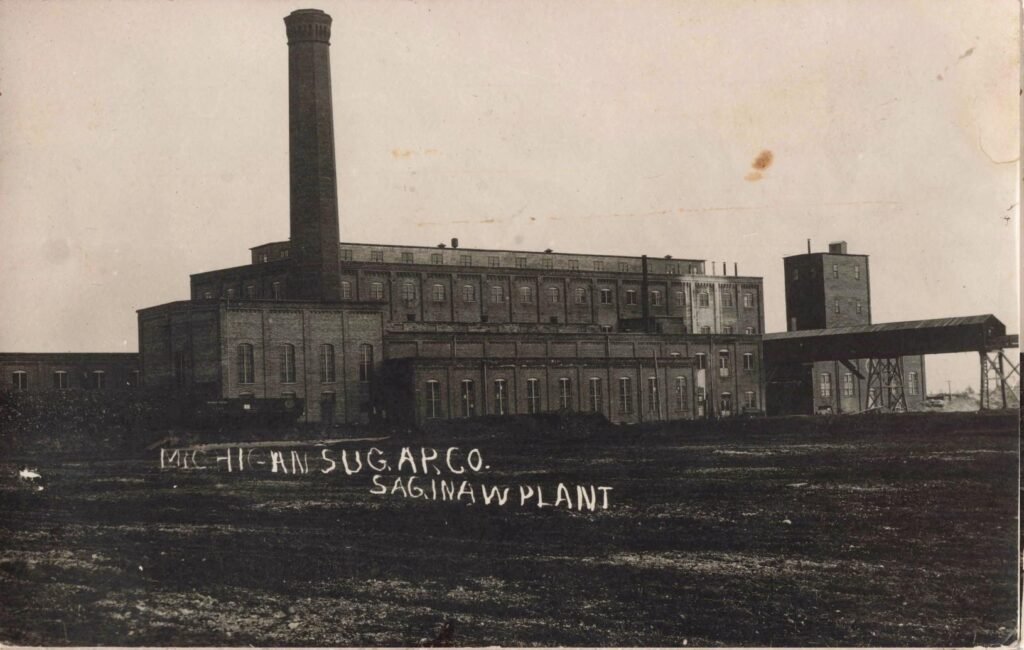
By the 1910s and 1920s, the local economy leaned on furniture, castings, and steering components. Shops focused on accuracy, repeatability, and volume. Foundries poured iron. Machine rooms cut to gauge. The Eskwin Chair Company view stands for that broader base and the search for year-round work. In the next war, Saginaw Steering Gear would build M1 carbines and other materiel, drawing on skills learned in peacetime. The photos place the town it in the transition years, when the old lumber identity gave way to a factory identity built on tools and training.
What the Photos Reveal About the History of Saginaw Michigan
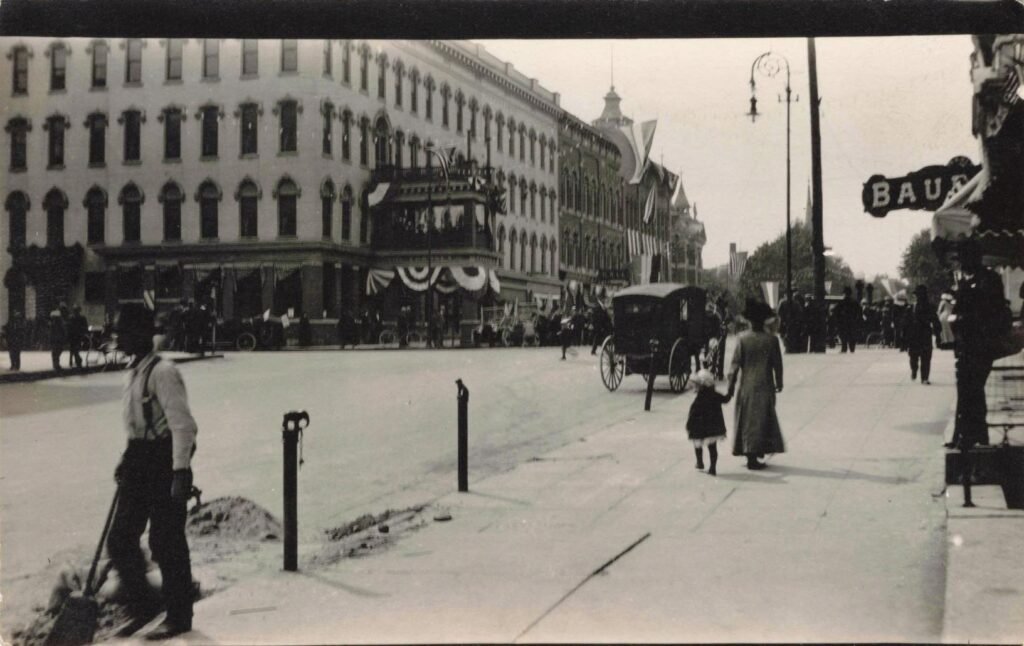
The photos are more than attractive views. The Court Street Bridge scenes show how two banks became one downtown. The South Washington Avenue image with the 1918 caption “Mich. Bell” places us inside the communication build-out. The Genesee and Baum corner in 1912 shows peak foot traffic, signs, and awnings in all directions. The Bristol Street Bridge collapse in 1916 records a rough season and a fast recovery. Together they read like a time-lapse: river, rivalry, union, growth, setback, and renewal. The History of Saginaw Michigan becomes concrete when you can point to piers, poles, stones, and street names.
A City That Kept Moving
Saginaw’s arc matches many Great Lakes towns, yet the details are its own. A river corridor pulled people and freight. A treaty changed control and opened the door to mills and yards. A merger ended a rivalry and cut waste. A downtown invested in phones, books, bridges, and better streets. A factory base learned new trades as markets shifted. If you stand at Court Street and look down the channel, you can read the story in one view. Water. Work. A public square. The next job coming off a line. That is the History of Saginaw Michigan, and it remains visible in the grid, in the riverfront, and in the habits of a city that plans for the next season.
Why It Still Matters
Saginaw’s record can guide present choices. Invest in shared assets when times are good. Respect the water that carries your work. Diversify when a single resource starts to thin. Keep a public room where people can learn together. The past in these photos is not distant. It is a checklist. It shows how a river town became a city that could change and still keep its bearings. That, in short, is the durable core of the History of Saginaw Michigan.
Works Cited
“About the Building.” Castle Museum of Saginaw County History, accessed 8 Nov. 2025.
“Charter City of Saginaw.” City of Saginaw, accessed 8 Nov. 2025.
“Core Sample (Court Street Bridge Marker).” HMdb.org, accessed 8 Nov. 2025.
“Bridges, Bristol, 1916-03-30.” Hoyt Public Library Archives, accessed 8 Nov. 2025.
“Hoyt Library History.” Saginaw Public Libraries, accessed 8 Nov. 2025.
“Salt Brines in the Saginaw Valley.” Michigan State University Geography, accessed 8 Nov. 2025.
“Saginaw Steering Gear: Small Arms Production.” Michigan Tech, Industrial Heritage, 11 Oct. 2015.
“U.S. Post Office (Castle Station) / Castle Museum.” SAH Archipedia, accessed 8 Nov. 2025.
“The Eskwin Chair Co., Saginaw (RPPC-107331).” David V. Tinder Collection, University of Michigan, accessed 8 Nov. 2025.
“Saginaw Mich. Cor. Genesee & Baum, May 25, 1912 (RPPC-107305).” David V. Tinder Collection, University of Michigan, accessed 8 Nov. 2025.
“So. Wash. Ave. Mich. Bell, Saginaw, Mich. (RPPC-107169).” David V. Tinder Collection, University of Michigan, accessed 8 Nov. 2025.
“Treaty with the Chippewa, 1819.” Indian Affairs: Laws and Treaties (Oklahoma State University), accessed 8 Nov. 2025.
“Treaty with the Chippewas (7 Stat. 203).” GovInfo, U.S. Government Publishing Office, accessed 8 Nov. 2025.
::contentReference[oaicite:0]{index=0}