 by
by 
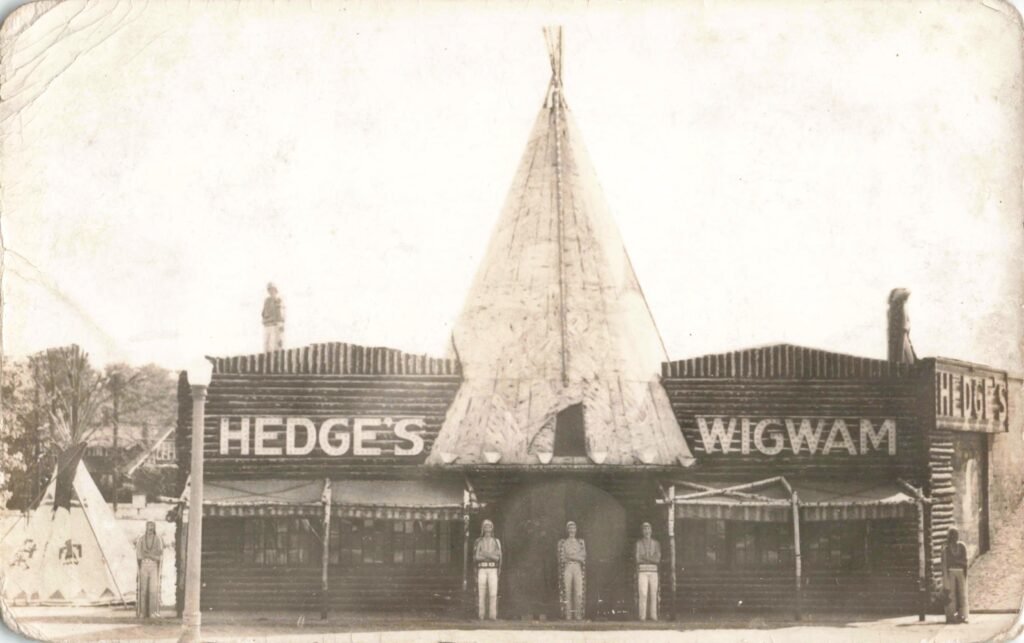
The faded photograph in the reel shows a curious structure on Woodward Avenue at 10 Mile Road. A giant concrete teepee rises from a log-sided building labeled “HEDGES WIGWAM.” Concrete figures in headdresses stand out front.
This was Hedge’s Wigwam, a Native American–themed cafeteria in Pleasant Ridge, Michigan, operating from 1927 to 1967. Though many postcards list it as Royal Oak, property records list the address as 24362 Woodward Avenue, one block east of the original Saginaw Trail.
Hedge’s Wigwam In Pleasant Ridge: Was The Woodward Roadside Icon Moved?
Quick answer: Hedge’s Wigwam was not moved as a restaurant building. It stood at Woodward Avenue and 10 Mile Road in Pleasant Ridge. The building closed in 1967 and was later destroyed by fire in 1972. Some of its large concrete statues were removed, sold or relocated after the restaurant closed.
Hedge’s Wigwam: Fast Facts
Hedge’s Wigwam was one of Woodward Avenue’s best-known roadside stops during the early auto age. Here are the key facts behind the Pleasant Ridge landmark.
| Question | Fast Answer |
|---|---|
| Was Hedge’s Wigwam moved? | Main answer The restaurant building was not moved. It closed in 1967 and was destroyed by fire in 1972. Some of the concrete statues were later moved to other Michigan locations. |
| Where was Hedge’s Wigwam located? | Location It stood at Woodward Avenue and 10 Mile Road in Pleasant Ridge, Michigan. Some postcards listed Royal Oak, but the Pleasant Ridge location is the key site. |
| When did Hedge’s Wigwam operate? | Dates The roadside restaurant operated from 1927 to 1967. Its story began earlier with Roy Hedge’s orange juice stand at the same busy corner. |
| Why was it popular? | Roadside draw The building had a giant concrete teepee, log-sided walls and large statues out front. Its unusual look made it easy for Woodward Avenue drivers to remember. |
| What happened to the building? | Final years Hedge’s Wigwam closed in 1967. A later business used the building, but a 1972 fire destroyed the structure. |
| What remains today? | What survives The restaurant is gone, but several concrete statues connected to the site reportedly survived and were moved to museums, businesses or private property. |
From Orange Juice Stand to Roadside Attraction
Owner Roy Hedge started on this corner in 1920 with a simple orange juice stand serving motorists heading north from Detroit. As traffic increased, he added sandwiches and hot meals.
After a trip to northern Michigan, Hedge reportedly saw a themed restaurant and decided to build his own version near 10 Mile. By 1927, the small stand had grown into a full cafeteria under the name Hedge’s Wigwam, open extended hours to catch both commuters and late-night drivers.
Concrete Teepee and “Chiefs” Out Front
The reel’s image, likely from the 1930s or early 1940s, highlights the building’s most striking feature: a native americanthemed hedges wigwam featured towering concrete teepee over the main door. The rest of the structure was finished with log siding to resemble a frontier stockade.
Five concrete statues of Native men, each about 1,800 pounds, stood with folded arms and blankets across their shoulders. They were not based on any particular nation or person. Instead, they offered a generic, romantic image that matched the “Indian” roadside marketing of the era.
Inside the Air-Conditioned Cafeteria At Hedges Wigwam
Hedge’s Wigwam advertised itself as a “unique air-conditioned cafeteria” at a time when cool indoor air was a selling point. Hedges Wigwam featured a cafeteria-style dining experience. Diners entered under the teepee and moved along a cafeteria line serving barbecued beef, chicken pot pie, and other comfort foods.
Inside, birchbark columns, stonework, mounted moose heads, and display cases filled with labeled “Indian curios” shaped the mood. Serving staff sometimes wore faux buckskin outfits. Period accounts describe a hostess dressed as a Native “maiden” leading guests to tables, reinforcing popular imagery rather than authentic culture.
Hedges Wigwam – A Stop on the Old Saginaw Trail
The site carried a longer travel story. Before cars, this bend in Woodward sat beside the Ridge Road portion of the Saginaw Trail, which linked Detroit with Saginaw. An earlier inn known as Rose’s Tavern stood nearby in the 1800s, offering beds and meals to riders and wagon traffic.
By the mid-20th century, Hedge’s Wigwam filled a similar role for drivers cruising Woodward. Families stopped on the way to the Detroit Zoo, while teenagers met friends before heading farther north.
Closure, Fire and What Remains Today
Plans for Interstate 696 in the 1960s cast doubt on the restaurant’s future. Investment slowed, and Hedges Wigwam closed in 1967. A new owner opened the Trading Post gift and antique shop in the building, but in 1972, a fire destroyed the structure. Arson was blamed, though no one was charged.
Parts of the story survive. Several of the concrete statues were auctioned off and still stand in Michigan. One is at Paint Creek Cider Mill in Oakland Township, another appears at the Royal Oak Historical Society Museum, and others are reported at a restaurant in Clarkston and a private yard in Royal Oak.
The old postcard view in this reel is more than a quirky roadside scene. It shows how a busy corner of Pleasant Ridge used stylized Native imagery to sell cafeteria meals to generations of southeast Michigan drivers.
Was Hedge’s Wigwam Moved Or Relocated?
Hedge’s Wigwam was not moved as a restaurant building. The Woodward Avenue landmark stood at 24362 Woodward Avenue near 10 Mile Road in Pleasant Ridge. It closed in 1967, and the building was destroyed by fire in 1972.
The confusion likely comes from the concrete statues that once stood outside the restaurant. After the building closed, several statues were sold, moved or placed at other Michigan locations. That means parts of the Hedge’s Wigwam story were relocated, but the restaurant itself was not.
Why Do Some Postcards Say Royal Oak?
Many older postcards and roadside references placed Hedge’s Wigwam in Royal Oak. The site was close to Royal Oak and was likely easier for travelers to recognize that way. Property records and local accounts place the restaurant at Woodward Avenue and 10 Mile Road in Pleasant Ridge.
Why Was Hedge’s Wigwam A Popular 1930s Roadside Attraction?
Hedge’s Wigwam became popular because the building served as its own advertisement. The concrete teepee, log-sided exterior and large statues made the restaurant stand out along Woodward Avenue. In the 1930s, motorists often chose roadside stops that looked unusual, memorable and easy to describe.
Pick Your Next Oddball Michigan Roadside Stop
Michigan’s old two-lane highways were built for pull-over moments. Use this guide to find bear stories, tourist towers, mystery roads, tiny chapels, roadside food stops and lost landmarks that still make Michigan road trips worth slowing down for.
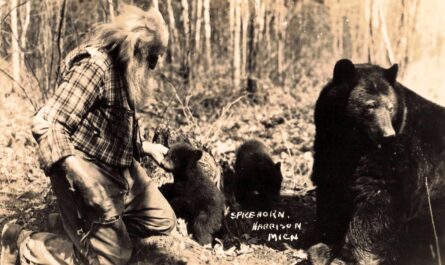
Spikehorn Meyers’ Bear Den
Harrison once had one of Michigan’s wildest roadside stops, where John “Spikehorn” Meyer turned live bears, hand-painted signs and backwoods showmanship into a US-27 legend.
Read the Spikehorn Meyers story15 Michigan Roadside Attractions In The Thumb
This Thumb-focused guide rounds up quick stops, odd signs, local landmarks and low-cost roadside breaks that fit well into an M-25 day trip.
See the Thumb roadside listThe Underground Forest
Michigan’s Underground Forest was the kind of roadside claim built for curious drivers: strange, memorable and made to pull families off the highway.
Read about the Underground ForestHedges Wigwam In Pleasant Ridge
Along Woodward Avenue, Hedges Wigwam showed how a building could become its own billboard in the motor age, long before online ratings and digital ads.
Read the Hedges Wigwam storyMichigan Tourist Towers
From Irish Hills to Devils Lake, Michigan’s early tourist towers gave motorists a reason to stop, climb and buy a postcard from the top.
See Michigan’s tourist towers20 Michigan Tourist Traps Worth Knowing
Big claims, strange stops and roadside oddities all helped build Michigan’s motor-tourism culture. This guide pulls together some of the state’s most unusual places.
See the Michigan attractions listGravity Hill In West Michigan
A road that seems to pull cars uphill is exactly the kind of simple, odd roadside claim that keeps families debating what they just saw.
Read about Gravity HillJenny, The Beer-Drinking Bear
Quanicassee’s bear story is part local lore, part roadside memory and part reminder that Michigan tourism once had a much looser idea of animal entertainment.
Read about Jenny the BearBay Shore Bar & Grill Car Fountain
A roadside bar, a memorable fountain and a hearty menu make this Fairgrove stop a modern example of the old rule: give drivers a reason to notice you.
Read about the car fountainMichigan’s Tiny Chapels
Small chapels such as Wayside Chapel and Rimwood Chapel offer a quieter kind of roadside stop, built around reflection rather than spectacle.
See Michigan’s tiny chapelsWalker Tavern At Cambridge Junction
Long before motor courts and tourist traps, Walker Tavern served travelers at a key southern Michigan crossroads. It is a useful bridge from stage roads to auto roads.
Read the Walker Tavern historyMichigan Road Trips And Pit Stops
Build a longer Michigan route around ghosts, rails, ruins, small towns and roadside surprises with this broader trip-planning guide.
Plan a Michigan road tripTravel note: Some sites are active stops, while others survive through photos, ruins, markers or local memory. Check hours, access rules and seasonal conditions before making a long drive.