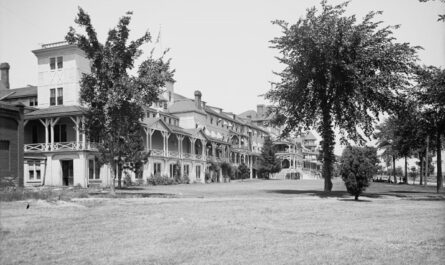
 by
by A Village on the Map
Gagetown Michigan’s roots trace to Joseph Gage, who laid out the village plan and anchored it in Michigan’s Elmwood Township. The early plat map, dotted with the Gage family’s holdings, shows a town ready for growth — with a mill yard, State Street businesses, and farmland stretching to the horizon.
The Gagetown Michigan Grist Mill
The flour and grist mill at Gagetown was one of the earliest and most important industrial operations in the village. Built by James Gage, one of the town’s founders, the mill played a central role in local economic life in the late 1800s.
The first saw and grist mills in Gagetown were powered by Mill Creek, which was dammed to provide water power. This was a typical setup for small Michigan towns during that era, as waterpower was essential before the widespread arrival of steam and electricity. The original sawmill burned in 1877, part of a common cycle of industrial fires in 19th-century Michigan.
Gagetown survived the Great Thumb Fires of 1871 and 1881, which devastated much of Huron County, though the village itself escaped major losses aside from the mill. The mill’s operations were a vital service to local farmers, who brought in grain to be ground into flour or meal. It also anchored commerce by attracting related trades, such as blacksmiths, merchants, and teamsters who hauled products in and out.
Railroads and Harvests
By the early 1900s, Gagetown thrived as a rail town. The depot bustled with activity, shipping sugar beets, dairy, and goods to larger cities. Trains powered the economy, linking farmers to markets and bringing in supplies. Photographs show a scene of determined labor: horse-drawn wagons piled high with sugar beets, men loading milk cans at the depot, and a railway car labeled “Grand Trunk” waiting on the tracks.
A Community at Play
Gagetown was not just about work. Parade days brought the whole town together. Families gathered along Main Street to cheer floats and marching bands. Storefronts displayed local pride, with awnings pulled down against the summer sun. A lone man stands beside his horse and buggy, umbrella overhead, advertising a local merchant — a small symbol of the town’s character.
A Night of Flames
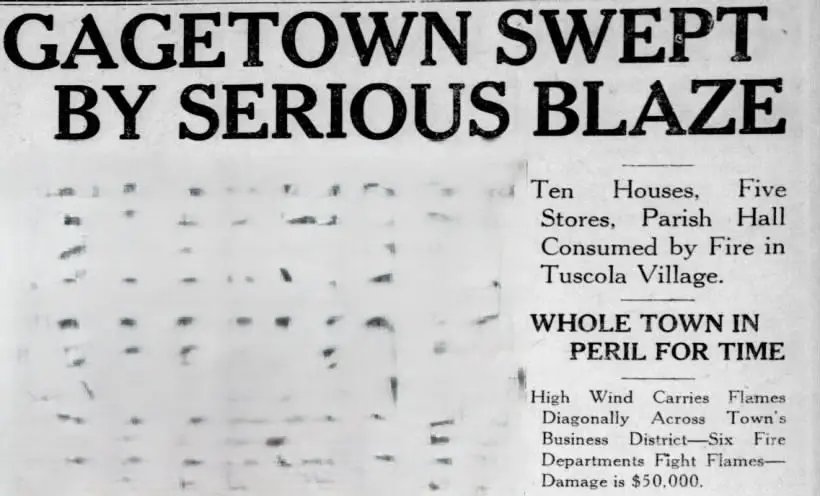
June 1925 marked a turning point. A fire sparked near St. Agatha’s parish hall quickly spread, leaping across streets and consuming buildings in its path. Ten houses, five stores, and the parish hall were lost. The town’s firefighting equipment failed under pressure, and only the arrival of neighboring fire departments stopped the blaze. The opera house and bank narrowly escaped the flames, standing as landmarks of survival.
Rebuilding For a New Generation
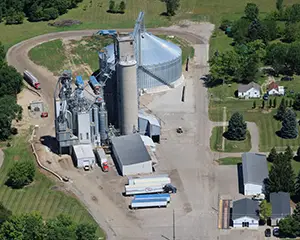
The site of the old Gagetown mill is now occupied by Vita Plus Corporation, a regional agribusiness that provides livestock feed and nutritional services to farmers. This continuation reflects Gagetown’s long-standing agricultural role in the Thumb. Vita Plus carries forward the land’s purpose — supporting Michigan’s farming community — even though the original wood-frame mill is long gone.
The history of Gagetown Michigan is also marked by the entrepreneurial spirit that led to the establishment of various businesses supporting the mill and the local community. Gagetown rebuilt from the ashes. The opera house continued to host events, and farmers returned to the fields. Main Street, once charred, resumed its rhythm. Today, old maps, photos, and family stories preserve Gagetown’s past — a past marked by hard work, close ties, and a shared determination to carry on.
Other Michigan Fire Disasters Worth Reading
Michigan’s fire history did not end with the 1908 Metz Fire. Across the state, hotels, schools, villages, forests and rail towns faced fires that reshaped local memory and public safety.
Fraser House Fire — Bay City, 1907
The Fraser House fire left Bay City with a stark reminder of how quickly a downtown hotel disaster could unfold in the early 1900s. The aftermath showed the limits of fire protection in dense commercial districts.
Read: Aftermath of the Fraser House Fire, Bay City, Michigan, 1907
Omer, Michigan — Fire, Flood and Survival, 1866-1940
Omer’s early history was marked by repeated disaster, including fire and flood. The small city’s story shows how vulnerable river communities were before modern infrastructure and emergency response.
Read: History of Omer Michigan — Fire, Flood and a Small City That Endured Disaster
Parisville Fire — 1881
The 1881 Parisville Fire destroyed much of a Thumb-area community and became tied to stories of faith, loss and survival. It remains one of Michigan’s most dramatic small-town fire accounts.
Read: 1881 Parisville Fire — Devastating Blaze Destroyed a Town and Brought Miracles
Elkton School Fire — 1930
The Elkton School Fire brought fear to a Huron County town and left a lasting mark on local memory. School fires forced Michigan communities to rethink building safety, exits and emergency planning.
Read: The Elkton School Fire — The Dreadful 1930 Blaze That Changed a Michigan Town
Caseville Forest Fire — 1924
Caseville faced a serious forest fire threat in 1924 as flames pushed toward the Lake Huron shore. The story stands out because local residents and responders fought to protect a community that could have suffered far greater damage.
Read: Flashback — The Heroic Battle to Save Caseville, Michigan from a Raging Forest Fire
Oscoda and AuSable Fire — 1911
The 1911 fire that struck Oscoda and AuSable became one of northern Michigan’s most destructive community disasters. It showed how lumber towns near Lake Huron remained exposed to fire long after the peak logging years.
Great Fires of 1871 — The Burning Great Lakes
The Great Fires of 1871 burned across several Great Lakes states during the same period as the Chicago Fire. Michigan communities were part of a wider regional disaster driven by drought, wind and heavily cut timberland.
1881 Michigan Fire — The Thumb Changed Forever
The 1881 Michigan Fire devastated the Thumb and became one of the state’s defining wildfire disasters. It destroyed farms, homes and settlements across a region still shaped by logging, land clearing and dry weather.
Mendon Fire — 1916
The 1916 Mendon Fire left behind the story of a Michigan village that was never the same. It is a reminder that fire could erase a community’s business district, homes and future plans in a matter of hours.
Hinckley Fire — 1894
The 1894 Hinckley Fire happened in Minnesota, but its smoke and fear reached Michigan. The event remains relevant to Great Lakes fire history because it showed how regional weather, timber waste and drought could create disasters felt far from the burn zone.
Read: 1894 Hinckley Fire — When the Sky Went Black — Michigan’s Day of Smoke and Fear
Metz Fire — 1908
The 1908 Metz Fire destroyed the village of Metz, Michigan, and killed 37 people. Hundreds were left homeless. The most painful chapter came when a Detroit & Mackinac Railway relief train derailed after intense heat damaged the rails near Nowicki’s Siding.
Read: History of The 1908 Metz Fire Michigan – The Shocking Day a Railroad Village Burned
A Final Nap About Gagetown Michigan
The Randall brothers’ mill stood as more than a structure — it was a working part of Gagetown’s economy, supporting farmers and shaping daily life in Michigan’s Thumb. Though the original building is gone, its role lives on through Vita Plus, which now occupies the same ground. From grinding grain to advancing livestock nutrition, the site continues to serve the same purpose it did in 1881 — supporting agriculture and sustaining a community built on hard work.
Throughout the challenges faced, Gagetown Michigan remained resilient, showcasing the strength and unity of its residents.