 by
by 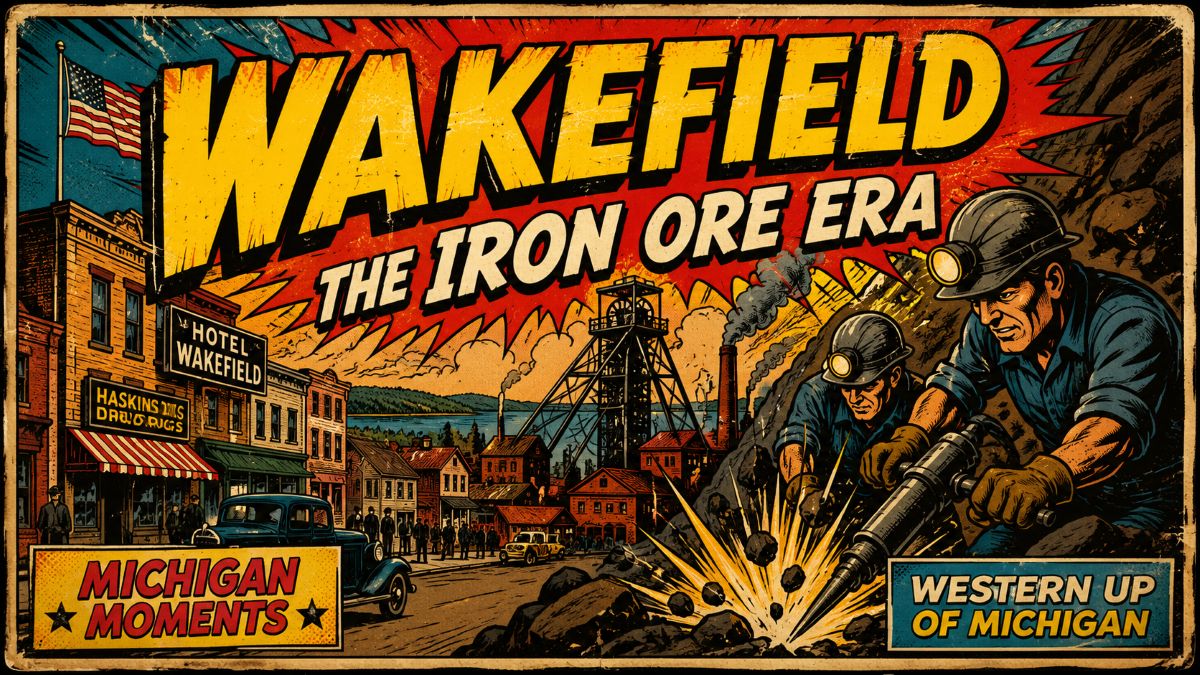
Michigan Moments Video
Wakefield Michigan Iron Mining History: Life in a Boomtown
Historic photographs show how iron ore transformed Wakefield from a frontier settlement into a busy Upper Peninsula mining city between 1890 and 1940.
Watch “Wakefield Michigan Iron Mining History: Life in a Boomtown (1890–1940),” presented by Michigan Moments.
What This Wakefield Mining Video Shows
Wakefield grew rapidly after iron ore was identified near Sunday Lake in the early 1880s. Mining camps and temporary shelters soon gave way to stores, hotels, saloons, homes and public services.
The photographs featured in this video show Main Street, miners working far below ground, towering mine structures, Cody Park, downtown businesses and a 1919 parade marking Wakefield’s transition from village to city.
Together, the images document Wakefield Michigan iron mining history during the years when ore production shaped employment, transportation, local government and everyday life.
Scenes From Wakefield’s Iron-Mining Era
A Mining Town Takes Shape
Around 1900, Main Street ran through a growing business district lined with wooden storefronts, striped awnings and a hotel carrying the Wakefield name.
The street reflected a town moving quickly from a rough mining settlement toward a more permanent commercial center.
Iron Ore Drives Wakefield’s Growth
The Sunday Mine began shipping iron ore in 1886. Its development helped attract workers, merchants and investors to the area around Sunday Lake.
Wakefield incorporated as a village in 1887, only a few years after the first major mining activity began.
Mining 1,800 Feet Below Ground
One photograph shows two miners drilling into rock about 1,800 feet below the surface.
Underground crews worked in dark, confined areas while drilling, blasting and moving ore toward shafts that carried it above ground.
Headframes Tower Over the City
The Sunday Lake Mine headframe rose above the surrounding buildings and woods. It supported the hoisting equipment used to move workers, machinery and ore through the shaft.
Rail cars carried the ore from the mine toward furnaces and steel mills elsewhere in the country.
Several Mines Support the Economy
Wakefield’s economy was not tied to one operation. The Brotherton, Iron Chief and Castile mines also worked iron deposits across the Gogebic Range.
Together, area mines removed millions of tons of ore from beneath the western Upper Peninsula.
Families Find Time Away From the Mines
Photographs of Cody Park show children riding bicycles and climbing trees beneath mature hardwoods.
Families gathered for picnics and community events, creating a sharp contrast with the heavy industrial work taking place nearby.
Stores Serve a Growing Population
Downtown scenes show families visiting businesses such as the Wakefield Drug Company.
Payday brought miners and their families into town to shop, handle bills and meet friends. Parades and baseball games added to the regular community schedule.
Wakefield Celebrates in 1919
By 1919, Wakefield’s population had passed 4,000. Residents lined Sunday Lake Street for a parade celebrating the community’s new status as a city.
New streetlights and paved roads marked the shift from mining outpost to established municipality.
“Wakefield was built on iron, but its streets, parks and public life made it more than a mining camp.”
How Iron Ore Built Wakefield
Wakefield Michigan iron mining history began taking shape after surveyors identified valuable ore near Sunday Lake. Mining companies moved quickly to develop shafts, transportation routes and processing facilities.
The Sunday Mine began shipping ore in 1886. Workers arrived for jobs below ground and around the surface facilities. Merchants followed, opening hotels, saloons, stores and service businesses needed by a growing population.
Mining also required major transportation support. Ore had to be loaded into rail cars and moved from the Gogebic Range to ports, furnaces and steel mills. The rail network connected Wakefield’s mines with industrial markets far beyond the Upper Peninsula.
Life Below Ground at the Sunday Lake Mine
Underground iron mining was demanding and dangerous. Crews descended deep shafts to reach ore deposits hundreds or thousands of feet below the surface.
Miners drilled holes into rock before explosive charges broke the material loose. Other workers loaded the ore, maintained equipment and reinforced tunnels to reduce the threat of collapse.
The photograph of workers at the 1,800-foot level gives the viewer a sense of the mine’s depth. The men appear small against the exposed rock, working with equipment that required physical strength and constant attention.
Wakefield Becomes a City
Wakefield’s growth brought demands for better streets, lighting, fire protection and public administration. The community became a village in 1887 and continued adding municipal services as its population increased.
By 1919, Wakefield had more than 4,000 residents and became a city. A public parade marked the occasion, while paved streets and new lighting showed that the community had moved beyond its early camp years.
Mining remained the main economic force. Ore prices, labor disputes and national downturns affected employment, but Wakefield continued through severe winters and the Great Depression.
The End of the Sunday Lake Mine
Wakefield’s mining industry did not operate at the same level forever. Mines closed as ore deposits became less economical and national demand changed.
The Sunday Lake Mine shipped its final trainload in 1961, closing a major chapter in the city’s industrial history. The mine had helped support Wakefield for generations and influenced nearly every part of local life.
Historic photographs preserve the years when mine headframes rose above town and ore trains carried the region’s wealth toward distant steel centers.
Key Facts About Wakefield’s Mining Years
- Iron ore was identified near Sunday Lake during the early 1880s.
- The Sunday Mine was shipping ore by 1886.
- Wakefield incorporated as a village in 1887.
- Miners worked at depths reaching about 1,800 feet below ground.
- The Brotherton, Iron Chief and Castile mines also operated in the area.
- Cody Park gave mining families a place for picnics and recreation.
- Wakefield’s population exceeded 4,000 by 1919.
- Wakefield became a city in 1919.
- Mining remained central during labor disputes and the Great Depression.
- The Sunday Lake Mine shipped its final load of ore in 1961.
Edited Video Transcript
Open the complete Wakefield video transcript
This is Michigan Moments, sharing the pioneering moments of the Great Lakes State.
It is a new day in Wakefield, Michigan. The year is 1900, and the town is changing quickly.
Main Street cuts through a growing boomtown framed by wooden storefronts, striped awnings and a hotel proudly carrying the community’s name.
This is not a quiet village. It is a town built on iron and moving into the 20th century.
The first major change came in the early 1880s when surveyors found iron near Sunday Lake. Word spread quickly. By 1886, the Sunday Mine was shipping ore, and Wakefield was gaining a place on Michigan’s mining map.
Within a few years, logging camps and tents gave way to saloons, hotels and a fire brigade. Wakefield officially became a village in 1887 and soon began taking on the functions of a city.
By the turn of the century, the town was booming. At the Sunday Lake Mine, workers tunneled hundreds of feet beneath the surface.
One photograph shows two men drilling into solid rock about 1,800 feet below ground.
Above them, iron carts moved along tracks, hauling ore toward the surface. The material was then sent to steel mills across the country.
The mine headframe towered over Wakefield. It was not alone. The Brotherton, Iron Chief and Castile mines also worked the rich Gogebic Range.
Together, the mines removed millions of tons of ore from beneath the forests of the Upper Peninsula.
Wakefield did not only work. At Cody Park, children climbed trees and rode bicycles beneath hardwoods. Families gathered for Sunday picnics.
On Main Street, children ate ice cream while their parents looked through the windows of the Wakefield Drug Company.
Daily life followed a familiar pattern of paydays, parades and baseball games near the lake.
By 1919, Wakefield’s population had passed 4,000. To mark its new city status, residents lined Sunday Lake Street for a flag-waving parade.
That year, the city also installed new streetlights and paved old dirt roads. Wakefield was no longer a frontier outpost.
Even as wooden storefronts gave way to brick and automobiles replaced wagons, mining remained the economic engine.
Ore prices rose and fell. Some mines closed, but many families remained. Wakefield continued through labor strikes, harsh winters and the Great Depression.
The work was difficult, but the community maintained strong ties.
Wakefield’s iron era did not last forever. In 1961, the Sunday Lake Mine shipped its final trainload of ore.
From 1890 through 1940, however, Wakefield operated at full speed, powered by mining, rail transportation and local labor.
These photographs keep that period in view. They record not only the ore shipped and buildings raised, but also the everyday life of a Michigan town that made its mark one load at a time.
This has been Michigan Moments, offering bite-sized stories from Michigan history.
Watch More Michigan Moments
See more short videos about Michigan mining towns, railroads, industries and Great Lakes communities.
View All Michigan MomentsVideo presented as part of the Michigan Moments history series from Thumbwind Publications LLC.
Related Posts