 by
by 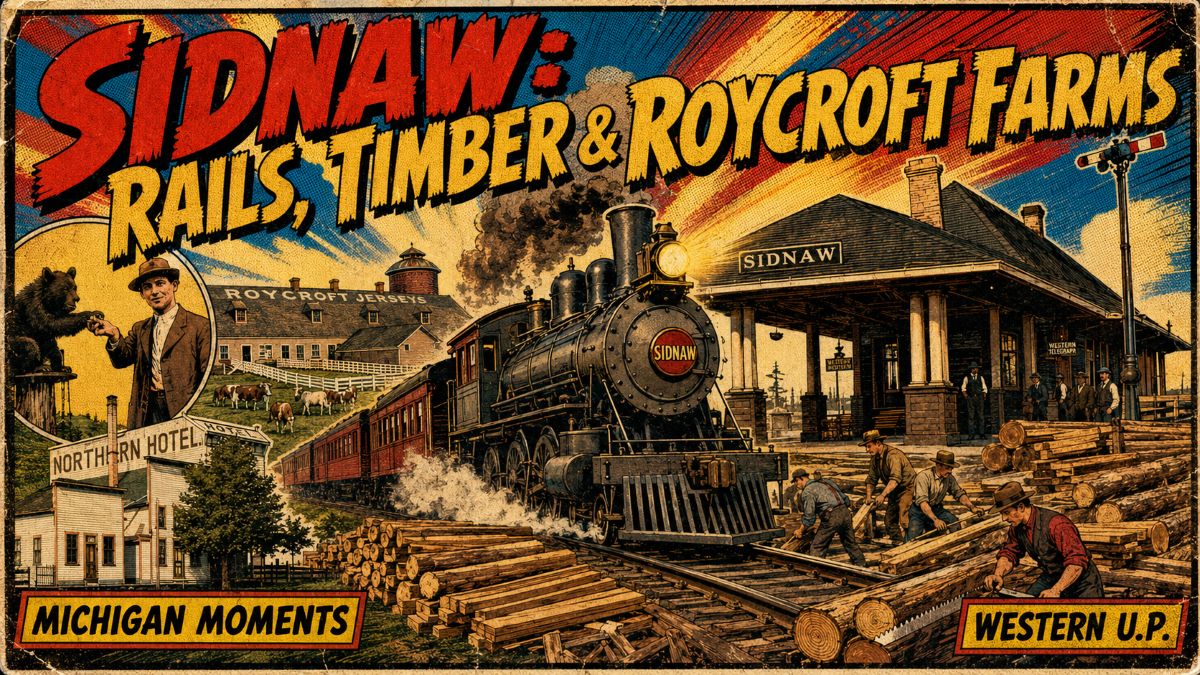
Sidnaw, Michigan History: Railroads, Logging, and Roycroft Farms
Sidnaw rose in Michigan’s western Upper Peninsula as timber, railroads and agriculture reshaped southern Houghton County. This Michigan Moments episode follows the community from its lumber-town boom through Roycroft Farms, Henry Ford’s model logging camp and a World War II German prisoner-of-war camp.
Jump to a Chapter
Sidnaw in Brief
About This Michigan Moments Episode
Sidnaw was first settled during the late-19th-century lumber boom, when white pine and hardwood drew sawmills, workers and railroad construction into the interior of the Upper Peninsula. The rail crossing gave the settlement an advantage: lumber could leave quickly, while food, equipment, mail and travelers could arrive on a regular schedule.
The town also became home to one of the region’s more unusual agricultural enterprises. Walter S. Prickett, who came to Michigan in 1893 and worked in logging before entering business for himself, owned Roycroft Farms. Historical records describe hundreds of improved acres surrounding Sidnaw and livestock operations that included sheep, Angora goats and Jersey dairy cattle.
Sidnaw’s economy weakened as the timber supply declined. Henry Ford brought logging activity back to the area in the 1920s with a camp noted for unusually modern worker housing. During World War II, the community also hosted a German prisoner-of-war camp. Today, Sidnaw is an unincorporated community along M-28, and the railroad tracks remain one of the clearest links to its industrial past.
Video Transcript
0:00–0:52 — Lumber and railroads build Sidnaw
This is Michigan Moments, rediscovering the pioneering moments of the Great Lakes State. In the late 1800s, the pine forests in Michigan’s western Upper Peninsula drew men, mills and railroads into this remote corner of Houghton County. Using a Native American name meaning “small hill by a creek,” Sidnaw began as a lumber town.
By 1900, the community was a thriving hub with sawmills, shingle mills and even factories producing wooden butter dishes and broom handles. The railroads gave Sidnaw its lifeline. At the crossing of the Duluth, South Shore and Atlantic and the Milwaukee Road, a union depot was built. Trains transported families, workers and supplies while carrying lumber, farm goods and livestock.
0:52–1:28 — Walter S. Prickett and Roycroft Farms
One of the town’s most striking figures was Walter S. Prickett. Arriving in Michigan from New Jersey in the 1890s, he built what came to be known as Roycroft Farms. With 300 acres of cleared land, herds of Jersey cattle, Angora goats and sheep, the farm was unlike anything else in the region.
Photographs from the time show bold white letters spelling “Roycroft” on barns and offices, a brand known across the county. These ventures marked Sidnaw’s transition from timberland to farmland.
1:28–2:15 — Town life, decline and Henry Ford
Sidnaw’s hotels, stores and schools reveal a place once full of energy. The Northern Hotel served travelers. Children attended a fine two-story public school. General stores stocked goods arriving daily by rail. But like so many Michigan logging towns, Sidnaw’s prosperity was short-lived. As the big timber disappeared, sawmills closed and families left.
In the 1920s, Henry Ford built a model lumber camp at Sidnaw. It was, in his words, “the likes of which no sober lumberjack had ever dreamed.” For men used to drafty shanties, the camp must have seemed extraordinary. They slept in heated bunkhouses wired for electricity. Smoking and drinking were banned, but a laundry service was available for $5 per pay period.
2:15–2:57 — POW camp and Sidnaw today
During World War II, Sidnaw was the site of a German prisoner-of-war camp. The camp held 251 Germans from February 1944 until April 1946.
Today, Sidnaw is quiet. A gas station, scattered farms and a few homes sit where hundreds once worked and lived. Trains still roll through, but the depot is no longer there. The forests have grown back around the small clearings that remain. Sidnaw stands as a reminder of the boom and bust that shaped much of Michigan’s north country.
Thanks for listening. Please share and follow us for future episodes. This has been Michigan Moments, offering bite-sized morsels of Michigan history.
Related Michigan History
Historical Sources
Background details were checked against the Michigan Technological University Archives’ Walter S. Prickett Papers, the David V. Tinder Collection of Michigan Photography at the University of Michigan Library, and Michigan railroad historical records.
Related Posts