
 by
by 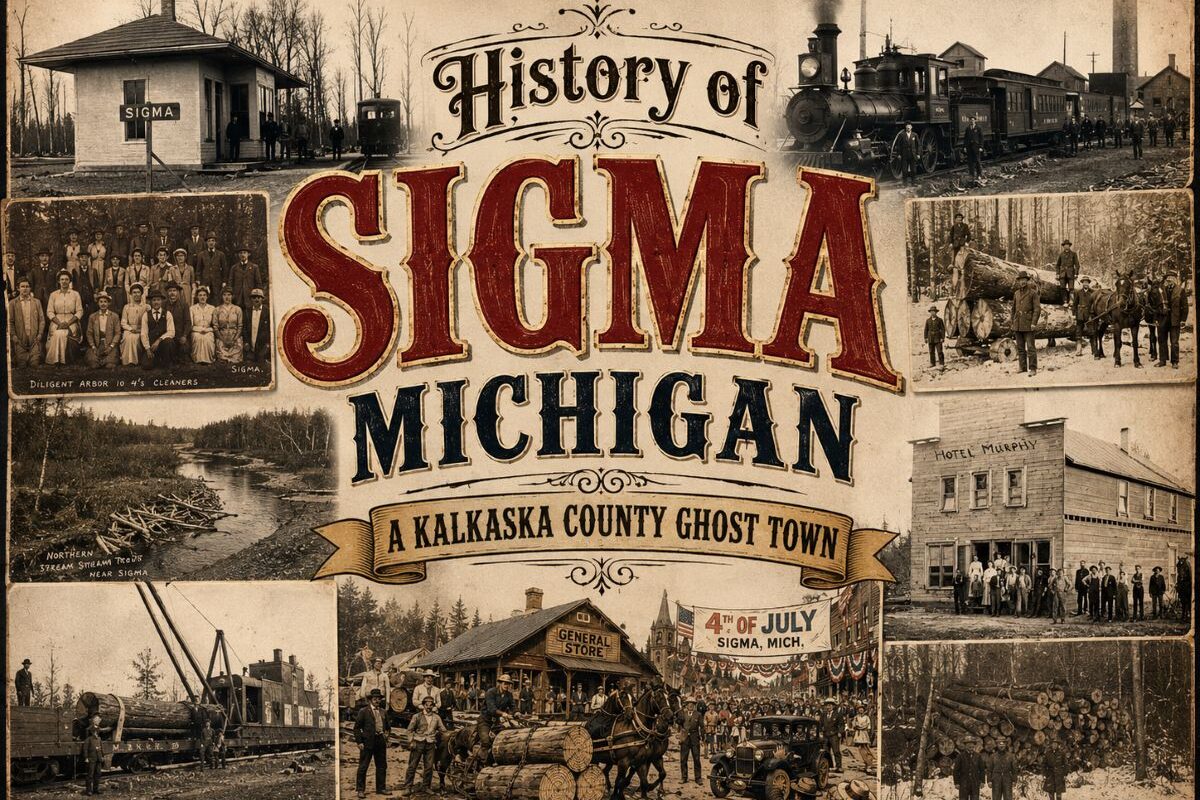
If you want to understand the History of the Ghost Town of Sigma Michigan, start with the railroad, not the ruins.
Sigma was never a large place, and it was never meant to be one of many Michigan ghost towns. It was a railroad town that rose quickly in Kalkaska County around 1910 on the Manistee & Northeastern Railroad’s Grayling branch. Local rail history places Sigma about 10 miles southeast of Kalkaska, and place-name records say it had a general store, a post office opened in 1914 with William T. Kirkby as first postmaster, and a depot that connected it to the timber trade that ruled the region.
A Railroad Town Built for One Job
The History of the Ghost Town of Sigma Michigan is really the history of a branch line and the timber it served.
The Manistee & Northeastern was built mainly as a logging railroad. It carried supplies into camps and hauled logs, lumber, and other forest products back out. Broader histories of the line say the last and longest extension reached Grayling in 1910 and opened a fresh stand of prime timber, which helped extend the railroad’s life. More detailed branch histories state the line reached Grayling on July 3, 1910, and that an excursion train ran the very next day, on the Fourth of July. In that setting, Sigma was born as a practical place. Freight had to be handled. Men had to be housed. Mail had to move. Stores had to be stocked.
That matters because Sigma was not a pioneer village that slowly grew out of farm clearings. It was a service town, built around a transportation line and a timber economy. That gave it energy, but it also meant the town’s fate was tied to a single system. Once the branch stopped paying its way, Sigma would be left with very little to stand on.
Sigma Was More than a Lumber Camp – It Had a Soda Shop!
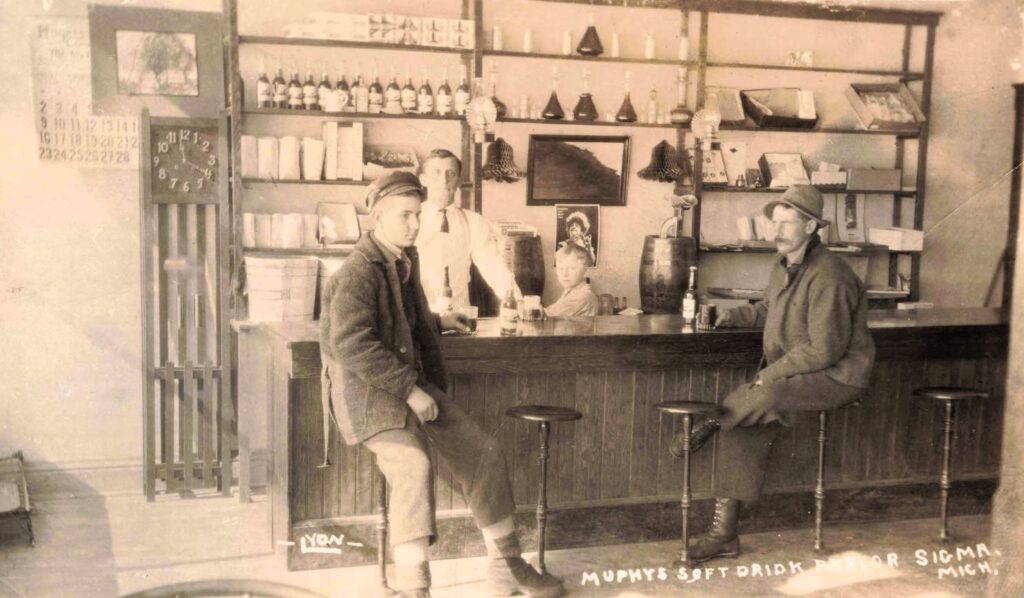
Here is where the attached visual record changes the story.
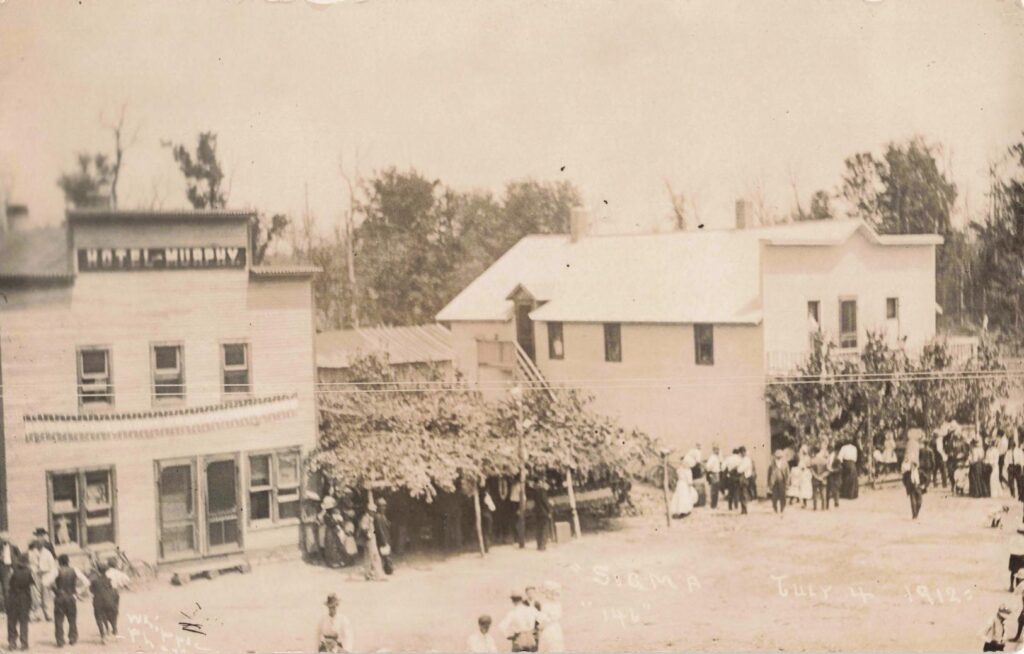
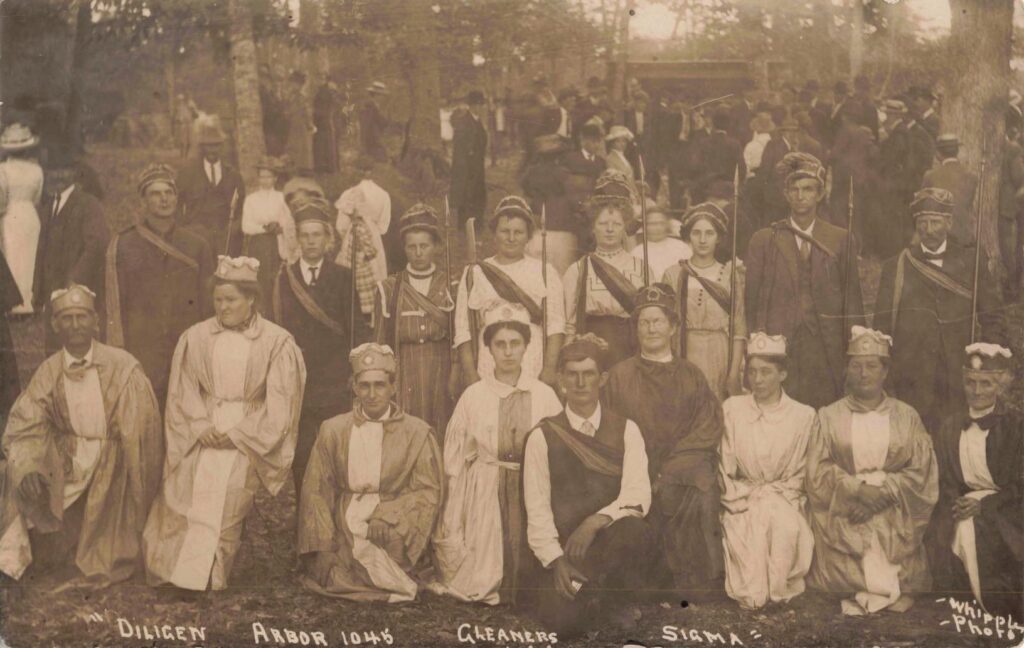
People often hear “ghost town” and imagine nothing but bunkhouses and mud. Sigma certainly had those things. Yet the images show a town with more range than that. One postcard shows a crowd gathered on July 4, 1912. Another shows Murphy’s Soft Drink Parlor. Another shows a barber shop scene with townsmen and boys posing with confidence and humor. Another shows members of the Gleaners in ceremonial dress. There is even an image labeled “free delivery,” which hints at the ordinary, daily service work that made Sigma function.
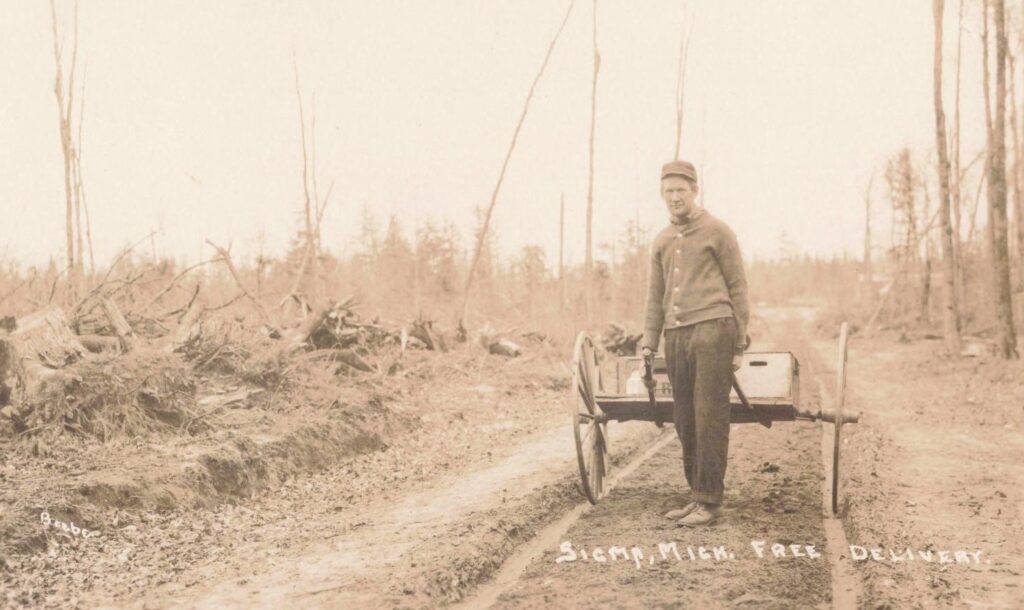
County historical material helps explain why those scenes belong here. Kalkaska history notes that camp work employed many men, but that social life was carried by schools, churches, lodges, and clubs. In other words, the county’s timber towns were not only places of labor. They were also places where residents tried to build order, ritual, and routine. Sigma fits that pattern exactly.
The Cement Block Depot that made Sigma Stand Out
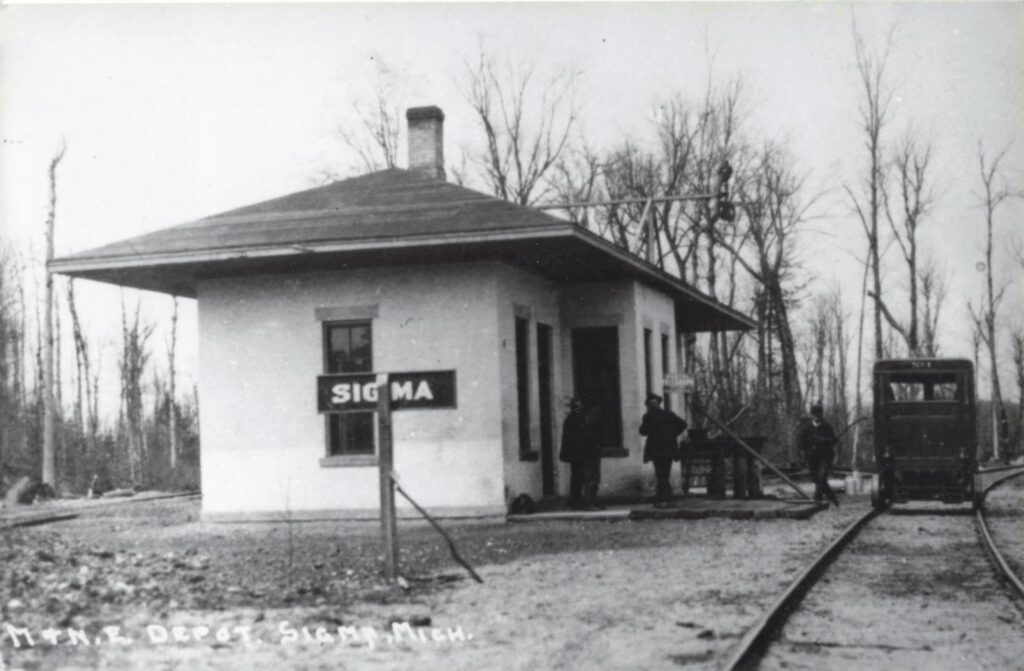
One reason the History of the Ghost Town of Sigma Michigan deserves more attention is the depot.
Michigan rail historians describe Sigma’s depot as a cinder-block station, an unusual material choice for a Northern Michigan depot. That detail is easy to miss, but it deserves a long look. In small railroad towns, the depot was often the most public building in sight. It was part freight office, part waiting room, part symbol. A sturdier depot suggested that the stop mattered.
The Manistee & Northeastern was built chiefly as a logging road, carrying supplies into camps and moving forest products out. Rail history on the line says the last and longest extension ran to Grayling in 1910 and opened a fresh stand of prime timber, which helped keep the railroad alive for a few more years. More detailed line histories say the branch reached Grayling on July 3, 1910, with an excursion train running on July 4. That timing helps explain why Sigma’s holiday scenes feel so proud and public: the railroad was still new enough to feel like a promise.
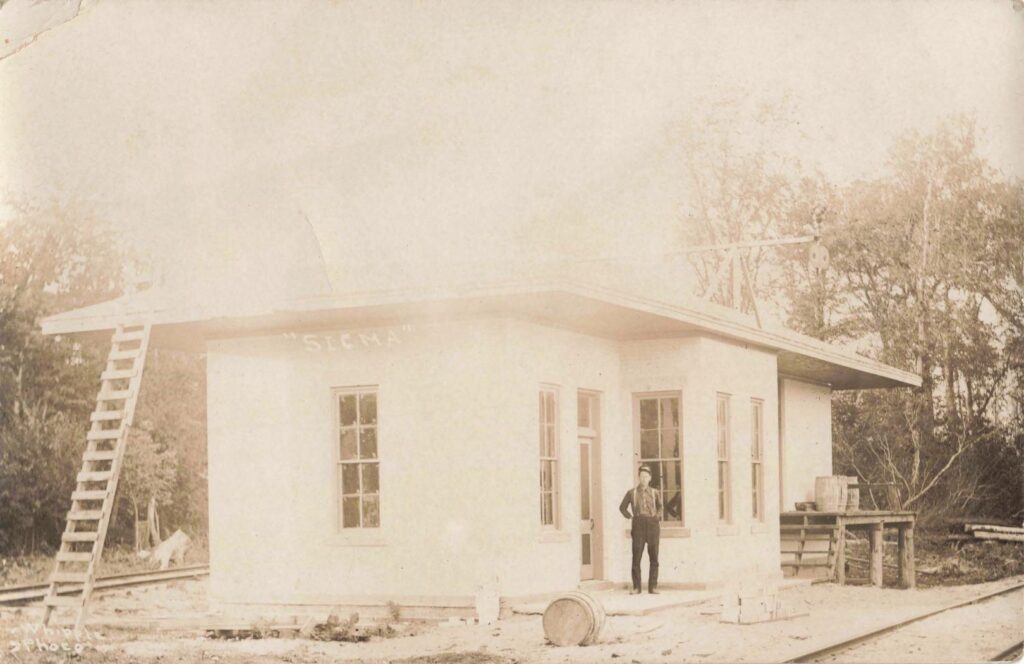
Sigma Depot, early 1900s: A man stands outside the depot, a key building in a town whose rise depended on rail service and the timber trade in Kalkaska County.
In Sigma’s case, that cinder-block station now feels almost ironic. It looked more permanent than the town’s economy proved to be. Still, at the time, it would have announced Sigma as a real stop on a real line, not just a throwaway siding in the woods. That is one of the most distinctive features in the town’s surviving record.
O’Lairy Camp and the Timber machine
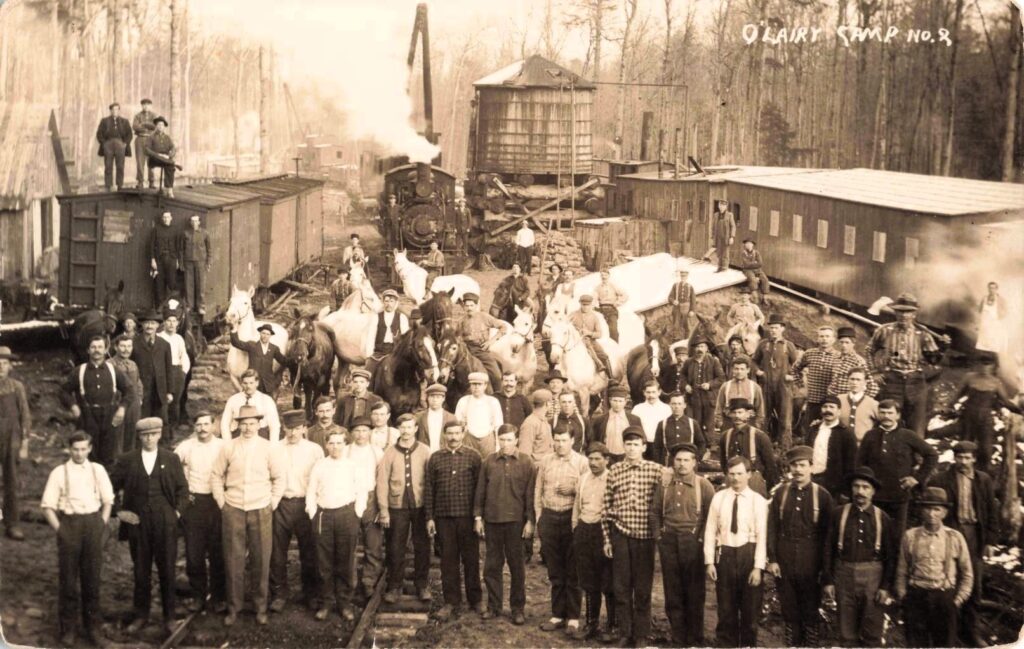
If the depot was Sigma’s public face, O’Lairy Camp No. 2 was its economic center of gravity.
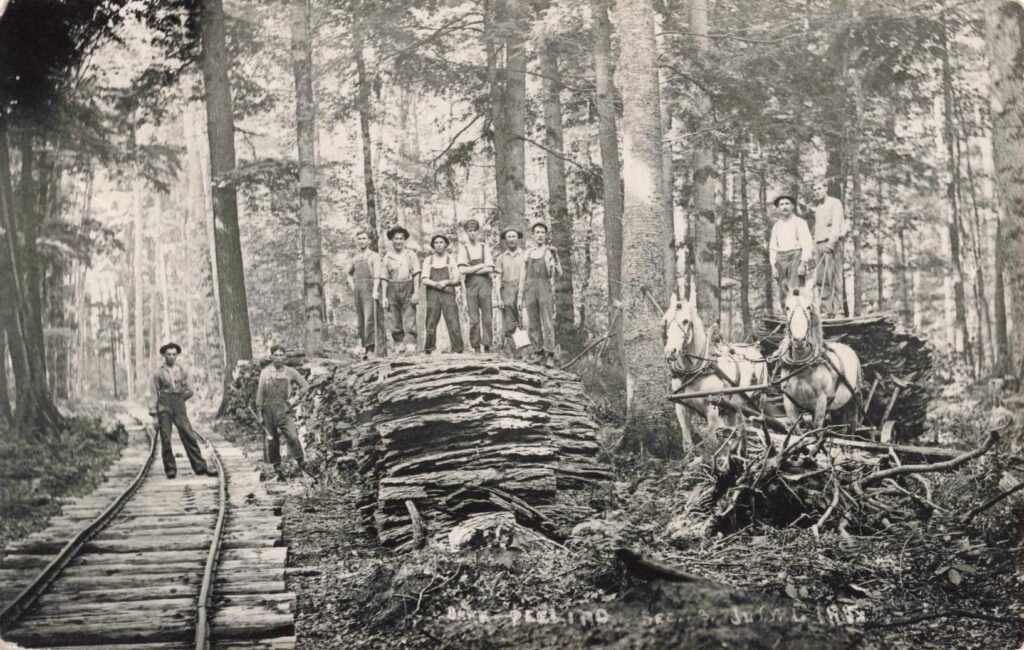
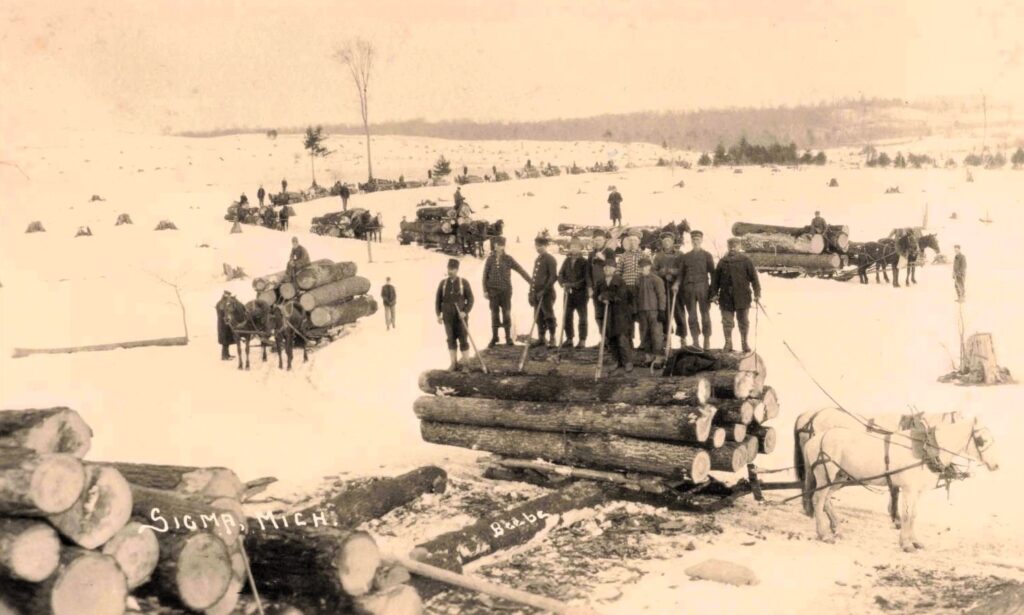
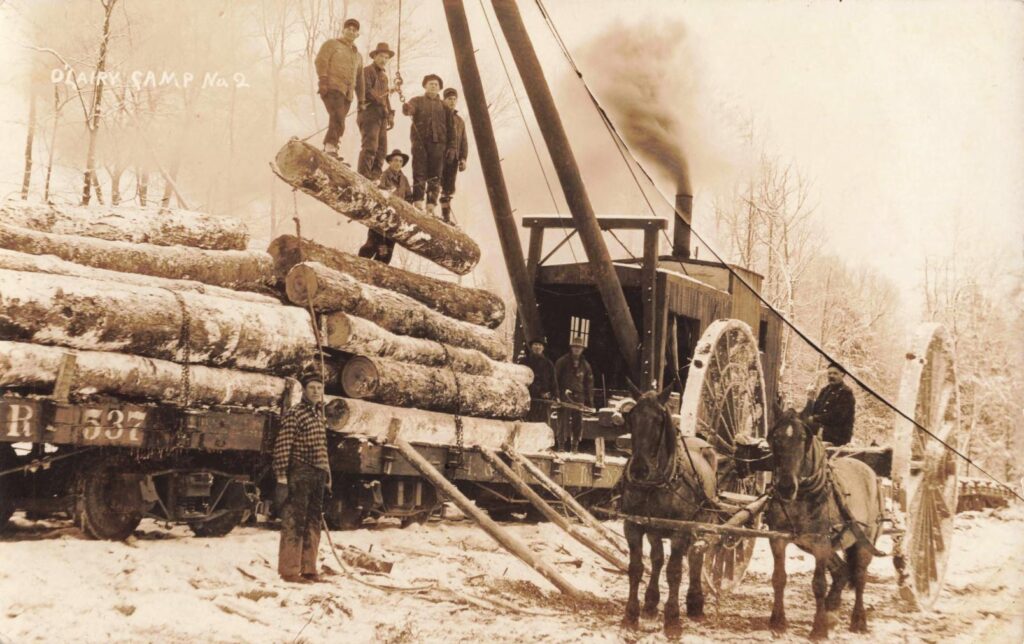
Archive records and rail history identify O’Lairy Camp east of Sigma as a major visual key to the area’s work life. The surviving views show group shots of workers, horses, rail cars, and steam equipment. One view shows a water structure built on log cribbing. Others in the attached set show rail-mounted loaders, winter hauling roads, immense stacked timber, and teams pulling logs through snow. The work was organized, loud, and relentless. Sigma did not exist beside this system. Sigma existed because of it.
O’Lairy Camp No. 2, near Sigma: Workers, horses, rail cars and a steam engine crowd the camp yard, showing the scale and organization of timber work east of Sigma.
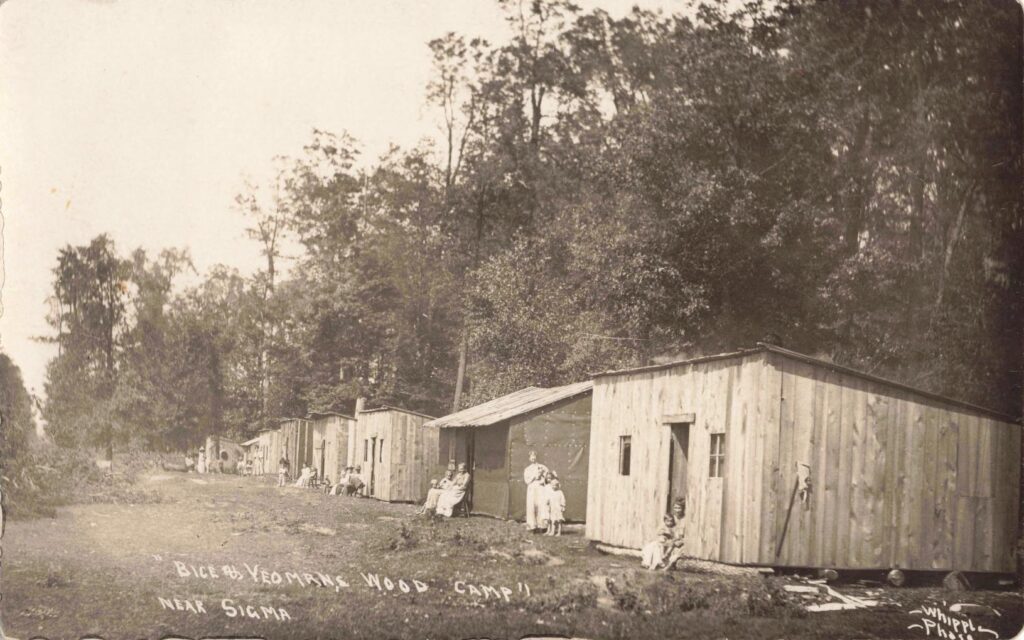
That is also why the attached family and shop scenes matter so much. They show the side of a logging town that often gets left out. Families lived near the job. Children were present. Business owners tried to keep a storefront alive. Residents marked holidays and belonged to organizations. The History of the Ghost Town of Sigma Michigan is stronger when those parts are included, because they turn Sigma from a work site into a human place.
Why Sigma faded so fast
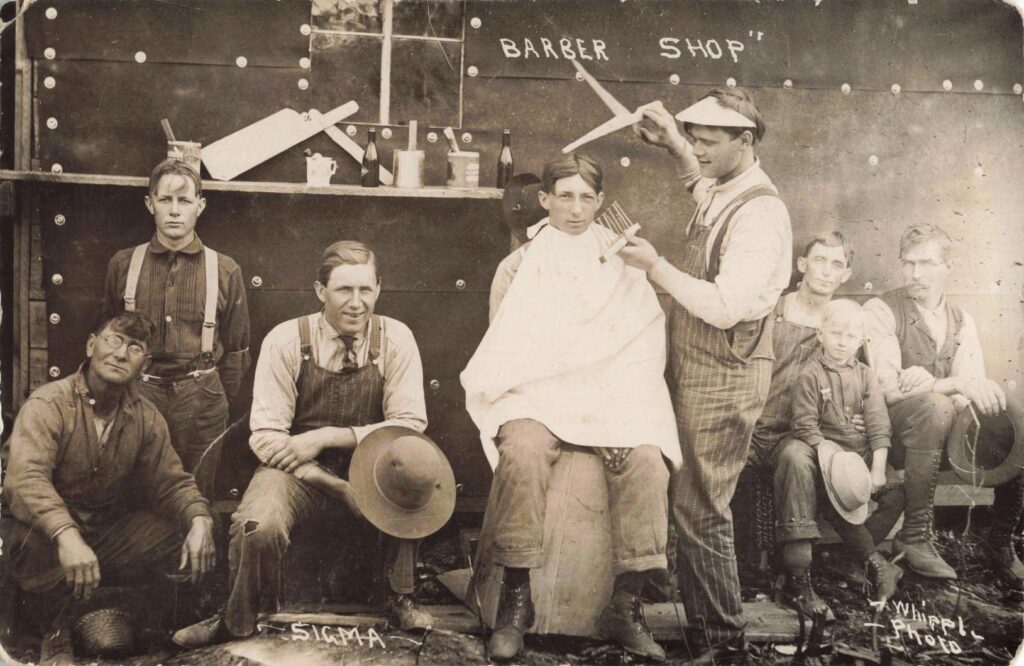
Barber shop scene, Sigma: Men and boys pose in a staged barber shop setting, a playful view that shows the humor and social life of a town often remembered only for logging.
The best answer is not remoteness. It is dependence.
That may sound backward, but the record points in that direction. Sigma had rail access, mail service, a depot, and commercial life. It was connected. The problem was that it was connected for one narrow purpose. The town’s economy rode on timber traffic and the branch that handled it. When freight weakened, the line weakened with it. Railroad histories show receivers moving toward abandonment in 1924, with the Grayling branch effectively gone by 1925. Once that support gave way, Sigma had little else to keep it busy at the same scale.
One small human story captures that fragility. Rail history preserves the death of Sigma station agent Luther Lawrence in 1919 after he got up at daybreak to help a patron unload freight. It is a brief note, but it says a great deal. Towns like Sigma ran on labor that was personal, constant, and close to the bone. People were not cogs in a distant system. They were the system.
What Sigma still tells Michigan
Today, Sigma remains on the map by name, but the boom years are gone. That is why the History of the Ghost Town of Sigma Michigan still has value. It reminds us that some northern towns did not fail because nobody cared. They failed because they were built to serve a narrow boom, and the boom ended.
Sigma also shows something many ghost-town stories miss. It had civic life. It had a soft drink parlor and a barber shop. It had delivery service and holiday crowds. It had people who dressed up for group portraits. It had a depot that looked stronger than its future. In that sense, Sigma was not only a lost logging town. It was a place where residents tried, briefly and sincerely, to make ordinary town life in a hard setting.
That is what makes Sigma memorable in Michigan history. It was not famous. It was not large. But for a few years, it was fully alive.
Images on this page may contain affiliate links in which we may receive a commission. See our affiliate disclosure for details.
Works Cited For the History of the Ghost Town of Sigma Michigan
“Genealogy & Historical Society.” Kalkaska County Library, Kalkaska County Library, accessed 23 June 2026.
Leary, Richard. “Remembering the Golden Age of Railroads: The Manistee and North Eastern Railroad and Its Grand Traverse Connections.” Grand Traverse Journal, 1 Nov. 2014, accessed 23 June 2026.
“Mason County Research: Locations.” Mason County Research Center, accessed 23 June 2026.
“Manistee and Northeastern Railroad.” MichiganRailroads.com, accessed 23 June 2026.
“Sigma, MI.” MichiganRailroads.com, accessed 23 June 2026.
“Sigma.” Geographic Names Information System, U.S. Geological Survey, accessed 23 June 2026.
“SWS (RMNE) – Grayling on the M&NE.” Geocaching, posted 24 May 2018, accessed 23 June 2026.
Related Posts

The Amazing History of Alabaster Michigan – 14 Powerful Scenes From a Ghost Gypsum Town

History of Copemish Michigan – Railroads, Woodenware, and a Main Street That Once Felt Big 1900–1935

The Quiet History of Concord Michigan – 1900s Postcards Show The River Mill, Depot and A Village That Kept Its Shape