 by
by 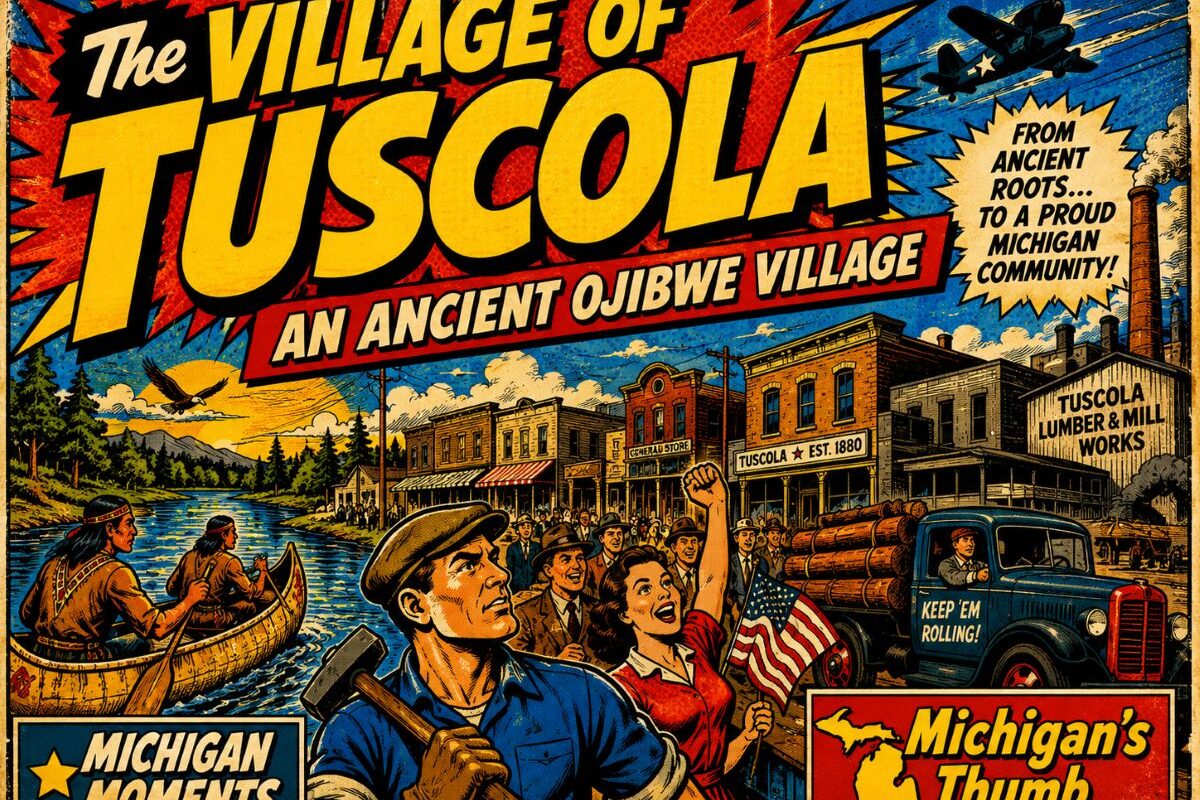
At first glance, this early 1900s view of Main Street of the village of Tuscola, Michigan, is almost too quiet. A wide dirt road cuts through the center of the frame. Two-story wooden buildings stand on either side. Utility poles rise above the street. A wagon is partly visible at the far right, caught between the horse age and the electric age.
But the history of the village of Tuscola tells us it was never just a quiet bend in the road. It was one of the early centers of settlement in Tuscola County, tied closely to the Cass River, the timber trade and the slow work of turning a frontier settlement into a village.
Watch – Village of Tuscola c1900 -The Otusson Link
The First Permanent Settler
An 1883 county history identifies Ebenezer Davis as the first permanent settler, arriving in June 1836. The same account lists several early firsts: the first birth, first death, first marriage, first school, first sermon, first lawsuit, first postmaster and first mail carrier. These details sound small until we remember there was no ready-made town waiting for anyone. Tuscola had to build civic life one event at a time.
Before Main Street, There Was the Cass River
The river mattered before the road did. According to History of Tuscola and Bay Counties, Michigan, floodwood had formed large obstructions in the Cass River. Canoes had to be unloaded, and both cargo and boat carried around the jams. Around 1839, E. W. Perry cleared the channel at a cost of about $1,500, opening the river for lumbering. The county history treated that work as a turning point because, in pine country, lumbering usually came before farming.
That detail helps explain the photograph. By 1900, the raw river-and-timber era had faded, but the street still carried its marks. Tuscola grew out of mills, bridges, stores, mail service and farm trade.
The Village Begins to Take Shape
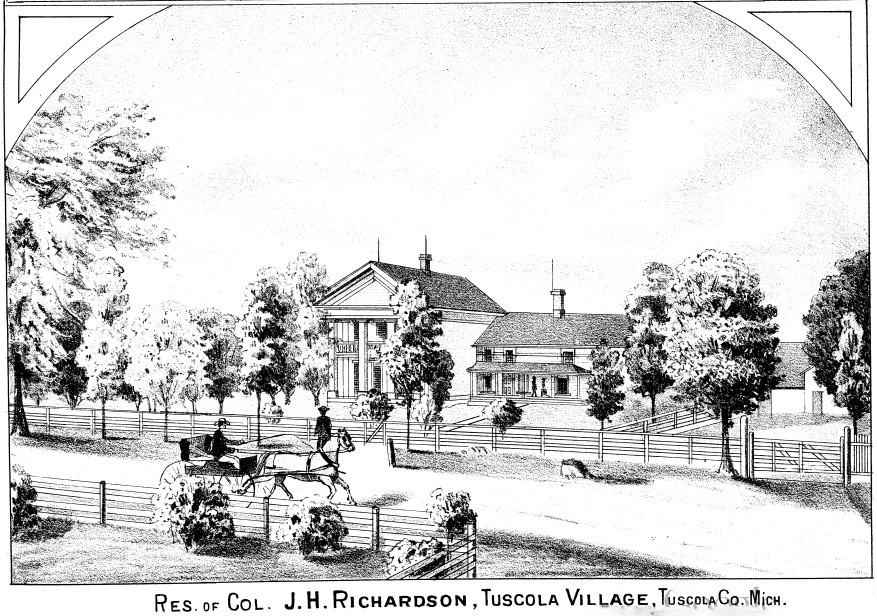
The village period began in earnest after 1848, when Col. John H. Richardson and Dr. Paschal Richardson arrived. The 1883 history says they found only 10 or 11 families, along with a sawmill, tannery and dam. That was the local inventory: a few households, a river, and enough machinery to suggest a future.
Growth came quickly after 1850. Col. Richardson built what the county history calls the first regular store in Tuscola County, and the post office moved into it. The village became a gateway for people traveling from Saginaw up the Cass River. Land buyers came looking for pine. Settlers followed. Tuscola was platted in 1850, and for a time its prospects looked bright.
Stores, Hotels and Village Ambition
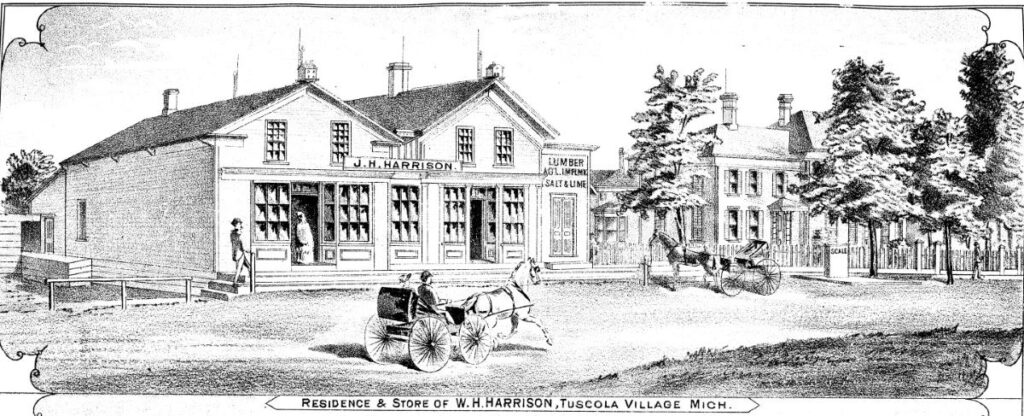
As Tuscola grew, the signs of a village appeared. William Harrison began an early mercantile business with $16 in cash capital. In 1854, the Cass River House was built by John Currey and first called the Currey House. About two years later, Dennis Harrison built the Tuscola House. By 1857, Dr. William Johnson was serving the public as both physician and landlord.
These were not just buildings. They were signals. A store meant trade. A hotel meant travelers. A doctor meant permanence. Tuscola was trying to become more than a river stop.
The Railroad Problem
Then came the catch: railroads. The county history notes that Tuscola had “one of the finest natural locations on the Cass River,” but no railroad connection. Without that link, the village “retrograded rather than advanced.” That sentence helps frame this photo. Main Street looks stable, even peaceful, but it also shows a place passed by as newer transportation routes shaped Michigan’s towns.
The utility poles in the image point toward the new century. The dirt road points backward. Tuscola stood between those worlds.
What About the Name Otusson?
There is another layer to the name Tuscola. Local tradition often connects the name to level land and sometimes to Chief Otusson. Treaty records from outside this excerpt support an Otusson place name connected to the Cass River area, but this 1883 village history excerpt does not confirm that Tuscola was named for him.
That distinction matters. The best history keeps the good story, but labels what can be proved. For this blog post, it is safest to say the Otusson connection belongs to local tradition unless another primary source can confirm it.
The Street Looks Empty. The History Is Not.
This image is not just a street scene. It is Tuscola after the river was cleared, after the mills were built, after the first mail arrived, after settlers came over trails and rough roads, and after the railroad chose other winners.
The dirt road in the photo may look empty, but it carries nearly a century of Michigan change.
Source for the History of the Village of Tuscola
History of Tuscola and Bay Counties, Michigan: With Illustrations and Biographical Sketches of Some of Their Prominent Men and Pioneers. H. R. Page and Company, 1883.