 by
by 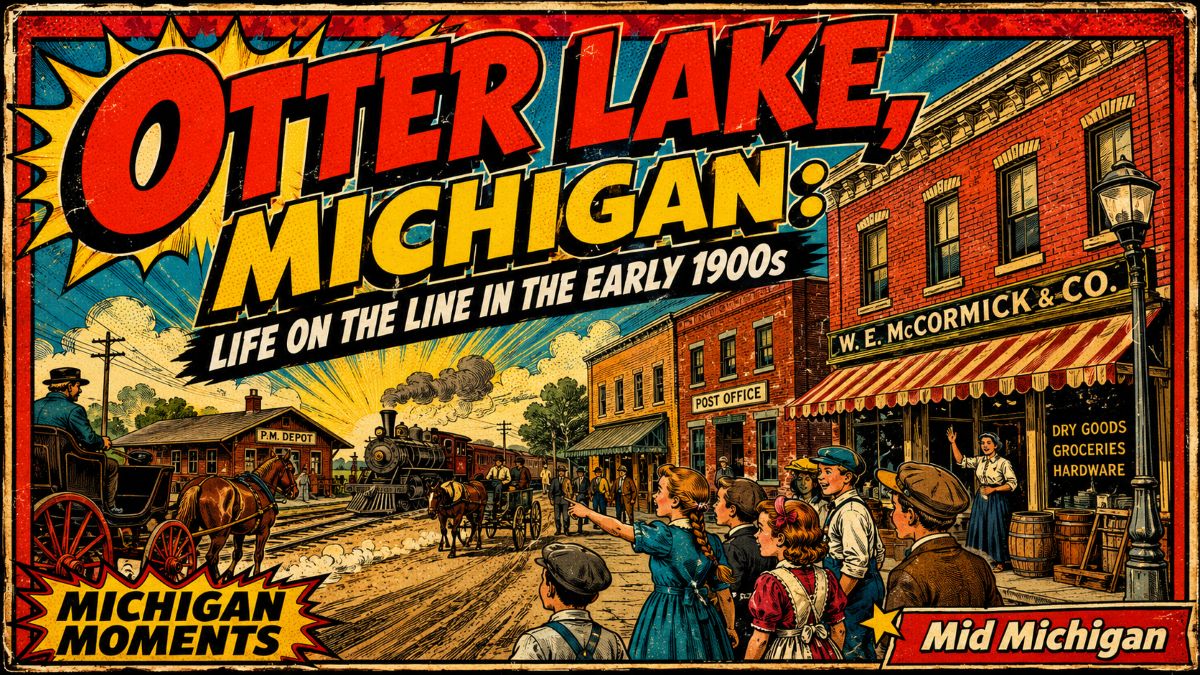
Michigan Moments Video
Otter Lake Michigan History: Life on Detroit Street in 1907
Historic photographs offer a close look at Otter Lake when Detroit Street, the railroad depot and the lake formed the center of daily community life.
Watch “Otter Lake, Michigan: Life on Detroit Street in 1907,” a Michigan Moments presentation from Thumbwind Publications.
What This Otter Lake History Video Shows
Otter Lake was a small Michigan town shaped by its railroad, commercial streets and nearby water. The photographs featured in this video record storefronts, residents, horse-drawn vehicles, railroad activity and seasonal work during the early 20th century.
Detroit Street appears as the town’s business center. The W.S. Hemingway store and W.E. McCormack and Co. served residents when locally owned businesses supplied much of what a household needed. Men, women and children posed outside stores, leaving a record of clothing, buildings and daily routines.
The video also visits the Otter Lake post office, sanitarium, railroad depot and shoreline. Together, the images show how commerce, transportation, health care and recreation operated within one compact community.
Scenes From Early Otter Lake
Detroit Street and the Hemingway Store
The video opens on Detroit Street South, where the W.S. Hemingway store anchors a commercial corner. Store awnings, railings and people gathered along the street show a business district built for foot traffic and horse-drawn travel.
Families Outside the Storefronts
Women and children stand in front of a local business while a horse and buggy waits nearby. The formal pose reflects a time when a photographer’s visit could become a community event.
The Otter Lake Post Office
Before electronic communication, the post office was one of the town’s main information centers. Mail, newspapers and personal news arrived through a place residents visited as part of their regular routine.
The Otter Lake Sanitarium
A large building with wraparound porches housed people recovering from serious illnesses, including tuberculosis. At the time, fresh air, sunlight, rest and separation from others were commonly used in tuberculosis care.
North Detroit Street Commerce
The W.E. McCormack and Co. store appears amid awnings and business signs. The scene suggests a busy local trading center serving residents and travelers passing through town.
Lake Street and the Waterfront
Stores give way to the sandy lakeshore, where children gather and horse-drawn wagons move through the background. The short distance between downtown and the water helped define Otter Lake’s character.
Ice Cutting in 1907
A winter photograph records workers harvesting blocks of natural ice. Before electric refrigeration became common, crews cut ice from frozen lakes and stored it in insulated icehouses for later use.
The Otter Lake Railroad Depot
The depot handled passengers, freight, livestock and mail. Rail service connected local farms and businesses with markets elsewhere in Michigan and gave residents access to communities beyond the immediate area.
A Summer Day at the Lake
The final image shows children in the water while adults watch from the shoreline. A dog stands among them. The relaxed scene records the lake as a place for community recreation as well as work.
“Otter Lake didn’t grow into a metropolis, but it didn’t need to. It lived on its own terms, block by block, season by season.”
Railroads, Stores and Small-Town Routine
Otter Lake Michigan history cannot be separated from the railroad. The depot handled the movement of people and goods while supporting businesses along Detroit Street. Store owners depended on regular deliveries, and residents used the trains for longer trips that would have been difficult by wagon.
The railroad also placed Otter Lake within a larger network of Michigan communities. Letters, newspapers and merchandise could arrive on a regular schedule. Local products could be sent to outside markets. The station was therefore more than a building beside the tracks. It was one of the town’s primary links to the rest of the state.
Yet the photographs are not limited to major events. Their value comes from ordinary details: shaded storefronts, bicycles near the post office, children standing beside adults and wagons waiting along the street. Such details show how people used the town rather than simply how its buildings appeared.
Ice Harvesting Before Electric Refrigeration
The 1907 ice-cutting photograph documents an industry once familiar across Michigan. Workers marked the frozen surface, cut the ice into blocks and moved the heavy pieces with specialized tools. The blocks were then packed into insulated storage buildings.
Stored ice helped households and businesses preserve food during warmer months. Hotels, meat markets, stores and homes relied on regular ice deliveries before mechanical refrigerators became widely available. The work was cold and physically demanding, but it turned Otter Lake’s winter ice into a useful local product.
Edited Video Transcript
Open the complete transcript
0:00 — This is Michigan Moments, sharing the pioneering moments of the Great Lakes State.
0:05 — At the turn of the 20th century, Otter Lake, Michigan, was more than a whistle stop. It was a community held together by rail, brick and daily routine.
We start with Detroit Street South. The scene tells a story without needing words. The W.S. Hemingway store anchors the corner, its awning shaded against a sky of coal dust and train smoke. Men lean against railings with the calm often found in towns where neighbors know one another well.
0:33 — Next, we shift down the same street. Women and children line up in front of another storefront, dressed in their best for the camera. There is pride in their appearance and in being part of something permanent. A horse and buggy waits as though pausing for history.
0:48 — Turn the corner and you are at the Otter Lake post office. People came here out of habit. It was where news arrived, gossip gained speed and residents leaned on their bicycles while waiting for the next delivery or a reason to stay.
1:03 — One structure stands out: the Otter Lake Sanitarium. It was a large, stately building with twin wraparound porches. It housed people recovering from illnesses such as tuberculosis, when fresh air and isolation were considered part of treatment.
1:18 — North Detroit Street shows another side of Otter Lake commerce. The W.E. McCormack and Co. store bustles with activity. Awning-covered windows and small business signs point to a lively center of trade.
1:35 — Over on Lake Street, storefronts give way to open space and the sand of the lake. Children gather outside the shops while horse-drawn wagons pass in the background. It is clear that Otter Lake served as both a waypoint and a destination.
1:42 — Winter did not stop the town. A 1907 photograph captures ice-cutting season. Men balance on the frozen water while timber scaffolds strain under freshly harvested blocks. Ice was a valuable product, hauled, stored and sold long before electric refrigeration.
2:00 — The depot marked the town’s pulse. Otter Lake’s train station bore the wear of regular use. Freight, passengers, letters and livestock passed through. The railroad did not simply connect Otter Lake to the outside world. It linked the town with the rest of Michigan.
2:18 — Finally, there is the shoreline. A group of children wades in the water, flanked by townspeople and the familiar curves of buildings in the background. Even a dog joins the moment.
No one is in a hurry. This is a pause, a breath and a summer Sunday when the town took a day of rest. That was enough.
Otter Lake did not grow into a metropolis, but it did not need to. It lived on its own terms, block by block and season by season. In these old photographs, it still does.
2:54 — This has been Michigan Moments, offering bite-sized stories from Michigan history.
Watch More Michigan Moments
View more short videos covering Michigan towns, historic buildings, railroads, industries and Great Lakes communities.
View All Michigan MomentsVideo produced as part of the Michigan Moments series by Thumbwind Publications LLC.