 by
by 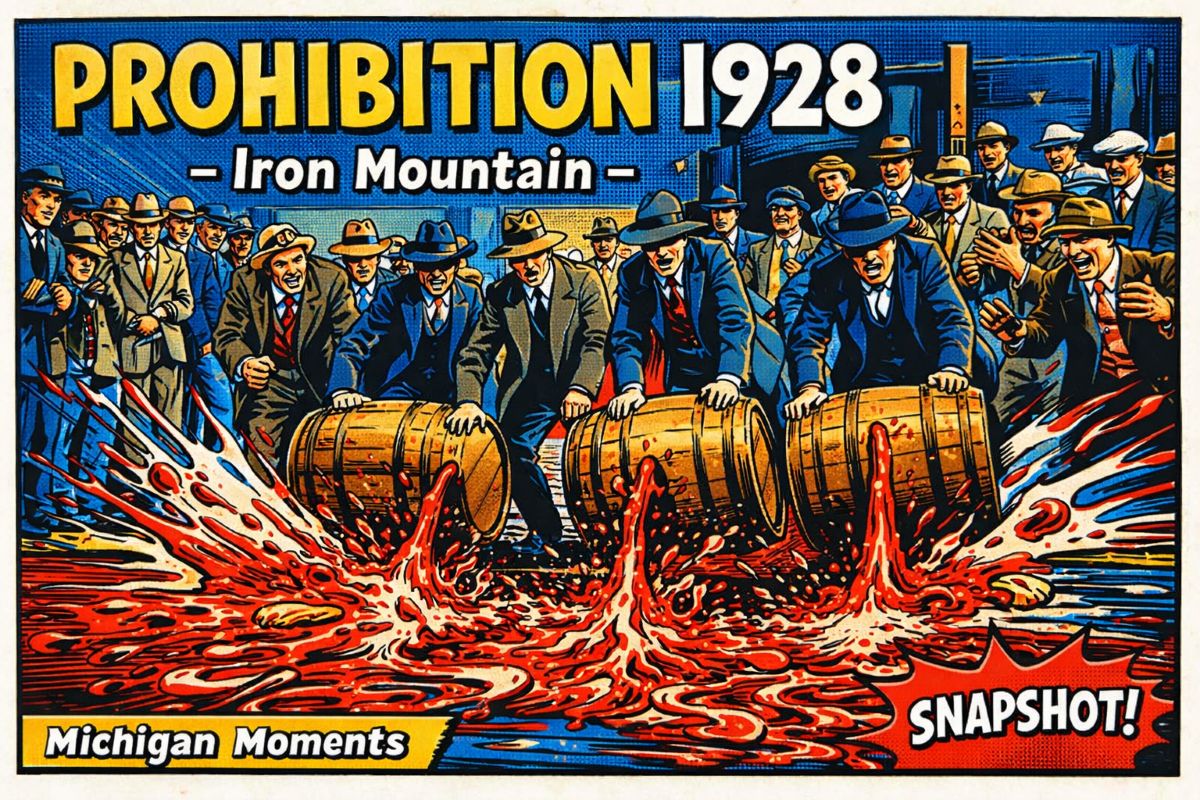
Michigan Moment Snapshot
Iron Mountain Prohibition: 14 Wine Barrels Meet the Gutter
In April 1928, a crowd watched Iron Mountain and Michigan State Police empty more than 850 gallons of seized wine into a Ludington Street gutter.
Watch “Prohibition Hits Iron Mountain in 1928,” a Michigan Moment Snapshot from Thumbwind Publications.
What Happened During the Iron Mountain Prohibition Event?
At 9:30 a.m. on April 17, 1928, Iron Mountain police rolled 14 barrels into the 200 block of East Ludington Street. Officers knocked out the barrel bungs and sent streams of red and white wine toward the sewer.
The barrels had been confiscated during a September 1927 raid at the West A Street home of Frank Porenta. Police stored the wine for months as evidence before receiving authority to destroy it.
A motion-picture camera recorded the scene. A crowd formed almost immediately, and the destruction took nearly an hour. Contemporary reports estimated that more than 850 gallons went down the gutter.
Scenes From Ludington Street in 1928
Fourteen Barrels Await Destruction
The wine barrels had been held as evidence since a police raid in September 1927. By the following spring, officials were ready to empty them in public.
The Barrels Are Rolled Into the Street
Officers moved the large containers outside the Iron Mountain police station on East Ludington Street.
The public setting made the destruction both an enforcement action and a visible warning.
A Crowd Quickly Forms
Residents gathered as workers broke open the barrels. Some watched with curiosity, while contemporary newspaper coverage suggested others viewed the destruction with regret.
City and State Police Enforce the Law
Iron Mountain officers handled the pouring with assistance from Michigan State Police. The documented account does not identify the workers as federal agents.
Wine Flows Toward the Sewer
Mixed red and white wine ran along the gutter. The odor reportedly filled the area as each barrel was emptied.
Some of the wine had spoiled during months of storage, while other barrels reportedly remained drinkable.
The Camera Records the Evidence
A motion-picture camera captured the event. The resulting film was scheduled to be shown that evening at Iron Mountain’s Braumart Theatre.
The destruction therefore became both a legal procedure and a local news event.
“The law was followed, the barrels were emptied and the crowd watched the evidence disappear into the sewer.”
Where the Wine Came From
Police seized the 14 barrels during a September 1927 raid at Frank Porenta’s home on West A Street. The quantity involved suggests more than a few bottles intended for private use.
Homemade wine was common in parts of the Upper Peninsula during Prohibition. Mining communities included many immigrant families whose food and drink customs had developed long before the national alcohol ban.
The law restricted the manufacture, transportation and sale of intoxicating beverages. Enforcement could involve federal officers, state troopers, county sheriffs and local police, depending on the case.
Iron Mountain Prohibition Enforcement
Iron Mountain Prohibition enforcement was uneven throughout the 1920s. Local officers conducted raids, seized stills and confiscated beer, wine and distilled liquor.
Dickinson County’s location added to the difficulty. Wisconsin was nearby, and Canadian liquor could move through Great Lakes transportation routes. Rural roads and wooded areas offered places for illegal production and storage.
Authorities also faced public skepticism. Many residents did not view homemade wine in the same way they viewed commercial bootlegging or dangerous moonshine. That gap between the written law and public opinion complicated enforcement.
A Public Event Recorded on Film
The April 17 destruction drew attention partly because officials staged it in the street. Newspaper coverage described considerable ceremony as the barrels were opened.
John C. Eslick helped move and pour the barrels. Police Chief Peter Carlevato and Lawrence D. Tucker, then a young reporter for The Iron Mountain News, were also identified in the surviving photograph.
Almost an hour was needed to empty all 14 barrels. The containers were then loaded onto a truck and removed.
Why Prohibition Ended
National Prohibition began in 1920 under the 18th Amendment and the Volstead Act. Enforcement placed heavy demands on police, prosecutors and federal courts.
Illegal alcohol production continued, while public support for the ban weakened. Michigan voters removed state prohibition language from the Michigan Constitution in November 1932.
Michigan became the first state to vote for ratification of the 21st Amendment on April 10, 1933. National Prohibition officially ended on Dec. 5, 1933.
Key Facts About the 1928 Wine Destruction
- The wine was confiscated from Frank Porenta’s West A Street home in September 1927.
- Police destroyed the wine on Tuesday, April 17, 1928.
- The event began at about 9:30 a.m.
- The barrels were emptied on the 200 block of East Ludington Street.
- Iron Mountain police led the operation.
- Michigan State Police officers assisted.
- Fourteen barrels of red and white wine were destroyed.
- Contemporary accounts estimated the quantity at more than 850 gallons.
- The operation took almost one hour.
- Motion-picture footage was scheduled for showing at the Braumart Theatre.
Edited and Corrected Video Transcript
Open the complete Iron Mountain transcript
0:00 — A Michigan Moment Snapshot.
0:02 — Iron Mountain, Michigan, April 17, 1928.
0:06 — Prohibition is the law, and these barrels do not get a trial. Fourteen of them, filled with wine, are rolled into the street and opened in public.
0:13 — Men in hats lean in. Some are curious. Some appear amused. Others are simply doing their jobs.
0:20 — This is Prohibition enforcement, Upper Peninsula style. Iron Mountain police, assisted by Michigan State Police, empty confiscated wine into the street.
The barrels had been seized the previous September at a West A Street home and held as evidence.
0:29 — More than 850 gallons of red and white wine flow down the Ludington Street gutter while a crowd watches.
0:36 — Prohibition promised public order, but scenes such as this showed a wide gap between the written law and opinion on the street.
0:40 — Five years later, national Prohibition would end. On this day, however, the barrels were emptied and the officers followed their orders while a motion-picture camera recorded the scene.
Historical Sources
Watch More Michigan Moments
See more short videos about Michigan communities, historic photographs, local industries and Upper Peninsula history.
View All Michigan MomentsVideo presented as part of the Michigan Moments history series from Thumbwind Publications LLC.
Related Posts