 by
by 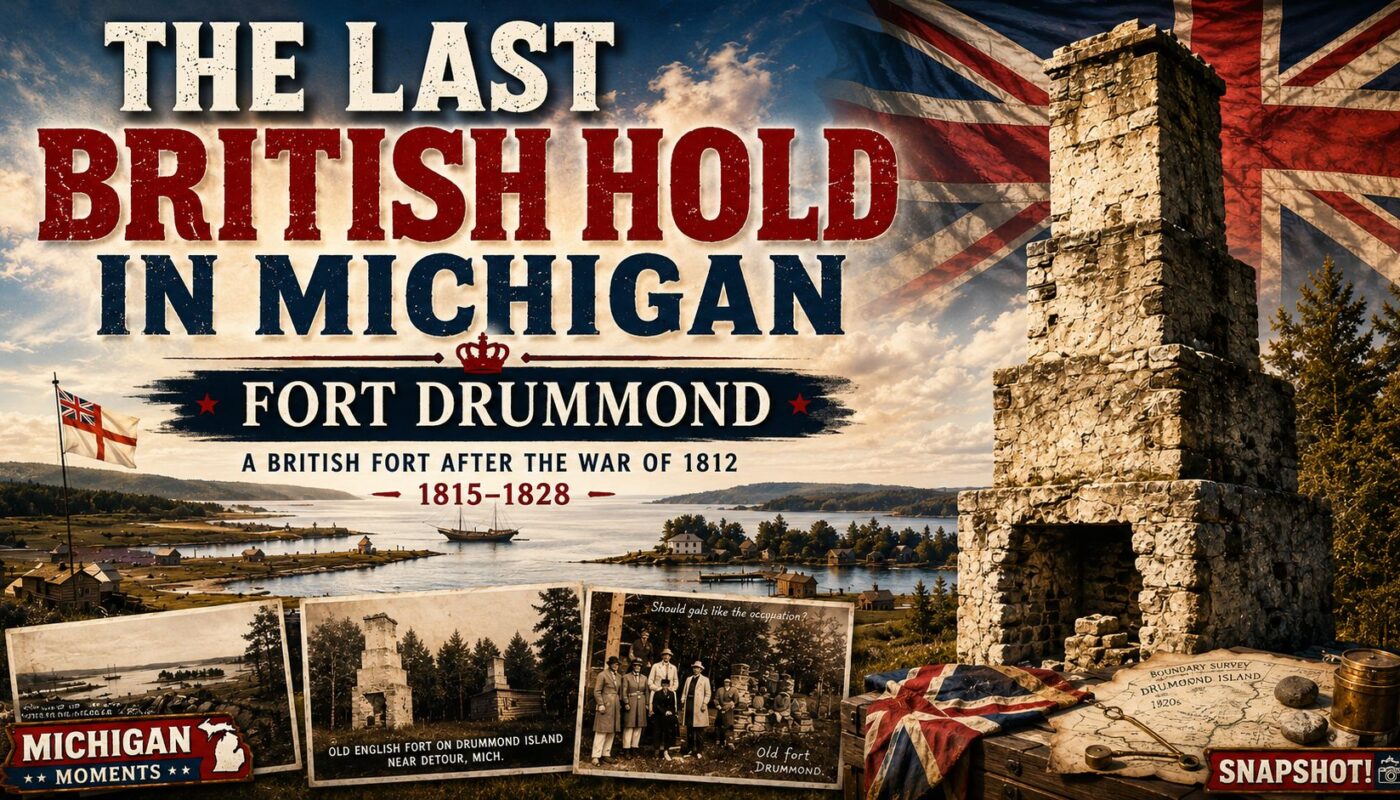
Fort Drummond, Michigan, and the war that would not quite end
At first glance, the old photographs look quiet: stone chimneys, cedar woods, rough clearings, and visitors posing among ruins. But Fort Drummond, Michigan, was not just a lonely ruin near DeTour. It was one of the strangest border leftovers in Great Lakes history.
The story begins after the War of 1812. The Treaty of Ghent ended the fighting between the United States and Great Britain, but the upper Great Lakes did not snap back to normal overnight. Fort Mackinac, seized by British and allied forces in 1812, returned to U.S. control in 1815. When the British left Mackinac Island, they did not sail far away.
They moved to Drummond Island.
A British fort Michigan was not expecting
The new post, often called Fort Drummond, rose at Whitney Bay on the west side of Drummond Island. It sat close to the Straits of Mackinac, the St. Mary’s River route, Lake Huron, and the fur trade. In other words, it was not random. It was a watchful place.
For Britain, the Drummond Island fort kept troops, traders and civilians near the same routes that had mattered before and during the war. For the United States, it became a diplomatic headache. The island sat in a border gray zone. British officials treated it as Canadian ground. Later surveys placed it on the American side.
That meant Fort Drummond, Michigan, functioned for years as a British military village on land that would become part of Michigan.
What stood at Fort Drummond Michigan?
This was not a grand castle. It was a frontier post built for survival, trade, and military control. Accounts point to barracks, homes, gardens, docks, roads, wells, a cemetery, and many chimneys. Some structures were made of logs. Stone chimneys helped families and soldiers endure northern winters.
The old photographs show those chimneys long after the rest of the site had faded. That is why they matter. They do not show battle. They show the stubborn afterlife of empire: walls, smoke, routine and paperwork.
The images also show later visitors standing in the ruins. They are not identified, and they should not be guessed into history. Their presence tells a different story: by the time those pictures were taken, the fort had become a local landmark and a curiosity.
War of 1812 aftermath on Drummond Island
The War of 1812 did not end cleanly in the upper Great Lakes. Native nations, British officers, fur traders, American officials, and local families all had stakes in the region. Control of the water routes mattered. So did trade alliances and military reach.
That is why Fort Drummond Michigan should not be treated as a simple footnote. It was part of the long, awkward process of deciding who controlled the northern border. The site shows how a treaty signed far away could take years to become real on the ground.
A Michigan border dispute with stone chimneys
The Michigan border dispute over Drummond Island was eventually settled through surveys and diplomacy, not cannon fire. By 1828, the United States pressed the issue hard enough that Britain left the island. The garrison and community moved to Penetanguishene in Ontario.
The Americans took possession, but Fort Drummond did not become a major U.S. post. Its military purpose had passed. Buildings declined, burned or were stripped away. The chimneys remained because stone is harder to erase than orders.
Why Fort Drummond Closed the War of 1812
Fort Drummond Michigan matters because it complicates the usual story. The War of 1812 ended, but British power still lingered on Drummond Island. Michigan’s border was not born neat and tidy. It had to be argued, surveyed, and enforced.
The ruins remind us that history often survives in pieces: a chimney, a postcard caption, a family snapshot, a place name. Fort Drummond was a British post, a fur trade outpost, a military settlement, and a border outpost all at once.
Today, the old chimneys stand as a warning against simple stories. The British did not “win” Michigan. The Americans did not instantly control it either. For 13 years after the war, Drummond Island sat in the middle of a slow-motion argument.
And somehow, the chimneys got the last word.