 by
by 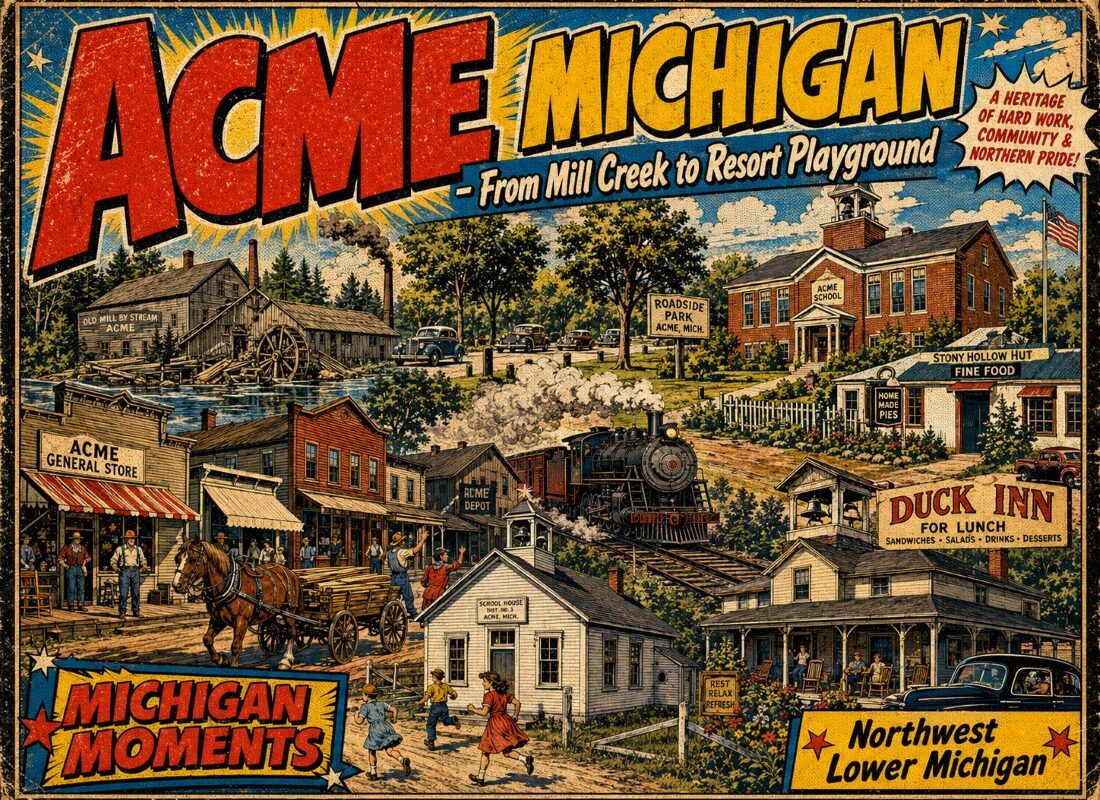
Acme, Michigan sits on the eastern shore of East Grand Traverse Bay, close enough to Traverse City to be overlooked and old enough to deserve its own story. The History of Acme Michigan is not just about resort rooms, golf and bay traffic. It begins with timber, creek water, schoolhouses, rail service and small businesses that served people moving through a changing northern Michigan town.
The name Acme sounds grand. It comes from a Greek word meaning a high point or summit. But Acme’s first real strength came from lower ground — Acme Creek, millponds, roadbeds and the rail line that connected the village to wider markets.
Table of Contents
Watch: History of Acme Michigan: From Mill Creek to Resort Playground
History of Acme Michigan Begins With Water and Wood
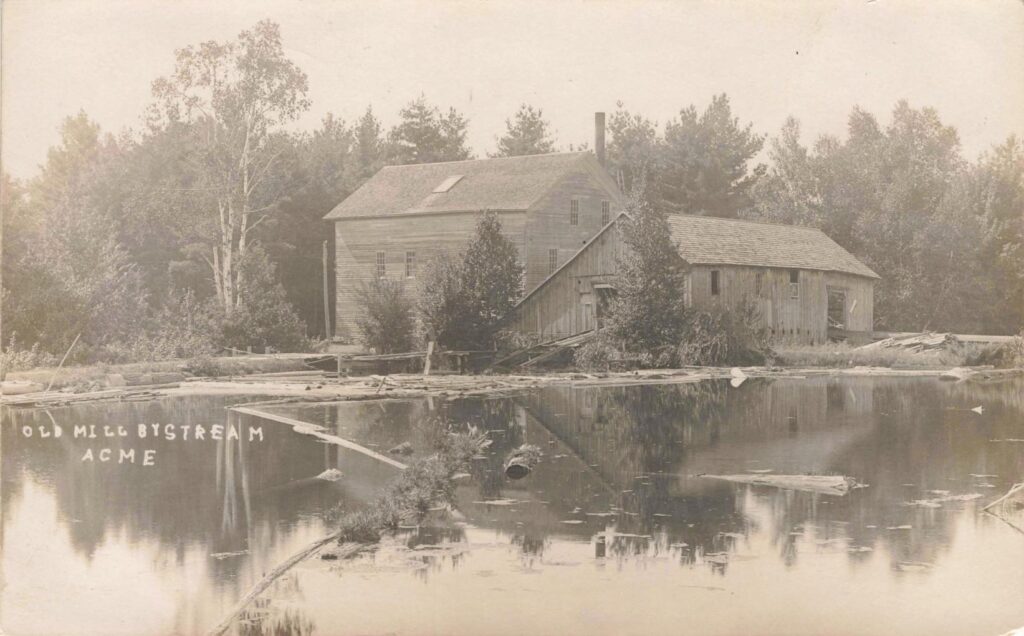
Acme’s founding story has one complication. Different sources give different start dates. Acme Township’s own master plan says L.S. Hoxsie established the village in 1855 and built a sawmill in 1858. MichiganRailroads.com says the area was settled in 1864. The best reading is that Acme began forming in the 1850s and 1860s, with the Hoxsie or Hoxie family central to the first mill and village development.
That sawmill was the town’s early engine. In the lumber era, a mill could turn a rural site into a working village. Timber became boards. Boards became barns, homes, stores and freight. The mill also supported wagon traffic, blacksmith work and general-store trade.
A Small Industrial Town Takes Shape
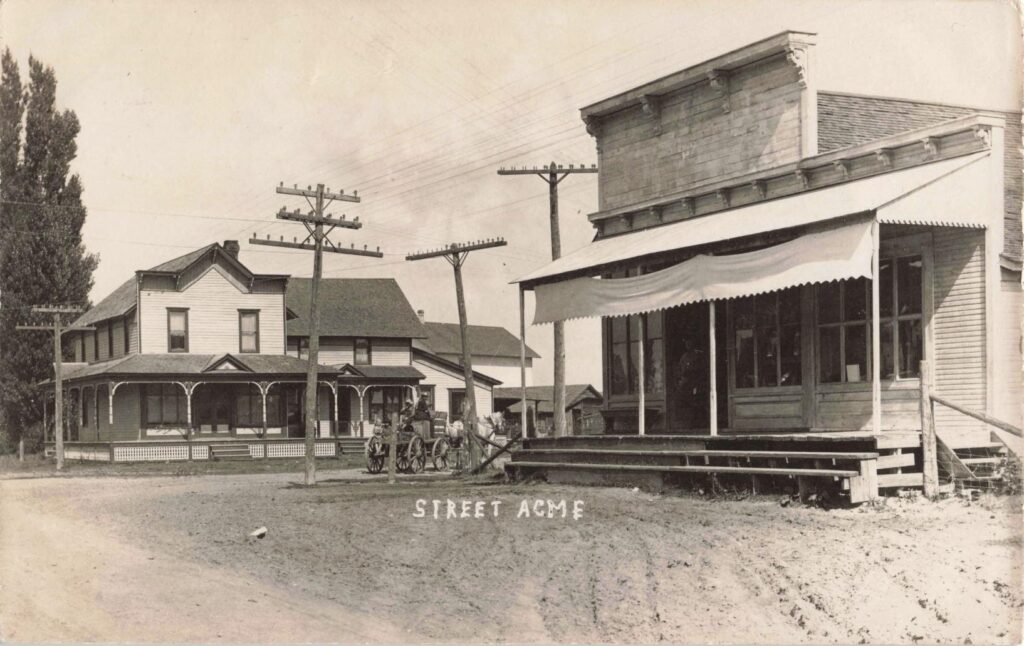
By the late 1800s, Acme had the features of a serious small town. It became a railroad stop. The township master plan says the village was once promoted as a “coming industrial town.” From 1880 to 1890, it had a hotel, several stores and a shingle mill. Acme Township was organized in 1891, with John Pulcipher as supervisor.
In 1901, John Hoxsie and John Scripture started a woolen mill west of the village on Acme Creek. A second woolen mill opened soon after but closed within a year. By 1903, Acme had a sawmill, saw and planing mill, shingle mill, general store, woolen mill and blacksmith shop. The township also had three sawmills, two shingle mills, a township hall, a Methodist Episcopal church, a Masonic lodge and three school buildings. The population was about 200.
This is the part of the history of Acme Michigan that may surprise many readers. Acme was not first known as a resort address. It was a compact mill and service village trying to build a broad local economy.
Acme School Bells and Staying Power
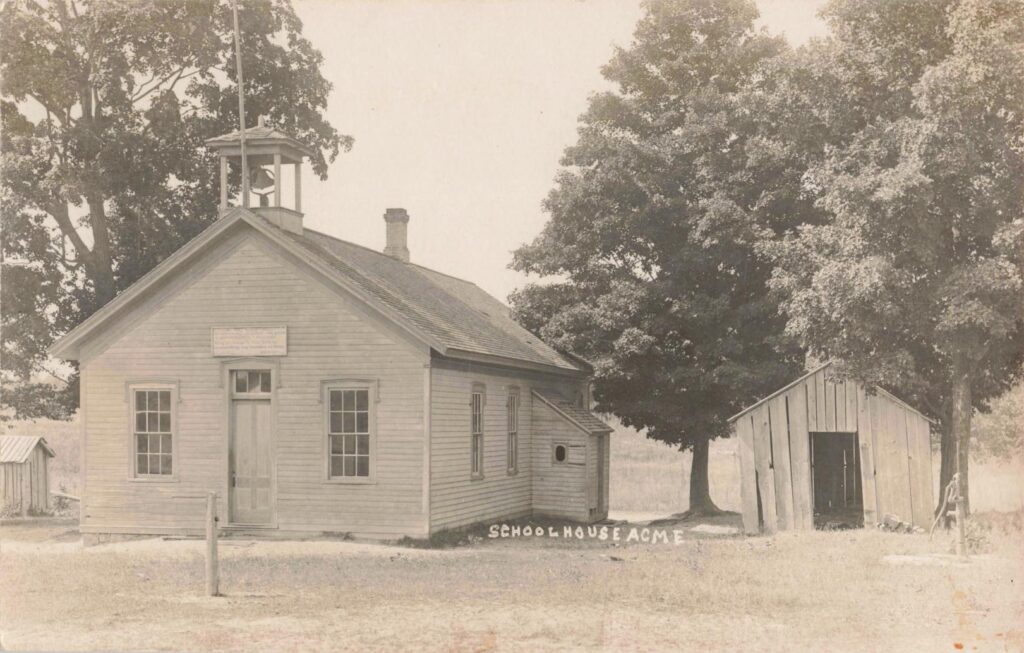
School buildings are often the clearest sign that a town expected to last. Acme’s old school views show two stages of local education. One is a plain rural schoolhouse with a bell tower and nearby outbuilding. The other is the larger Stanford School, a brick building with tall windows and a cupola.
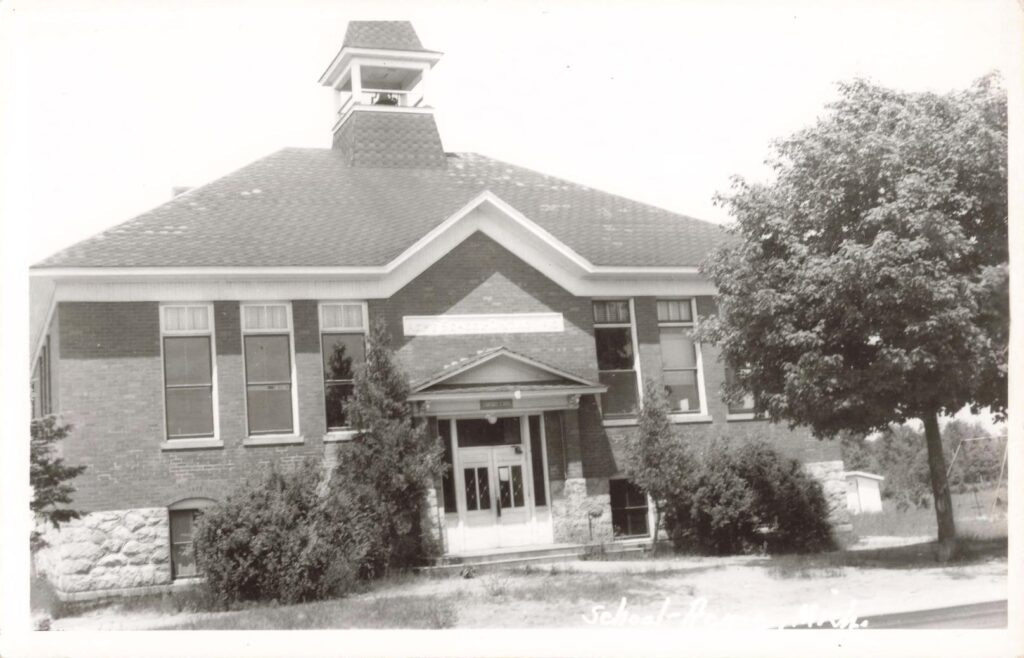
These buildings served farm families, mill families and merchants. They also helped hold scattered rural households together. Children came for lessons, but schools also anchored local identity. In small towns, a school was more than a classroom. It was a meeting point and a statement of confidence.
The End of the First Boom
Acme’s first economy depended heavily on timber. That made growth possible, but it also made the town vulnerable. As the best timber was cut, mill activity slowed. The township history says stores closed, the hotel was torn down and the woolen mill eventually closed.
This was common across northern Michigan. Many towns rose quickly during the lumber boom, then faced a new reality when the forest no longer supplied easy profit. Acme did not disappear, but it had to change.
Good farmland took on greater value. Orchards and other farming became more important. Bates and Yuba, other early settlements in Acme Township, also served rural trade. Bates had a railroad stop, general store, post office and cold storage warehouse. It became a shipping point for potatoes, fruit, lumber, cordwood, logs and tanbark.
Roads Changed Acme Again
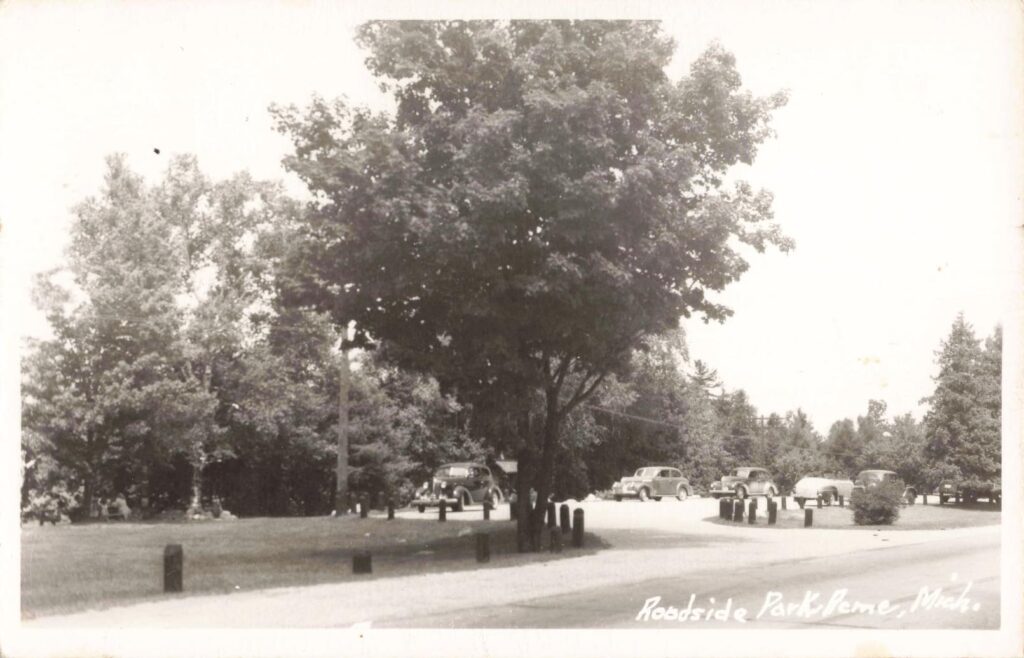
The next chapter came with roads and automobiles. Michigan road building expanded in the early 20th century, and Acme was well placed at important travel routes. The township master plan identifies the U.S. 31 and M-72 junction as one of the main gateways to the Traverse City area.
The attached roadside views show this change clearly. By the 1930s and 1940s, Acme was no longer just a mill and farm community. It was serving motorists. People stopped for shade, meals and rest. They came north for the bay, for vacation and for the experience of small-town northern Michigan.
Acme’s Lunch Stops, Diner Signs and the Motor Age
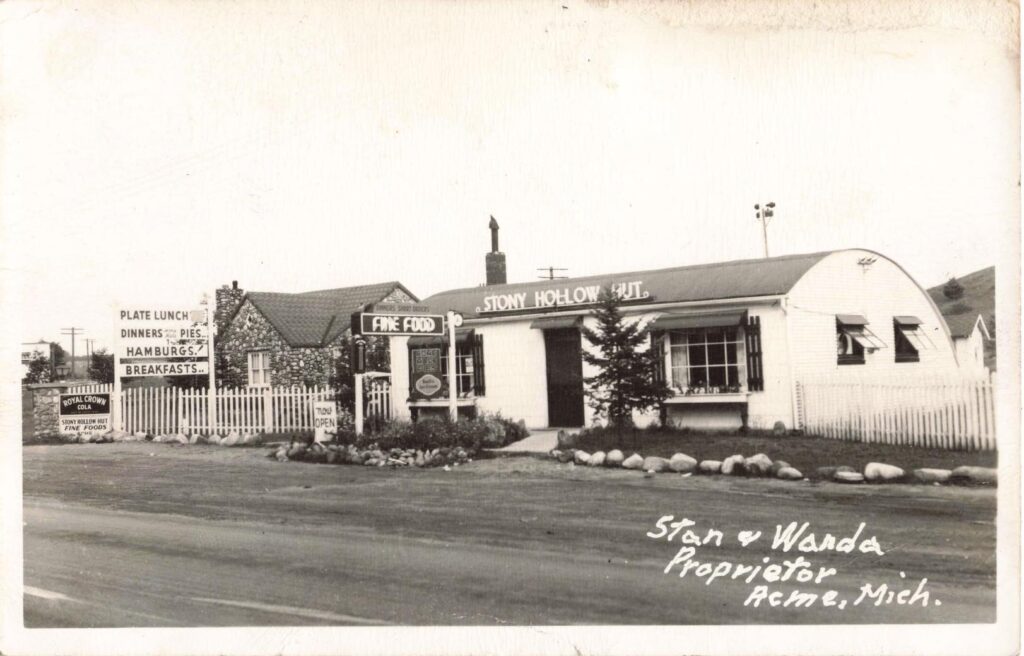
Stony Hollow Hut and Duck Inn represent Acme’s roadside years. Their signs were plain and direct: plate lunches, dinners, pies, hamburgs, breakfasts, sandwiches, salads, drinks and desserts. These were not luxury stops. They were useful places for travelers and locals.
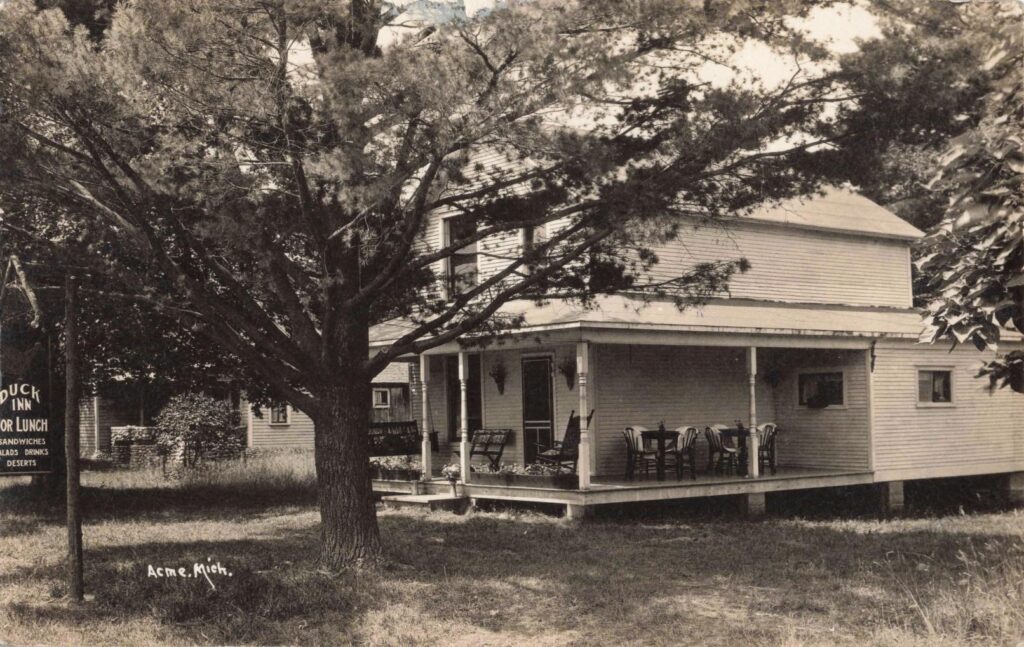
That is what makes them valuable historical evidence. They show Acme adapting again. A town that once served mill workers and farmers began serving families in cars. The change was practical, not glamorous. The food was simple. The signs were readable from the road. The business model depended on traffic.
From Golf Course to Resort Gateway in Acme
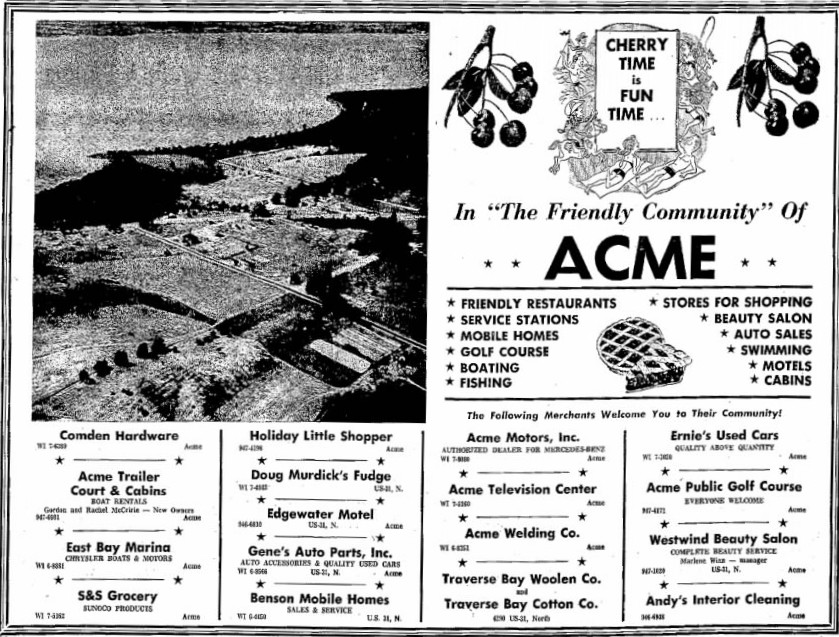
In the early 1970s, a nine-hole golf course was built near M-72 and U.S. 31. It was later purchased and expanded into Grand Traverse Resort. The township master plan notes the resort’s growth, including golf courses, residential units, a hotel and convention center.
The resort’s later development added a new layer to Acme’s identity. The modern Grand Traverse Resort and Spa promotes its 15-story tower and is owned and operated by the Grand Traverse Band of Ottawa and Chippewa Indians.
This modern chapter did not erase the old Acme. It built on the same geography that helped the village grow in the first place: bay access, routes to Traverse City, inland farms and a location suited to people moving through.
Why the History of Acme Michigan Still Counts
The History of Acme Michigan is a story of adjustment. First came mills and timber. Then came schools, stores and rail. Then farming and orchard country took a larger role. After that came cars, roadside parks, diners and tourism. Finally, Acme became part of the modern Traverse City travel economy.
The most important lesson is that Acme was never just one thing. It was a creek town, a mill village, a farm service point, a road stop and a resort gateway. Its history explains how many small Michigan communities survived change by changing with it.
Today, Acme Township had 4,456 residents in the 2020 Census count. That number is far larger than the roughly 200 residents recorded in the early 1900s. Yet the older story remains visible in the names, roads, schools, creek and bay. For readers who care about the History of Acme Michigan, the town offers a compact look at northern Michigan’s move from timber to tourism.
Northwest Michigan History Videos
Short Michigan Moments videos on towns, railroads, fires, lakes and early tourism in Northwest Lower Michigan.
History of Acme Michigan: From Mill Creek to Resort Playground
Watch on YouTubeLake Ann, Michigan: The Lumber Town That Fire Forced to Change
Watch on YouTubeGrawn, Michigan — How a Railroad Stop Built a Northern Michigan Town
Watch on YouTubeHistory of Interlochen Michigan — Between Two Lakes, Between Two Eras
Watch on YouTubeHistory of Empire Michigan: The Mill Town Fire That Changed Everything
Watch on YouTubeHistory of Glen Arbor, Michigan: 5 Rare Views from the Early 1900s
Watch on YouTubeMichigan Acme Facts
How did Acme, Michigan get its name?
Acme was founded by L. S. Hoxie, a New York native who settled in the area in 1864 and laid out the village. The community’s post office originally operated under the name “Whitewater,” but in 1869 it was renamed Acme. The name comes from the Greek word acme, meaning “highest point” or “summit.”
What industries helped build early Acme?
Like many Northern Michigan communities, Acme grew during the lumber era. Sawmills and docks were operating along Grand Traverse Bay by the 1850s, taking advantage of the region’s vast pine forests and water transportation routes. The lumber trade attracted settlers, merchants, and supporting businesses that formed the foundation of the village.
When did the railroad arrive in Acme?
A major turning point came in 1892 when the Chicago and West Michigan Railway extended its line from Traverse City to Petoskey through Acme. The railroad improved transportation, connected local businesses to larger markets, and helped shift the area from a lumber-based economy toward farming, tourism, and commerce
Works Cited for the History of Acme Michigan
Acme Township. Acme Township Master Land Use Plan. Updated 18 May 2009.
Eckert, Kathryn Bishop. Grand Traverse Resort Village (Grand Traverse Resort and Spa). SAH Archipedia, Society of Architectural Historians.
Genealogy Trails. City and Township Histories of Grand Traverse County, Michigan.
Grand Traverse Resort and Spa. The Tower at Grand Traverse Resort and Spa.
Michigan Department of Transportation. 2020 Township Census. 21 Mar. 2022.
MichiganRailroads.com. Station: Acme, MI.
“Acme Ad 1970” Newspapers.com, Traverse City Record-Eagle, July 8, 1970, https://www.newspapers.com/article/traverse-city-record-eagle-acme-ad-1970/199820412/