 by
by 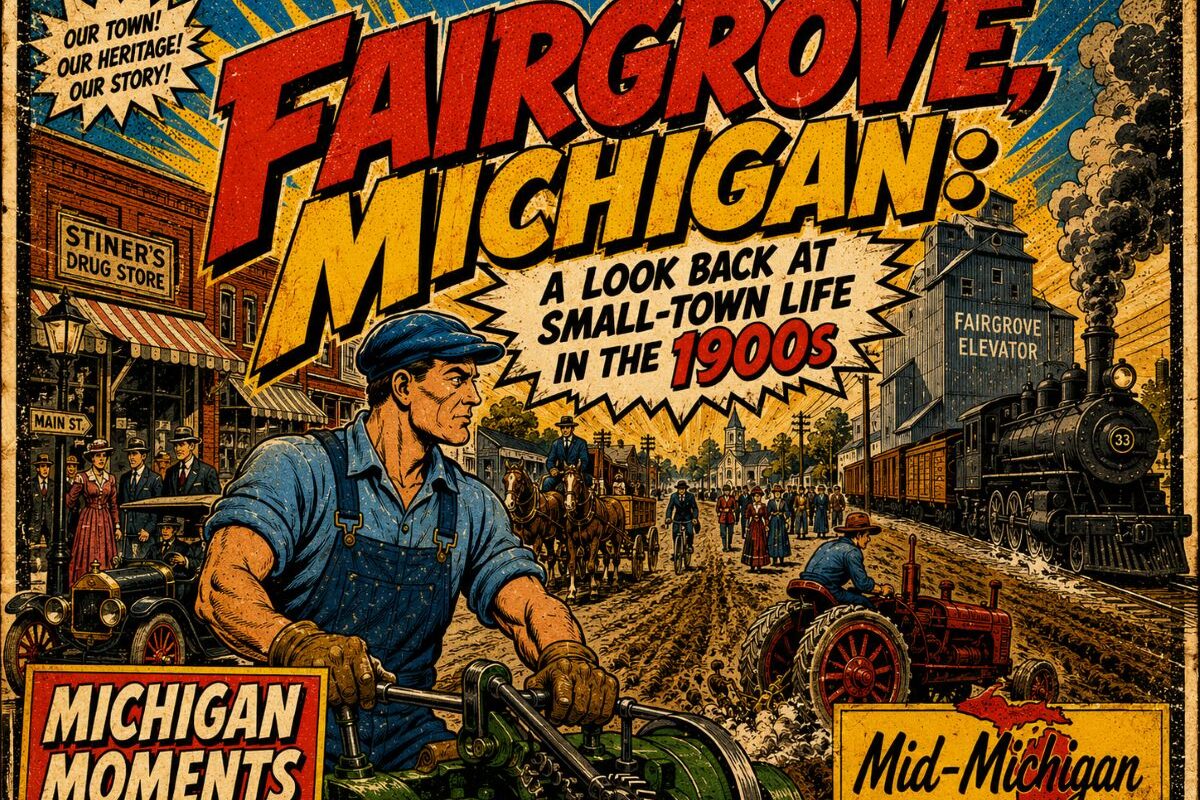
This Michigan Moments video looks at Fairgrove Michigan history, through rare postcards from the early 1900s. The images show village streets, Stiner’s Drug Store, the Pere Marquette Railroad depot, the town elevator and signs of changing travel in rural Tuscola County.
About This Video of Fairgrove Michigan History
Fairgrove, Michigan, stood as a small farming community in Tuscola County at the turn of the 20th century. This video uses early postcard views to show how agriculture, rail service and local commerce shaped daily life in the village.
The scenes include Stiner’s Drug Store, local businesses, unpaved streets, wooden sidewalks, the Pere Marquette Railroad depot and the town elevator. The images also show a period when horse-drawn wagons and early automobiles shared the road.
Video Transcript
At the turn of the 20th century, Fairgrove, Michigan, stood as a small but thriving farming community in the heart of Tuscola County. Settled in the mid-1800s, Fairgrove developed as agriculture expanded across Michigan’s Thumb region, fueled by wheat, beans and sugar beet farming.
The images from the early 1900s tell the story of a self-sufficient town anchored by modest brick and wood-framed buildings. Stiner’s Drug Store, built in 1900, offered residents remedies, newspapers and conversation, a vital meeting point for a close-knit rural community.
Down the street, businesses like the local garage sold gasoline, signaling the gradual arrival of automobiles alongside horse-drawn wagons.
The Pere Marquette Railroad depot played a crucial role in Fairgrove’s economy. Trains moved crops and goods to larger markets, connecting farmers with Detroit, Saginaw and beyond.
The town elevator, towering above nearby buildings, underscored the area’s dependence on agriculture. It stored and shipped grain grown in the rich Thumb soils.
Fairgrove streets, captured in bird’s-eye views and roadside scenes, were wide and unpaved, lined with young trees and wooden sidewalks. Stores, churches and homes were clustered tightly together, creating a walkable village atmosphere.
Early gasoline pumps and parked Model T’s hinted at modernization, but life remained rooted in agriculture and small-town traditions.
By the 1910s and 1920s, Fairgrove’s growth mirrored that of many rural Michigan towns: steady, modest and centered around family farming.
These postcards offer a rare look at daily life when the town was entering a new century, but still deeply tied to its pioneer roots.
Key Moments
- 0:04 Fairgrove at the turn of the 20th century
- 0:14 Agriculture expands across Michigan’s Thumb region
- 0:30 Stiner’s Drug Store as a local meeting point
- 0:51 Pere Marquette Railroad depot and crop shipping
- 1:14 Unpaved streets, wooden sidewalks and village life
- 1:38 Fairgrove’s growth in the 1910s and 1920s
Related Reading