 by
by 
Cross Village history starts with a simple warning: do not judge this Lake Michigan village by its size.
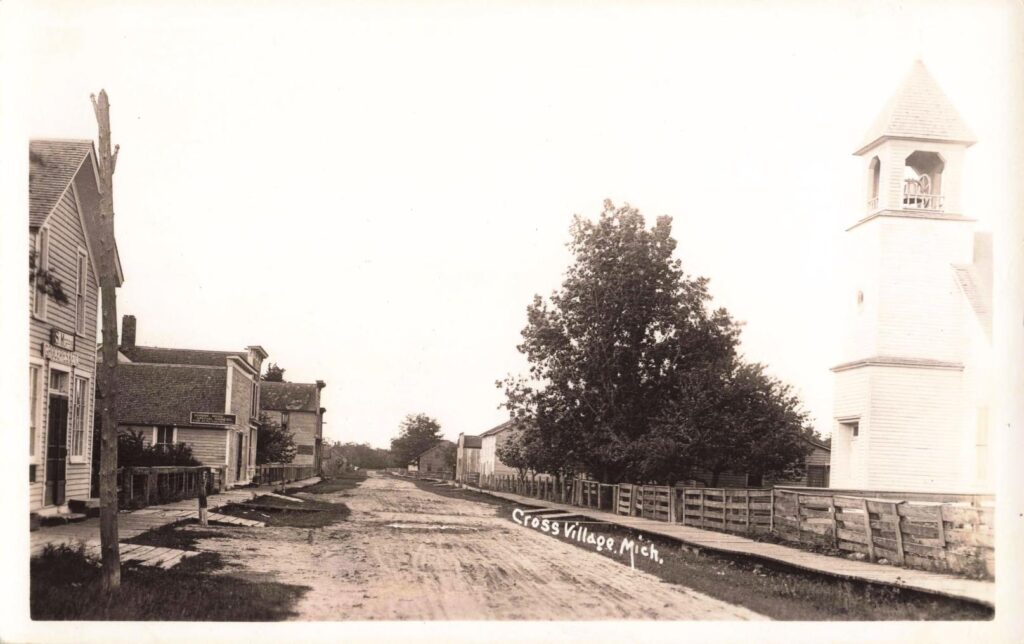
Today, Cross Village feels quiet. It sits near the northern end of M-119, where the Tunnel of Trees brings drivers through one of Michigan’s best-known scenic routes. But old postcards tell a louder story. They show boardwalks, churches, logging crews, roadside inns, craft shops, a pow-wow portrait and the oddball wonder of Legs Inn.
Watch – Cross Village’s Colorful Past: Logging Camps, Pow-Wows, and Stovepipes
Cross Village history then and now
Cross Village has one of those Michigan stories that gets bigger the longer you sit with it. At first glance, it looks like a quiet place at the top of M-119, where the Tunnel of Trees finally gives way to open sky and Lake Michigan. Then the old postcards start talking.
Suddenly, Cross Village is no longer just a scenic stop with a famous restaurant. It is a former lumber town, an Odawa community, a mission site, a place rebuilt after a fire, and a village that was once marketed as a future “second Chicago.” That last claim alone deserves a raised eyebrow and maybe a good cup of coffee. Still, it was real, and it says a lot about how people once saw this bluff-top town.
Cross Village history is an older story than the road
Long before tourists started driving north for Polish sausage and lake views, Cross Village stood within the larger Waganakising homeland of the Odawa. Officials with the township and regional Native history programs trace the village’s history through earlier names, including Waganakisis and Ahnamiwatigoning, before the French and then English names took hold. Emmet County’s own history says Indian villages once stretched almost continuously along this shore. That matters because it keeps the story in the right order. Cross Village was not “founded” when outsiders arrived. It was already here. The newcomers changed it, renamed it, preached to it, and traded through it, but they did not start the clock.
Main Street – Cross Village history at full throttle
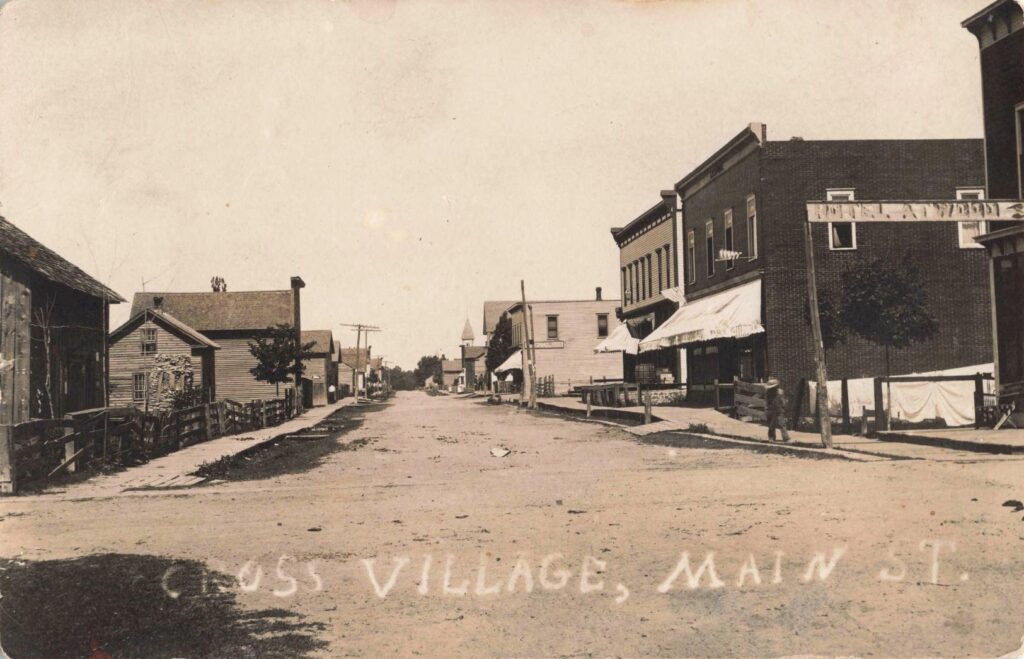
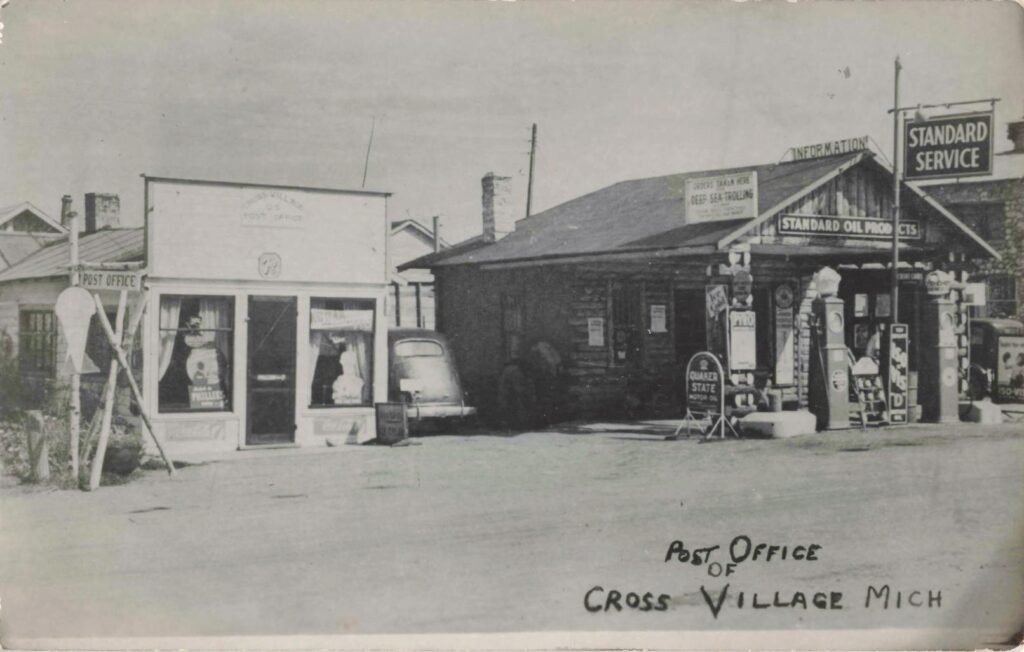
By the late 1800s and early 1900s, Cross Village was far busier than many people would guess today. The township’s walking tour says the village had more than 50 houses, multiple stores, three hotels, three churches and two schools. The postcards back that up. Main Street does not look sleepy. It looks useful. Boardwalks line the road. The post office and service station card suggests a town that served both residents and travelers. One roadside sign advertises “deep sea trolling,” which is about as clean a summary of Cross Village’s economy as you could ask for: fish on one hand, gas pump on the other.
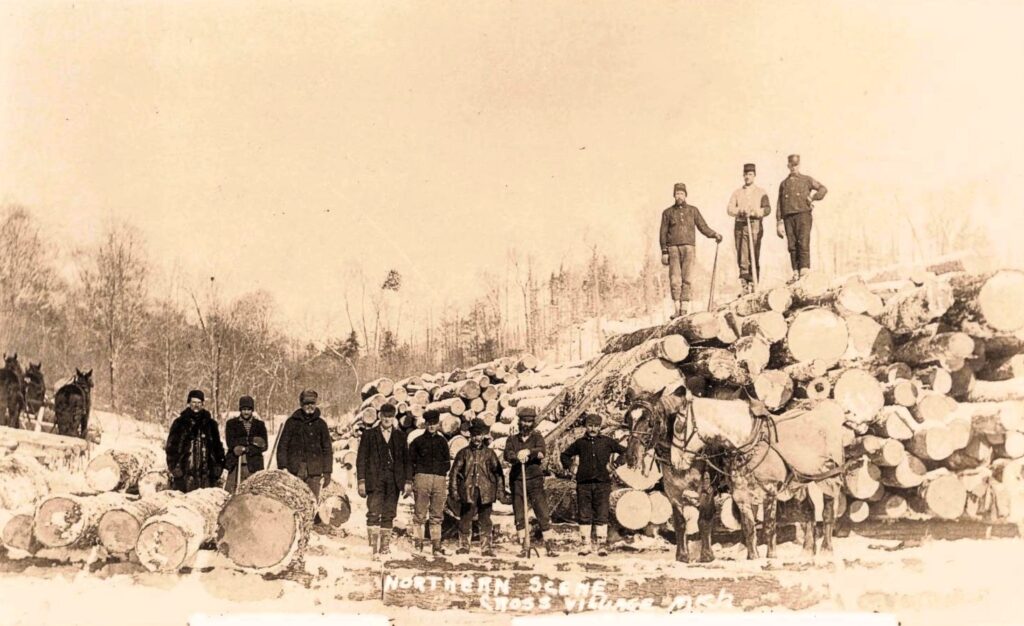
This was also lumber country, and not in the romantic sense that modern gift shops like to sell. Michigan was the nation’s top lumber producer from 1869 to 1900, and lumber crews cut through winter, worked with horses, and moved logs with brute force and timing. The logging postcard from Cross Village history collections shows piles of timber stacked so high that every man in the image looks smaller than the job. It is the kind of photo that quietly says: nobody in this frame was asking for a soft workday. Cross Village history rode that economy for as long as it could, just as many northern Michigan towns did.
Faith, school, and Father Weikamp
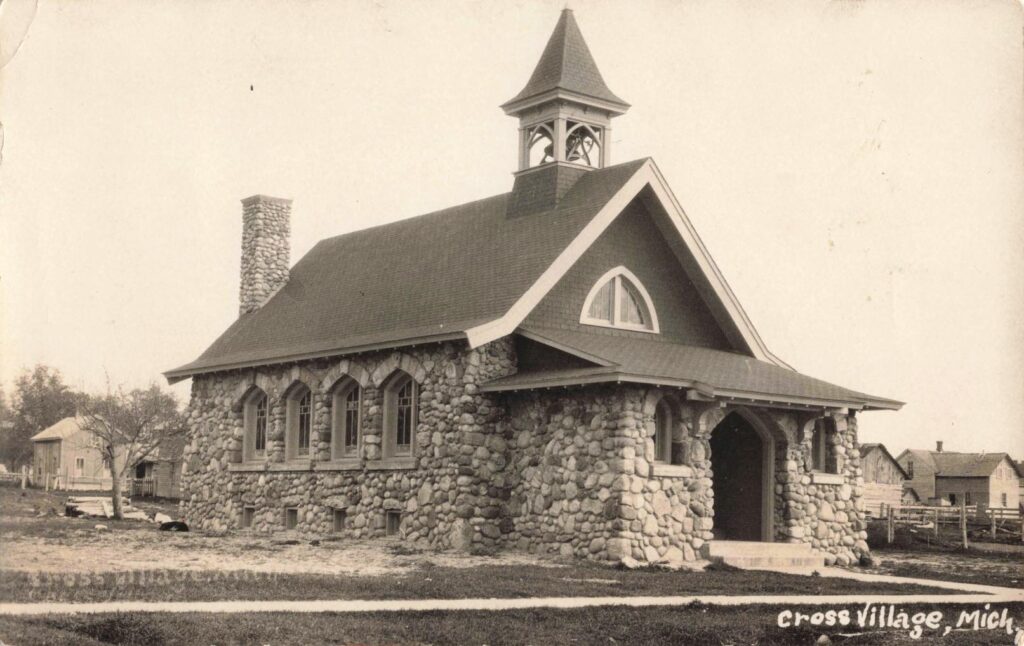
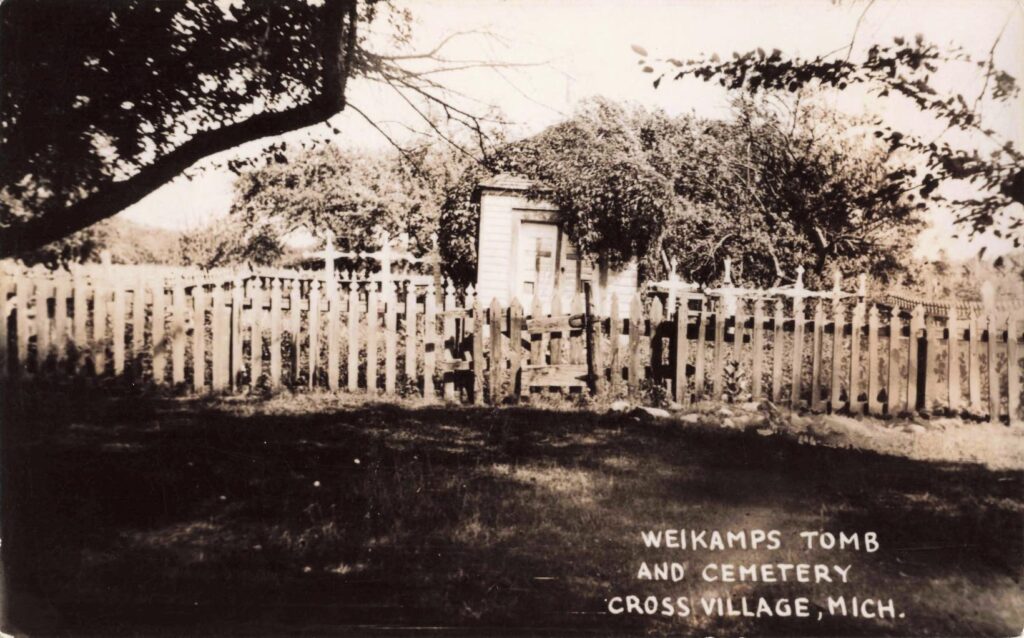
Religion was not a side detail in Cross Village. It was built into the ground. Holy Cross Church records run back to 1847, and Father John Weikamp’s work in the village left such a mark that his tomb became postcard material. The Diocese of Gaylord says the religious society he founded in Cross Village dates to 1856. That helps explain why the town’s church views feel so central. They were central. The schools, church life, and convent activity were part of the daily order, not separate from it. In Cross Village, faith helped organize both the spiritual and practical business of community life.
Then the fire changed the math
On Sept. 28, 1918, fire started in the Atwood Hotel and tore through two sides of Main Street. About 300 people were left homeless. Only Holy Cross Church survived. Then influenza arrived. That one-two punch, paired with the decline of lumber, changed Cross Village for good. It did not kill the village, but it ended the version of Cross Village that boosters once pitched as a booming commercial center. If the early postcards show a town standing tall, the later ones show a town getting tougher and more selective about what it would become next.
What came next was stranger and better
This is where the story gets fun. A lesser town might have faded into plain usefulness. Cross Village answered with Legs Inn.
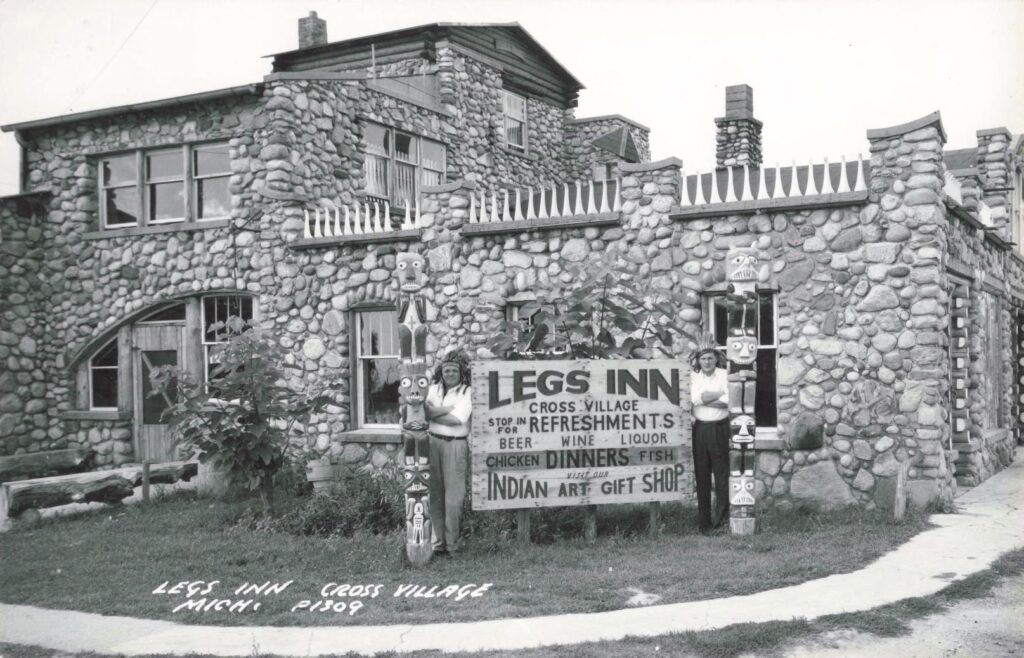
According to the inn’s official history, Stanley Smolak, a Polish immigrant who settled in Cross Village in 1921, built the place during the 1930s with help from Odawa and other area residents, using local timber and stone.
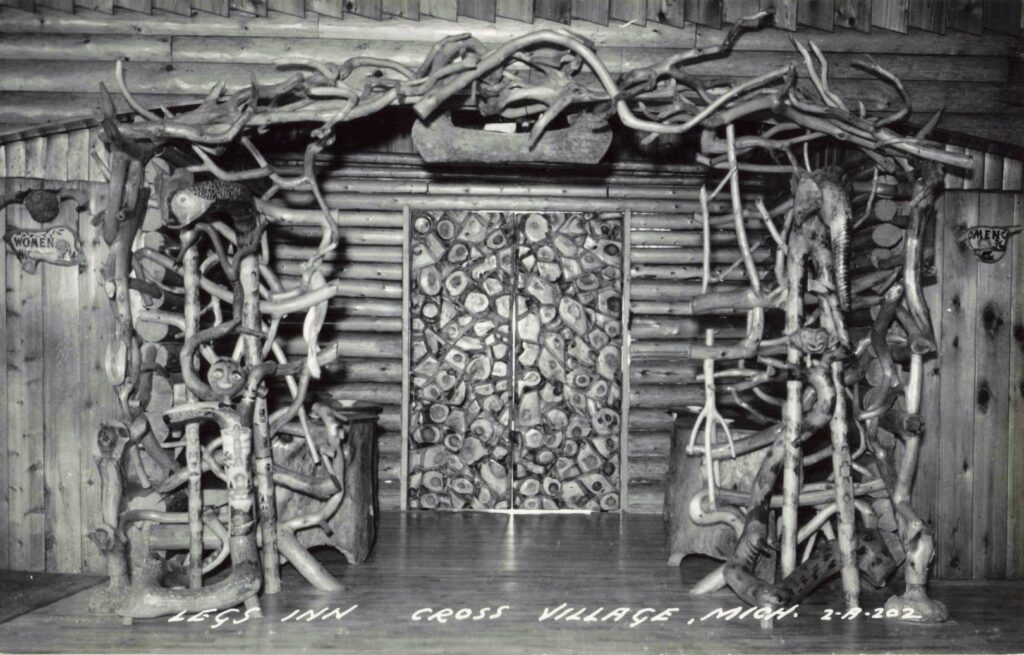
He trimmed the roofline with stove legs, filled the place with hand-carved branchwork and root forms, and created a building that looks as if it were designed by a carpenter, a folk artist, and a cheerful contrarian at the same table. The result is one of Michigan’s oddest and best-known buildings. Good for Stanley Smolak. Also good for every traveler who has ever rounded the curve and said, “What on earth is that?”
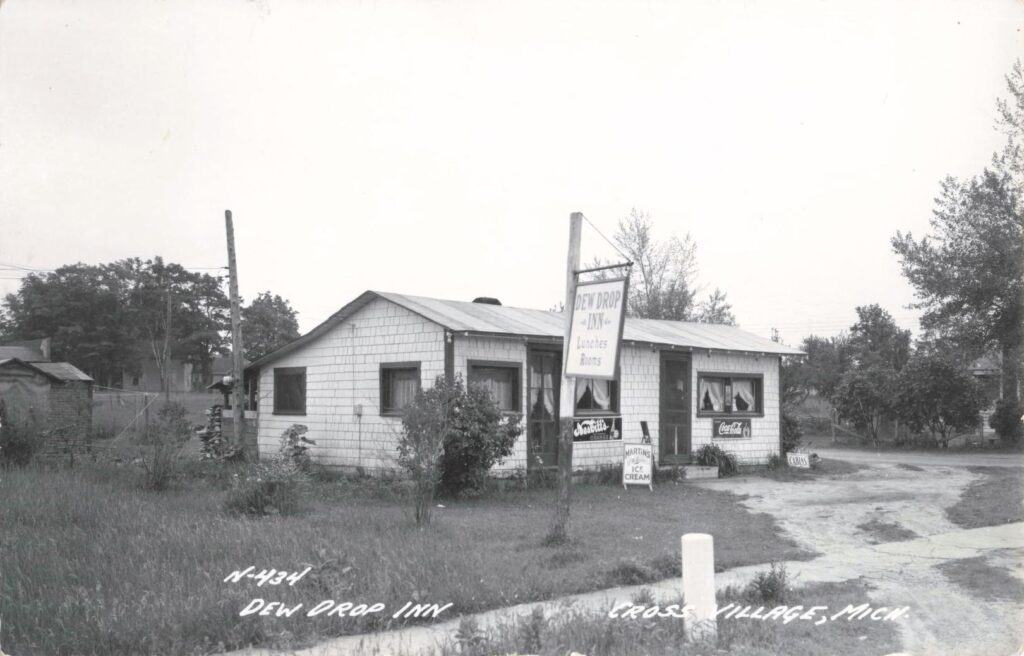
The postcards show that Cross Village history also leaned into roadside trade in smaller ways. The Dew Drop Inn offered lunches, rooms, and ice cream. A craft shop advertised “Indian Craft Work,” which reflects a period when Native-made arts and souvenirs were part of the area’s visitor economy.
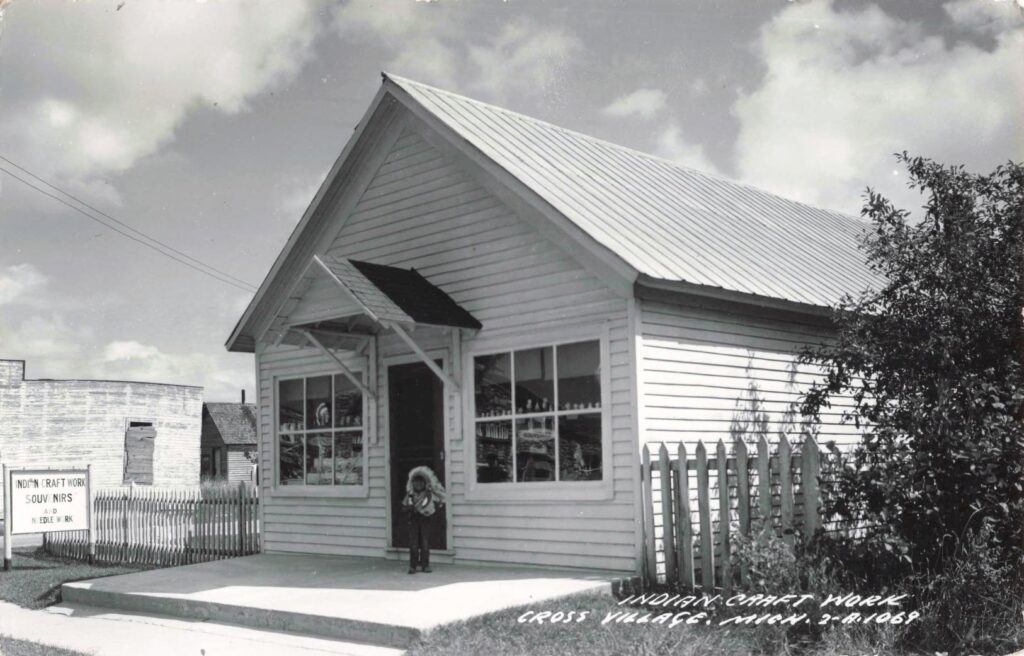
The township history adds another useful detail: during the Great Depression, the old town hall served as a workshop through the Indian Emergency Conservation Work program, where Native artisans made baskets, quill boxes, and other goods. In other words, tourism did not replace local culture. It often repackaged it, marketed it, and put it in the window.
The part of the story that never left
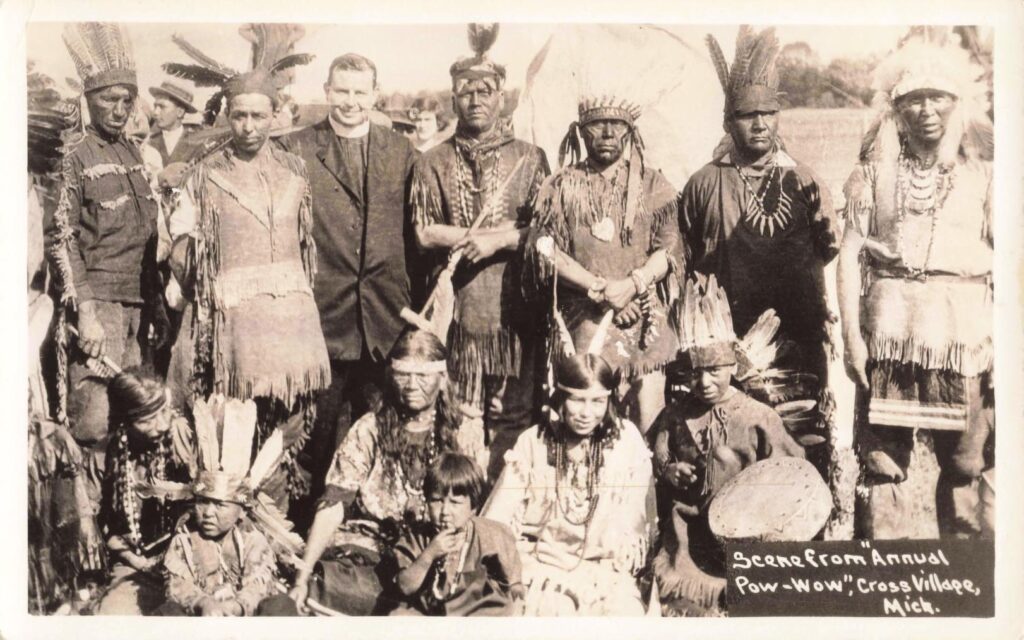
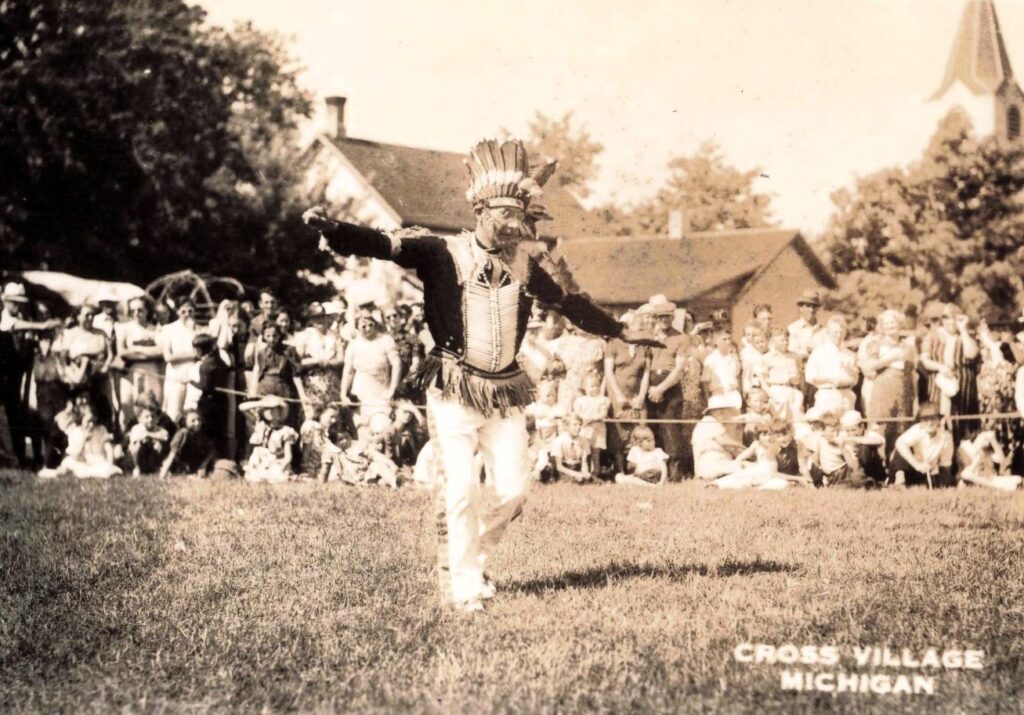
The pow-wow postcard may be the most important image in the set. Regional Odawa history says that by the turn of the 20th century, many Odawa still lived and worked in the old villages, including Cross Village, and public pageants and Native cultural gatherings continued through much of the first half of the century. That means the image is not just ceremonial color dropped into the local record. It shows continuity. While speculators dreamed of Chicago and motorists rolled in for lunch, the Odawa were still here, still visible, still shaping what Cross Village meant.
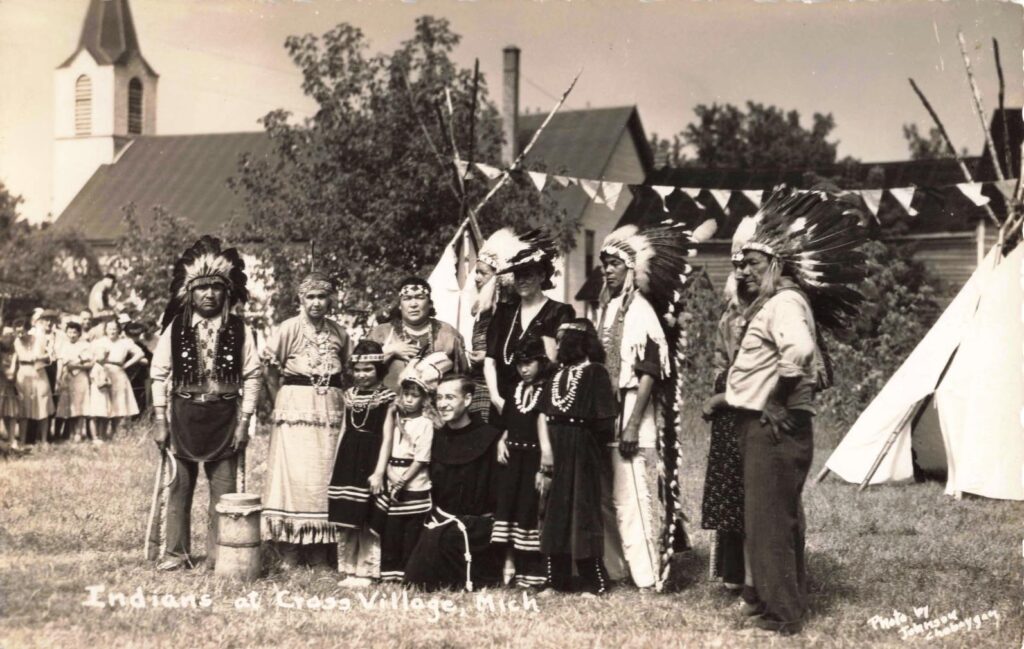
That may be the sharpest lesson in these old photos. Cross Village changed jobs, changed buildings, changed traffic, and changed pace. But it did not become a blank slate. It kept its memory in plain sight: in the churches, in Weikamp’s tomb, in the old street views, in the postcard signs, and in a restaurant roof lined with stove legs because normal was never going to be enough.
Cross Village is small. Its history is not.
Sources Cited for Cross Village History
- Cross Village Township. “Cross Village Historic Walking Tour.” Cross Village Township, 2023. Accessed 1 July 2026.
- Petoskey Area Visitors Bureau. “Native American History & Culture.” Petoskey Area, 25 Mar. 2026. Accessed 1 July 2026.
- Michigan Forests Forever. “Michigan Forests During the Logging Era.” Michigan Forests Forever Teachers Guide, Michigan Technological University. Accessed 1 July 2026.
- Dern, Michael. “Legacy of Faith.” Diocese of Gaylord, 21 May 2025. Accessed 1 July 2026.
- Legs Inn. “Legs Inn.” Legs Inn, Smolak Enterprises, Inc., 2026. Accessed 1 July 2026.
- Petoskey Area Visitors Bureau. “Tunnel of Trees – M 119.” Petoskey Area, 2026. Accessed 1 July 2026.