 by
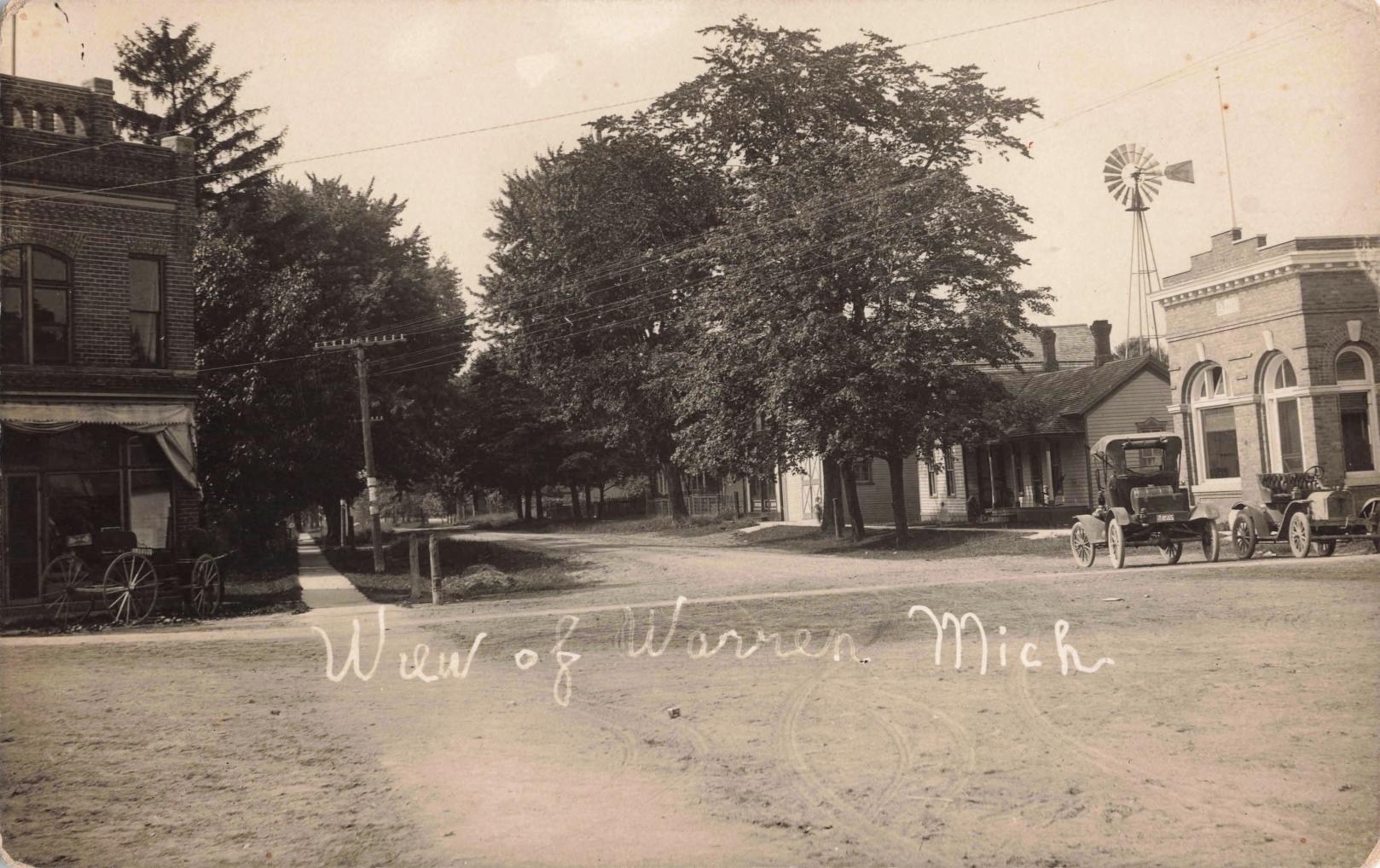
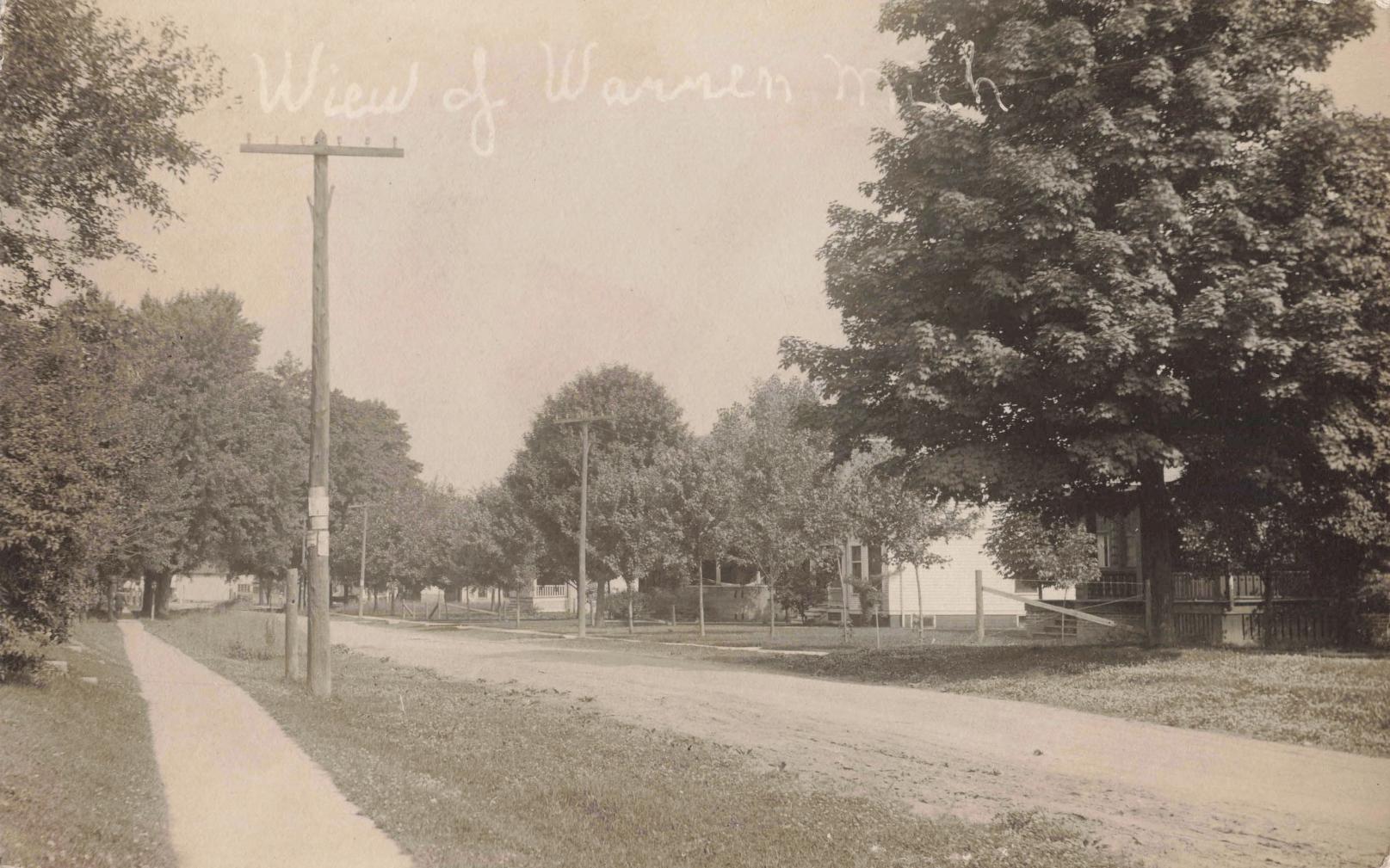
A postcard postmarked Aug. 31, 1909, records the main street of Warren, Michigan. A drugstore and a shop selling women’s hats faced an unpaved road. A horse-drawn carriage stood across the street from the hotel. Within 32 years, a factory a few miles south would be delivering its first tank to the U.S. Army.
A history of Warren Michigan that begins with the tank plant misses a century of local life. The old village had fewer than 600 residents as late as 1940, while Warren Township already had more than 22,000. The two places grew at decidedly different speeds.
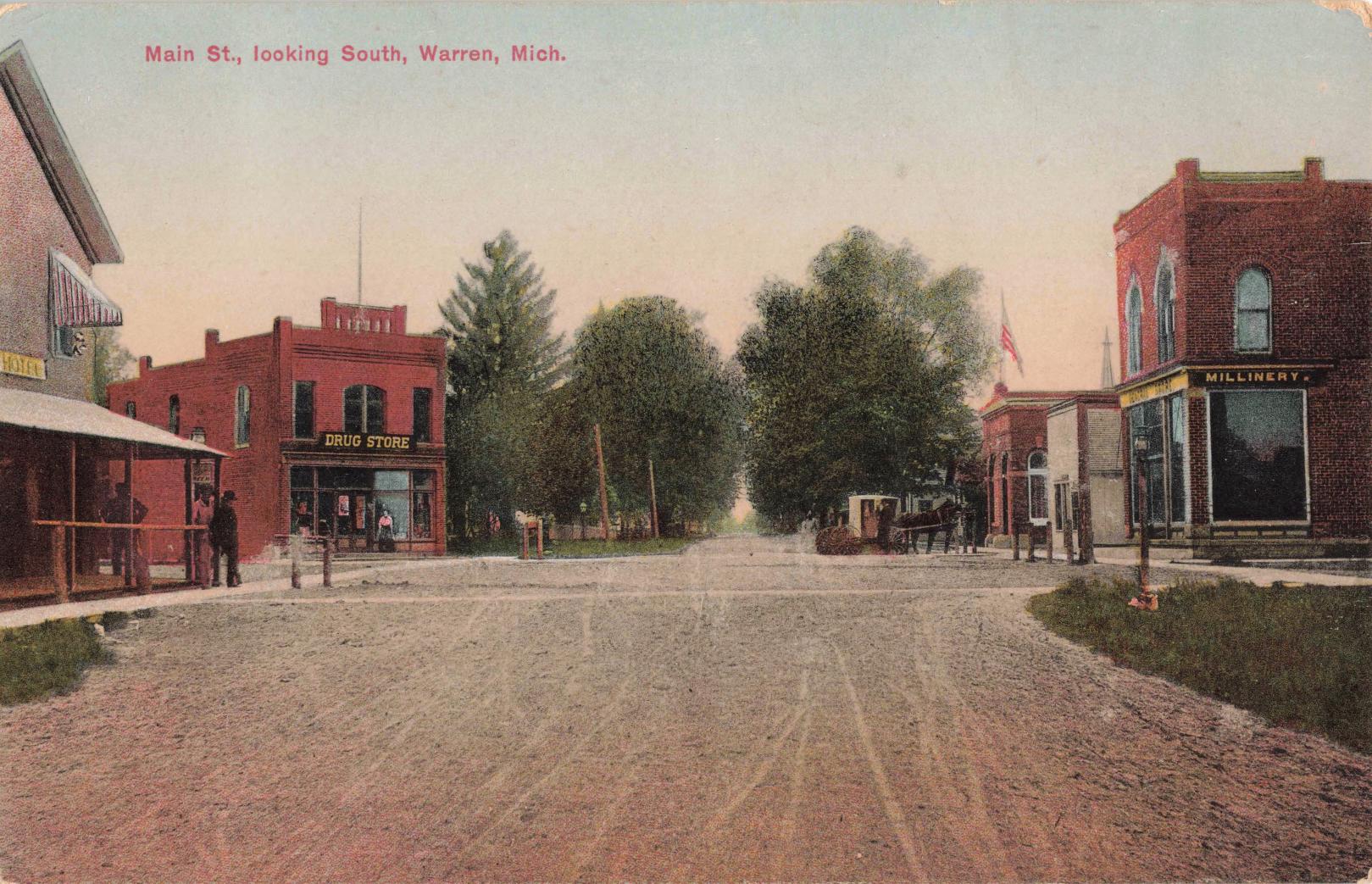
Table of Contents
Watch: Warren, Michigan: From Stagecoaches to WWII Tank Plants
History of Warren Michigan: The Toll Gate at Beebe’s Corners
In the early 1830s, farming families began settling near the intersection of present-day Mound and Chicago roads. Travel through this part of southwestern Macomb County was difficult. Water collected in low spots near Red Run Creek, and tree roots complicated roadbuilding.
The intersection became a stopping place for coaches traveling between Detroit and Utica. John L. Beebe, who collected tolls on the plank road to Detroit, gave Beebe’s Corners its name. Wooden planks provided a firm surface for wagons on ground that could otherwise turn into deep mud. Sawmills at 12 Mile and 14 Mile roads processed timber as farmers cleared land for crops.
Local government went through several name changes. Hickory Township was established in 1837, became Aba Township in 1838 and took the name Warren in 1839. The tiny settlement grew around its shops and the traffic that passed through it.
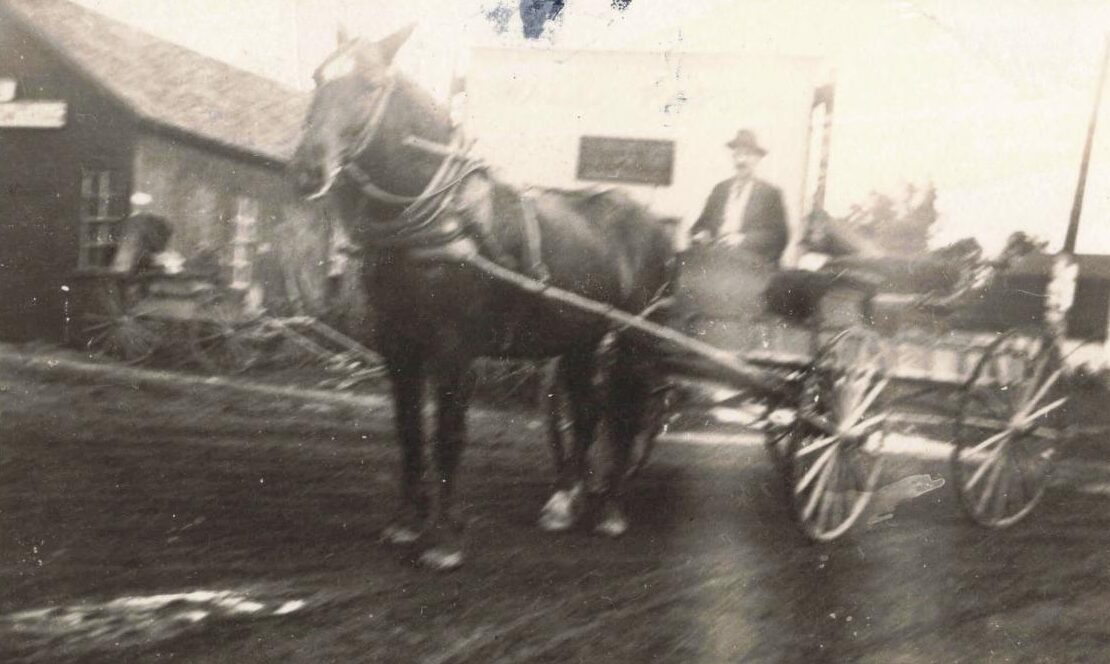
Warren Railroad History: A Village That Served the Farms
One early railway between Detroit and Utica used iron straps laid on wooden rails. A more substantial railroad arrived when the Detroit & Bay City Railroad opened its southern section in 1872. The Michigan Central took over the route in 1881. Farmers could send produce to markets farther away, and the village’s mills could receive and ship goods by rail.
On April 28, 1893, Warren incorporated as a village. Its first president, Dr. J. D. Flynn, was a physician. The village covered about one square mile and was home to many German families. Local businesses included a grain mill and Fred Lutz’s wagon shop. A State Savings Bank opened in 1902, according to the local history of Warren businesses.
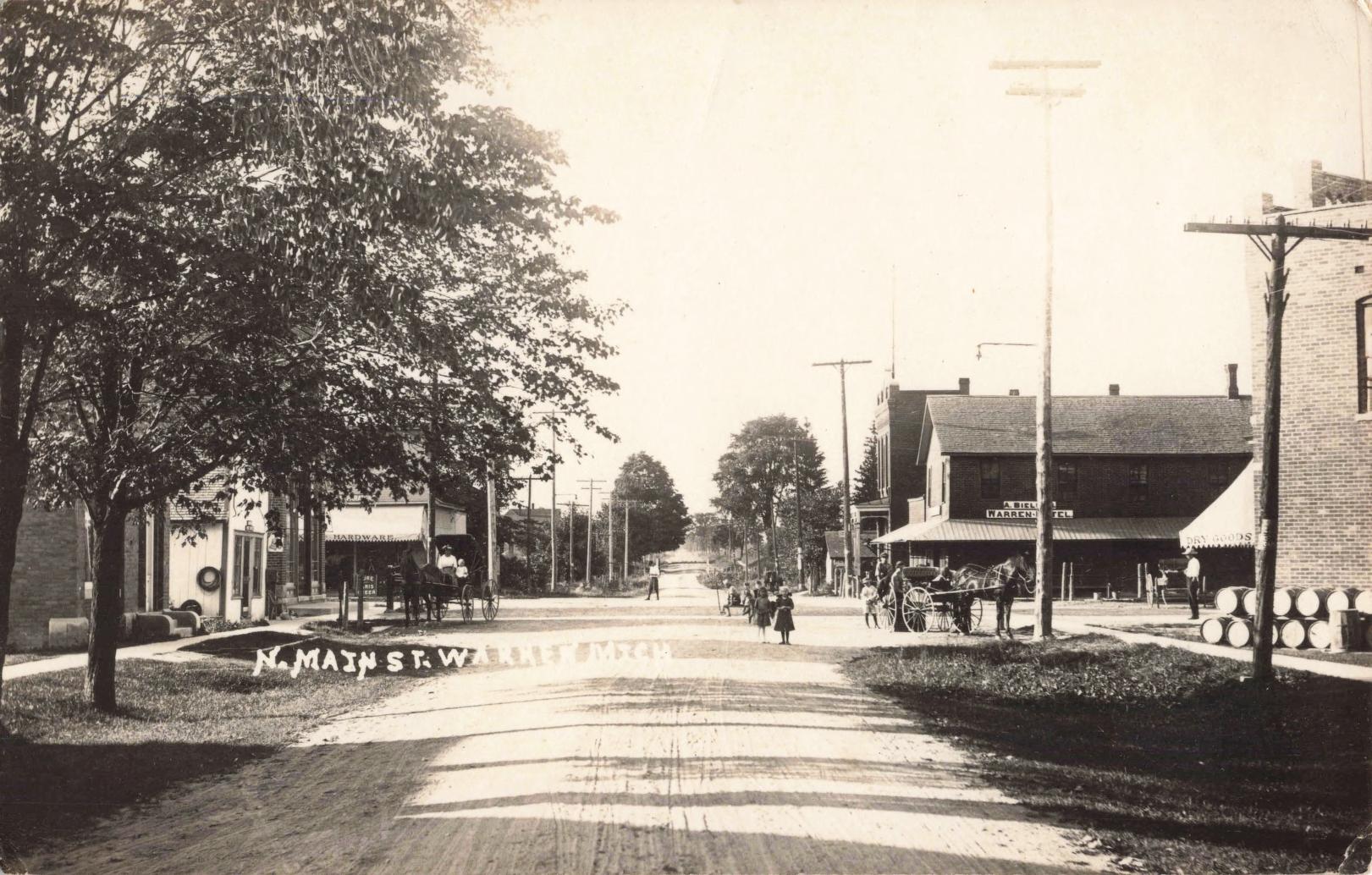
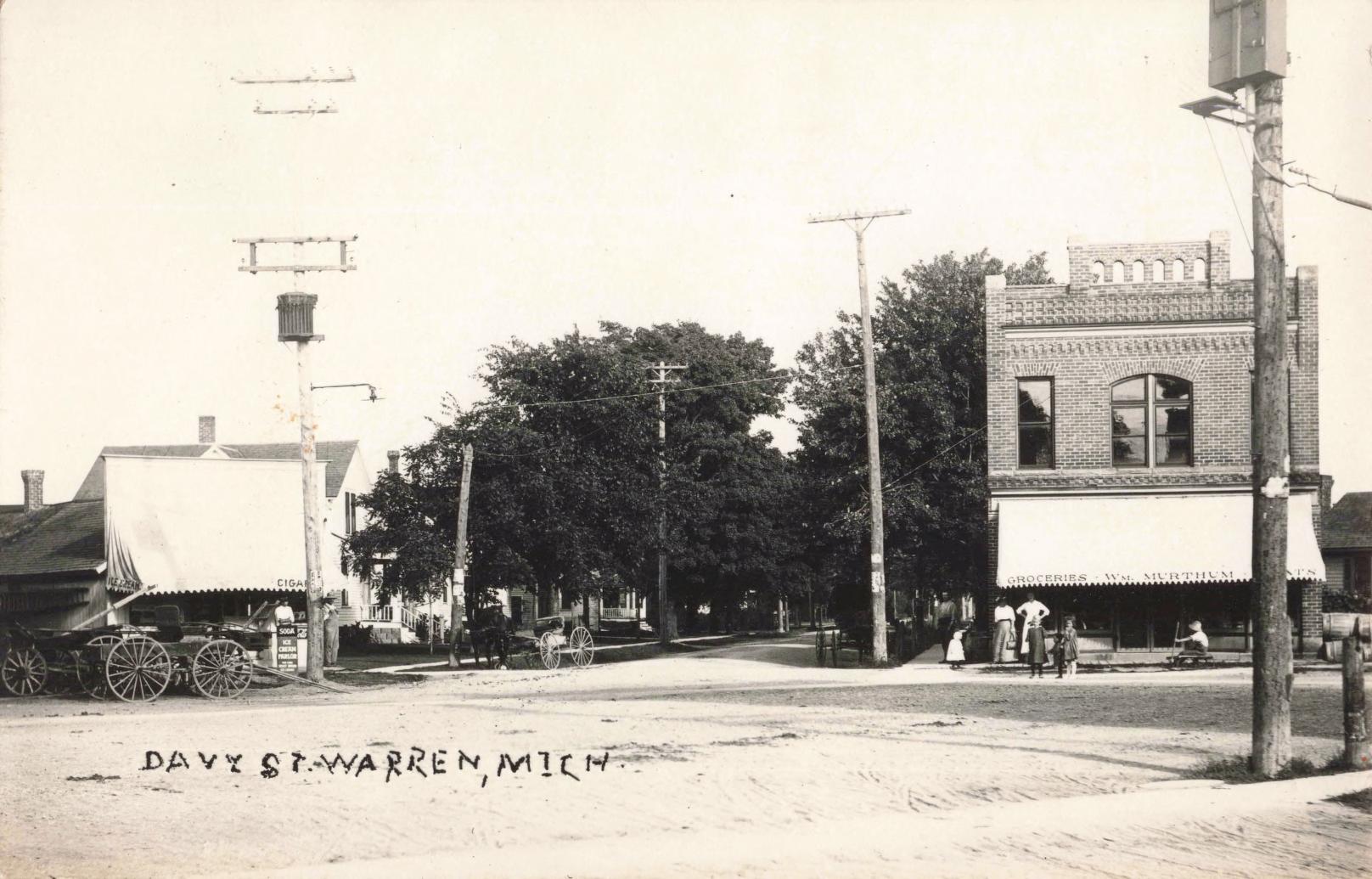
William Murthum’s grocery occupied an imposing brick storefront in the village. Across the street, another shop advertised ice cream and cigars. The broad sidewalks and awnings made shopping easier, though the road between them was still dirt. These modest businesses served an area far larger than the village itself.
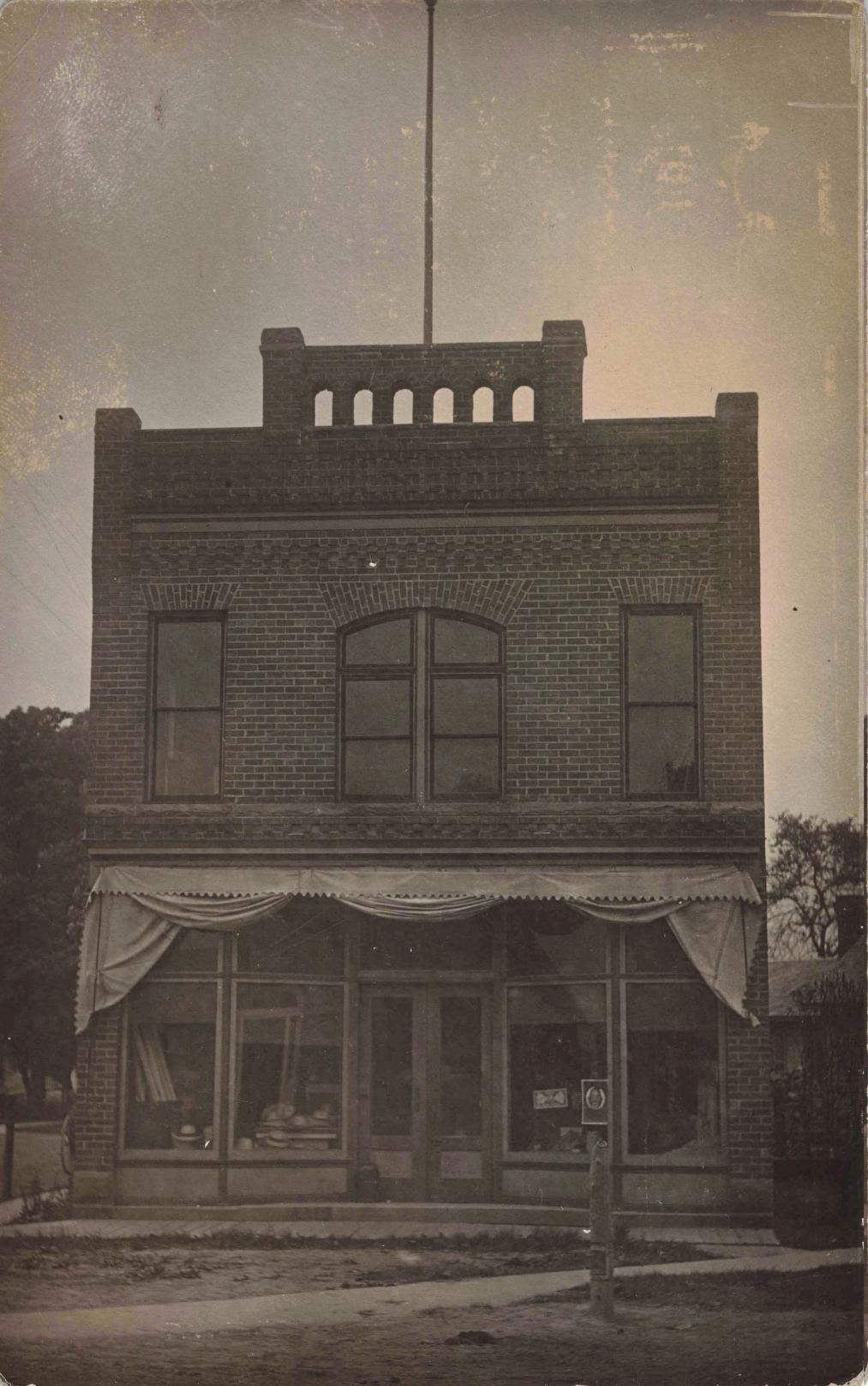
A German-Language Church and a One-Room School
St. Paul Evangelical Church began as a German-speaking congregation in 1864. Its brick sanctuary, built in 1894, had a tall spire and a German Bible sealed in the cornerstone. For many immigrants, worship in their own language helped them maintain family and community traditions.
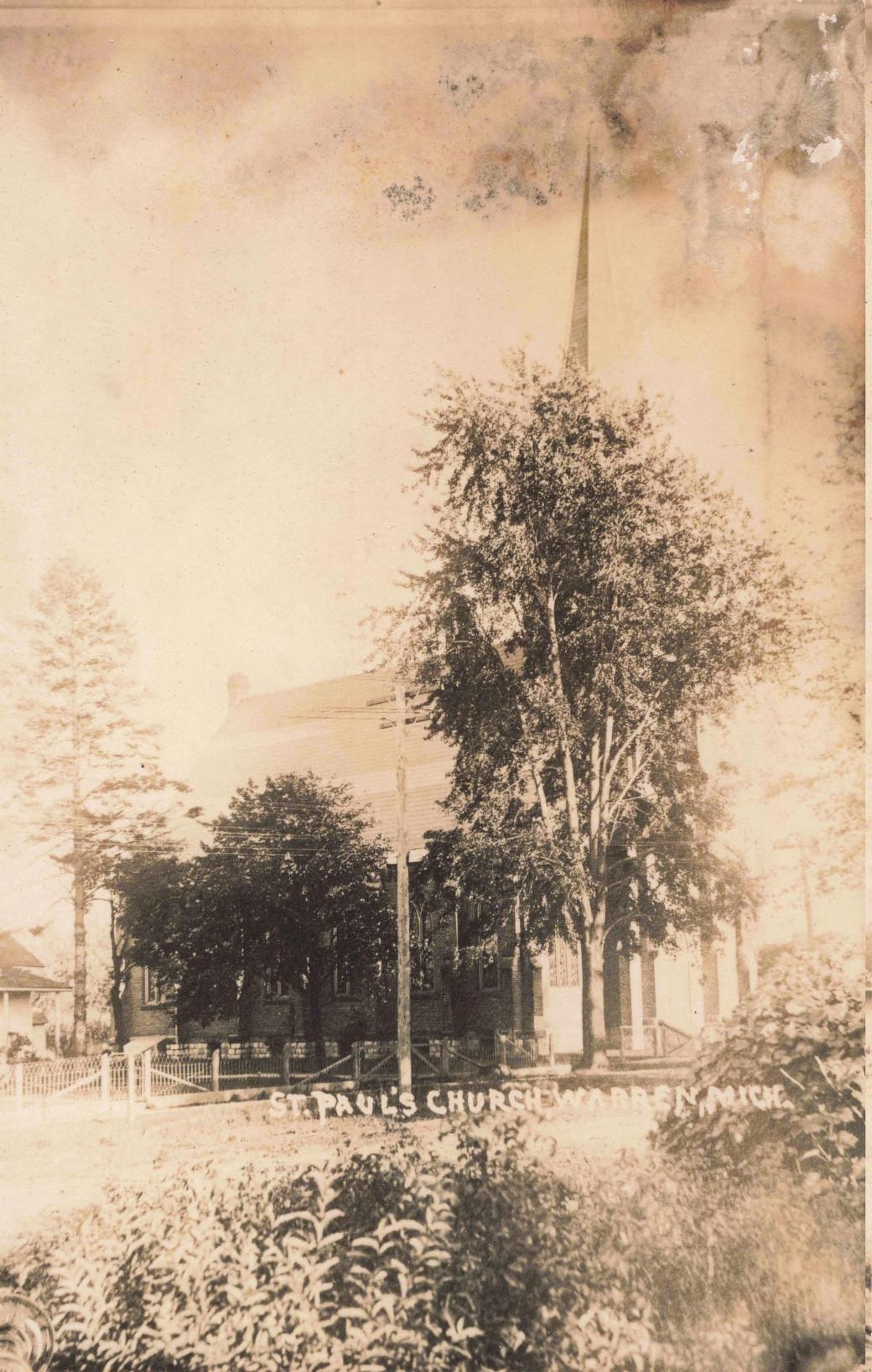
Lightning damaged the spire in 1921, forcing the congregation to remove the upper 35 feet. According to the church’s historical marker, the congregation added a parish hall in 1924 for Sunday school and community events. German remained the principal language of services until 1935.
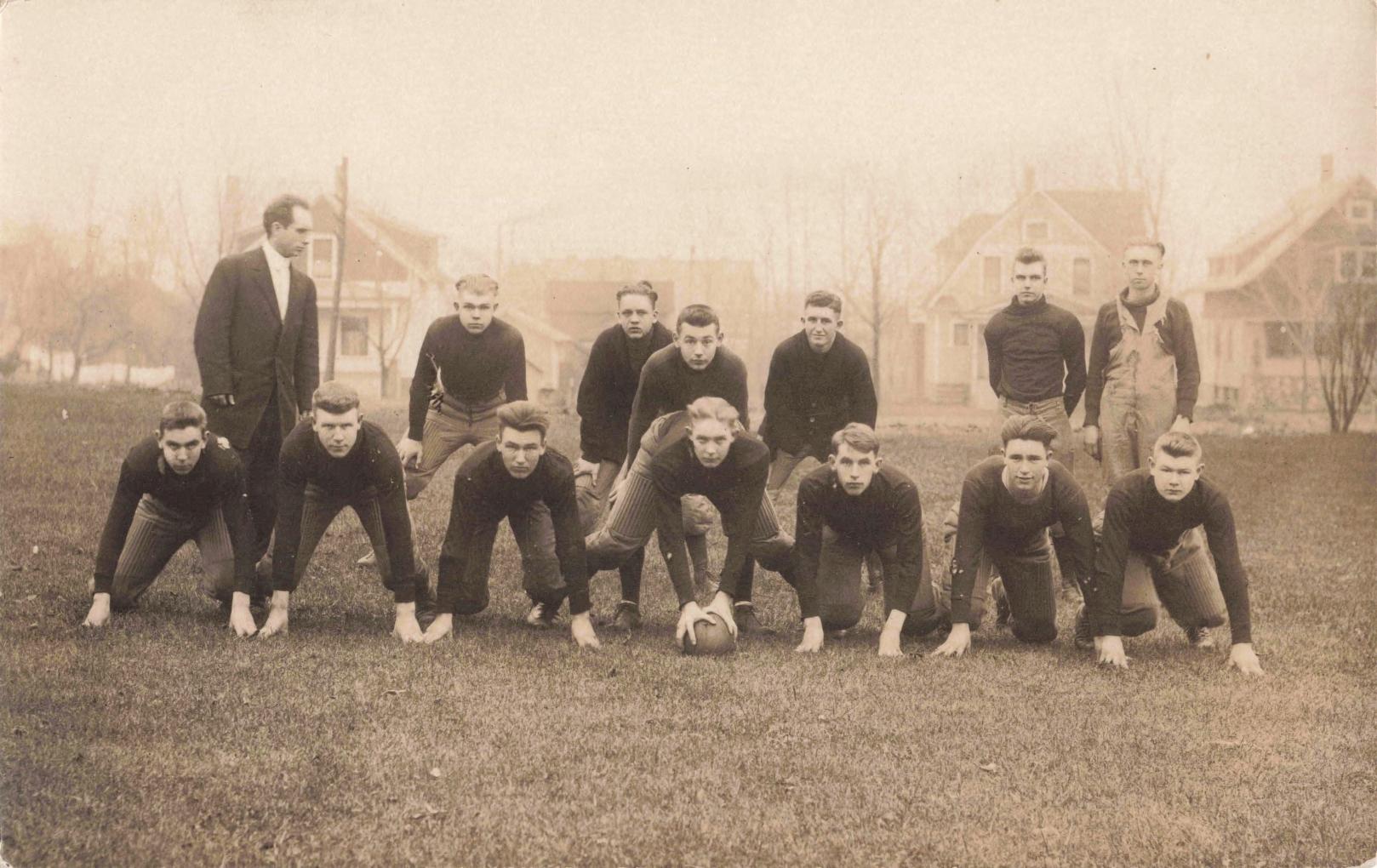
Schooling followed the township’s gradual development. In 1875, August and Mine Bunert sold land to District No. 4 for a one-room schoolhouse. The Bunert School remained in use until 1944. Meanwhile, the William E. Murthum School opened in 1926 and gained a high school addition in 1931, as a larger community needed more classrooms.
When the Automobile Arrived in Warren
For the next chapter in the history of Warren Michigan, look at its roads. By the 1910s, automobiles were appearing beside horse-drawn buggies. Detroit’s motor-vehicle industry gave local residents access to a new means of travel and, increasingly, a new way to earn a living.
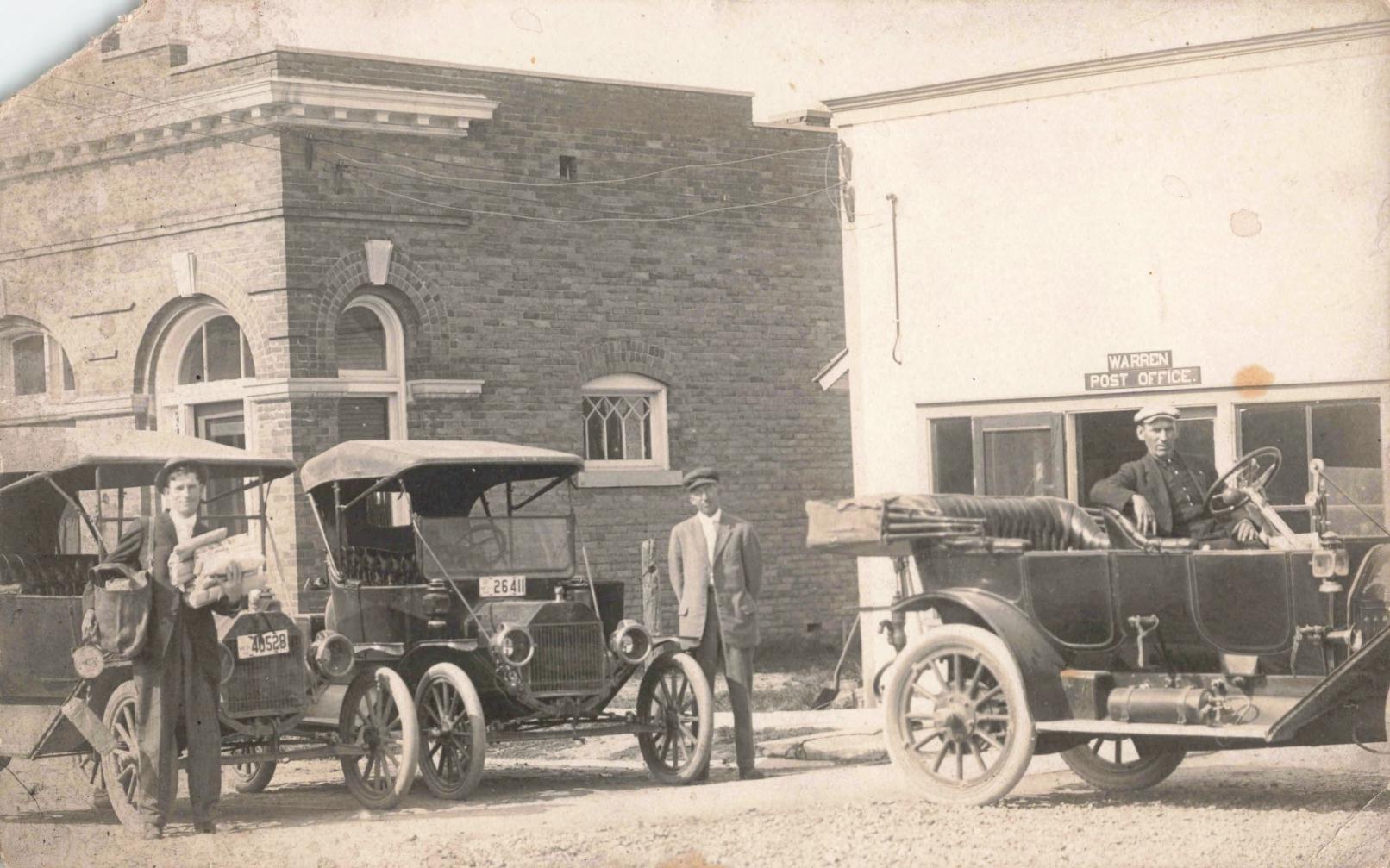
Cars began to alter public services, too. Rural mail delivery had become a permanent national service in 1902. According to the U.S. Postal Service, better roads helped rural carriers switch almost entirely from horse-drawn transportation to motor vehicles by 1929.
One Warren Township native was especially influential in the shift to better roads. Alexander J. Groesbeck, born in 1873, served as Michigan’s governor from 1921 through 1926. He championed highway construction and the state’s first gasoline tax, linking vehicle use to road costs.
A Railroad Depot Full of Rhubarb
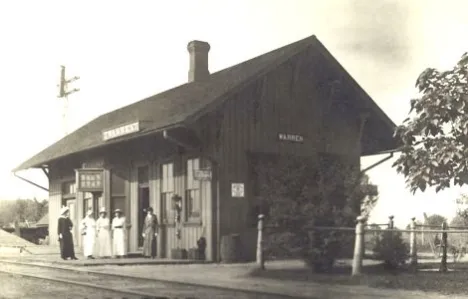
Industry did not immediately drive agriculture out of Warren. Clem and Cora Young began farming there in 1923 and built their first greenhouse the following year. Other growers specialized in winter rhubarb, a crop for which buyers paid a premium when outdoor gardens were frozen.
Local historian Linda Osborne Cynowa records that 843,000 pounds of rhubarb passed through Warren’s Michigan Central depot from January through May 1931. The shipments amounted to more than 400 tons. A 1948 field study by Wayne University geographer Floyd A. Stilgenbauer found the area around Warren and Utica still a leading producer of winter rhubarb.
How could Warren farmers grow rhubarb during the winter?
Growers brought dormant rhubarb roots into warm, dark sheds. The resulting tender stalks could be harvested when Michigan’s outdoor fields were frozen. Express rail service connected growers with distant winter markets.
Two Warrens Grew at Different Speeds
Warren Township’s population rose from 3,564 in 1920 to 14,269 in 1930. The incorporated village had only 515 residents in 1930. At the township’s southern end, an electric streetcar along Van Dyke helped bring new residents within commuting distance of Detroit. Center Line incorporated as a village in 1925 and became a separate city in 1936.
Another significant institution took shape on 13 Mile Road in 1925. Detroit funeral director Charles Diggs Sr. and pharmacist Aaron Toodle helped establish Detroit Memorial Park Cemetery in Warren Township, organizing Michigan’s first Black-owned cemetery in response to discriminatory burial practices. Among those interred there is inventor Elijah McCoy.
Despite the Great Depression, industrial development advanced north from Detroit. By 1940, Warren Township counted 22,126 people, even after Center Line separated. Large tracts of land and the area’s existing transportation routes made it attractive for manufacturing.
The Factory That Changed Warren
In August 1940, the U.S. Army contracted with Chrysler to build and operate a factory in Warren Township. Detroit architect Albert Kahn designed the Detroit Arsenal Tank Plant. On April 24, 1941, the first completed tank was presented to the Army, more than seven months before the attack on Pearl Harbor.
By the end of the war, the plant had produced 22,234 tanks, about one quarter of the American total. A Defense Department history reports that in 1944 almost one quarter of its workers were women, and about 10% were Black. The employment boom created new demand for housing, while roads and schools struggled to keep up.
In May 1956, General Motors inaugurated its Technical Center in Warren, designed by architect Eero Saarinen. Voters adopted the city charter that October, and the modern City of Warren began operating on Jan. 1, 1957. The 1960 census counted 89,246 residents within the new city’s boundaries.
The history of Warren Michigan is unusual because its older village survived the industrial transformation around it. St. Paul’s 1894 sanctuary remains among the buildings of the historic village near Mound and Chicago roads. The missing upper portion of its steeple still dates to the lightning strike of 1921, a small but visible reminder of Warren before the tank plant.
Warren, Michigan: Historical Timeline
Fifteen milestones trace the old village and the township that grew around it.
Open the timeline: 1830–1957
- Early 1830s — Farming families settle near Mound and Chicago roads. The crossroads becomes known as Beebe’s Corners.
- 1837–1839 — Hickory Township is organized, renamed Aba and then Warren.
- 1864 — German-speaking worshippers organize St. Paul Evangelical Church.
- 1872 — The Detroit & Bay City Railroad is built through the district. It becomes part of the Michigan Central system in 1881.
- 1875 — Warren Township District No. 4 builds Bunert School, a one-room schoolhouse.
- 1893 — The Village of Warren incorporates. Physician J. D. Flynn is elected village president.
- 1894 — St. Paul builds its new sanctuary, with the tall steeple pictured on the postcard below.

- 1909–1910s — A color postcard postmarked in 1909 records the business district. Early automobiles soon appear outside the village post office.


- 1921 — Lightning damages the St. Paul steeple. Its upper section is removed.
- 1925 — Black Detroit business leaders organize Detroit Memorial Park Cemetery in Warren Township. Center Line becomes an incorporated village.
- 1926–1931 — William E. Murthum School opens in 1926; a 1931 addition houses Warren’s high school.
- 1930–1931 — The census counts 515 people in the village and 14,269 in Warren Township. Local historian Linda Osborne Cynowa records shipments of 843,000 pounds of rhubarb through Warren’s depot in the first five months of 1931.
- 1936 — Center Line becomes an independent city.
- 1940–1941 — Chrysler builds the Detroit Arsenal Tank Plant in Warren Township. The first completed tank is presented to the Army on April 24, 1941.
- 1956–1957 — General Motors inaugurates its Technical Center in May 1956. Warren’s city charter is adopted in October, and the new city begins operating January 1, 1957.
Images: David V. Tinder Collection of Real Photo Postcards, William L. Clements Library, University of Michigan. Source records: Village of Warren, 1930 U.S. Census, Detroit Arsenal state historical marker.
Frequently Asked Questions About Warren, Michigan
When was Warren, Michigan, founded?
The settlement at Beebe’s Corners took shape in the early 1830s. The Village of Warren incorporated in 1893, and the modern City of Warren began operating on January 1, 1957.
What railroad served the historic village of Warren?
The Detroit & Bay City Railroad was built through the area in 1872. It was transferred to the Michigan Central Railroad in 1881. Warren’s depot served local passengers and agricultural shipments.
What did Warren produce during World War II?
The Detroit Arsenal Tank Plant, built by Chrysler in Warren Township beginning in 1940, produced 22,234 tanks during World War II, roughly one quarter of American wartime tank production.
What historic places remain in Warren?
The historic village near Mound and Chicago roads includes St. Paul United Church of Christ, whose sanctuary dates to 1894. The restored 1875 Bunert School and Detroit Memorial Park Cemetery are other important historic sites.
Did your family work on a Warren farm, attend Murthum School or shop in the old village? Please share your recollections, family names or information about the businesses shown in these postcards in the comments.
Works Cited for History of Warren Michigan: From Stagecoaches to Tank Plants
“Businesses of Warren Michigan Area through the Years.” Warren Michigan History, vol. 46.
City of Center Line. “City History.” City of Center Line, Michigan.
City of Warren. City of Warren Master Plan. 12 Jan. 2021.
City of Warren. “New Interpretive Markers Reflect History of the Warren Community Center.” Newsbeat, fall 2021.
City of Warren. “Warren City Hall Displays Historic Photos.”
City of Warren. Warren Village Historic District Plan. Mar. 2022.
Converse, Elliott V., III. Rearming for the Cold War, 1945–1960. Vol. 1 of History of Acquisition in the Department of Defense, Historical Office, Office of the Secretary of Defense, 2012, p. 181.
Cynowa, Linda Osborne. “Farming in Northern Macomb County.” Linda Osborne Cynowa.
Detroit Historical Society. “Main St., Looking South, Warren, Mich.” Digital Collection, postcard 2012.020.713, 1909.
Detroit Historical Society. “Print, Photographic.” Chrysler Tank Arsenal first tank delivery, Digital Collection, item 2012.022.245, 1941.
General Motors. “Cadillac CELESTIQ to Be Built at GM’s Global Technical Center.” 15 June 2022.
Macomb County. Official Directory, Macomb County, Michigan, 1961–1962. Compiled by Arthur J. Miller, county clerk.
Michigan Court of Appeals. “Cockerline v. City of Warren.” Michigan Appeals Reports, vol. 2, p. 8, 20 Dec. 1965.
Michigan Department of Transportation. “Alex J. Groesbeck.” Michigan Transportation Hall of Honor.
Michigan Historical Commission. “Detroit Arsenal Tank Plant.” Michigan historical marker S674, 2001.
Michigan Historical Commission. “Detroit Memorial Park Cemetery.” Michigan historical marker L392, 1976.
Michigan Historical Commission. “Village of Warren.” Michigan historical marker L833B, 1982.
Michigan Historical Commission. “Warren Township District No. 4 School.” Michigan historical marker 1654, 1992. Historical Marker Database.
MichiganRailroads.com. “Detroit & Bay City Railroad.”
National Governors Association. “Gov. Alexander Joseph Groesbeck.”
National Park Service. “General Motors Technical Center.” National Register of Historic Places, 27 Mar. 2000.
Stilgenbauer, Floyd A. “Settlement Expansion Across Detroit’s Northern Metropolitan Rim into Southwest Macomb County.” Papers of the Michigan Academy of Science, Arts and Letters, vol. 35 (1949), University of Michigan Press, 1951.
United States Army Detroit Arsenal. “History.”
United States Census Bureau. Fifteenth Census of the United States: 1930, Population, Volume I. Michigan, tables 4–5.
United States Census Bureau. 1950 Census of Population, Volume I: Number of Inhabitants. Michigan, table 6. IPUMS USA.
United States Census Bureau. 1960 Census of Population, Volume I: Characteristics of the Population, Number of Inhabitants. Michigan, table 7.
United States Postal Service. “Rural Free Delivery.”
Warren Historical Commission. “Young’s Garden Mart.” Historical marker, 2005. Historical Marker Database.
Warren Village Historic District Commission. “St. Paul United Church of Christ.” Historical marker, 1994. Historical Marker Database.
William L. Clements Library. “David V. Tinder Collection of Michigan Photography.” University of Michigan. The ten Warren postcards used here are from the David V. Tinder Collection of Real Photo Postcards, gift of David and Cynthia Walters, Meaghan and Joel Cole, and Jennifer and Zachary SantAmour.