<!--
SEO TITLE:
Wacousta Michigan History: Life Along the Looking Glass River

META DESCRIPTION:
See Wacousta Michigan history through rare photos of its mill, dam, post office, churches, school, stores and the Looking Glass River.

URL SLUG:
wacousta-michigan-history-looking-glass-river

FOCUS KEYWORD:
Wacousta Michigan history

EXCERPT:
Historic photographs show how the Looking Glass River, local mills, churches, schools and small businesses shaped life in Wacousta, Michigan.
-->

<style>
.tw-watch-page {
  --tw-navy: #17324d;
  --tw-blue: #285f7c;
  --tw-red: #963a31;
  --tw-gold: #d89b32;
  --tw-cream: #f7f1e6;
  --tw-light: #f4f6f7;
  --tw-border: #d9dee3;
  --tw-ink: #222;
  --tw-muted: #60656b;
  max-width: 920px;
  margin: 0 auto;
  color: var(--tw-ink);
  font-family: Arial, Helvetica, sans-serif;
  font-size: 17px;
  line-height: 1.7;
}

.tw-watch-page *,
.tw-watch-page *::before,
.tw-watch-page *::after {
  box-sizing: border-box;
}

.tw-watch-page h1,
.tw-watch-page h2,
.tw-watch-page h3 {
  color: var(--tw-navy);
  line-height: 1.25;
}

.tw-watch-page h1 {
  margin: 0 0 14px;
  font-size: clamp(2rem, 5vw, 3.2rem);
}

.tw-watch-page h2 {
  margin-top: 42px;
  padding-bottom: 9px;
  border-bottom: 3px solid var(--tw-gold);
  font-size: clamp(1.5rem, 3vw, 2rem);
}

.tw-watch-page h3 {
  margin-top: 0;
  margin-bottom: 9px;
  font-size: 1.24rem;
}

.tw-watch-page p {
  margin: 0 0 20px;
}

.tw-kicker {
  margin: 0 0 7px;
  color: var(--tw-red);
  font-size: 0.84rem;
  font-weight: 700;
  letter-spacing: 0.1em;
  text-transform: uppercase;
}

.tw-deck {
  margin-bottom: 24px;
  color: var(--tw-muted);
  font-size: 1.2rem;
  line-height: 1.55;
}

.tw-video-wrap {
  position: relative;
  width: 100%;
  margin: 28px 0;
  padding-top: 56.25%;
  overflow: hidden;
  border: 5px solid var(--tw-navy);
  border-radius: 14px;
  background: #000;
  box-shadow: 0 12px 28px rgba(0, 0, 0, 0.18);
}

.tw-video-wrap iframe {
  position: absolute;
  inset: 0;
  width: 100%;
  height: 100%;
  border: 0;
}

.tw-video-caption {
  margin-top: -15px;
  color: var(--tw-muted);
  font-size: 0.9rem;
  text-align: center;
}

.tw-fact-grid {
  display: grid;
  grid-template-columns: repeat(4, minmax(0, 1fr));
  gap: 1px;
  margin: 30px 0;
  overflow: hidden;
  border: 1px solid #d7dce0;
  border-radius: 12px;
  background: #d7dce0;
}

.tw-fact {
  min-height: 100%;
  padding: 18px 13px;
  background: #fff;
  text-align: center;
}

.tw-fact strong {
  display: block;
  margin-bottom: 4px;
  color: var(--tw-navy);
  font-size: 1.03rem;
}

.tw-fact span {
  color: var(--tw-muted);
  font-size: 0.86rem;
}

.tw-intro-box {
  margin: 32px 0;
  padding: 25px;
  border-left: 6px solid var(--tw-gold);
  border-radius: 0 12px 12px 0;
  background: var(--tw-cream);
}

.tw-intro-box h2 {
  margin-top: 0;
  padding: 0;
  border: 0;
}

.tw-scene-grid {
  display: grid;
  grid-template-columns: repeat(2, minmax(0, 1fr));
  gap: 18px;
  margin: 25px 0;
}

.tw-scene-card {
  padding: 22px;
  border: 1px solid var(--tw-border);
  border-radius: 12px;
  background: #fff;
  box-shadow: 0 5px 16px rgba(20, 43, 63, 0.07);
}

.tw-scene-card p:last-child {
  margin-bottom: 0;
}

.tw-scene-label {
  display: inline-block;
  margin-bottom: 11px;
  padding: 3px 10px;
  border-radius: 20px;
  background: var(--tw-navy);
  color: #fff;
  font-size: 0.78rem;
  font-weight: 700;
}

.tw-quote {
  margin: 34px 0;
  padding: 27px 30px;
  border-radius: 12px;
  background: var(--tw-navy);
  color: #fff;
  font-size: 1.22rem;
  font-style: italic;
}

.tw-history-list {
  margin: 24px 0;
  padding: 0;
  list-style: none;
}

.tw-history-list li {
  position: relative;
  margin-bottom: 12px;
  padding: 14px 18px 14px 49px;
  border: 1px solid #dce1e5;
  border-radius: 9px;
  background: var(--tw-light);
}

.tw-history-list li::before {
  position: absolute;
  top: 15px;
  left: 18px;
  color: var(--tw-red);
  font-weight: 700;
  content: "?";
}

.tw-transcript {
  margin: 25px 0;
  border: 1px solid #d6dce1;
  border-radius: 12px;
  background: #fff;
}

.tw-transcript summary {
  padding: 18px 22px;
  color: var(--tw-navy);
  font-size: 1.1rem;
  font-weight: 700;
  cursor: pointer;
}

.tw-transcript summary:hover,
.tw-transcript summary:focus {
  background: var(--tw-light);
}

.tw-transcript-content {
  padding: 0 22px 22px;
}

.tw-transcript-content p {
  margin-bottom: 17px;
}

.tw-cta {
  margin: 40px 0 22px;
  padding: 29px;
  border-radius: 14px;
  background: linear-gradient(135deg, var(--tw-navy), var(--tw-blue));
  color: #fff;
  text-align: center;
}

.tw-cta h2 {
  margin-top: 0;
  padding: 0;
  border: 0;
  color: #fff;
}

.tw-cta p {
  max-width: 680px;
  margin-right: auto;
  margin-left: auto;
}

.tw-cta a {
  display: inline-block;
  margin-top: 7px;
  padding: 12px 22px;
  border-radius: 7px;
  background: var(--tw-gold);
  color: #172533;
  font-weight: 700;
  text-decoration: none;
}

.tw-cta a:hover,
.tw-cta a:focus {
  background: #efb64e;
  text-decoration: underline;
}

.tw-editor-note {
  color: var(--tw-muted);
  font-size: 0.9rem;
}

@media (max-width: 720px) {
  .tw-fact-grid {
    grid-template-columns: repeat(2, minmax(0, 1fr));
  }

  .tw-scene-grid {
    grid-template-columns: 1fr;
  }

  .tw-intro-box,
  .tw-scene-card,
  .tw-cta {
    padding: 20px;
  }
}

@media (max-width: 430px) {
  .tw-fact-grid {
    grid-template-columns: 1fr;
  }

  .tw-watch-page {
    font-size: 16px;
  }
}
</style>

<article class="tw-watch-page">

  <header>
    <p class="tw-kicker">Michigan Moments Video</p>

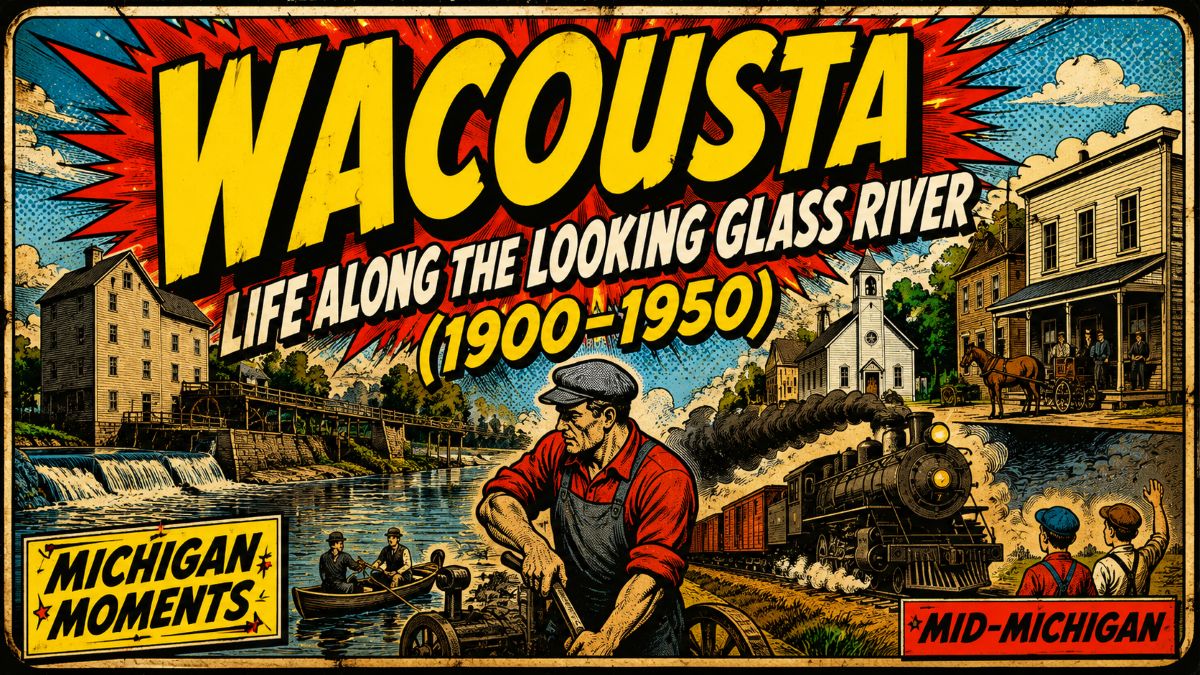
    <h1>Wacousta Michigan History: Life Along the Looking Glass River</h1>

    <p class="tw-deck">
      Rare photographs show how the Looking Glass River, a water-powered mill,
      churches, schools and locally owned businesses shaped this Clinton County
      community during the early 20th century.
    </p>
  </header>

  <div class="tw-video-wrap">
    <iframe src="https://www.youtube-nocookie.com/embed/9i_BoebfwzI?rel=0" title="Wacousta Michigan History: Life Along the Looking Glass River" loading="lazy" allow="accelerometer; autoplay; clipboard-write; encrypted-media; gyroscope; picture-in-picture; web-share" referrerpolicy="strict-origin-when-cross-origin" allowfullscreen="">
    </iframe>
  </div>

  <p class="tw-video-caption">
    Watch “Wacousta Michigan History: Life Along the Looking Glass River,”
    presented by Michigan Moments.
  </p>

  <div class="tw-fact-grid" aria-label="Video details">

    <div class="tw-fact">
      <strong>Wacousta</strong>
      <span>Clinton County, Michigan</span>
    </div>

    <div class="tw-fact">
      <strong>1837</strong>
      <span>Early settlement period</span>
    </div>

    <div class="tw-fact">
      <strong>Looking Glass River</strong>
      <span>Local source of water power</span>
    </div>

    <div class="tw-fact">
      <strong>Michigan Moments</strong>
      <span>History video series</span>
    </div>

  </div>

  <section class="tw-intro-box">

    <h2>What This Wacousta History Video Shows</h2>

    <p>
      Wacousta developed along the Looking Glass River in what is now
      Watertown Charter Township. The river provided water power for mills and
      influenced farming, commerce and daily life.
    </p>

    <p>
      The photographs featured in this video show the community’s dam, mill,
      post office, churches, public school, Manzer store, Masonic Hall and new
      concrete sidewalks.
    </p>

    <p>
      These scenes record a rural Michigan community during a period when
      electricity, telephones, improved roads and manufactured goods were
      changing small-town life.
    </p>

  </section>

  <h2>Historic Scenes From Wacousta</h2>

  <div class="tw-scene-grid">

    <section class="tw-scene-card">
      <span class="tw-scene-label">Looking Glass River</span>

      <h3>The River Shaped the Settlement</h3>

      <p>
        The Looking Glass River was more than a scenic feature. It supplied the
        moving water needed to operate local milling equipment and helped make
        the area useful to early settlers.
      </p>

      <p>
        Residents also harvested winter ice from nearby waterways and stored it
        for use during warmer months.
      </p>
    </section>

    <section class="tw-scene-card">
      <span class="tw-scene-label">Mill and Dam</span>

      <h3>Water Power Supported Local Farming</h3>

      <p>
        A winter photograph shows the town dam holding against ice and moving
        water. The dam directed water toward a large mill that processed grain
        brought from surrounding farms.
      </p>

      <p>
        Farmers arrived by wagon, and the mill converted locally grown grain
        into products needed by households and businesses.
      </p>
    </section>

    <section class="tw-scene-card">
      <span class="tw-scene-label">Postal Service</span>

      <h3>The Wacousta Post Office</h3>

      <p>
        A photograph marked No. 367 shows a modest frame post office with tall
        windows and a false-front facade.
      </p>

      <p>
        The post office delivered letters, newspapers, business notices and
        government information. It also served as an informal meeting place
        where residents exchanged local news.
      </p>
    </section>

    <section class="tw-scene-card">
      <span class="tw-scene-label">Community Life</span>

      <h3>Congregational and Methodist Churches</h3>

      <p>
        Wacousta’s Congregational and Methodist churches served purposes beyond
        weekly worship.
      </p>

      <p>
        Their buildings hosted weddings, socials, school programs, meetings and
        other events in a community with few large public gathering spaces.
      </p>
    </section>

    <section class="tw-scene-card">
      <span class="tw-scene-label">Education</span>

      <h3>The Two-Story Public School</h3>

      <p>
        Historic photographs show a two-story wooden schoolhouse that served
        children from Wacousta and the surrounding farming district.
      </p>

      <p>
        Students often attended classes with relatives, neighbors and people
        they would continue to know throughout adulthood.
      </p>
    </section>

    <section class="tw-scene-card">
      <span class="tw-scene-label">Local Commerce</span>

      <h3>The Manzer Store</h3>

      <p>
        By the late 19th century, the Manzer store supplied dry goods,
        household necessities and other merchandise that residents could not
        produce at home.
      </p>

      <p>
        General stores reduced the need for long trips to larger towns and
        often became informal centers of community activity.
      </p>
    </section>

    <section class="tw-scene-card">
      <span class="tw-scene-label">Civic Organizations</span>

      <h3>The Wacousta Masonic Hall</h3>

      <p>
        The Masonic Hall reflected the role fraternal organizations played in
        local business and government.
      </p>

      <p>
        Members included merchants, farmers, tradesmen and public officials who
        helped organize community projects and charitable efforts.
      </p>
    </section>

    <section class="tw-scene-card">
      <span class="tw-scene-label">Modern Improvements</span>

      <h3>New Concrete Sidewalks</h3>

      <p>
        A photograph from about 1910 records new concrete walks running beside
        homes and public buildings.
      </p>

      <p>
        The sidewalks improved travel during wet weather and represented a
        visible civic improvement in a village still served largely by dirt
        roads.
      </p>
    </section>

  </div>

  <blockquote class="tw-quote">
    “Wacousta moved with the river, changed with the times and remained tied to
    the people who called it home.”
  </blockquote>

  <h2>How the Looking Glass River Powered Wacousta</h2>

  <p>
    Water power was central to early Wacousta Michigan history. Before electric
    motors became common, mills relied on flowing water to operate machinery.
    A dam controlled the river and created the steady flow needed to turn mill
    equipment.
  </p>

  <p>
    The mill served farmers throughout the surrounding area. Grain arrived by
    wagon and was processed closer to home, reducing the time and cost involved
    in reaching larger markets.
  </p>

  <p>
    The river also marked the working year. Spring floods, summer low water,
    winter ice and seasonal thaws affected transportation and mill operations.
    Residents had to adjust their work to changing river conditions.
  </p>

  <h2>Stores, Churches and Civic Life</h2>

  <p>
    Wacousta’s public life was spread among several buildings. The post office
    brought outside information into town. The school educated children from
    nearby farms. Churches provided space for worship and community programs.
  </p>

  <p>
    The Manzer store supplied manufactured goods, clothing, tools and household
    items. Such stores often extended credit and ordered special merchandise
    for regular customers.
  </p>

  <p>
    The Masonic Hall offered meeting space for a fraternal organization whose
    members often held positions in local commerce and government. Together,
    these institutions helped a small settlement function without depending
    entirely on Lansing or other larger communities.
  </p>

  <h2>What the Old Photographs Record</h2>

  <ul class="tw-history-list">
    <li>
      The Looking Glass River supplied water power for Wacousta’s mills.
    </li>

    <li>
      The dam controlled water used by local industrial equipment.
    </li>

    <li>
      Farmers brought grain to town by wagon for milling.
    </li>

    <li>
      The post office served as both a communications center and meeting place.
    </li>

    <li>
      Congregational and Methodist churches hosted civic and social events.
    </li>

    <li>
      The public school served children from the village and nearby farms.
    </li>

    <li>
      The Manzer store supplied dry goods and household merchandise.
    </li>

    <li>
      New concrete sidewalks showed Wacousta’s push for modern public
      improvements.
    </li>
  </ul>

  <h2>Edited Video Transcript</h2>

  <details class="tw-transcript">

    <summary>Open the complete Wacousta video transcript</summary>

    <div class="tw-transcript-content">

      <p>
        This is Michigan Moments, sharing the pioneering moments of the Great
        Lakes State.
      </p>

      <p>
        Today, we head upstream to the banks of the Looking Glass River in
        Wacousta, Michigan.
      </p>

      <p>
        It is a quiet community today, but in the early 1900s, this was the kind
        of place where residents knew the local blacksmith, the grocer
        remembered regular customers, and children crossed muddy roads to reach
        the schoolhouse.
      </p>

      <p>
        Wacousta began taking shape in 1837. Its eventual name was tied to a
        local legend about a Native woman who reportedly rode to warn Fort
        Detroit about an attack. Historical accounts describe the woman as a
        fictional or legendary figure rather than a documented resident.
      </p>

      <p>
        The name remained, as did the river.
      </p>

      <p>
        The Looking Glass River was not simply scenery. It supplied power for
        the gristmill, provided winter ice for summer storage and marked each
        season through its freezes and thaws.
      </p>

      <p>
        One photograph shows the town dam during a severe Michigan winter. Its
        timber structure stands against the river’s current and accumulated
        ice.
      </p>

      <p>
        That water powered a four-story mill. Grain arrived from nearby farms
        by wagon as the mill processed products needed throughout the
        surrounding area.
      </p>

      <p>
        Wacousta’s post office stood near a dirt road lined with young trees
        and telegraph poles.
      </p>

      <p>
        In a photograph marked No. 367, the building appears as a modest wooden
        structure with tall windows and a false front. It was a place where news
        arrived in letters, newspapers and conversation.
      </p>

      <p>
        Faith played a major role in the community. The Congregational and
        Methodist churches stood plainly against the horizon.
      </p>

      <p>
        They served purposes beyond Sunday worship, hosting socials, weddings,
        meetings and school programs.
      </p>

      <p>
        The public schoolhouse appears in another photograph. It was a
        two-story wooden building attended by children from the village and
        surrounding farms.
      </p>

      <p>
        Local commerce occupied several corners. By the late 19th century, the
        Manzer store sold dry goods and household necessities.
      </p>

      <p>
        The Masonic Hall stood nearby as a symbol of the fraternal
        organizations that played a major role in local civic affairs.
      </p>

      <p>
        Concrete sidewalks were poured in straight lines between dusty roads
        and clapboard houses. In one photograph from about 1910, the new walk
        was identified with pride as a sign that the village was keeping pace
        with modern improvements.
      </p>

      <p>
        Over time, Wacousta added blacksmith shops, medical offices and other
        small businesses. It also remained a center for local farming and
        commerce.
      </p>

      <p>
        Much of early Wacousta is now gone or changed. In these photographs,
        however, the old town remains still: a Michigan community shaped by the
        river and remembered by its people.
      </p>

      <p>
        This has been Michigan Moments, offering bite-sized stories from
        Michigan history.
      </p>

    </div>

  </details>

  <section class="tw-cta">

    <h2>Watch More Michigan Moments</h2>

    <p>
      See more short videos about Michigan communities, mills, railroads,
      industries and Great Lakes history.
    </p>

    <a href="https://thumbwind.com/michigan-moments-episodes-and-snapshots/">
      View All Michigan Moments
    </a>

  </section>

  <p class="tw-editor-note">
    Video presented as part of the Michigan Moments history series from
    Thumbwind Publications LLC.
  </p>

</article>

<!--
IMPORTANT:
Replace the example uploadDate below with the actual YouTube publication
date and time shown in YouTube Studio.

Use a complete ISO 8601 datetime with timezone:
YYYY-MM-DDTHH:MM:SS-04:00
-->

<script type="application/ld+json">
{
  "@context": "https://schema.org",
  "@type": "VideoObject",
  "name": "Wacousta Michigan History: Life Along the Looking Glass River",
  "description": "Historic photographs show how the Looking Glass River, a water-powered mill, churches, schools and locally owned businesses shaped Wacousta, Michigan.",
  "thumbnailUrl": [
    "https://thumbwind.com/wp-content/uploads/2026/07/Ironwood-MM.jpg"
    ],
  "uploadDate": "2026-08-25T12:00:00-04:00",
  "embedUrl": "https://www.youtube.com/embed/9i_BoebfwzI",
  "publisher": {
    "@type": "Organization",
    "name": "Thumbwind Publications LLC",
    "url": "https://thumbwind.com/"
  },
  "about": [
    {
      "@type": "Place",
      "name": "Wacousta, Michigan",
      "address": {
        "@type": "PostalAddress",
        "addressLocality": "Wacousta",
        "addressRegion": "MI",
        "addressCountry": "US"
      }
    },
    {
      "@type": "Place",
      "name": "Looking Glass River"
    },
    {
      "@type": "Thing",
      "name": "Michigan history"
    },
    {
      "@type": "Thing",
      "name": "Water-powered mills"
    }
  ],
  "keywords": [
    "Wacousta Michigan history",
    "Looking Glass River history",
    "Wacousta gristmill",
    "Clinton County history",
    "historic Wacousta Michigan",
    "Michigan Moments"
  ]
}
</script>
Views:355
Michael Hardy
Michael is the owner of Thumbwind Publications LLC. It started in 2009 covering Michigan and the Upper Thumb. Today, his Michigan Moments series has established a loyal base of 110,000 followers.

 by
by