 by
by 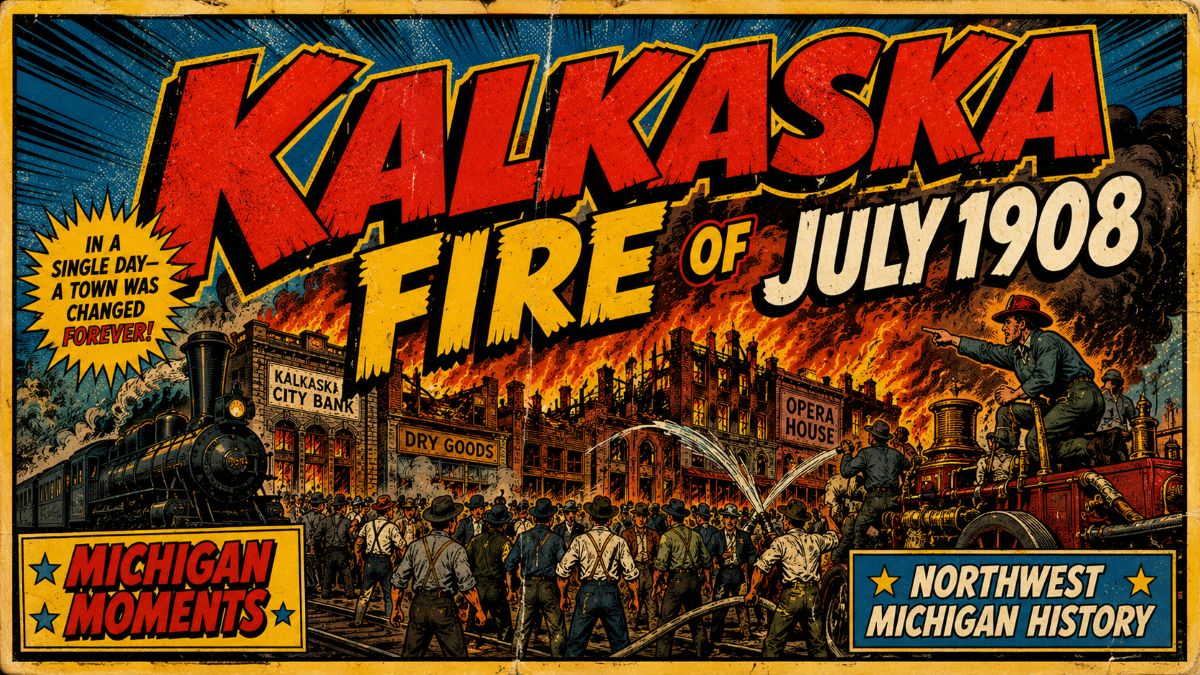
Michigan Moments Video
Kalkaska Fire of 1908: How Downtown Rose From the Ashes
A wind-driven fire tore through downtown Kalkaska on July 5, 1908. Volunteers fought the flames while merchants watched stores, offices and public gathering places disappear.
Watch “Kalkaska Fire of July 1908,” presented by Michigan Moments.
What Happened During the Kalkaska Fire of 1908?
Downtown Kalkaska was quiet on the afternoon of July 5, 1908, one day after the Fourth of July. That calm ended shortly after 2:30 p.m., when smoke began pouring from the basement of the Palmer and Cole Brothers building on Cedar Street.
The fire reportedly started in a dry-goods storeroom. Investigators suspected spontaneous combustion. A strong west wind then carried the flames from one wooden building to another.
Within an hour, much of the business district was burning. Telephone and telegraph service failed, electric power was interrupted, and outside assistance could not be summoned quickly. Kalkaska’s volunteer fire crew and local residents were left to fight the fire themselves.
Kalkaska’s Downtown Fire, Minute by Minute
Smoke Appears on Cedar Street
Shortly after 2:30 p.m., smoke was seen coming from the basement of the Palmer and Cole Brothers building. The apparent source was a dry-goods storage area.
Fire Spreads Between Wooden Buildings
Flames quickly escaped the building. A stiff west wind carried fire, sparks and embers toward neighboring wooden storefronts.
Volunteers Form Bucket Brigades
Kalkaska’s roughly 30 volunteer firefighters were joined by residents. Bucket brigades formed, and water wagons moved toward the burning district.
Communications and Power Fail
Falling lines and fire damage interrupted telephone and telegraph service. Electric power also failed, leaving the village unable to request help through its normal communications systems.
Downtown Buildings Are Lost
The Palmer Block, Kalkaska City Bank, jewelry and professional offices, drugstores, hardware businesses and other commercial buildings were consumed.
The Opera House Burns
The opera house, which contained a hardware store and the village band hall, was among the buildings destroyed as the fire moved through the business district.
Losses Reach an Estimated $250,000
At least 14 major businesses and a blacksmith shop were reportedly destroyed. Estimated losses reached as high as $250,000, an enormous sum for a small Michigan village in 1908.
Residents Fight Rooftop Fires
Residents climbed onto roofs to extinguish burning embers. Several people were hurt, including a man who fell from a second-story ladder while carrying buckets of water.
Businesses Resume Operations
Salvaged ledgers were opened in temporary offices. The bank resumed business in borrowed quarters, and local newspapers returned to print within days.
Brick Replaces Vulnerable Wood
Merchants announced rebuilding plans almost immediately. New brick buildings began rising before winter, creating a business district designed to better withstand future fires.
“We are bruised, but not broken.”
Buildings and Businesses Reported Lost
The fire damaged or destroyed a large section of Kalkaska’s commercial center. Buildings and businesses named in accounts presented in the video include:
- The three-story Palmer Block
- Kalkaska City Bank
- Walker’s Jewelry
- John Axe’s office
- The Glazier-Coulson building
- Stover’s drugstore
- The opera house
- Mike Leonard’s hardware store
- The village band hall
- A local blacksmith shop
Some merchants carried merchandise, records and equipment from their buildings before the flames arrived. Others lost nearly everything.
Why the Fire Spread So Quickly
Several conditions made the Kalkaska Fire of 1908 difficult to stop. Downtown buildings were close together, and many were constructed largely from wood. Once one structure was fully involved, heat and airborne embers threatened the next building.
The strong west wind accelerated the spread. Burning material landed on roofs ahead of the main fire, forcing residents to defend several locations at the same time.
Kalkaska also had limited firefighting equipment. Volunteers used water wagons and hand-carried buckets, but they faced heat powerful enough to drive people away from threatened structures.
The loss of telephone and telegraph service made the situation worse. Outside departments could not be contacted through the usual channels, leaving local volunteers without quick reinforcements.
Kalkaska Rebuilds With Brick
Recovery began before the ruins had fully cooled. Business owners salvaged records and reopened in temporary locations. The bank began operating from borrowed space, while local newspapers returned to production within the week.
Community meetings were held in churches. Merchants announced plans for new buildings, but they did not intend to repeat the same construction pattern. Brick would replace much of the wood that had made the old commercial district vulnerable.
By the end of July, workers were pouring foundations and laying brick. Buildings were rising again by winter. Several downtown facades dated 1908 remain physical reminders of the fire and the rebuilding program that followed.
Key Facts About the Kalkaska Fire of 1908
- The fire began shortly after 2:30 p.m. on July 5, 1908.
- It started in the Palmer and Cole Brothers building on Cedar Street.
- Spontaneous combustion was cited as a possible cause.
- A strong west wind carried flames through the business district.
- Kalkaska had about 30 volunteer firefighters.
- Telephone, telegraph and electric service failed during the emergency.
- At least 14 major businesses and a blacksmith shop were destroyed.
- Property losses were estimated as high as $250,000.
- Reconstruction began within weeks.
- Many replacement buildings were constructed with brick.
Edited Video Transcript
Open the complete Kalkaska video transcript
0:00 — This is Michigan Moments, sharing the pioneering moments of the Great Lakes State.
0:07 — On the quiet afternoon of July 5, 1908, the people of Kalkaska, Michigan, were still settling down after a calm Fourth of July weekend.
0:17 — Just after 2:30 p.m., thick smoke began pouring from the basement of the Palmer and Cole Brothers building on Cedar Street.
0:24 — The fire started in a dry-goods storeroom, possibly because of spontaneous combustion. Within minutes, the flames were out of control.
0:33 — Driven by a stiff west wind, the blaze jumped from one wooden storefront to another. Within an hour, the heart of Kalkaska’s downtown was engulfed.
0:41 — The local fire department, consisting of about 30 volunteers, did what it could. Bucket brigades formed, and water wagons rolled toward the fire.
0:52 — The wind and heat proved too much. Embers rained across rooftops. Telegraph and telephone lines were knocked out, and electric power failed.
1:01 — Help could not be called through the normal communications network. Kalkaska was largely on its own.
1:08 — By late afternoon, more than a dozen buildings were burning or already gone.
1:16 — The flames consumed the three-story Palmer Block, then spread to Kalkaska City Bank, Walker’s Jewelry and John Axe’s office.
1:24 — The Glazier-Coulson building and Stover’s drugstore followed. The opera house, which housed Mike Leonard’s hardware store and the village band hall, was also lost.
1:32 — In all, at least 14 major businesses and a blacksmith shop were destroyed.
1:41 — Losses were estimated as high as $250,000, a staggering amount at the time.
1:49 — Some business owners saved inventory, but many lost everything. Several residents were injured while fighting fires on rooftops.
1:57 — One man fell from a second-story ladder while attempting to fight the flames with buckets of water.
2:04 — Within a day, salvaged ledgers were opened in temporary offices. The bank resumed operations from a borrowed storefront.
2:11 — Local newspapers printed again within the week. Community meetings filled the churches. One editor wrote, “We are bruised, but not broken.”
2:20 — Rebuilding began almost immediately.
2:27 — Business owners announced plans for new brick buildings. By the end of July, foundations were poured and bricklayers were working.
2:35 — By winter, downtown Kalkaska was rising again with buildings designed to be more fire-resistant.
2:44 — Today, downtown facades marked 1908 remain evidence of the fire and the rebuilding effort that followed.
2:51 — This has been Michigan Moments, offering bite-sized stories from Michigan history.
Watch More Michigan Moments
See more short videos covering Michigan communities, major fires, railroads, historic businesses and Great Lakes history.
View All Michigan MomentsVideo presented as part of the Michigan Moments history series from Thumbwind Publications LLC.
Images on this page may contain affiliate links in which we may receive a commission. See our affiliate disclosure for details.
Related Posts