 by
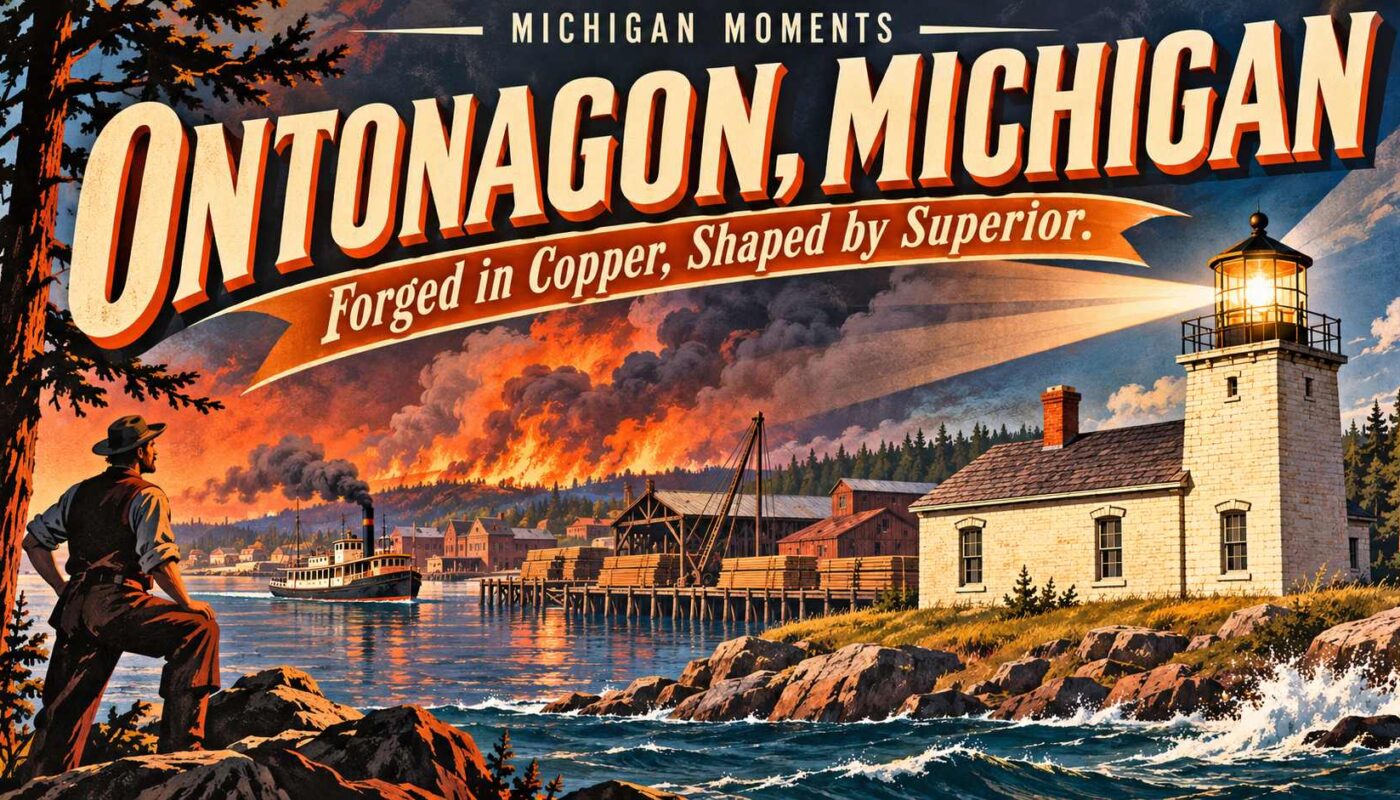
On the morning of Aug. 25, 1896, a vessel entered the harbor at Ontonagon, Michigan, to load lumber. Before the day was over, the vessel, the mills supplying it, and much of the village had burned. Yet at dusk, a light was still shining at the mouth of the Ontonagon River.
The keeper of that light was James Corgan, whose home stood on the west bank near the lumberyards. His experience offers a useful starting point for the history of Ontonagon, Michigan, a community whose fortunes changed as the industries using its harbor came and went.
Table of Contents
Watch: Ontonagon, Michigan Reborn: Rare Photos from 1900–1950
The Copper Boulder and the Settlement at the River Mouth

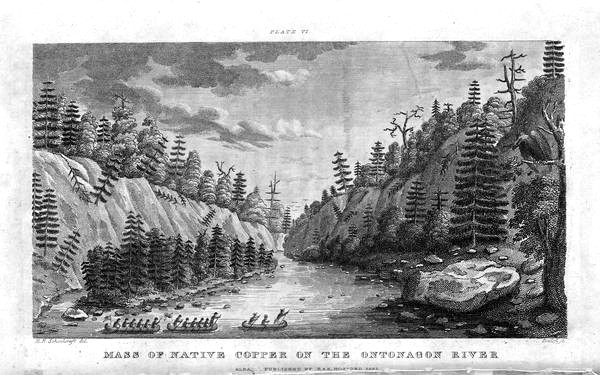
Long before American mining companies developed the western Upper Peninsula’s deposits, the Anishinaabe knew the copper there. One especially large mass of native metal became well known to European visitors. Trader Alexander Henry traveled upriver to the boulder in 1766 and took a portion of it away. It took another 77 years for someone to remove the remainder.
Detroit merchant Julius Eldred undertook the job in 1843. His crew moved the heavy mass across rough ground with a small railway that could be laid and relaid as the load advanced. The boulder weighed 3,708 pounds. After its removal, the federal government took possession, and the specimen was transferred to the Smithsonian Institution in 1860. The Smithsonian’s repatriation case report also records a 1991 request from the Keweenaw Bay Indian Community for its return.
James Kirk Paul arrived in the area in 1842 and, by 1843, had established a cabin as mineral prospectors made their way into the district. The harbor gave the growing village an advantage: supplies could enter by water, and newly mined copper could be shipped out the same way. Among the inland operations was the prosperous Minesota Mine, whose name really was spelled with one N.
A wooden lighthouse entered service in 1853 to guide ships into the river. The present brick lighthouse replaced it in 1866, as the federal government began investing in the harbor’s navigation facilities. Ontonagon was both a county seat and a supply point, dependent on activity far inland and on the lake.
How White Pine Changed the History of Ontonagon Michigan
By the 1870s, mines farther north in the Copper Country were overtaking the Ontonagon district. The village’s next major industry came from the forests. Pine logs could be floated down the river, collected near the mouth and cut into boards, and shipped. The first sawmill opened in 1881, with another following in 1882.
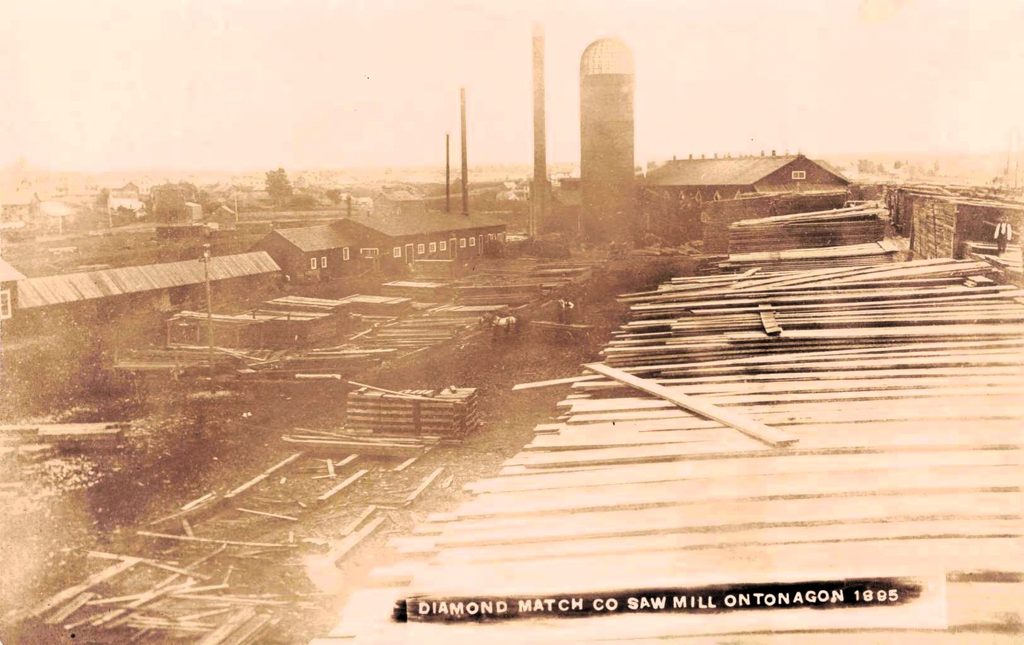
The Diamond Match Company entered the district during the 1880s and acquired extensive timber holdings and industrial facilities. Its lumber helped supply a remarkably commonplace product: the wooden match. The firm’s store on River Street offered much more than provisions for lumbermen. According to the National Park Service, the building measured about 110 feet on each side and contained skylights and an elevator.
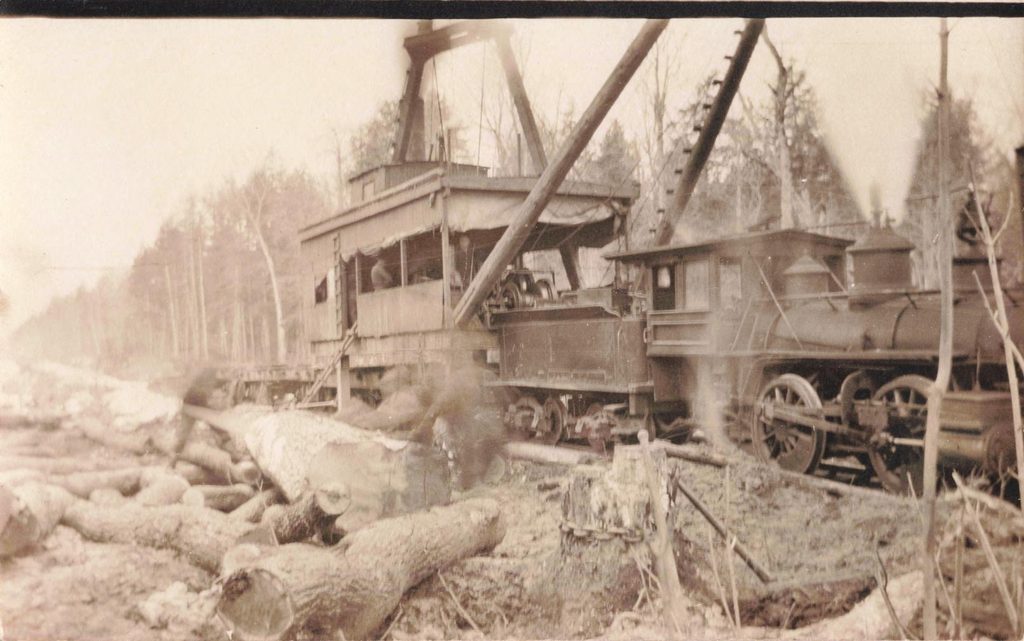
Rail connections supplemented the water route. By 1882 the Ontonagon and Brule River Railroad reached Rockland; the Milwaukee and Northern connection in 1889 linked the region with Chicago. At the height of the log-driving years, a jam in 1895 reportedly spread across the river so thoroughly that people could walk over it without wetting their feet.
Aug. 25, 1896: The Fire That Swept Through Town
Fires had been burning west of the river for weeks during the summer of 1896. Corgan noted smoke in his lighthouse journal on several days in August. On the 25th, the wind strengthened. Diamond Match employees tried to fight the encroaching flames, but the fire reached the mills and lumber piles, then spread into the village.
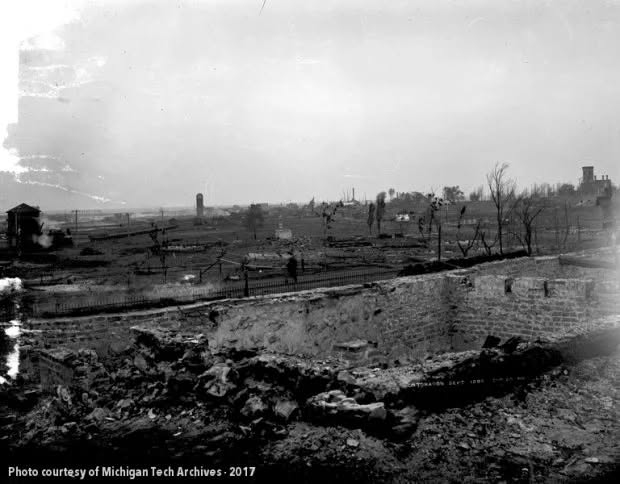
The destruction included the four-story Bigelow House hotel, churches, schoolhouses, and the county courthouse. Families headed toward Rockland and Greenland. Corgan’s wife Josephine, his son Harry, and a household member helped him carry water to keep the lighthouse and its outbuildings from catching fire. At nightfall, the light remained in service.
Nearly 2,000 residents were left homeless. The day after the fire, a tug arrived with relief supplies from Baraga County, and nearby communities took in evacuees. Five Ontonagon households that still had their residences accommodated a combined 110 people. The Michigan Tech Archives account, drawing on the local newspaper and lighthouse journal, also records the death of an elderly resident, Mrs. Pirk.
For the Diamond Match Company, the fire marked the end of large-scale operations in the village. The surrounding pine forests had already been heavily cut, and the company never rebuilt its mills. Households returning to Ontonagon faced the prospect of starting again in a town that had lost its largest employer.
Historic Ontonagon Michigan Takes Shape Again
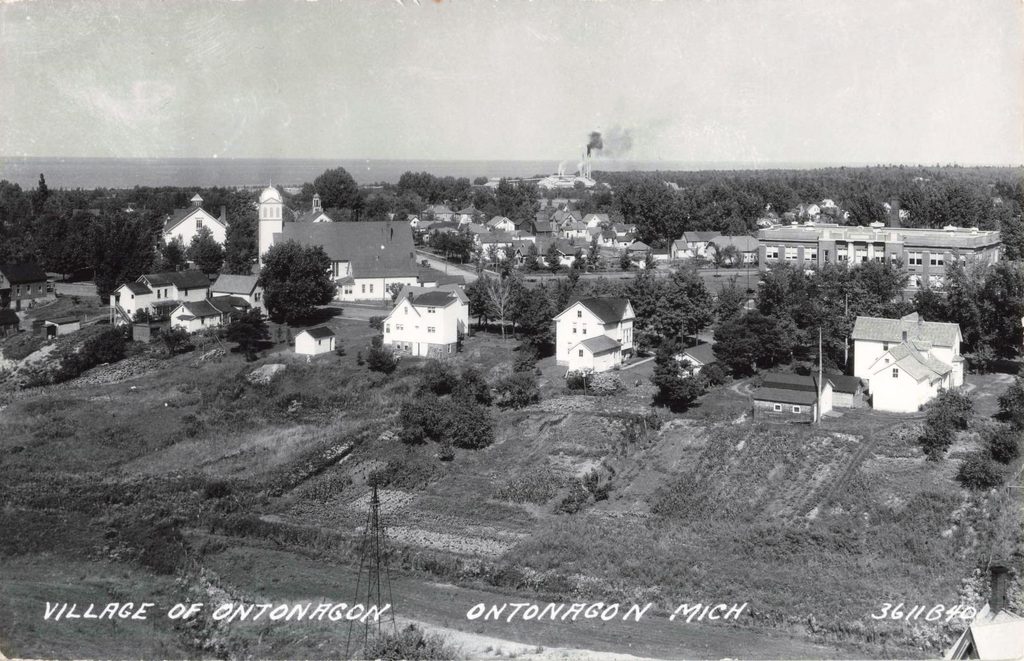
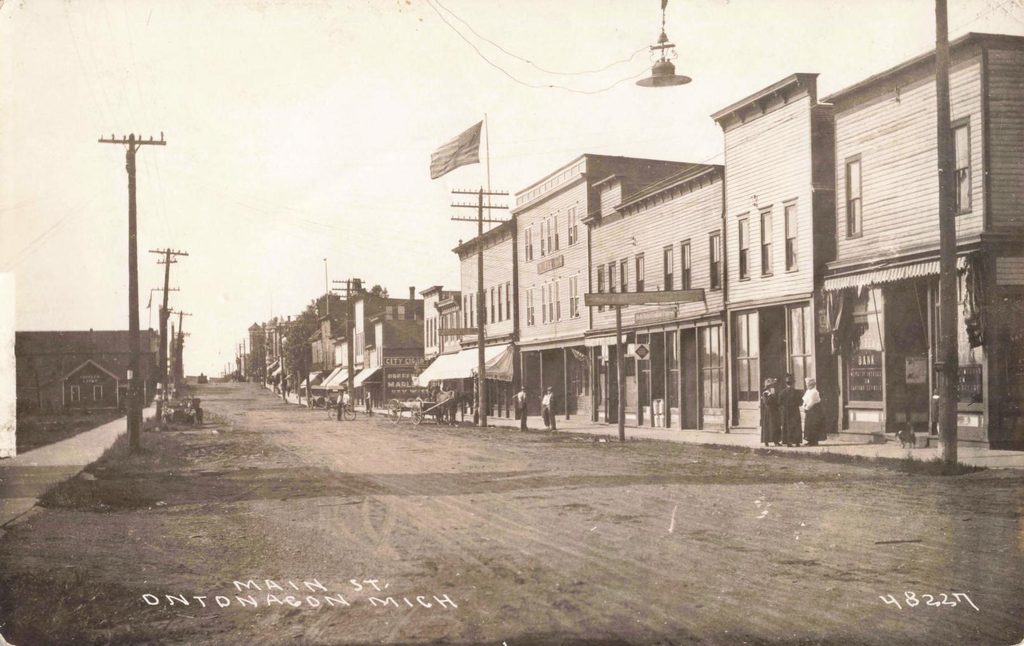
By 1900, the federal census counted 1,267 village residents. The total dropped to 1,064 in 1910, then rose to 1,406 in 1920 and 1,997 in 1930. The population figures trace a gradual recovery. Business returned to the commercial street, where wooden storefronts stood beside utility poles, and people gathered along the sidewalks.
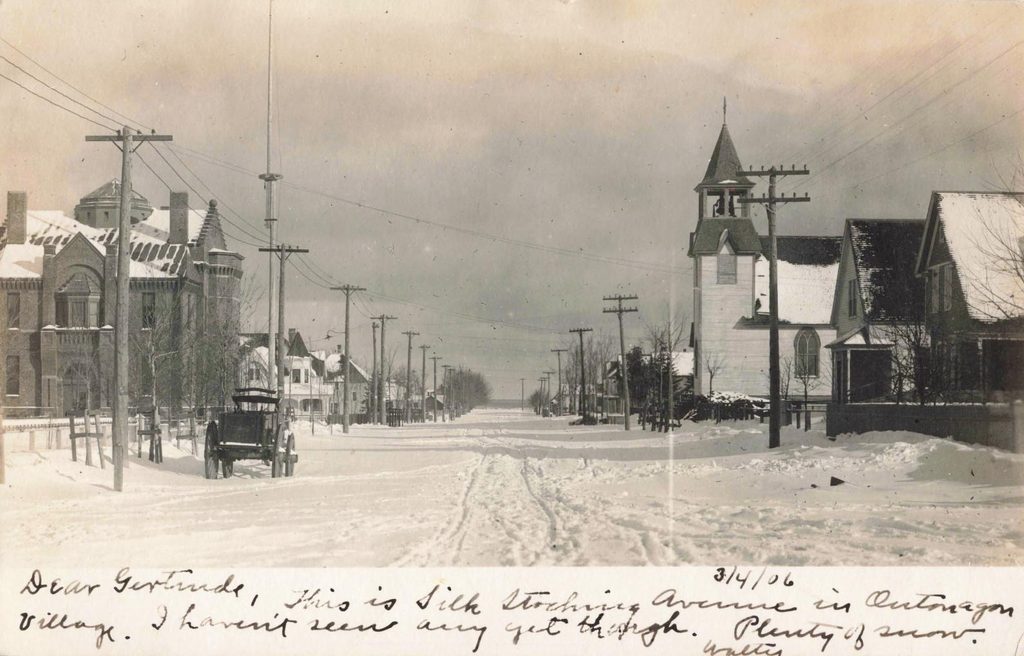
A winter postcard dated March 4, 1906, offers a quieter view of Ontonagon’s historical buildings. Its writer nicknamed the neighborhood Silk Stocking Avenue. A church tower rises beside snow-covered houses and a substantial masonry building. Tracks through the snow show that ordinary travel didn’t stop when the streets turned white.
Watch: Ontonagon Silk Road
The Harbor, Rail Depot and Working Mills
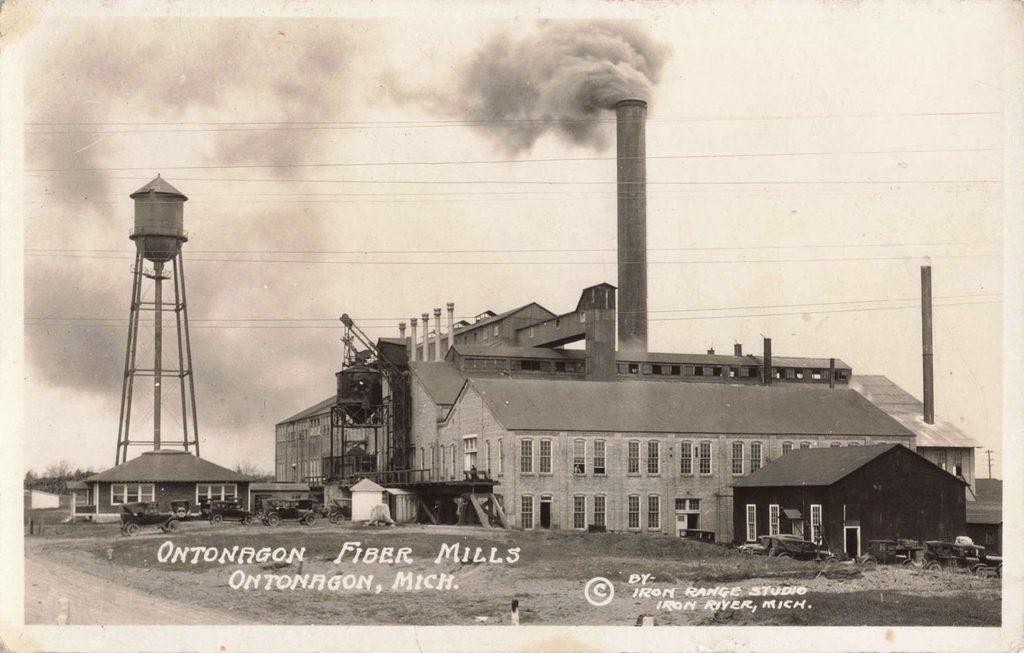
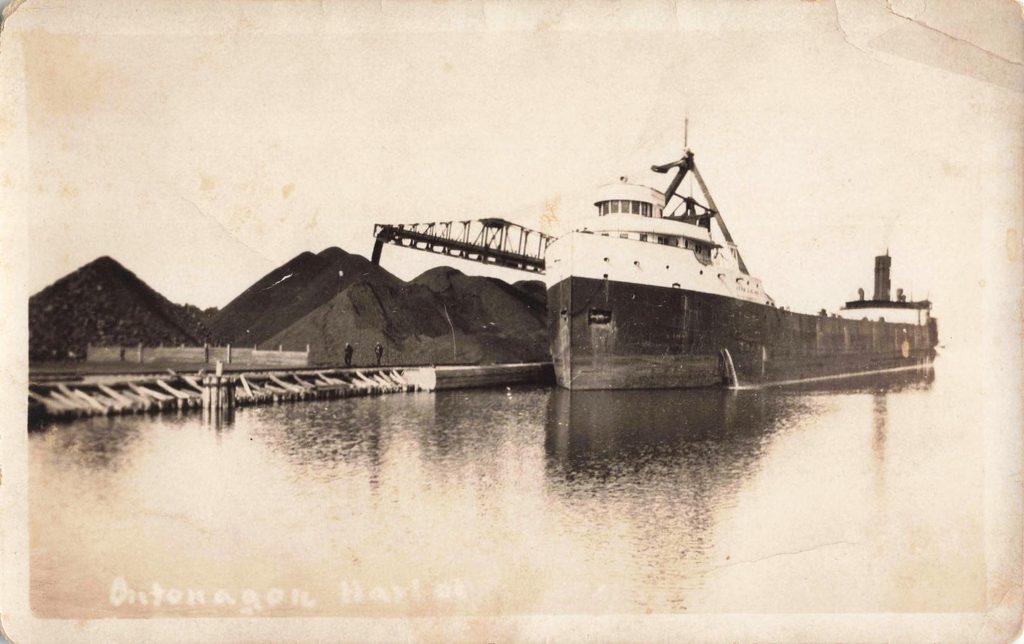
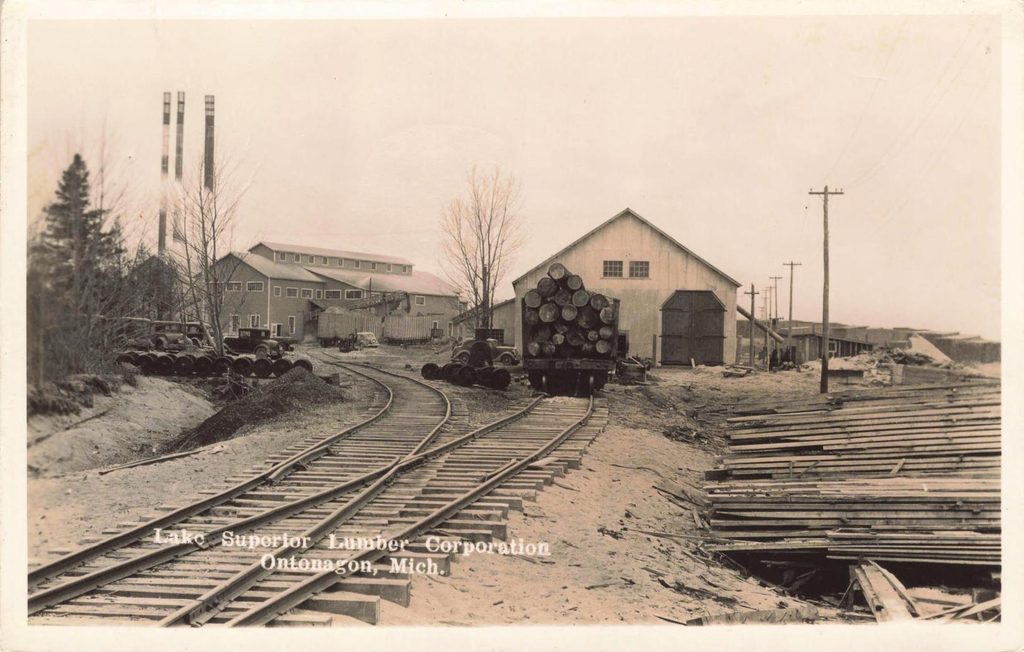
Although Diamond Match was gone, lumber remained important. A federal harbor report found that lumber represented 83 percent of vessel freight tonnage in 1907. The same report noted that some mining companies had established stamp mills elsewhere because Ontonagon’s harbor depth limited their operations.
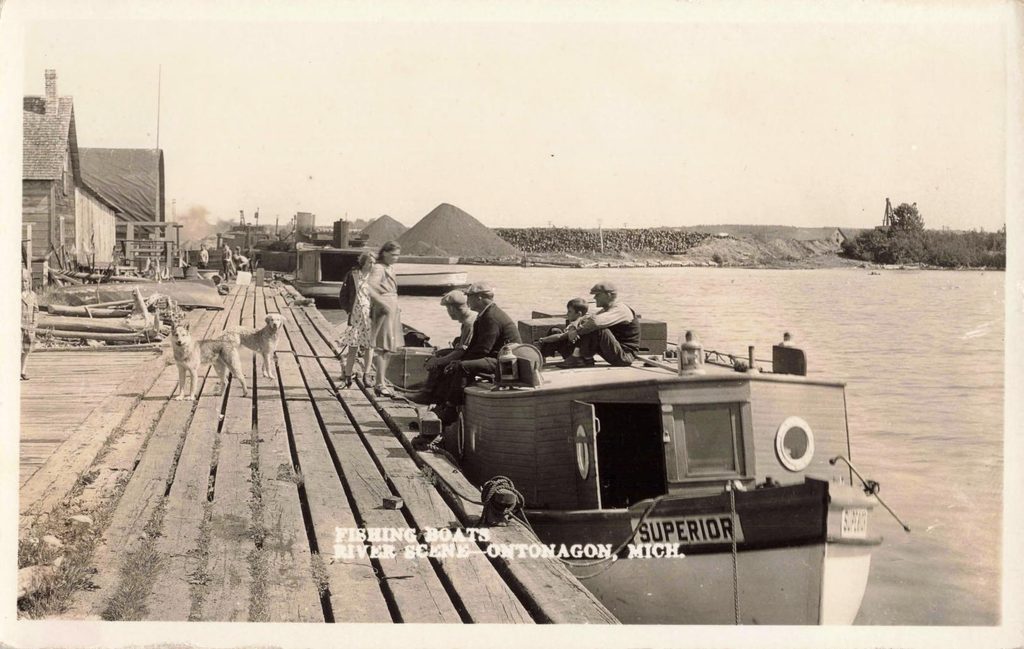
Commercial fishing offered another way to earn a living. Smaller boats worked alongside the larger freight vessels, using wharves along the river. Inland, farms developed on some of the previously logged land. Agriculture in the watershed reached its greatest extent between 1910 and 1920, although the short growing season limited its expansion.
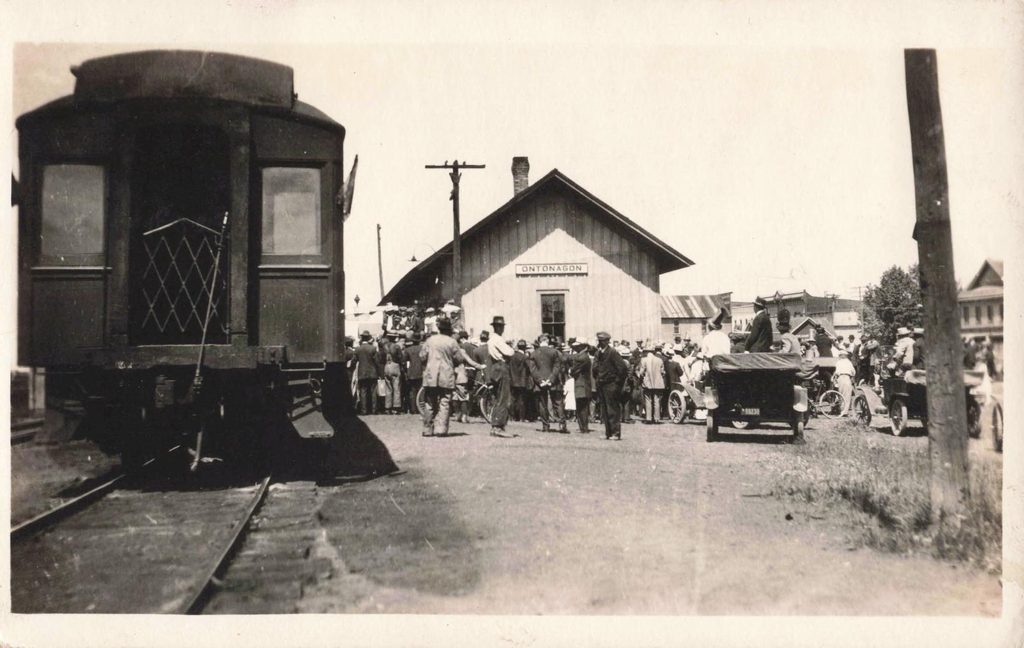
Ontonagon railroad history is visible in the depot crowds and industrial yards. Passenger trains brought people to town, while freight trains carried supplies and products along the inland network. For residents of nearby rural communities, a trip into Ontonagon meant access to merchants and other services.
When the River Began Providing Electricity
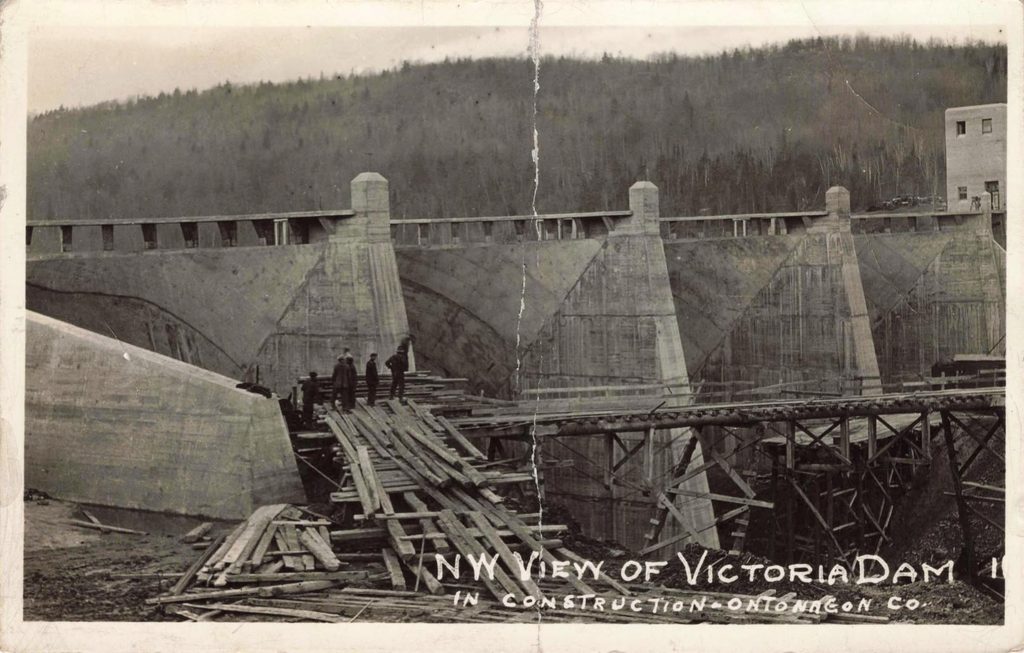
Another chapter in the history of Ontonagon, Michigan, unfolded upriver at Victoria Mine. In 1906, a system of using water to compress air was completed there, supplying power for mine equipment. After the mine shut down in 1921, the Copper District Power Company bought the property in 1928 and completed the present Victoria Dam in 1931.
Water from the new dam traveled through a pipeline to a hydroelectric station. The system grew during the 1930s with additional reservoirs and the Bond Falls project. The Michigan DNR’s river assessment documents both the projects’ economic benefits and their effects on the waterways.
The Ottawa National Forest was established in 1931, and nearby Porcupine Mountains State Park followed in 1945. Forests that had supplied the mills also became places where visitors came to fish and hike. Paper manufacturing continued in Ontonagon until the Smurfit-Stone mill closed in 2010, taking away the village’s largest employer and taxpayer, according to its own financial report.
The history of Ontonagon, Michigan, can still be traced from the historical society’s museum on River Street to the brick lighthouse across the river. The original mills and vast lumberyards that prompted James Corgan’s family to carry all those buckets of water are gone. The very building they saved on that August afternoon still stands at the harbor entrance.
Ontonagon, Michigan: Historical Timeline
From a copper shipping settlement to a Lake Superior industrial port. Open the Historical Timeline: 1766–2010
MICHIGAN MOMENTS
Ontonagon Through the Years
Forged in Copper, Shaped by Superior
1766–2010 • Select any event to explore its history.
1766 Alexander Henry Visits the Copper Boulder
Fur trader Alexander Henry travels up the Ontonagon River to examine an enormous mass of native copper already known to the Anishinaabe. He removes a portion of the boulder, which becomes widely known among explorers and mineral prospectors.
1843 Copper Rush and a Growing Settlement

Detroit merchant Julius Eldred removes the famous 3,708-pound Ontonagon Boulder. Meanwhile, James Kirk Paul establishes a cabin near the river mouth, helping lay the foundations of the American commercial settlement.
1848 Ontonagon County Is Organized
Originally established in 1843, Ontonagon County is formally organized in 1848. The developing community at the river mouth becomes an important administrative and commercial center for the western Copper Country.
1853 A Lighthouse Guides Ships to Safety
Ontonagon’s first wooden lighthouse enters service, guiding vessels carrying mining supplies and copper through the mouth of the Ontonagon River on Lake Superior.
1866 The Historic Brick Lighthouse Is Built
A permanent brick lighthouse replaces the earlier wooden structure. The building survives the great fire of 1896 and becomes one of Ontonagon’s most recognizable historical landmarks.
1881 The Lumber Industry Takes Root
The village’s first sawmill begins operating. Extensive white pine forests and access to the river make Ontonagon an attractive location for lumber companies supplying distant markets.
1882 The Railroad Reaches Rockland
The Ontonagon and Brule River Railroad connects the port with Rockland, improving transportation for residents, mining supplies and industrial freight.
1889 A Rail Connection to Chicago
A connection with the Milwaukee and Northern Railroad provides access to Chicago-area markets. Timber and other products can now be transported south by rail rather than relying exclusively on Great Lakes shipping.
1896 ? The Great Ontonagon Fire
August 25, 1896. Strong winds carry flames into the Diamond Match Company mills and lumberyards before the fire sweeps into the village. Hundreds of buildings are destroyed, leaving nearly 2,000 residents homeless.
Lighthouse keeper James Corgan and members of his household protect the brick lighthouse by carrying water to wet its roof and outbuildings. The lighthouse remains operational that evening.
Diamond Match never rebuilds its mills in Ontonagon.
1906 A Rebuilt Community
A postcard dated March 4, 1906, captures a snowy Ontonagon street nicknamed Silk Stocking Avenue. Churches, houses and substantial buildings illustrate how residents rebuilt their community following the great fire.
1907 Lumber Dominates the Working Harbor
A federal harbor report documents the recovery of Ontonagon’s maritime commerce. Lumber accounts for 83 percent of vessel freight tonnage, demonstrating the continued importance of forestry after the 1896 disaster.
1921 Victoria Mine Closes
Victoria Mine ceases operations after years of using an innovative water-powered air compression system. The property will later play an important role in regional hydroelectric development.
1931 Victoria Dam and a New Industrial Era
The Copper District Power Company completes the present Victoria Dam. Water from the Ontonagon River is directed to a hydroelectric generating station. The Ottawa National Forest is also established that year.
1938 Bond Falls Hydroelectric Development
The Bond Falls dam and canal system is completed, expanding the regional water management and hydroelectric network associated with the Ontonagon River.
1945 Porcupine Mountains State Park Established
Michigan establishes Porcupine Mountains State Park, protecting extensive forests near Ontonagon and contributing to the region’s developing outdoor recreation economy.
2010 The Paper Mill Era Ends
The Smurfit-Stone paper mill closes, ending an important chapter in Ontonagon’s industrial history. The village loses its largest employer and taxpayer.
Frequently Asked Questions About Ontonagon History
When was Ontonagon, Michigan, founded?
The American commercial village took shape in the early 1840s, when James Kirk Paul arrived in 1842 and established a cabin by 1843. Indigenous communities had lived in the region long before then.
What caused the Ontonagon fire of 1896?
In dry conditions, strong winds carried fire from burning areas west of the river into the Diamond Match Company mills and lumberyards, then into the village on Aug. 25
Which industries supported Ontonagon?
Regional copper mining, lumber processing, commercial fishing, Great Lakes shipping, rail freight and later paper manufacturing provided important sources of employment and trade.
Where can visitors learn about historic Ontonagon?
The Ontonagon County Historical Society operates a museum on River Street and preserves the 1866 Ontonagon Lighthouse. Its collections document the village before and after the 1896 fire.
Do You Remember Old Ontonagon?
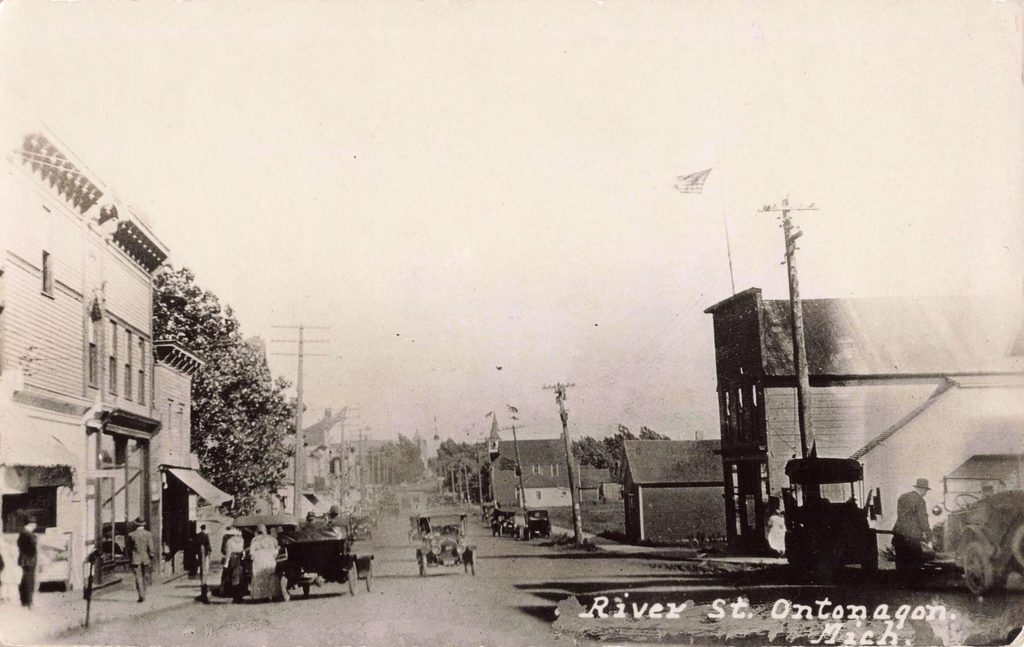
Do you recognize a business, church, family, or railway building in these old Ontonagon views? Share the name, approximate date, or a family recollection in the comments. Those details can help identify more of the town’s buildings and people.
? Works Cited for History of Ontonagon Michigan: Copper, Fire and Lumber
A. E. Seaman Mineral Museum. Float Copper of Michigan. Michigan Technological University, 2017.
Archives of Michigan. “Ontonagon County Guide.” Michigan History Center.
Michigan Department of Natural Resources. Ontonagon River Assessment. Fisheries Division.
Michigan Department of Natural Resources. “Porcupine Mountains Wilderness State Park.”
Michigan Geological Survey. Michigan’s Copper Country.
Michigan State University. “Ontonagon Boulder.”
Michigan Technological University Archives. “Flashback Friday: Fire on the Banks of the Ontonagon.” 14 Aug. 2020.
National Park Service. “Diamond Match Store.” Keweenaw National Historical Park.
Ontonagon County Historical Society. “Walk into History.”
Ontonagon: Michigan Coastal Community Working Waterfronts Case Study. NOAA Institutional Repository.
Smithsonian Institution, National Museum of Natural History. Northeast Region Repatriation Case Reports.
United States Census Bureau. Fourteenth Census: Population, Table 51. 1920.
United States Census Bureau. Fifteenth Census: Population, Michigan. 1930.
United States Congress. Ontonagon Harbor, Michigan. Congressional Serial Set.
University of Michigan Library. Tinder Collection of Michigan Photography. Historical postcard identifiers listed in the captions.
Village of Ontonagon. Corrective Action Plan. Michigan Department of Treasury.