 by
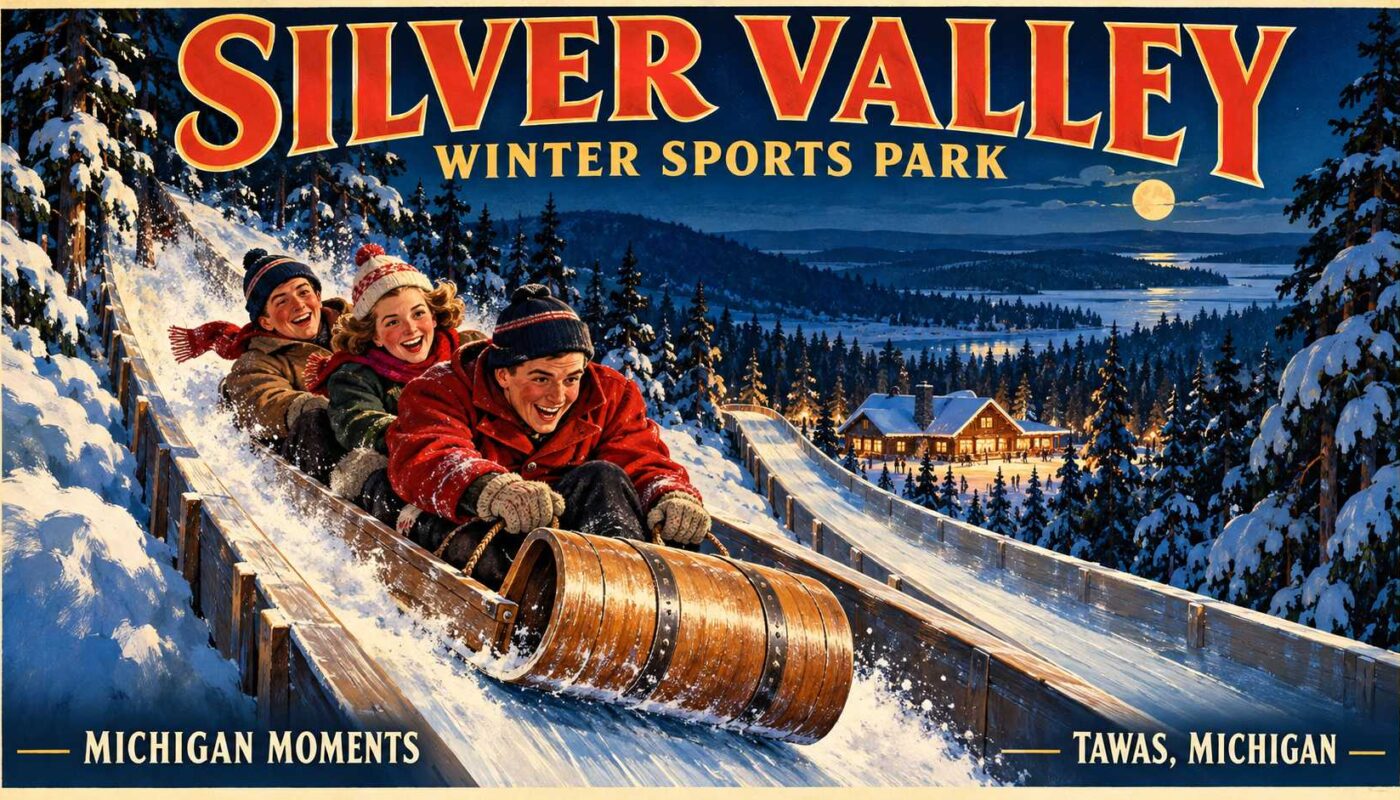
Wooden toboggan chutes, a stone fireplace, and large group outings turned a wooded valley near Tawas into one of Michigan’s best-known winter recreation destinations.
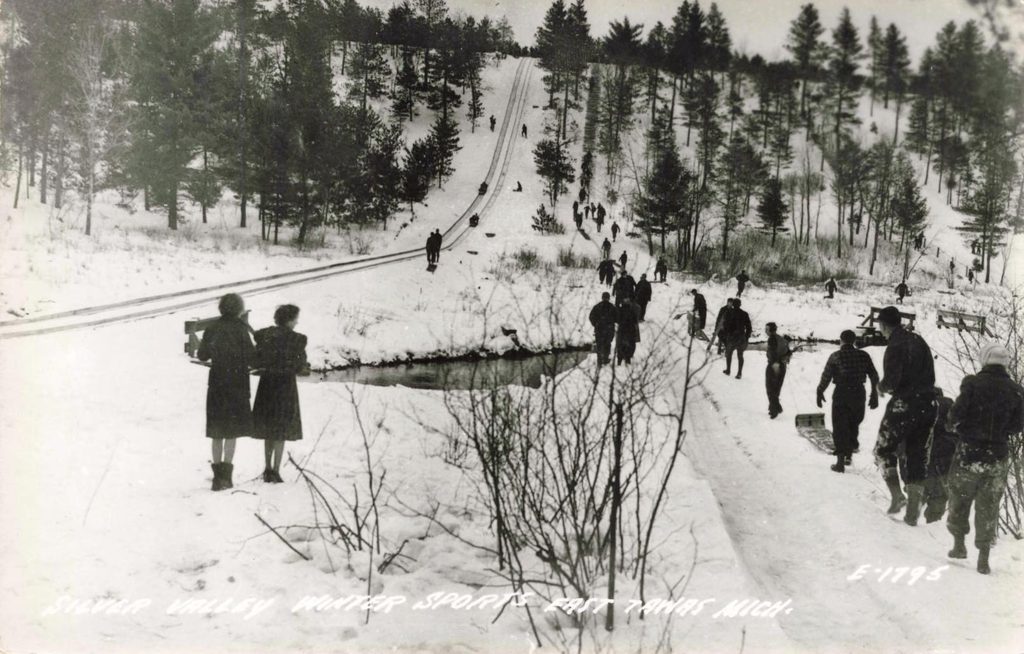
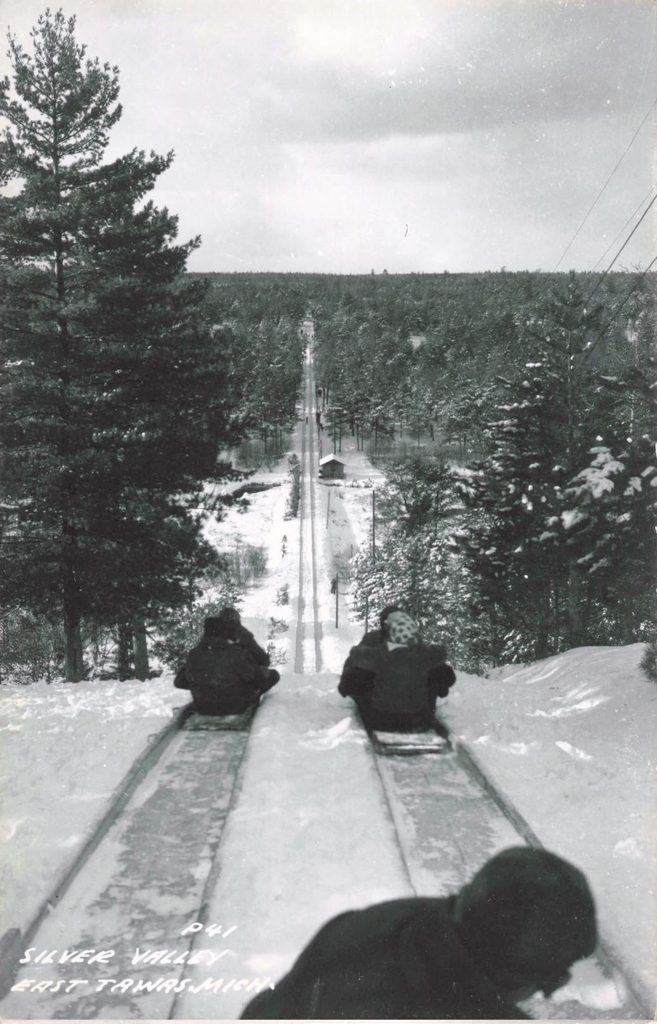
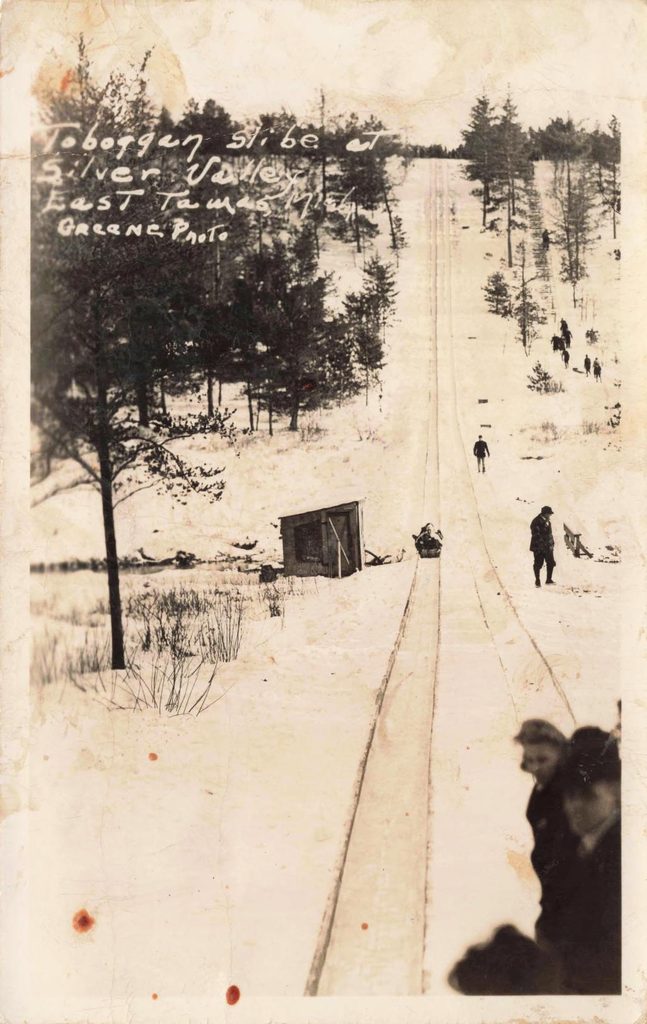
Two wooden toboggan chutes dropped through the pines at Silver Valley Winter Sports Park, Michigan, with riders seated one behind another and spectators waiting beside the run. The history of Silver Valley Winter Sports Park, Michigan, begins with the practical work of making a forest hill usable for a winter crowd: building slides, providing shelter, and giving visitors several reasons to stay.
The park stood near Tawas in Iosco County, inland from Lake Huron along Monument Road. A Forest Service guide made the offer straightforward. Visitors could use the slides and warming shelter for free, bring their own equipment, or rent it from a concessionaire. A winter outing didn’t require owning everything needed.
Watch: Silver Valley: Michigan’s Winter Thrills Before Ski Resorts
History of Silver Valley Winter Sports Park Michigan: A Winter Use for the Forest
The Civilian Conservation Corps helped develop the recreation area during the Depression. A winter carnival began in 1938. By January 1939, the Ingham County News described two toboggan slides, four ski lanes of different difficulty, snowshoe trails, and skating.
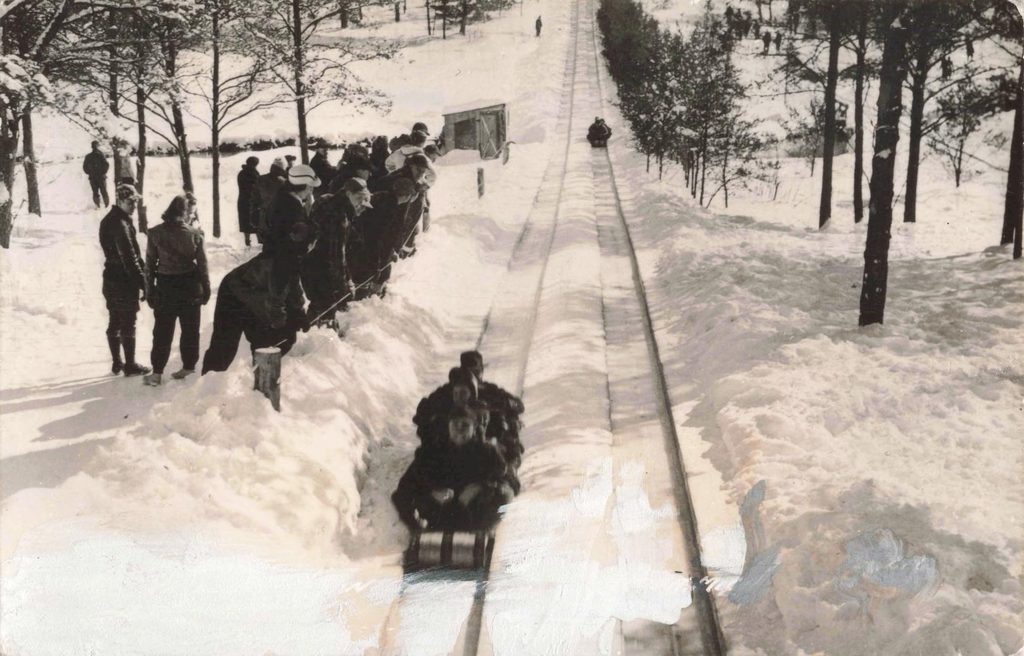
That range suited a group whose members did not all ski. A toboggan could carry several riders together, while others watched from beside the chute. In one postcard, a rope separates a line of spectators from the passing sled. The crowd was part of the outing, even for people who stayed on their feet.
The Forest Service’s description of the Huron National Forest placed recreation alongside forest restoration. Public facilities had grown from scattered tables and fireplaces into developed camping, picnic and winter-sports areas. Silver Valley gave that policy a particularly visible form: a hill equipped to receive paying equipment-rental customers and people using the free facilities.
Wooden Tracks Beneath the Ice
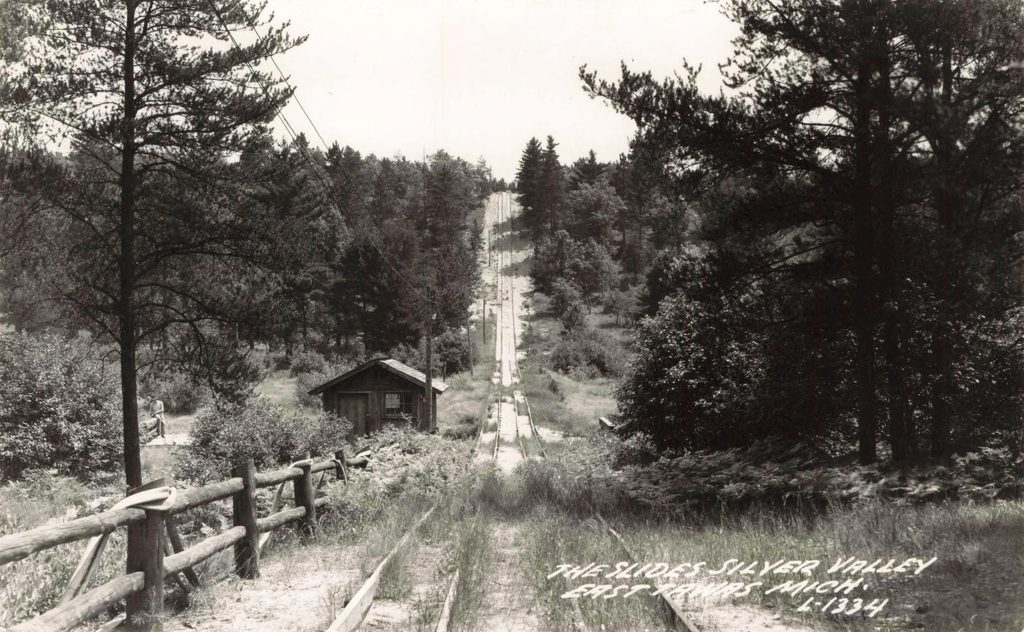
A snow-free postcard makes the construction easier to understand. Long wooden troughs follow the hill past a small building, with trees close to either side. The winter surface concealed some of that structure, but the summer view shows how much of the ride depended on built equipment.
Each chute confined a sled to a narrow route. At the start, riders looked down the track as it descended through the valley. The arrangement concentrated the action where spectators could watch, while paths through the surrounding grounds carried people and equipment between rides.
Snow covers edges and surfaces that are visible in the summer card. Together, the seasonal views explain the wooden construction without treating the snow-free scene as evidence that the park had closed.
A Fireplace Kept the Outing Going
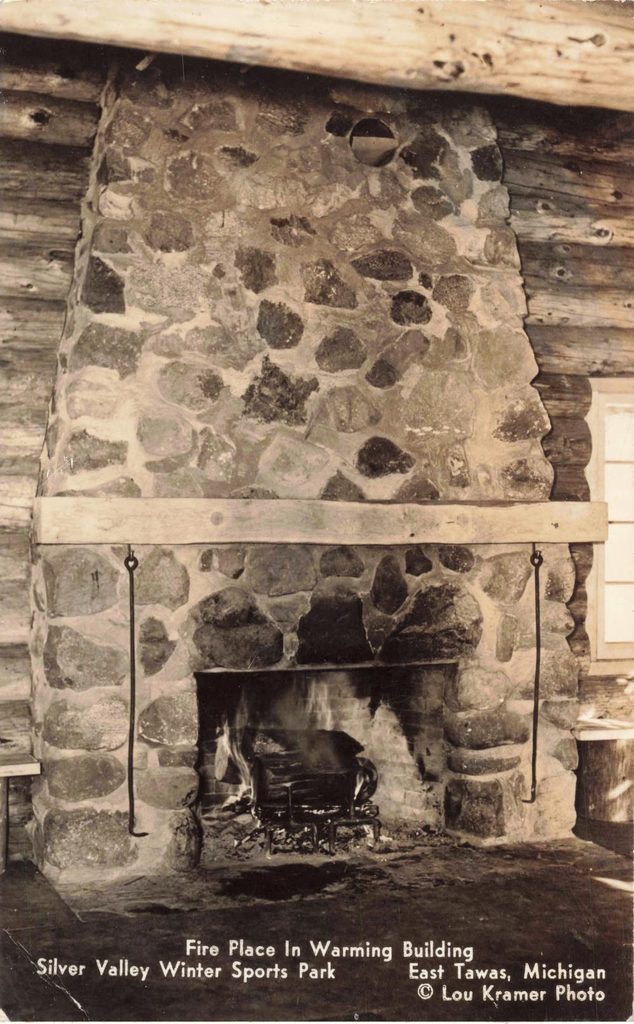
Inside the warming building, a broad fieldstone fireplace stood against log walls. The postcard credited to Lou Kramer shows a fire burning beneath a heavy timber mantel. Its printed caption identifies the interior as Silver Valley’s warming building.
Shelter was a practical part of winter recreation. Visitors could take a break without ending their outing immediately. The Forest Service included the large warming shelter in its description of Silver Valley, alongside outdoor activities and equipment rentals.
Winter Visitors Extended the Business Season
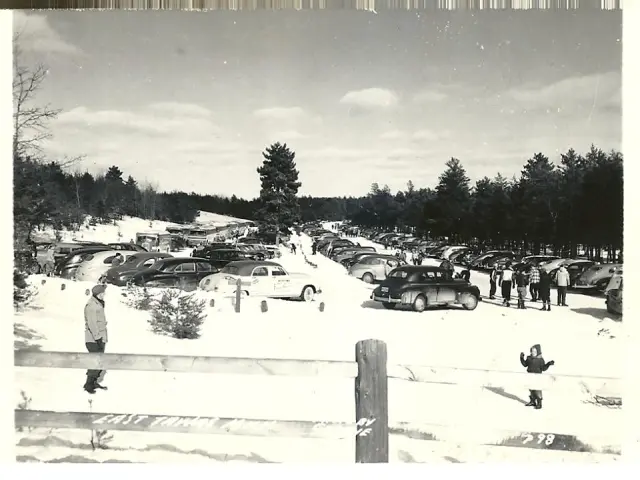
The history of Silver Valley Winter Sports Park Michigan also reflects changes in how people used the national forests. Improved rail and automobile transportation helped winter visitors reach places that had been difficult to access in snowy weather. The Forest Service’s regional history lists Silver Valley among its heavily used winter recreation areas.
During the winter of 1939–40, the agency’s North Central Region recorded nearly half a million visits across 15 facilities. More than a quarter involved tobogganists. Skaters and spectators also outnumbered skiers, indicating how broad the winter audience had become.
The agency’s Michigan guide explicitly connected winter recreation with a longer season for tourism businesses. At Silver Valley, the benefit was clear: an outdoor attraction gave people a reason to travel, and those travelers needed services. The busy parking area puts ordinary cars and bundled-up visitors into that economic story.
Group Outings and Later Improvements
Silver Valley also gave people time to get to know one another. After noticing Irene Pretzer at a Frankenmuth gathering in 1945, Wally Bronner got to know her better on a motorcoach excursion to the park. According to Bronner’s account, they married in 1951.
By 1955, the Tawas Herald described a toboggan tow, a new ski area, and activities for different abilities. The tin-pan slide required little specialized equipment: cardboard or a rubber car floor mat would do. That combination kept the park accessible to visitors seeking different kinds of winter fun.
Organized travel remained substantial. In January 1963, the local newspaper reported that a Lansing group of 590 young people stayed overnight in Tawas school buildings. The park’s operation reached into the surrounding community, where visitors slept and ate before returning to the snow.
From the Old Slides to Corsair Trails
The final winter carnival was held in 1965. Today, Silver Valley is a trailhead within the Corsair cross-country network. Michigan’s tourism listing describes that portion as gentler and less hilly, with two Silver Creek crossings.
For anyone tracing the history of Silver Valley Winter Sports Park Michigan, the postcards preserve a precise earlier arrangement: wooden chutes down a wooded hill, pedestrians moving beside them and a warming building equipped with a substantial fireplace. Modern winter outings follow trails through the woods; the old cards preserve the view along the toboggan tracks.
Silver Valley Winter Sports Park Timeline
Select a year to read what changed. The small illustrations are placeholders for the accompanying historical postcards. Photo dates and reproduction rights have not been confirmed.
1930sCCC crews help build the parkSelect for details
New Deal workers help develop the winter recreation area in the Huron National Forest. The work comes before the first carnival.
1938The first winter carnivalSelect for details
Silver Valley begins its winter carnival tradition. This date does not mark the start of every structure at the park.
1939Two slides are already documentedSelect for details
The Jan. 12 Ingham County News mentions a pair of toboggan slides, four ski lanes, snowshoeing and skating.
1939–40A regional winter boomSelect for details
Forest Service records count nearly 500,000 visits across 15 regional facilities; that is not a Silver Valley attendance total.
1941Skiing shares the spotlightSelect for details
Federal photo records document the senior ski hill. Silver Valley is more than a toboggan attraction.
After 1945A Bronner family connectionSelect for details
On a motorcoach outing after their first 1945 encounter in Frankenmuth, Wally Bronner and Irene Pretzer become better acquainted.
1955Tows and new ski slopesSelect for details
The Tawas Herald describes a toboggan tow, new ski slopes and a tin-pan hill where cardboard and car floor mats could be used.
1963Large groups fill the valleySelect for details
A Lansing group brings 590 young people. Tawas schools help with lodging and meals for visiting groups.
1965The final winter carnivalSelect for details
A local-history account places Silver Valley’s last winter carnival in 1965. Published closure dates for downhill operations differ.
TodayThe Corsair trailhead remainsSelect for details
Silver Valley is a trailhead in the Corsair system, with gentler terrain and Silver Creek crossings. The historic slides are not operating.
If your family visited Silver Valley, share a date, a remembered outing or the names of people you recognize in these images. Dated cards and family records can help identify individual scenes.
Questions About Silver Valley Winter Sports Park
Was Silver Valley a town?
Silver Valley was a winter sports area in the Huron National Forest near Tawas, in Iosco County, Michigan. It was not an incorporated town.
Was Silver Valley only for skiers?
No. Visitors also enjoyed tobogganing, ice skating, coasting and snowshoeing. The park’s twin toboggan slides were a major attraction, and a warming building provided shelter between outdoor activities.
What uses the Silver Valley name today?
Silver Valley is one of the trailheads in the Corsair hiking and cross-country ski trail system. Its trails offer gentler terrain and include crossings of Silver Creek.
Works Cited
Bronner’s CHRISTmas Wonderland. “Wally Bronner’s Life Story.” Accessed 28 Oct. 2026.
Conrad, David E. “Regions 7 and 9 in the Great Depression.” The Land We Cared For: A History of the Forest Service’s Eastern Region, edited by Jay H. Cravens, U.S. Forest Service, ch. 7. Reproduced by NPS History.
Ingham County News, 12 Jan. 1939. Capital Area District Libraries digital archive.
Michigan Economic Development Corporation. “Corsair Hiking and Cross Country Skiing Trail.” Pure Michigan. Accessed 28 Oct. 2026.
National Archives and Records Administration. “Snow Sports in the National Archives.” 25 Mar. 2024.
Stock, Dan. “Silver Valley Winter Sports Carnival.” Huron Shores Genogram, Dec. 2021, pp. 6–7.
The Tawas Herald, 3 Feb. 1955. Iosco-Arenac District Library digital archive.
The Tawas Herald, 30 Jan. 1963. Iosco-Arenac District Library digital archive.
Thornton, Neil. “Government at Work: CCC.” Up North Voice, Feb. 2025.
United States, Forest Service. “Huron National Forest.” National Forests in Michigan. Reproduced by NPS History.
Selected related reporting from the Tawas area and Saginaw Bay.