 by
by 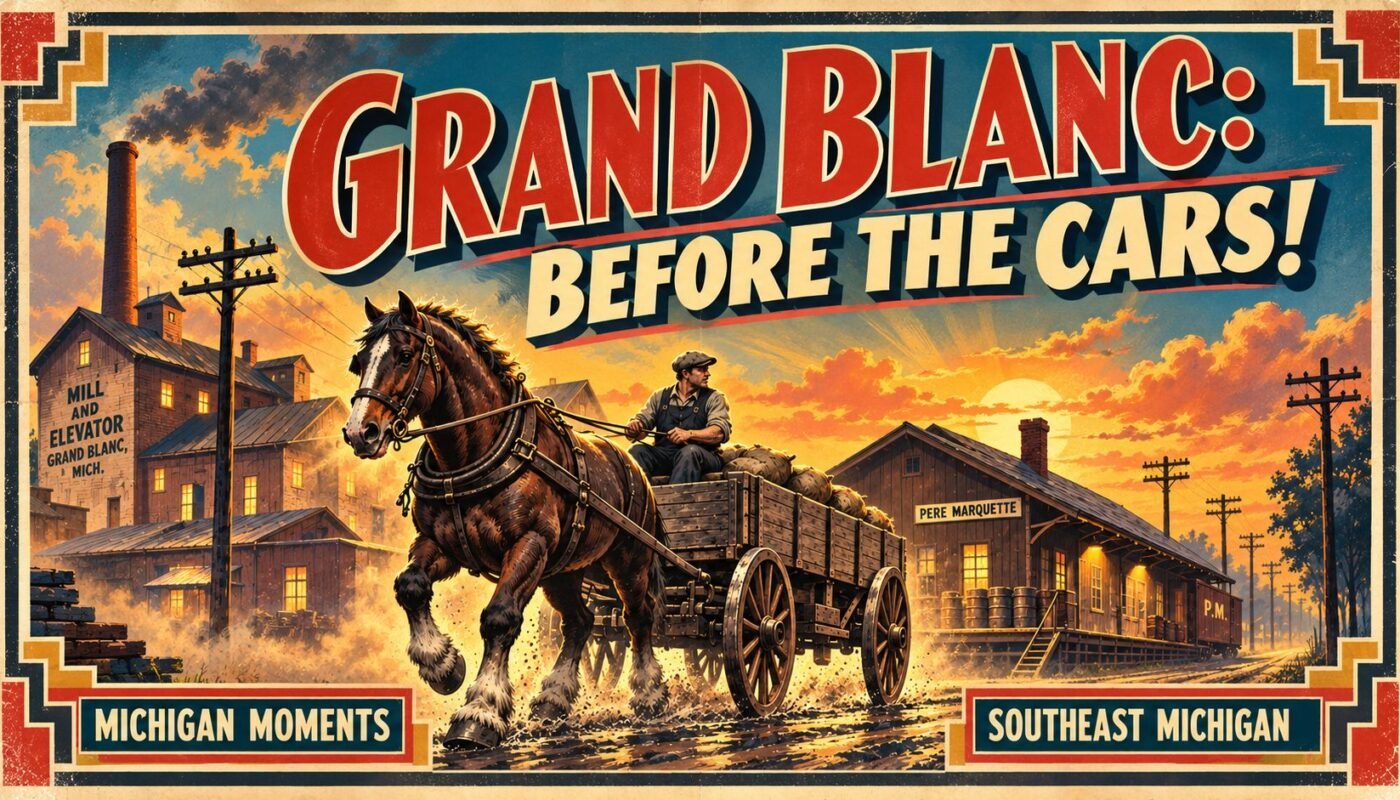
Historic photographs trace Grand Blanc from Michigan’s pioneering school consolidation to the mills, railroads and businesses that shaped the community.
Grand Blanc was still closely tied to the farms of Genesee County when residents made an important change to local education. In 1904, local school districts formed a consolidated system, allowing children from the surrounding countryside to attend a shared school. This Michigan Moments video follows that story through historic images of schools, mills, railroad depots, businesses, churches, homes, and Saginaw Street.
About This Video
Grand Blanc’s early school system stands at the center of this collection of historic scenes. In 1904, the community consolidated rural school districts, an unusually early step in Michigan education. Students could be transported to a shared school by horse-drawn vehicles years before motorized school buses became common.
The school seen later in the video belongs to another period. The earlier Grand Blanc school burned in 1920. A replacement opened in 1922, continuing the community’s changing approach to education.
Other photographs show how closely early Grand Blanc was connected to agriculture. A mill and grain elevator served farmers, while a steam-powered tractor appears hauling a heavy load through the mill yard. The Pere Marquette depot linked the community to a broader railroad system, providing another route for people, crops and supplies.
Village commerce appears in photographs of Hotel Waldo and the Farmers Exchange Bank. Historical banking directories list the Grand Blanc Farmers Exchange Bank as discontinued in 1935. Homes associated in the photographs with A.D. Banker, Mrs. Beals and Henry Mason show another side of the community, with large porches, gables and mature trees lining residential streets.
The Congregational and Methodist Episcopal churches appear with distinctive towers, while another photograph identifies Gundry Hall. The source material does not establish what role Gundry Hall played, so its function remains an open question.
Later views of Saginaw Street show Grand Blanc adapting to automobile travel. A Ford service business appears in one north-facing scene. Another view includes a canopy, gasoline pumps and tourist-room signs. The photographs are undated, but the vehicles and roadside businesses suggest scenes from roughly the 1930s.
A later depot photograph carries the Chesapeake & Ohio name. The Pere Marquette Railway formally became part of the C&O in 1947, placing that image in a later era of Grand Blanc railroad history.
Grand Blanc adopted its city charter in 1930, but the community shown in these photographs was already well established. Schools, farms, mills, shops, churches and rail service had shaped the town long before that municipal milestone.
Video Transcript
0:00 — This is Michigan Moments, rediscovering the pioneering history of the Great Lakes State. In 1904, the folks in Grand Blanc, Michigan, did something ahead of its time. They consolidated their schools.
0:12 — This farming community helped change Michigan education by bringing rural districts together. Children reached the shared school in horse-drawn buses. This modern school system began before the Model T and motorized transport.
0:25 — The Grand Blanc High School shown here in 1937 belongs to a later chapter. The earlier school building burned in 1920 but was rebuilt, with the replacement opening in 1922.
0:38 — We turn and walk back to Saginaw Street in 1908. The broad road is unpaved. Trees and utility poles line a town still closely tied to surrounding farms.
0:47 — Grand Blanc’s mill and elevator explain that connection. The photo notes that this was Chaz Mackham’s mill and John Crapser’s elevator. A steam-powered tractor drags a heavy load across the yard.
0:56 — The second mill view shows the mill and elevator still at work in the early 1900s, giving this farming community a way to move its products toward market.
1:08 — The Pere Marquette depot connected the local economy with a wider rail network. Its platform and neighboring rail car make the station’s purpose easy to see. Crops and supplies needed routes into and out of town.
1:21 — Hotel Waldo offered lodging and served as a meeting place for people from out of town. The Farmers Exchange Bank represented the financial side of village commerce. Historical banking records list the Grand Blanc bank as discontinued in 1935.
1:37 — The beautiful homes in town belonged to A.D. Banker, Mrs. Beals and Henry Mason. The wide porches, gables and mature trees preserved the town’s residential character alongside places of work.
1:50 — The Congregational and Methodist Episcopal churches had distinct towers that called people in to meet and worship. Gundry Hall adds another familiar name, although we aren’t sure what the role of this hall was. Do you know?
2:04 — Walking along Thread Creek gives us a quieter view of town, with water running between wooded banks. Then we return to Saginaw Street.
2:12 — In the north-facing view, automobiles park outside a Ford service business. In the south-facing view, the Atkins canopy, gasoline pumps and tourist-room signs show merchants serving road travelers. These undated scenes appear to be from the 1930s.
2:29 — One final depot carries the C&O name. This 1950s shot must have been taken after the Pere Marquette Railway merged into the C&O in 1947.
2:39 — Grand Blanc adopted its city charter in 1930. Its community was much older. Farms, mills, shops and schools had already shaped a place learning how to change.
2:47 — Thanks for watching. Please let us know which small town you would like to see next.
2:53 — Michigan Moments, offering bite-sized morsels of Michigan history.
Key Moments
- 0:00 — Grand Blanc and Michigan’s early school consolidation
- 0:38 — Saginaw Street in 1908
- 0:47 — The mill, grain elevator and farming economy
- 1:08 — The Pere Marquette railroad depot
- 1:21 — Hotel Waldo and the Farmers Exchange Bank
- 1:50 — Grand Blanc’s historic churches and Gundry Hall
- 2:12 — Automobile-era businesses on Saginaw Street
- 2:29 — The Chesapeake & Ohio railroad era
Related Reading