 by
by 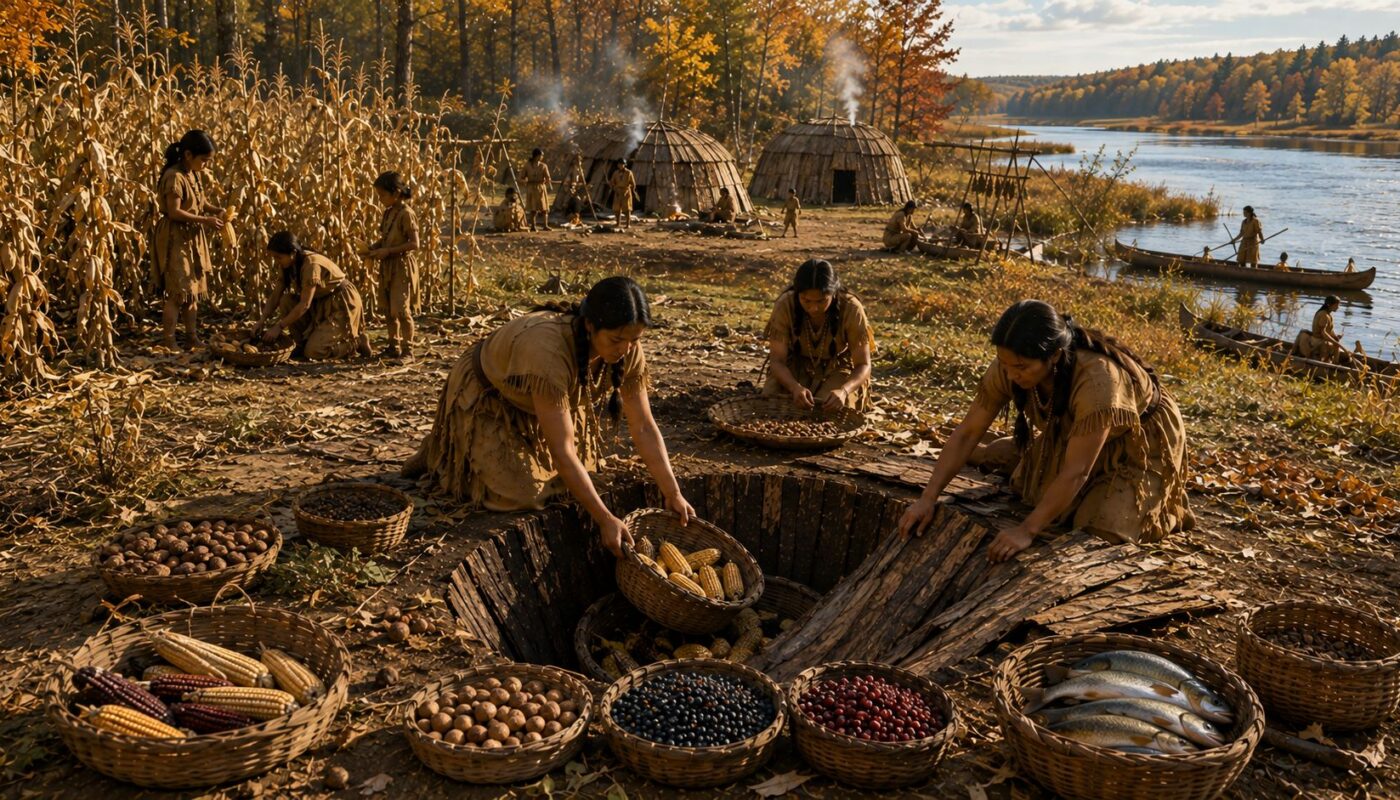
A shallow depression in a Michigan forest can be easy to dismiss. It may look like the scar of a fallen tree, an animal burrow, or simply uneven ground. In parts of the Saginaw Valley, however, some of those depressions are the remains of underground Michigan Indigenous food caches or food-storage pits built centuries ago by Indigenous communities.
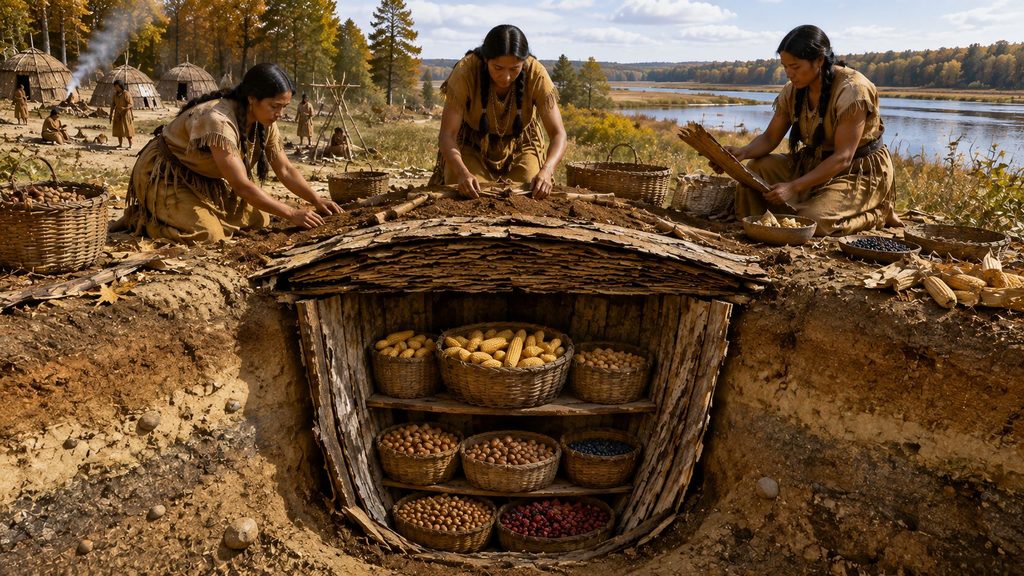
These caches were part of a carefully managed food system. Some were several feet deep and lined with bark. They could hold corn, nuts, berries, and other foods gathered when supplies were plentiful. For people who moved between fishing grounds, hunting areas, settlements, wetlands, and seasonal camps, storing food underground offered a practical way to reduce the risk of hunger without having to carry everything from place to place.
A new book by Michigan archaeologist Kathryn M. Frederick brings fresh attention to that system and, especially, to the women who helped manage it. Food Storage in Michigan’s Late Woodland: The Work of Indigenous Women, published in August 2026, examines how storage shaped mobility, planning, and survival in Indigenous communities.
The Saginaw Valley offers some of the clearest evidence of how that system worked.
Thirty-Six Pits Near the Cass River
In April 1934, Saginaw historian and amateur archaeologist Fred Dustin examined a sandy ridge in Frankenmuth Township near the Cass River. He found a series of shallow depressions and began mapping them. By the time he finished, he had counted 36 within an area only about 60 feet wide and 300 feet long.
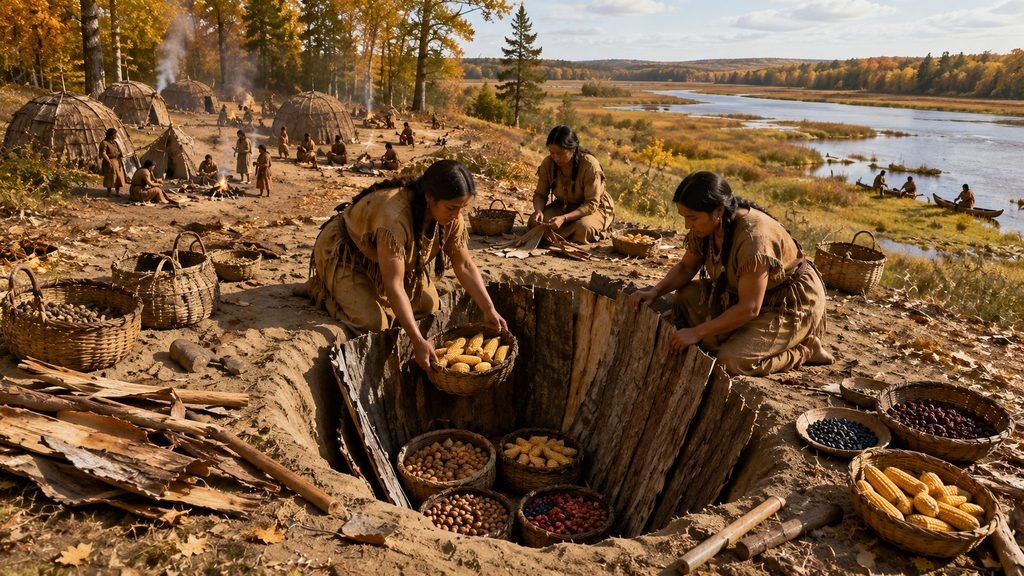
Dustin believed the depressions were Indigenous storage pits. He approached the site cautiously, excluding holes that appeared to have been caused by animals or fallen trees. Nearby evidence strengthened his conclusion. About 500 feet away, he found signs of an Indigenous village, and an old trail passed close to the ridge.
The location made sense. The Saginaw Valley had fertile river-bottom soils where crops could grow, while nearby sandy ridges drained more easily and offered better conditions for underground storage. Dustin estimated that some pits may originally have been 5 or 6 feet deep before centuries of erosion gradually filled them.
At the time, features like these were often called “corn pits,” but Dustin noted that the term could be misleading. Corn was only one of the foods people stored underground, a point later archaeological work has made even clearer.
Built to Last Through Winter
Modern excavations show that some storage pits were carefully engineered.
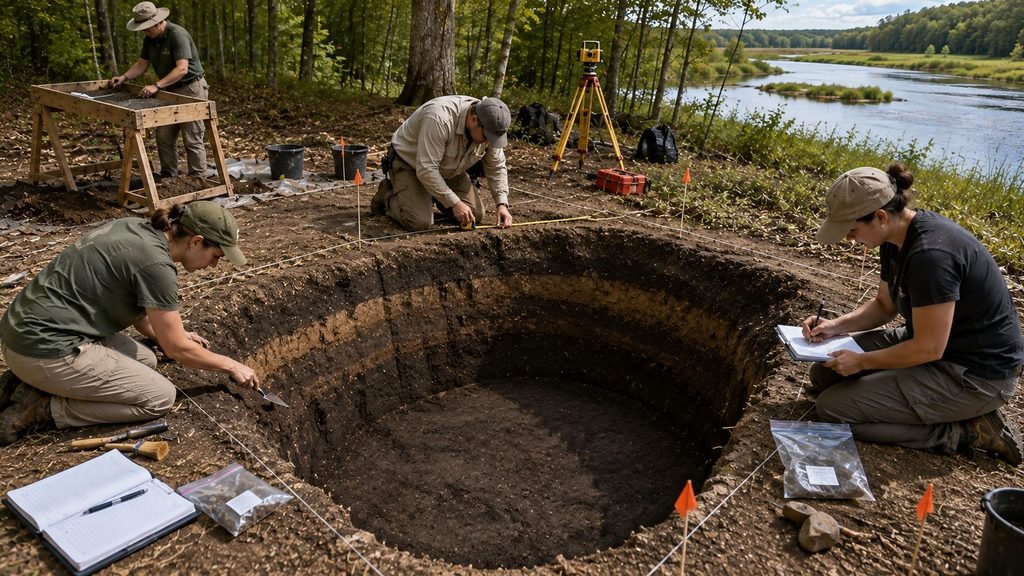
At the Clunie archaeological site along the Tittabawassee River, researchers uncovered two large pits dating roughly from A.D. 1400 to 1650. One was more than 4 feet deep. Its bottom, and possibly its sides, had been lined with thick bark.
That detail matters because it shows the amount of planning involved. Someone had to choose the location, dig the chamber, gather the bark, prepare the lining, and seal the pit well enough to protect its contents from moisture, spoilage, and animals.
A badly built cache could ruin months of work. A successful one could help sustain a family long after the harvest or gathering season had ended.
Archaeologists also found evidence that one of the Clunie pits had been burned. One possibility is that fire was used to clean or sterilize the interior before reuse. If so, these pits were not merely emergency holes dug once and abandoned. At least some may have been maintained as part of a recurring storage system.
A Much Broader Menu Than Corn
Corn often receives most of the attention in discussions of Late Woodland food systems, in part because it survives well in archaeological deposits and because agriculture eventually became more important across much of eastern North America.
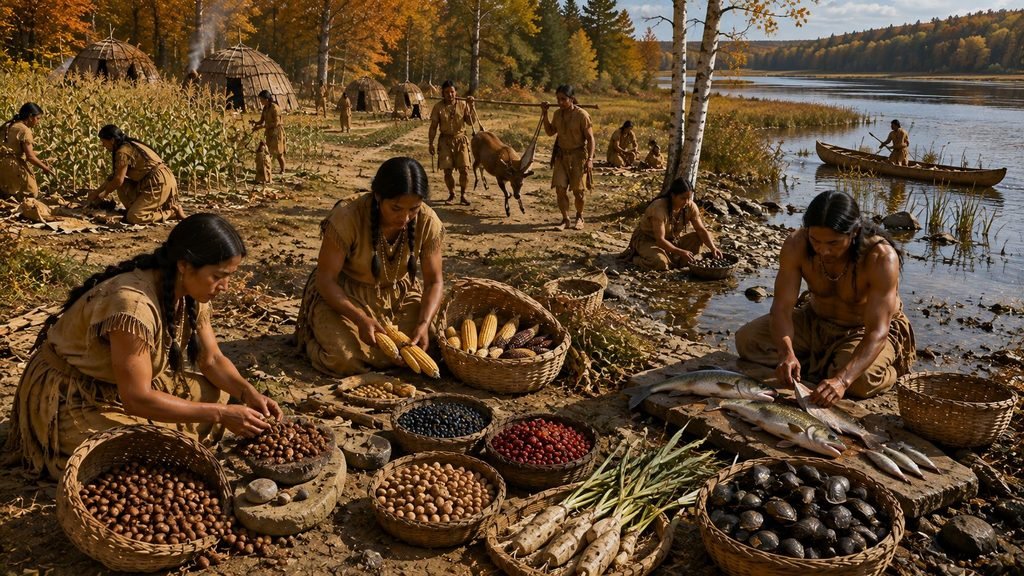
But the Saginaw Valley evidence points to a broader diet.
Archaeologists have found remains of sturgeon, walleye, suckers, freshwater mussels, deer, elk, bear, acorns, and maize. At the Clunie site, charred plant remains included aquatic tubers that may have been fragrant water lily.
The result is not a picture of farmers replacing hunters and fishers. People continued to use a wide mix of resources while adding crops to an already productive food system.
That diversity provided insurance against failure. Poor fishing did not necessarily mean hunger if hunting was good. A weak crop could be offset by gathered plants or stored nuts. Abundant fish could be preserved for later use.
Food storage helped connect those different food sources across seasons.
Corn Came Earlier Than Once Thought
Recent research has also pushed back the timeline for maize in the Saginaw region.
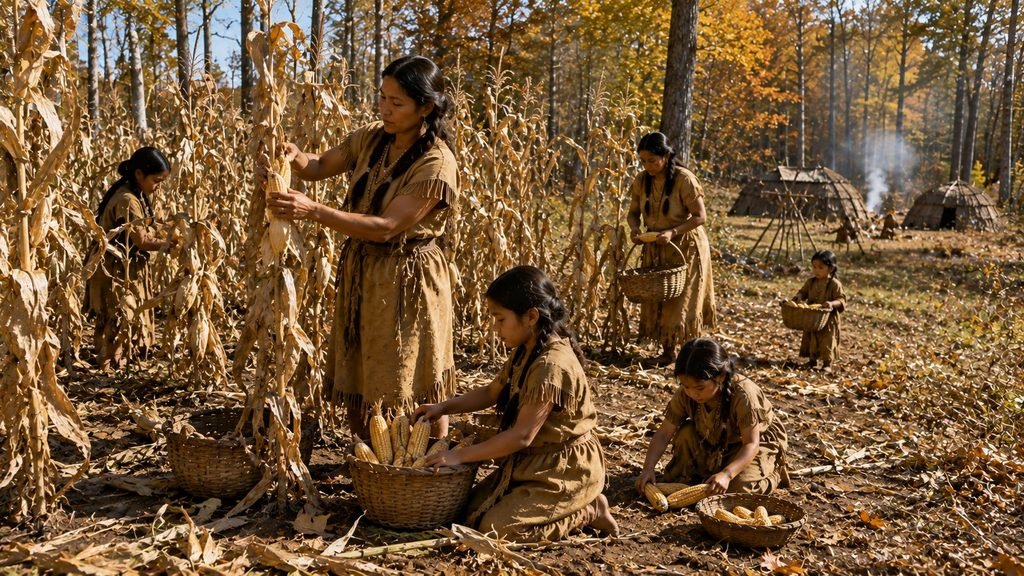
Michigan State University researchers William Lovis and Kathryn Egan-Bruhy examined evidence gathered during more than six decades of archaeological work along the lower Saginaw River. Their findings suggest maize was present in the region roughly 1,900 years ago.
That does not mean people immediately became intensive corn farmers. For a long period, maize appears to have been a relatively small part of the food supply. Only later did it become more economically important.
The distinction matters because it shows how gradually agriculture was adopted. Indigenous communities did not suddenly abandon older ways of finding food. They added farming to a system that already depended on fishing, hunting, wetlands, and gathered plants.
That made the food economy more flexible, not less.
Why Bury Food at All?
The obvious answer is winter, but Frederick’s research points to a more complicated problem involving mobility and risk.
Many Indigenous communities moved between different places during the year. Families might fish in one area, hunt in another, gather plants elsewhere, and return later to a major settlement. That seasonal movement created a simple but difficult logistical problem: food was heavy.
Carrying months of dried corn, nuts, or berries through miles of forest would have been costly and impractical.
Underground caches offered another solution. Food could be left at places people expected to revisit later. In effect, families could place supplies along a seasonal route rather than carry everything with them.
The idea has a modern parallel. A hunter who stocks a remote camp before winter or a family that leaves supplies at a seasonal cabin is solving the same basic problem.
The technology was different. The planning was not.
Archaeologists Tested the System
One of the more unusual aspects of Frederick’s work was its use of experimental archaeology.
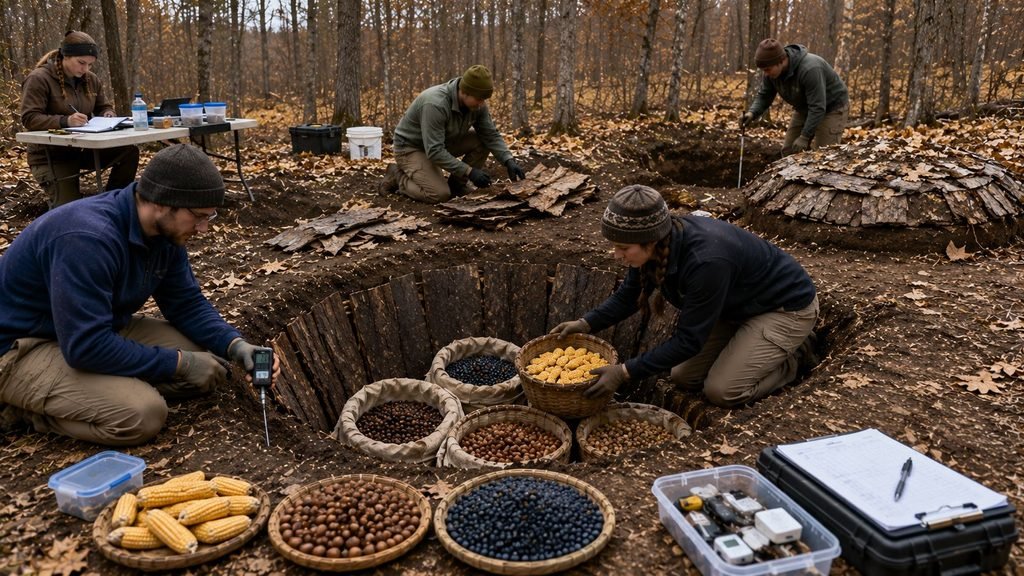
Instead of relying solely on pits excavated centuries after their use, researchers attempted to build and operate underground caches themselves.
The Michigan State University Subterranean Storage Research Experiment recreated Late Woodland storage methods using natural materials. Researchers placed dried blueberries, acorns, and corn in underground caches in November and left them through the winter.
They monitored temperature and humidity, adjusted designs over several experimental cycles, and eventually achieved successful storage. The recovered food was then tested for pathogens, toxins, and other safety concerns.
The experiment answered a question archaeology alone could not settle. A pit can survive for centuries, but the surrounding soil cannot easily show whether the food inside remained edible.
Rebuilding the system provided another way to test the technology.
The result was significant because it showed that underground storage was not merely plausible. Under the right conditions, it worked.
Further Reading: Food Storage in Michigan’s Late Woodland
Affiliate disclosure: Thumbwind Publications may earn a commission if you purchase this book through our Bookshop.org link, at no additional cost to you.
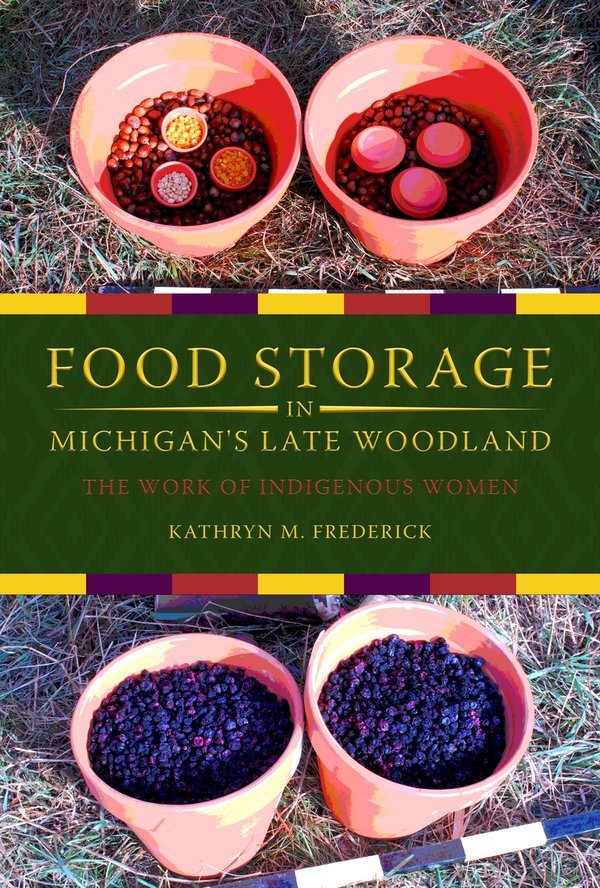
Michigan archaeologist Kathryn M. Frederick examines how Indigenous women used underground food caches to manage food supplies, mobility, and the risk of shortages in Food Storage in Michigan’s Late Woodland: The Work of Indigenous Women. Published by the University of Alabama Press in August 2026, the book draws on archaeology, ethnographic evidence, and experiments that tested whether subterranean food storage could survive a Michigan winter.
The Women Behind the Food Supply
Frederick’s larger contribution is not simply proving that people could store food underground. Her work shifts attention toward the people making those decisions, especially Indigenous women.
Older archaeological interpretations have often emphasized stone tools, weapons, pottery, and large structures because those materials survive well. Food work is harder to trace and easier to underestimate.
Yet managing stored food required constant judgment. Someone had to know when crops were ready, when berries and nuts were most abundant, and how much food could be consumed immediately. Someone had to decide what should be preserved, where it should be stored, and when a cache should be opened.
Those were not minor household tasks. They were economic decisions with consequences that could last for months.
A mistake in late summer might become a serious problem in February. A well-managed cache could prevent that problem.
Seen this way, food storage becomes part of a wider system of planning and authority. Frederick’s work argues that women were not simply preparing food after other decisions had been made. They were helping shape the decisions themselves.
Why Saginaw Bay Mattered
The geography of the Saginaw Valley helps explain why the region contains so much evidence of Indigenous settlement and food production.
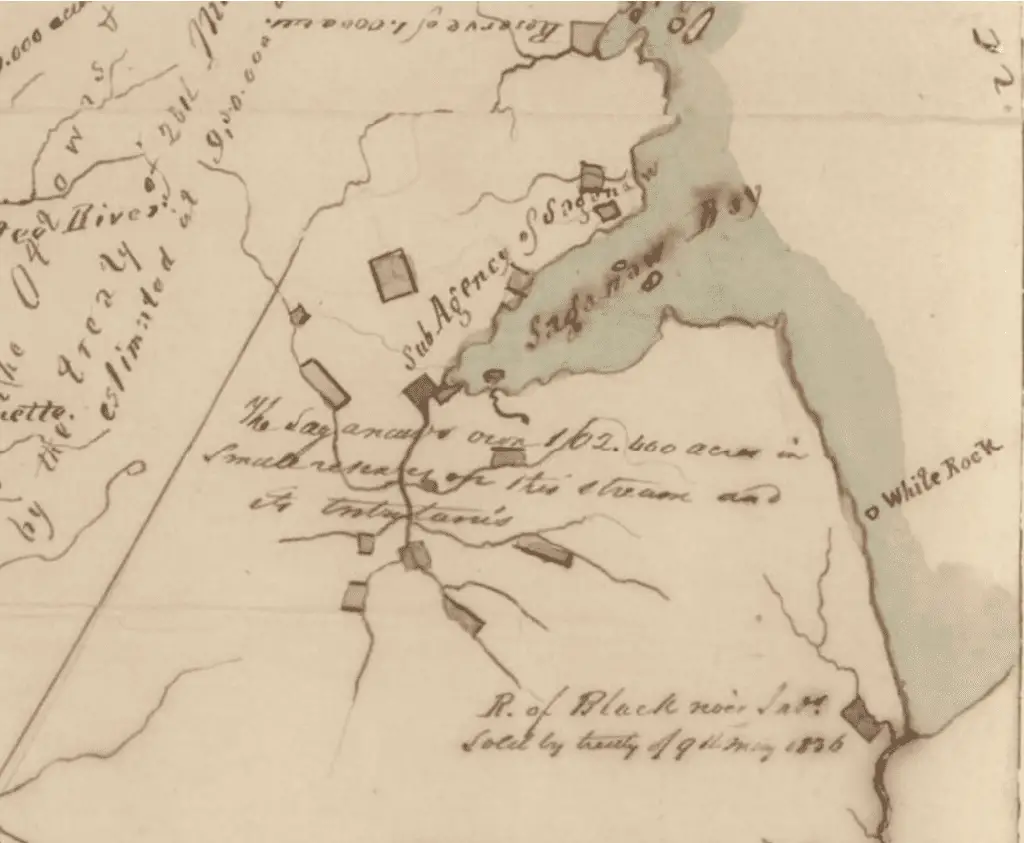
The Saginaw River system drains a broad portion of Lower Michigan. The Cass, Flint, Shiawassee and Tittabawassee rivers all feed into it. Those waterways served as transportation routes while also supporting fish, wetlands, wildlife, and fertile floodplains.
Archaeological sites at Clunie, Schultz, Frazer-Tyra and Tobico show repeated use of different parts of that system.
At Tobico in Bay County, archaeologists found evidence of Late Woodland occupation along old beach ridges and marsh edges. Food remains included fish, deer, muskrat, raccoon, acorns, tubers, and possible maize. Walleye and perch appear in the archaeological record there.
That detail makes the past feel less distant. Some of the same waters that attract anglers today were feeding people many centuries ago.
The difference is that those fish were only one part of a larger seasonal system that included wetlands, forests, crops, and underground storage.
The Thumb Was Part of the Same Regional Economy
The Upper Thumb appears to have played a different role from the main Saginaw Valley.
Later historical accounts from Huron County describe Indigenous people traveling into the region for hunting, fishing, and maple-sugar production. In spring, groups gathered where maple trees could be tapped and sap boiled into sugar. At other times, families hunted through heavily forested areas or used the shoreline for fishing and travel.
Those 19th-century accounts should not be automatically projected back onto the Late Woodland period, but they fit a broader pattern of seasonal movement documented by archaeologists.
Instead of imagining fixed villages surrounded by unused forest, it is more useful to think of a regional network. People moved between river settlements, fishing places, hunting territories, sugar camps, marshes and gathering areas according to the season.
The Saginaw Valley could support larger settlements and food production. The Thumb offered forests, wildlife, shoreline fisheries and seasonal resources. Storage allowed those places to function as parts of one larger system.
What a Shallow Depression Can Tell Us
That is what makes these old storage pits so revealing.
They lack the drama of a shipwreck, a ruined fort or a lighthouse. There is no towering structure and often little to see beyond a shallow bowl in the earth.
Yet a single depression can offer clues about where people traveled, what they ate, how they prepared for winter and how they managed uncertainty.
It can also point to forms of labor that older histories often pushed aside. Indigenous women were not merely preparing food after the hunt or harvest. They were helping manage one of the most important systems in community life.
They decided what could be eaten, what had to be preserved and what needed to be saved for months ahead. Those choices required knowledge of weather, harvest cycles, soils, storage methods and the likely needs of the community.
In a Michigan winter, that knowledge had practical consequences.
A Different Way to Read Michigan’s Early History
Frederick’s Food Storage in Michigan’s Late Woodland arrives after decades of archaeological work in the Saginaw Valley and across the Great Lakes region. New methods are adding detail to older findings, while experimental archaeology is testing how ancient technologies actually worked.
Together, that research is changing how Michigan’s early history can be told.
The questions are becoming more practical and more human. What did a family eat in February? Who made sure enough food remained? How did communities move between river valleys, forests and seasonal camps without carrying everything they owned?
The answers are beginning to emerge from places that once looked insignificant.
In the Saginaw Valley, some of the clearest evidence has been sitting quietly beneath sandy ridges for centuries.
Sources and Further Reading About Michigan Indigenous Food Caches
Kathryn M. Frederick, Food Storage in Michigan’s Late Woodland: The Work of Indigenous Women. University of Alabama Press, 2026. Frederick examines subterranean food caching, risk management and the role of Indigenous women in Late Woodland Michigan.
Fred Dustin, “Prehistoric Storage Pits in Saginaw County, Michigan”. Papers of the Michigan Academy of Science, Arts and Letters, Vol. 21, 1936. Dustin documented prehistoric storage pits in Saginaw County and described the relationship between fertile bottomlands and sandy ridges used for underground storage.
William A. Lovis and Kathryn C. Egan-Bruhy, “Multiproxy Analysis of Indigenous Maize (Zea mays) Use, Lower Saginaw River, Great Lakes, USA”. The Holocene, Vol. 35, No. 4, 2025. The study combines several forms of archaeological evidence to trace maize use in the lower Saginaw River region.
Michigan State University Department of Anthropology, “MSU Professor Emeritus Co-Authors Study on Indigenous Maize Use in Michigan”. Jan. 9, 2025. The university provides additional context on more than 60 years of archaeological research along the lower Saginaw River and the relationship between living areas, food preparation and underground storage.
Clarke Historical Library, Central Michigan University, Native American Archaeology Bibliography. The collection identifies Fred Dustin’s Saginaw Valley research and additional archaeological studies useful for understanding Indigenous occupation of mid-Michigan.