
 by

The End of the Road in Michigan returns for its eighth season, bringing listeners stories about the people, places and events that made Michigan what it is today.
For history buffs who enjoy hearing how things used to be, the new season offers a trip into Michigan’s past. Its stories range from early aviation and small-town telephone exchanges to Great Lakes maritime history, Detroit’s factories and the people who helped change American life.
Produced by Thumbwind Publications LLC, the podcast is based on historical research and stories featured on ThumbWind.com and Michigan4You.com.
The series is intended for listeners who enjoy Michigan history but may not have time to read lengthy historical articles. Episodes turn research into audio narratives you can enjoy while driving, walking, traveling, or relaxing at home.
And for longtime Michigan residents, many stories may sound familiar. They involve places people have visited, buildings they have passed, and names they remember hearing from parents or grandparents.
Season 8 Brings Michigan’s Forgotten Stories to Life
The new season continues the podcast’s emphasis on historical events that often receive little attention outside local museums and historical societies.

One recent episode, The First Ticket to Fly Across Michigan, takes listeners back to July 31, 1926, when Stout Air Services began scheduled passenger flights between Detroit and Grand Rapids.
Today, boarding a commercial flight is routine. A century ago, paying $18 to climb aboard an airplane for a trip across Michigan was an entirely different experience. The episode examines the early passengers, pioneering aircraft, and business decisions that helped establish commercial aviation in the state.
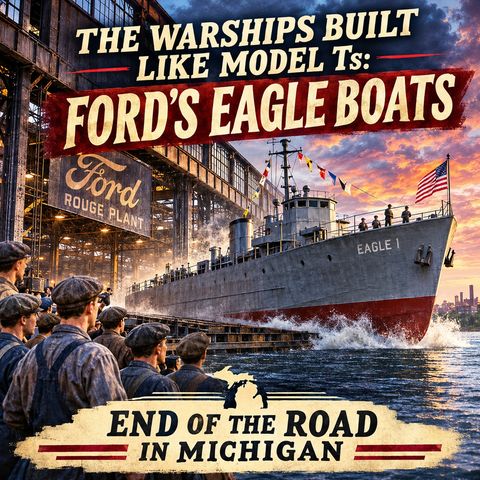
Another episode, Henry Ford’s Forgotten Navy, revisits an unusual chapter of World War I
In 1918, Ford attempted to apply automobile mass-production techniques to naval shipbuilding. The goal was to construct 100 steel patrol boats for the U.S. Navy. The effort encountered serious production problems, and only 60 vessels were completed. The story shows how Michigan’s industrial ambitions extended far beyond automobiles.
Listeners can also hear the decades-long fight to build the Mackinac Bridge. Before its opening in 1957, ferries carried motorists across the Straits of Mackinac. The episode follows the political disputes, financing difficulties and construction challenges that eventually connected Michigan’s two peninsulas.
Other episodes examine the origins of the Michigan State Police, the controversy surrounding Diego Rivera’s Detroit Industry Murals and Michigan women’s long campaign for the right to vote.
The podcast also revisits more personal stories, including the telephone operators who once connected calls in Lowell. Their work recalls an era when a community’s telephone switchboard was an essential service and the operator on duty often knew the people calling.
Why Michigan History Still Matters
Michigan’s history is often told through major industries and familiar public figures. Yet much of the state’s character developed in small towns, railroad depots, factories, fishing ports and farm communities.
A railroad could create a town almost overnight. A sawmill could provide work for hundreds of families. When the timber ran out or the trains stopped arriving, those same communities faced uncertain futures.
Great Lakes storms shaped the lives of sailors and their families. New roads changed how people traveled. Telephone service brought isolated communities into closer contact with the outside world.
These developments are central to The End of the Road in Michigan.
Rather than simply reviewing historical dates, episodes examine what happened, why it happened and how it affected the people who lived through it.
That approach also gives listeners a different way to understand places they know today. An ordinary stretch of highway may once have carried an interurban railway. A quiet waterfront could have been a crowded lumber port. A familiar factory building may have played a part in a national event.
The podcast follows those connections, helping listeners better understand how Michigan became the state they know.
A Podcast With Roots in Michigan’s Thumb
The series grew from the historical reporting and feature articles published by Thumbwind Publications, whose Michigan coverage began in 2009.
ThumbWind.com originally concentrated on the Thumb region, including Caseville, Port Austin, Bad Axe, Harbor Beach and the surrounding Lake Huron communities. Its coverage later expanded to include Michigan’s industrial history, Great Lakes shipping, lost settlements and other historical subjects throughout both peninsulas.
The podcast brings that same interest in local history to audio.
Earlier episodes have covered Michigan ghost towns, shipwrecks and unusual regional businesses. One recounts the J.W. Westcott Company’s floating mail service on the Detroit River, where a small boat delivers mail and supplies to passing Great Lakes freighters.
The result is an audio collection that connects the history of Michigan’s smallest communities with events that influenced the entire country.
Where to Listen to Season 8
All episodes of The End of the Road in Michigan are available through Spreaker.
Listeners can also visit the new Michigan History Podcast episode library on Michigan4You.com.
The interactive library displays individual episode artwork, descriptions and direct listening links. Visitors can search the collection to find programs about particular people, places or historical subjects.
The series is free to listen to, and new episodes are added to the podcast archive as they are released.
For Michigan history enthusiasts, former residents who have moved away and anyone who remembers hearing family stories about life in the Great Lakes State, Season 8 offers another opportunity to hear how Michigan’s past continues to shape its present.
Listen to The End of the Road in Michigan on Spreaker, and follow the podcast for future episodes.