 by
In 1924, a new hydroelectric plant began operating about three miles west of Glennie, Michigan. Three years later, the railroad branch through town closed. Glennie’s history runs through that overlap: older ways of earning a living continued while new uses of the river, roads, and lakes took shape.
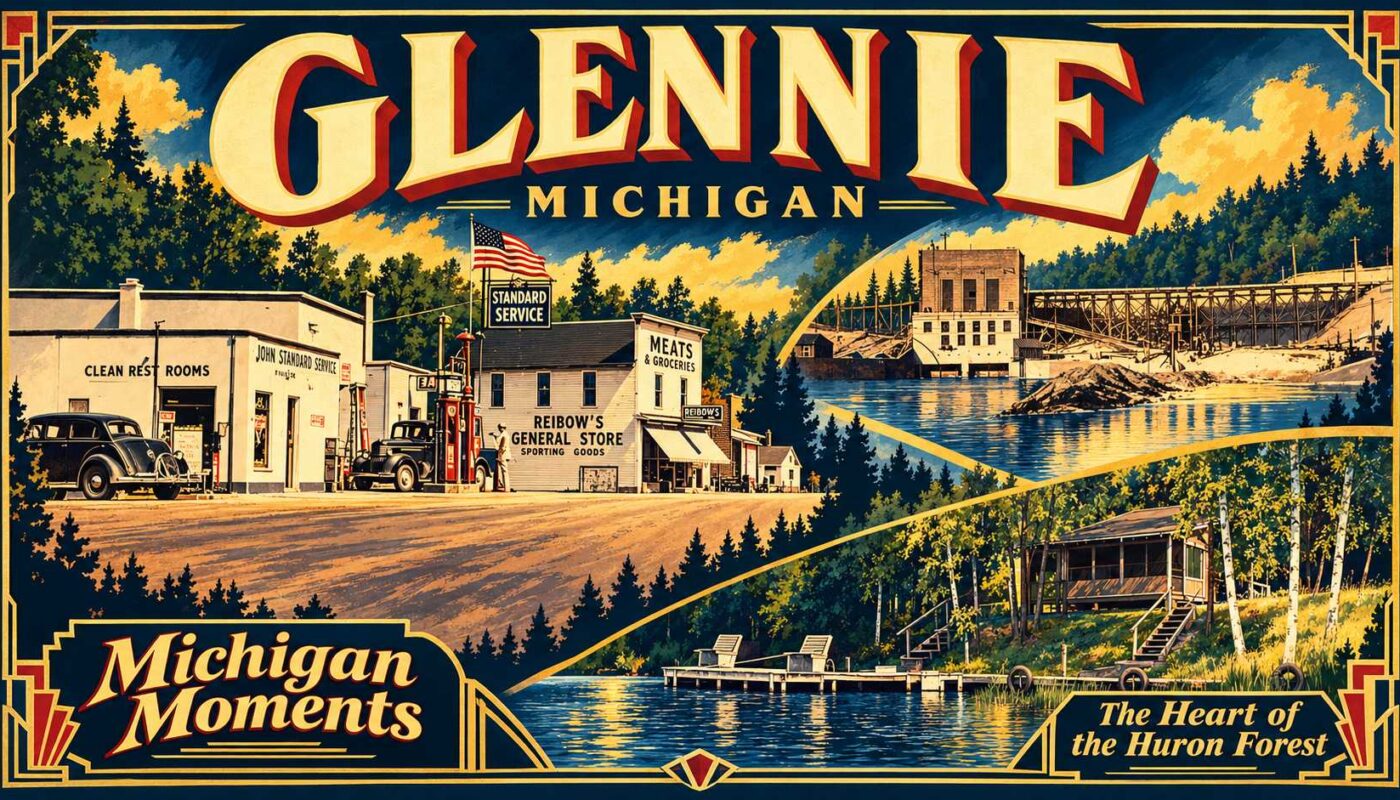
Glennie developed in Curtis Township, southwestern Alcona County, where lumbering drew settlers and businesses into the interior. Its later storefronts tell a broader story. Groceries shared advertising space with sporting goods, and gasoline pumps gave motorists another reason to stop.
The History of Glennie Michigan Begins with a Working Connection
The settlement’s railroad belonged to a system developed for the lumber trade. The Potts operation became the Au Sable & Northwestern, whose narrow-gauge tracks connected forest country with the region’s Lake Huron side. Detroit & Mackinac leased the line in 1912 and purchased it in 1914, according to the railroad’s historical chronology.
Glennie Station received its post office on Oct. 5, 1889, with Ella Deacon as the first postmaster. The name was shortened to Glennie in 1894. Mail service and a railroad stop helped connect local households with people and businesses outside the settlement.
The name honored John Glennie, who died in April 1880 while trying to rescue people aboard a stranded Lake Huron schooner. He fired a cannon intended to send a line to the vessel, but it burst. The contemporary newspaper account, reprinted in 2023, records a fatal rescue attempt on shore rather than a drowning.
A Church and a Place for Community Life
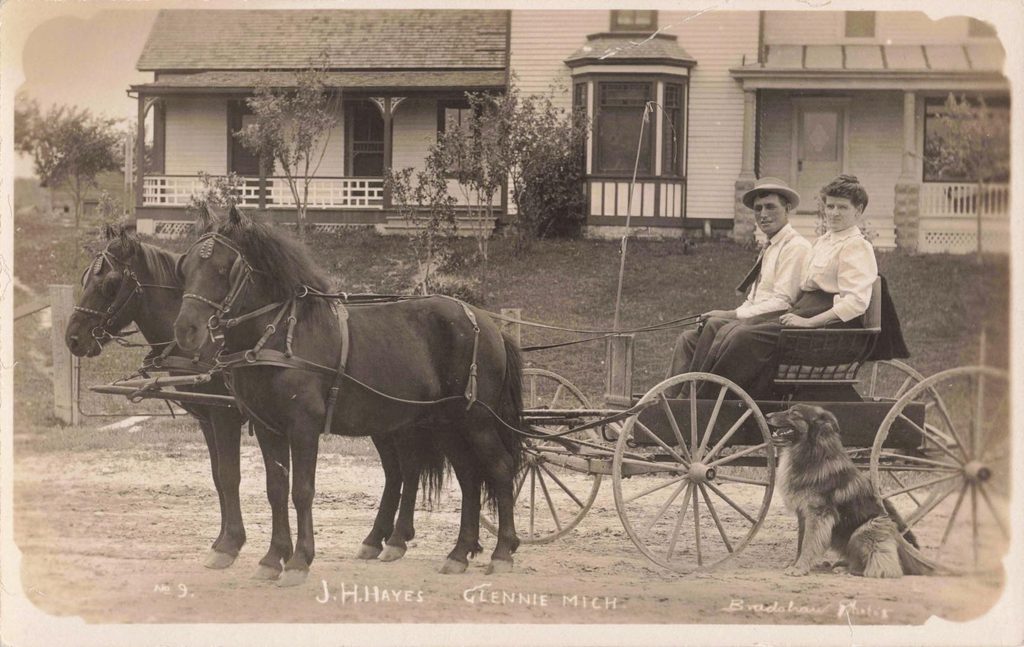
Rail service did not replace the need for local transportation. Horses carried people along roads between homes, businesses, and gathering places. The buggy view also shows the care invested in a substantial wooden house: decorative porch supports and a projecting bay window belonged to a household building a life here.
The Methodist Episcopal church brought another kind of investment. Its bell tower, arched windows, and steep rooflines made it recognizable beside an unpaved road. The building stood out as a public landmark among the surrounding houses.
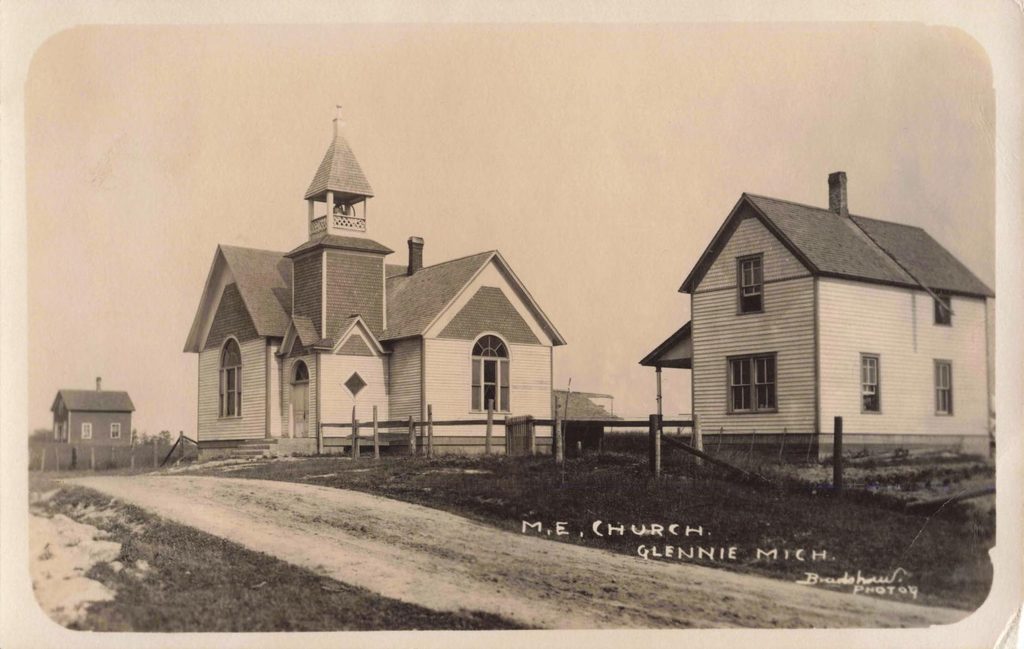
The 1908 Methodist conference minutes give community life useful dimensions. The Glennie charge reported 20 full members and two Sunday schools with 60 scholars. Children and teachers formed a larger circle than the membership figure alone suggests.
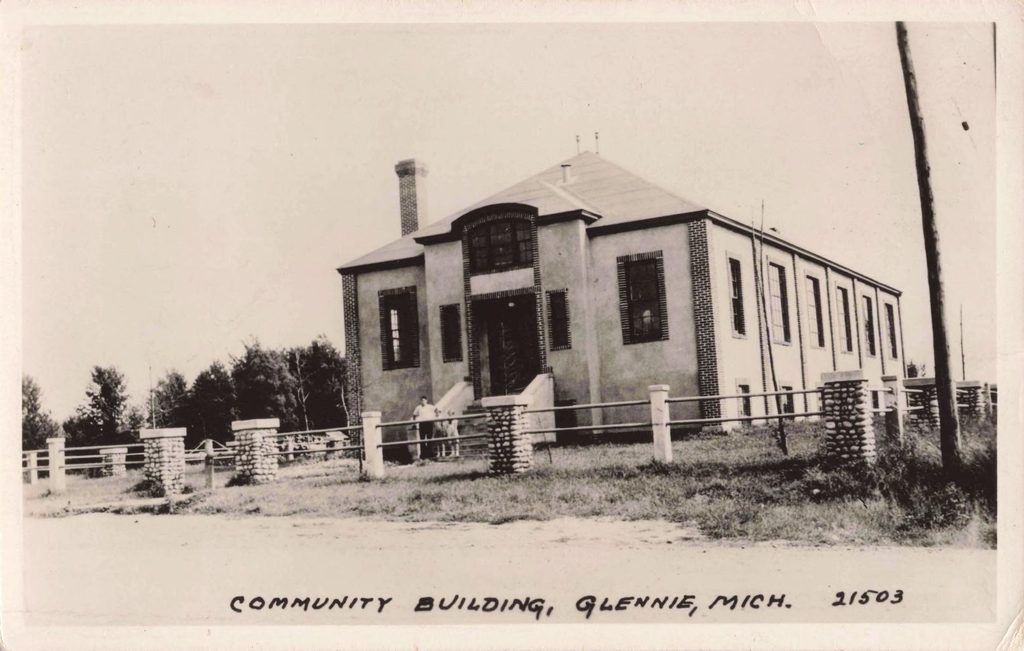
A separate postcard identifies Glennie’s community building. Its raised entrance and rows of tall windows stand behind a fence punctuated by stone pillars. Together, these Glennie historical buildings show public life taking physical form alongside private homes and commercial property.
Alcona Dam Changed the River’s Work
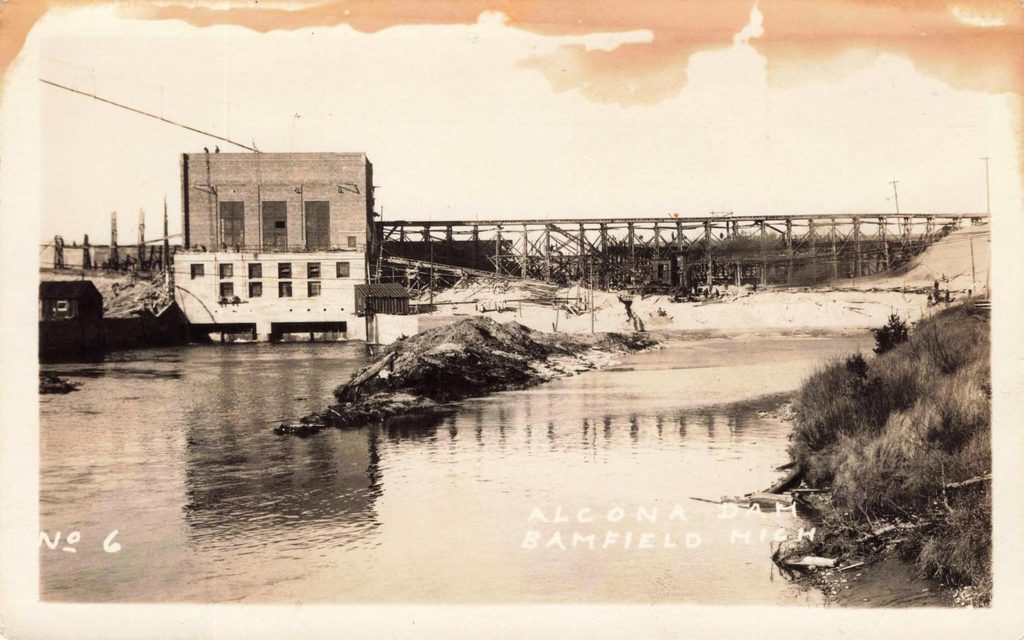
West of town, Alcona Dam introduced a different scale of construction. The powerhouse rose beside the river while extensive temporary framework crossed the works. Consumers Energy’s hydroelectric history dates commercial generation to 1924.
The river powered turbines and generators, and the dam held water in an upstream impoundment. This industrial project sat alongside small stores and wooden houses, linking the Glennie area to a wider electricity system.
North Lake Life Before the Railroad Closed
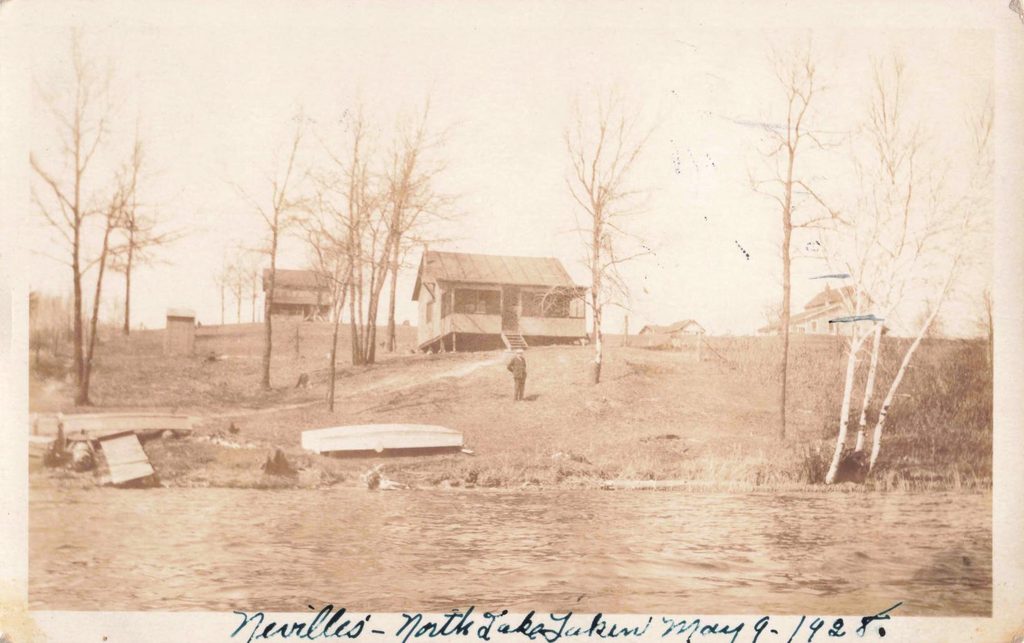
The history of Glennie, Michigan, also reaches beyond the village crossroads. At North Lake, cottages occupied rising ground above the water. One view shows a May 9, 1925 inscription and depicts small boats pulled ashore below a cottage.
That date places lakeside life within the railroad era. Recreation didn’t wait for the last train to arrive in the district. The cottage, its porch, and the boats show shore use that existed alongside the remaining rail connection.
Groceries, Sporting Goods and Gasoline
The branch was abandoned in 1927, but Glennie remained a service community. Its motor-era streets show shops positioned to meet several needs at once. Reibow’s General Store advertised sporting goods alongside food, while the adjoining Standard Service station offered gasoline and clean restrooms.
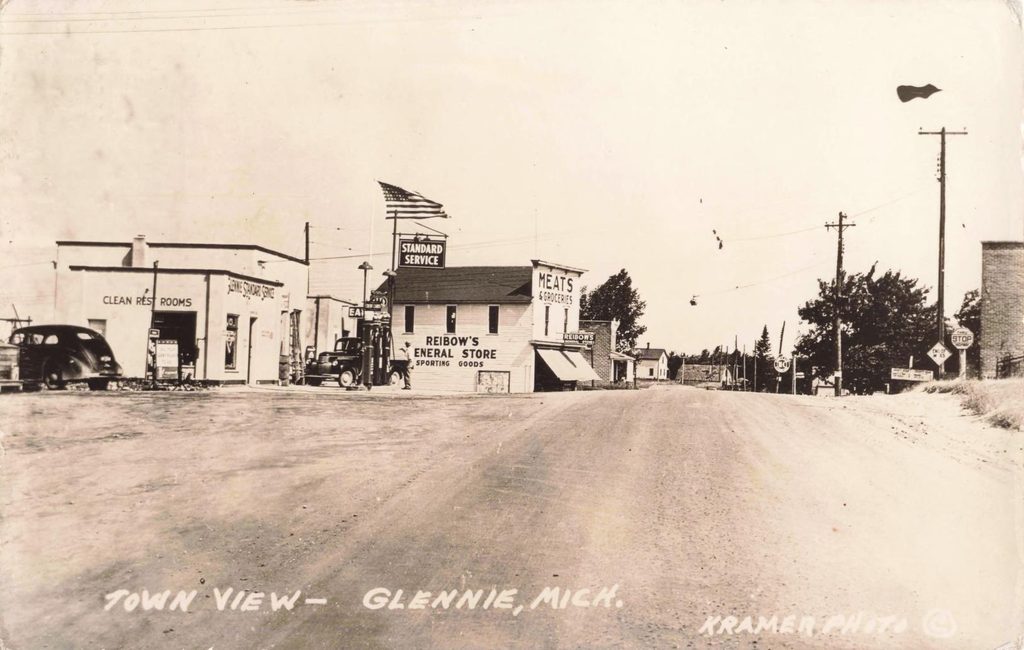
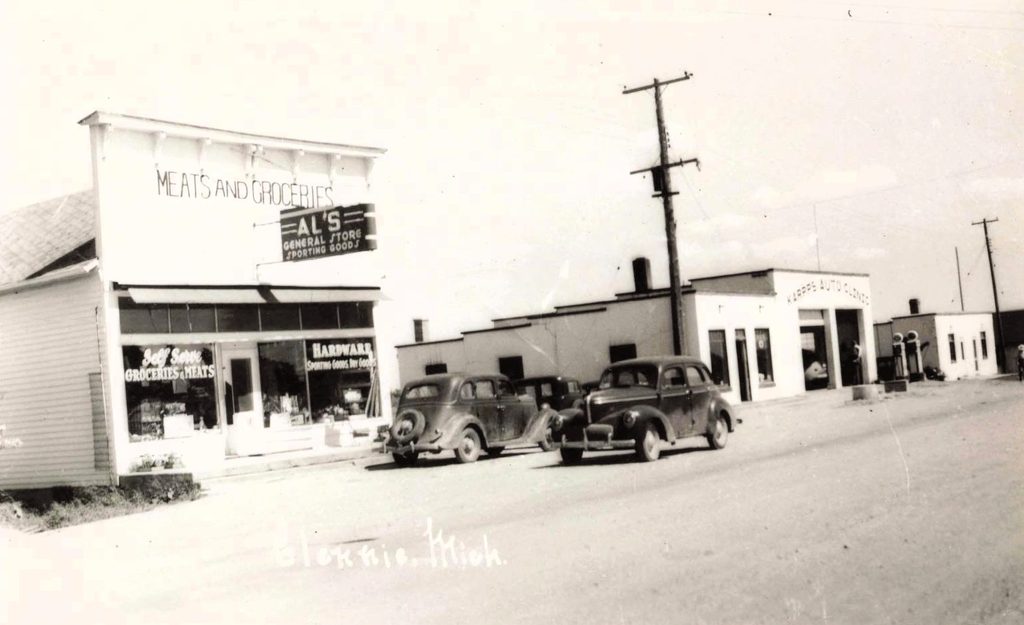
Al’s General Store offered a similarly broad selection, including hardware. Parked automobiles and the neighboring garage connect shopping with road travel. These signs are useful evidence for Glennie, Michigan history because they record what businesses actually offered, rather than what later memory assumes they sold.
Growing Trees and Spending Time by the Water
Federal forestry added another change. The Michigan National Forest was established in 1909, and the Huron designation followed in 1928. During the Depression, Glennie was among Michigan’s national forest CCC camp locations, part of a larger effort to restore and manage forestland.
At Shaw’s Camp on North Lake, the practical arrangements centered on the water. Steps connected a wooded cabin site with the shore. Chairs stood on the dock, giving people a place to sit and a way to reach a boat.
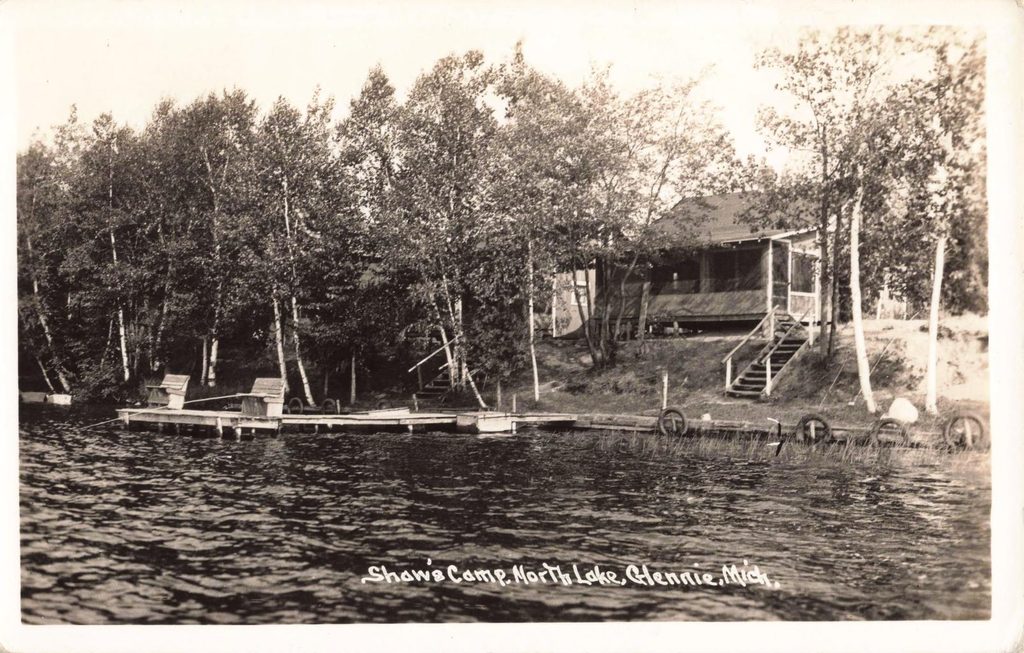
Historic Glennie, Michigan, accommodated these uses together. The general store supplied food and outdoor equipment; the garage served vehicles; lakeside buildings provided places to stay. Glennie’s history shows a clear overlap: North Lake cottages were established while the railroad still ran, and Alcona Hydro generated electricity before the branch closed.
Glennie, Michigan: Historical Timeline
Michigan Moments · 1880–1928
Glennie, Michigan:
Historical Timeline
A fatal rescue attempt. A railroad through lumber country. A river put to work generating electricity. Follow the years that helped shape Glennie and its surrounding lake country.
Select an event to open its story. Select an image for a larger view.
-
1880 The rescue attempt behind Glennie’s name Lake Huron · April
John Glennie joins an effort to rescue people aboard a stranded Lake Huron schooner. A cannon intended to send a rope to the vessel bursts when he fires it, fatally injuring him. A lifesaving crew later brings the vessel’s occupants safely ashore.
His name becomes the name of an inland community. Read the reprinted 1880 newspaper account .
-
1889 Glennie Station gets a post office Community · October 5
The Glennie Station post office opens with Ella Deacon as its first postmaster. Mail service gives the settlement another regular connection with people and businesses outside the local lumber district.
-
1891 A lumber railroad changes hands Au Sable & Northwestern
The Potts railroad operation passes to the Au Sable & Northwestern. Its narrow-gauge network links forest country with the Au Sable–Oscoda area on Lake Huron. The rails stand three feet apart.
-
1894 “Glennie Station” becomes “Glennie” A shorter name
The community’s postal name is shortened to Glennie. The change keeps the name honoring John Glennie while dropping “Station,” five years after the post office opened.
-
1908 Church records put numbers to community life Worship and education
Methodist conference statistics for 1907–08 record 20 full members in the Glennie charge. Its two Sunday schools report 60 scholars and 12 officers and teachers.
These figures describe the church charge as a whole. The separate postcard preserves the appearance of Glennie’s Methodist Episcopal church.

Methodist Episcopal church, early 20th-century view. Tinder Collection, Clements Library, University of Michigan. Exact image year unverified. -
1909 A national forest takes shape Federal forestry · February 11
President Theodore Roosevelt establishes the Michigan National Forest. Part of that forest will receive the Huron name in 1928, forming an important part of the setting associated with Glennie today.
-
1912 Detroit & Mackinac leases the line A new railroad operator
Detroit & Mackinac leases the Au Sable & Northwestern. The former lumber railroad comes under the operation of a larger regional railway.
-
1914 The railroad sale follows Lease becomes ownership
Detroit & Mackinac purchases the Au Sable & Northwestern operation. The 1912 lease and 1914 purchase are separate steps in the line’s history.
-
1924 Alcona Dam begins generating electricity A new job for the Au Sable
Alcona Hydro begins commercial operation west of Glennie. The powerhouse and dam put the river to work generating electricity and create an upstream impoundment.
The construction view shows the scale of the undertaking: a substantial powerhouse beside extensive temporary works.
Alcona Dam during construction, before its 1924 commercial opening. Tinder Collection, Clements Library, University of Michigan. -
1925 North Lake cottages are already here Lakeside life · May 9 inscription
A North Lake cottage view bears a handwritten May 9, 1925 inscription. Boats lie upside down along the shore below a cottage with a porch.
The date places this lakeside scene within the railroad era—two years before the branch through Glennie closes.
North Lake cottage scene, inscribed May 9, 1925. Tinder Collection, Clements Library, University of Michigan. -
1927 The railroad branch closes The community continues
Detroit & Mackinac abandons the former Au Sable & Northwestern branch through Glennie. The community continues after losing the rail connection that helped shape its development.
Alcona Hydro is already operating nearby, and the dated North Lake cottage scene shows that lakeside life has already become part of the district.
-
1928 The Huron National Forest name arrives Forest country · July 30
A presidential proclamation redesignates part of the Michigan National Forest as Huron National Forest. The name becomes closely associated with the wooded country surrounding Glennie.
The forest chronology begins in 1909; the Huron designation follows in 1928.
Questions About Glennie’s Past
Who was Glennie named for?
John Glennie, who died while helping attempt to rescue the occupants of a stranded schooner in 1880.
Which railroad served Glennie?
The Au Sable & Northwestern served the community before Detroit & Mackinac took over its operation.
When did Alcona Dam begin producing electricity?
Its hydroelectric plant began commercial operation in 1924.
What does “narrow gauge” mean?
It describes track narrower than the standard railroad gauge. The early Au Sable & Northwestern used rails three feet apart.
What did the CCC contribute?
Civilian Conservation Corps crews worked on tree planting, roads, recreation facilities and fire protection. Glennie appears among Michigan’s national forest camp locations in the state’s forestry history.
Do you recognize a business owner, a cottage, or someone in these Glennie scenes? Family records and dated local images can help identify the people and places.
? Works Cited
Consumers Energy. “Hydroelectric Generation.” Accessed 2 Nov. 2026.
Methodist Episcopal Church. Minutes of the Detroit Annual Conference, 1908. Michigan Conference Archives.
Michiganrailroads.com. “Railroad: The Au Sable & Northwestern Railway Company.” Accessed 2 Nov. 2026.
Moore, Mike. “The National Forests in Michigan: A Short History.” Michigan Society of American Foresters.
National Archives and Records Administration. “Records of the Forest Service.” Section 95.11.9. Accessed 2 Nov. 2026.
Parsons, William. “Scooner Flounders in Storm, John Glennie Dies in Rescue Attempt.” Alcona County Review, 19 Apr. 2023, p. 5. Includes an account originally published 23 Apr. 1880.
Roorda, Eric Paul. “More on John Glennie and Chris Grover—Part I.” Alcona County Review, 26 Apr. 2023, pp. 8, 10.
Silent Whistles. “SWS (RAAS)—Glennie on the AS&NW (D&M).” Geocaching. Accessed 2 Nov. 2026.
William L. Clements Library, University of Michigan. David V. Tinder Collection of Real Photo Postcards. Items TINDER-RPPC-000081, 000095, 000105, 000109, 000113, 000125, 000127 and 000135. Supplied digital copies. Gift of David and Cynthia Walters, Meaghan and Joel Cole, and Jennifer and Zachary SantAmour.