 by
by 
Weather radar revealed a major southbound movement early Wednesday, while Michigan Fall bird migration over Huron County’s skies remained comparatively quiet.
Bad Axe, Mi. – September 9, 2026 – More than 2 million migrating birds were estimated to be flying over Michigan early Wednesday morning as the state’s fall migration season gained momentum.
At 3:20 a.m. Sept. 9, the Cornell Lab of Ornithology’s BirdCast system estimated that 2.37 million birds were aloft over Michigan. The migrants were traveling southeast at an average ground speed of 45 mph and an average altitude of about 2,100 feet.
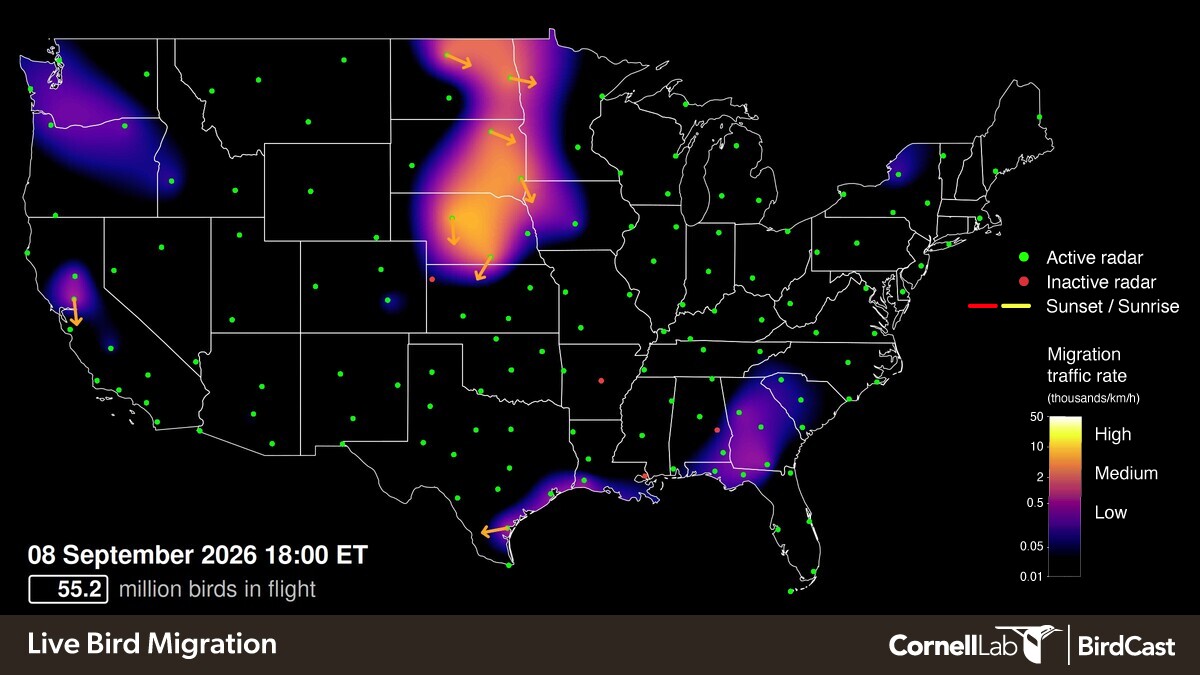
By 3:50 a.m., the estimate had declined to about 2.01 million birds in flight, while nearly 1.1 million birds had completely crossed the state since 8:10 p.m. Tuesday.
The changing figures reflect snapshots of a migration already in motion. A bird can be counted among those in flight without crossing the entire state, and some birds may land before sunrise.
The statewide movement was not distributed evenly. In Huron County, BirdCast estimated that only about 200 birds had crossed the county during the same night. No birds were detected in flight there at the dashboard’s 3:50 a.m. reading.
That contrast illustrates why statewide totals do not necessarily describe conditions over the Thumb at a particular moment. Weather, wind and the geography of the Great Lakes can shift migration pathways from one part of Michigan to another.
Radar Reveals a Michigan Fall Bird Migration Most People Never See

BirdCast uses data from the national weather-surveillance radar network to detect birds moving through the atmosphere. Its algorithms distinguish patterns associated with birds from precipitation and estimate their numbers, direction, speed and altitude.
The system does not track individual birds, and its totals are estimates rather than direct counts. Radar also generally cannot identify which species are flying. BirdCast supplements its radar results with observations submitted to Cornell’s eBird program to suggest species likely to be arriving or departing during a particular week.
The system processes data from 143 radar stations and updates its local dashboards about every 10 minutes during the night. Its live migration feed operates from Aug. 1 through Nov. 15 during the fall season.
Most fall migration through the contiguous United States occurs from early September through October. Many songbirds travel after dark, when the atmosphere is cooler and typically less turbulent.
BirdCast says more than 80% of North America’s migratory bird species migrate at night.
Turn Off Unnecessary Lights
Heavy migration nights carry a public-service message for homeowners, businesses and local governments.
Artificial light can attract or disorient nocturnal migrants, drawing them toward buildings and other structures. Glass creates an additional hazard because birds may not recognize windows as solid barriers.
BirdCast recommends switching off unnecessary lights from dusk until dawn during fall migration, particularly between Aug. 15 and Nov. 30. Curtains and blinds can reduce light escaping from buildings, while shielded fixtures can direct necessary outdoor lighting toward the ground.
The U.S. Fish and Wildlife Service also recommends dimming unnecessary lights and using timers, motion sensors and warmer-colored fixtures where illumination is required. These measures can reduce collision risks while lowering energy use.
Residents can follow migration conditions through the Michigan BirdCast Migration Dashboard. BirdCast also provides county dashboards, including a Huron County migration page, that allow readers to compare local activity with the statewide picture.
Because the figures change throughout the night, each reading should be understood as a time-stamped estimate—not a final count of every bird that passed over Michigan.
Information about reducing lighting hazards is available through BirdCast’s Lights Out program and the U.S. Fish and Wildlife Service’s bird-conscious lighting guidance.