 by
by 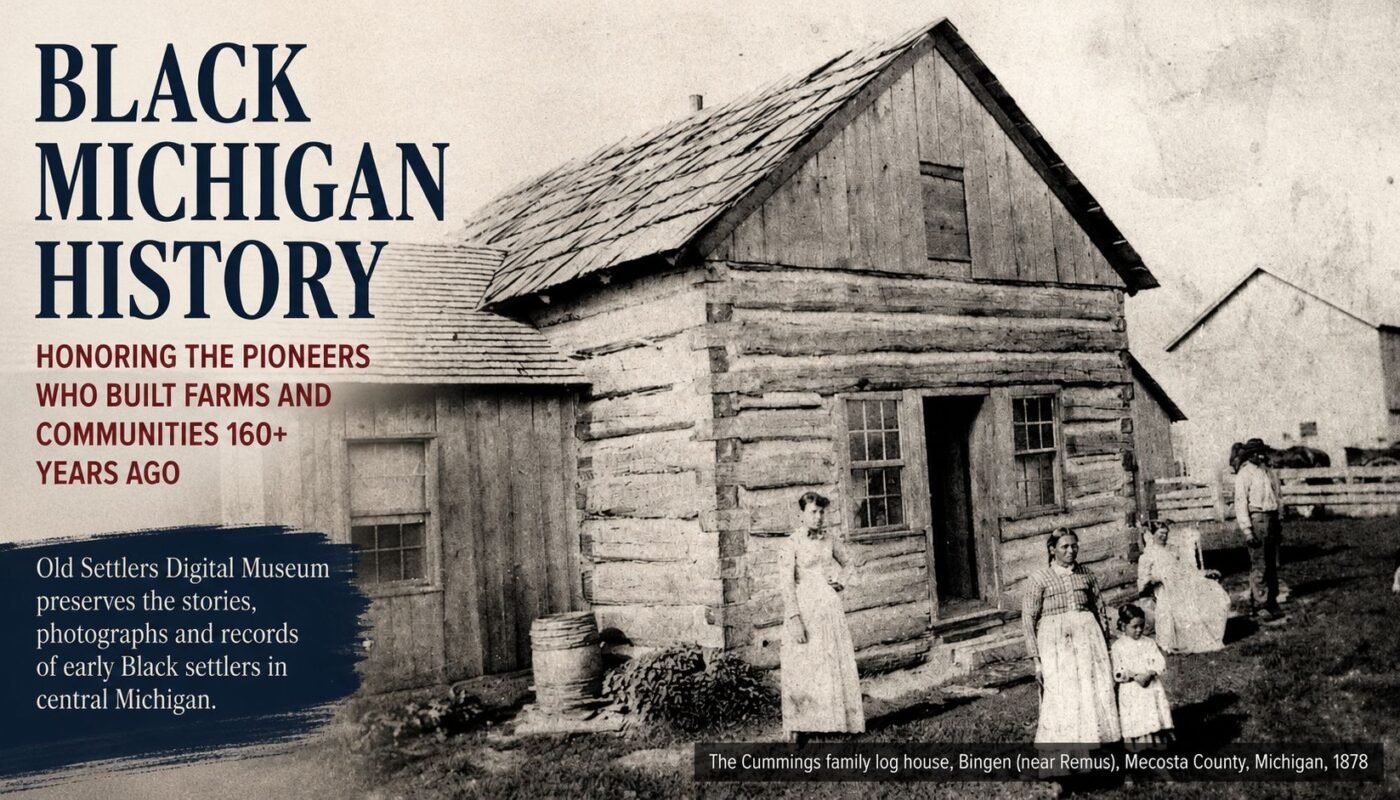
A $5,000 gift is helping descendants of Black pioneers preserve the photographs, documents and family stories of communities established in central Michigan more than 160 years ago.
MECOSTA, Mich. — A piece of Black Michigan History that began before the Civil War ended is getting new help from 21st-century technology.
Their descendants are now using a digital museum to make sure those stories survive.
The Old Settlers of Mecosta County received a $5,000 donation Aug. 15 to support the Old Settlers Reunion Digital History program. The gift came during the organization’s 92nd annual reunion at School Section Lake Veterans Memorial Park.
The online museum preserves photographs, documents, oral histories, family records, quilts and other material connected to Black families who settled in Mecosta, Isabella and Montcalm counties. Interest in the collection has expanded among universities, libraries, museums, authors and historical researchers.
Black Michigan History Began on Central Michigan Farms
The story reaches to about 1860, when Black settlers began establishing homes in Mecosta, Isabella and Montcalm counties.
Central Michigan University research identifies Dorvil Whitney as the first documented Black settler in Isabella County in 1860. Black families arrived in greater numbers the following year. Some had escaped slavery before moving to Michigan, while others arrived from Ohio, southern Michigan, and Canada.
In Mecosta County, James Guy is identified as the first documented Black settler. Old Settlers records say Guy obtained 160 acres in Wheatland Township and received a land patent signed during Abraham Lincoln’s presidency.
Land ownership became an important part of the community’s story. By 1873, Black residents owned 1,392 acres across Mecosta, Isabella, and Montcalm counties, according to Michigan Humanities. Many worked as farmers and woodsmen while establishing homes in and around communities that would become associated with Remus, Millbrook and School Section Lake.
Their arrival also occurred during a complicated transformation of central Michigan. CMU researchers note that families settled on land previously transferred from the Saginaw Chippewa Indian Tribe through treaty agreements. The Old Settlers themselves included Black, Native American, and white ancestry, and descendants continue to document relationships among those communities.
Farms Led to Schools, Churches and Communities
The Black Farming Communities created in central Michigan also produced schools, churches, cemeteries and businesses.
They established churches, cemeteries and schools, sometimes alongside their white neighbors. A Michigan historical account notes that schools and churches founded in the region were integrated, including the Wheatland Church of Christ, organized near Remus in 1869.
One surviving landmark is the Little River Schoolhouse at School Section Lake.
Isaac and Lucy Berry purchased 80 acres there in the 1870s. Isaac Berry, who had escaped slavery and gone to Canada before coming to Michigan, built an early log schoolhouse. Lucy Berry became its first teacher. The school developed as an early multiracial institution serving local families.
Another physical link to the settlement is the Morgan West Wheatland Cemetery near Remus. Established in the 1860s, it became the area’s largest historic Black burial ground and was added to the National Register of Historic Places in 2014. Pioneer families and Civil War veterans are among those buried there.
Descendants Went Far Beyond the Farms
The legacy of those farm families eventually reached universities and international affairs.
Old Settlers research helped Central Michigan University identify Emma Norman Todd as its earliest known African American graduate. Todd attended Central Michigan Normal School in 1907 to become a teacher. Researchers traced her family to the Old Settlers with help from her descendants.
Another descendant, Merze Tate, was born in rural Michigan in 1905. Her grandparents were among Mecosta County’s early Black settlers. Tate went from walking miles from her family’s farm to school to becoming an internationally recognized scholar. Western Michigan University says she later became the first Black woman to earn a doctorate in government and international relations from Harvard University’s Radcliffe College.
Those connections help explain why the Old Settlers collection has attracted growing academic attention.
A Digital Museum Gives the History a Wider Audience
The Old Settlers organization began its annual reunion tradition in 1934. In recent years, preservation has increasingly moved online. Its website developed into a digital museum containing family histories, photographs, videos and historical documents, and the site has also been selected for preservation in the Library of Congress Web Archives.
This year’s reunion showed how far that interest has spread.
Guests included Central Michigan University President Neil MacKinnon, representatives of CMU’s Clarke Historical Library and a videographer from Ferris State University’s Jim Crow Museum. The expanded Jim Crow Museum is scheduled to open Sept. 30 in Big Rapids and is expected to include Old Settlers history among its presentations.
Author Sonya Bernard-Hollins, who has written about Merze Tate, also attended and interviewed descendants for additional work documenting their experiences.
The $5,000 donation will help continue that preservation work.
But the larger value of the project is what is being preserved: evidence that Black Michigan history did not begin and end in Detroit or other industrial cities.
Long before the Great Migration reshaped Michigan’s urban centers, Black farmers were buying land, building homes, opening schools and raising families in the woods of central Michigan.
Their descendants are now making sure that history can be found.
Primary resources: Old Settlers Reunion Digital Museum | Old Settlers Reunion history project | Central Michigan University research on the Old Settlers | National Park Service — Morgan West Wheatland Cemetery