
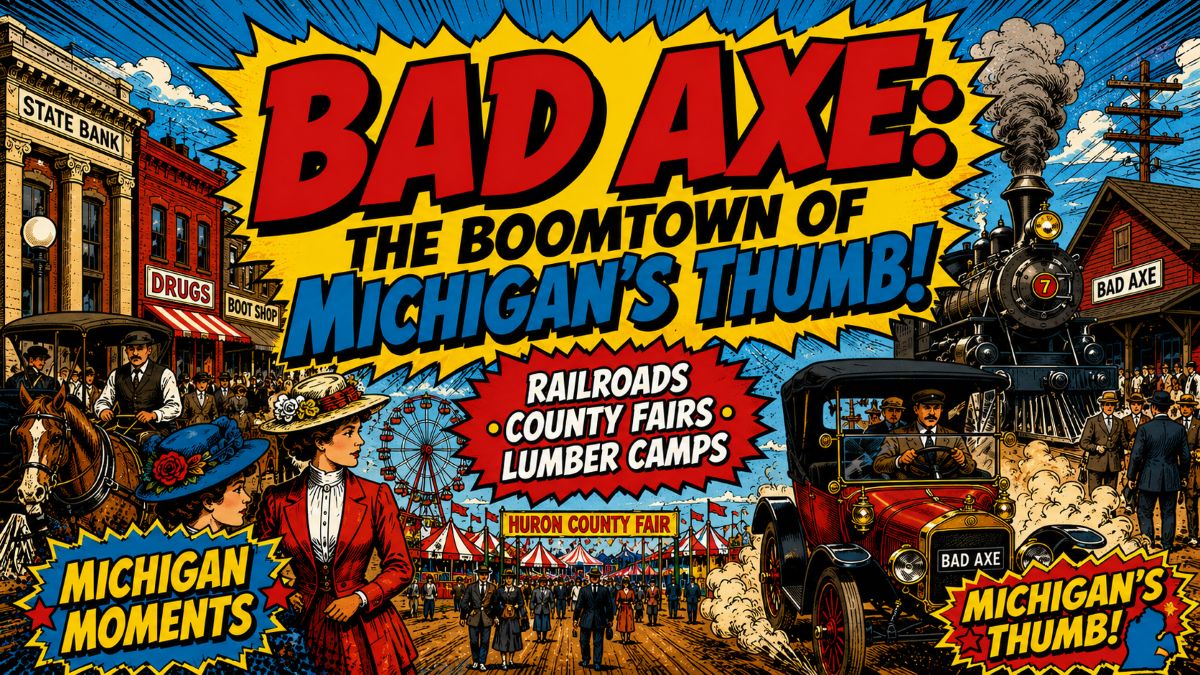
Bad Axe is one of Michigan’s most memorable place names. But the history of Bad Axe is about more than a broken tool found near a campsite.
This Michigan Moments video looks at the history of Bad Axe Michigan, and how it became the inland center of Huron County. The story includes a county seat fight, a major fire, railroad service, the Huron Community Fair, Gov. Albert E. Sleeper and the nearby Palestine Colony, Michigan’s first recorded Jewish farming settlement.
Watch The Video
The history of Bad Axe began with a name that sounded rough but proved hard to replace. In 1861, surveyors working on a state road found an old broken axe near a campsite north of the future village. The name Bad Axe stuck.
By 1870, the community had a post office. By 1872, Huron County supervisors voted to place the county seat there. County records moved to Bad Axe in October 1873.
The town’s future was tested in 1881, when fire destroyed nearly the entire village except the courthouse and a few small houses. One year later, railroad service reached Bad Axe on the line to Port Austin. That timing helped turn disaster into growth.
By the early 1900s, Bad Axe had become a full-service county town, with stores, hotels, banks, schools and public institutions. In 1905, it became Huron County’s first city.
The town nearly lost its name in 1909, when a legislative move changed the city’s name to Huron, subject to local approval. The change did not last.
The history of Bad Axe also includes the Huron Community Fair, one of Michigan’s longest-running fairs, and Albert E. Sleeper, a Bad Axe resident who later served as governor of Michigan. Just outside town, the Palestine Colony became Michigan’s first recorded Jewish farming settlement in 1891.
Bad Axe was never just a place with an unusual name. It became the working civic center of Michigan’s Thumb.
Video Details
Series: Michigan Moments
Topic: History of Bad Axe
Location: Bad Axe, Huron County, Michigan
Related Article: History of Bad Axe, Michigan
Video URL: https://youtu.be/BFo5mEfpmgs
Transcript
This is Michigan Moments, sharing the pioneering history of the Great Lakes State.
Bad Axe should have been easy to miss. It sat in the middle of Michigan’s Thumb, away from the shoreline harbors where lumbering and commercial fishing made fortunes. Yet this is where Huron County held its records, its courtroom, its business block and its community fair each August.
The name came first.
In 1861, surveyors working on a state road reached a campsite near a mineral spring north of the future village. An old broken axe was found there. The words “Bad Axe” were fixed to the place, and the name stayed.
A post office followed in 1870. It was becoming a point people could write to, travel to and count on.
Then came the county seat fight.
After the courthouse burned in 1864, the seat moved for a time to Port Austin. The argument never really settled until the board of supervisors voted in 1872 to place the seat at Bad Axe. County records moved there in October 1873.
Septimus Irwin cleared the site, put up a temporary public building and soon began a hotel. That is when Bad Axe changed from a wide spot in the road into a working civic center.
The next turn was harsh but decisive.
In 1881, a fire destroyed nearly the whole village except for the courthouse and a few small houses. That could have ended the place. Instead, the fire served almost like a reset.
One year later, railroad service reached Bad Axe on the line to Port Austin, and the town gained the outside link it had lacked.
That pairing, disaster followed by transport, is one of the strongest moves in the story. The fire cleared space. The railroad filled it with traffic, goods and new purpose.
By the 1880s and early 1900s, Bad Axe looked less like a frontier county seat and more like a full-service town. Stores handled general merchandise, hardware, furniture and clothing. Banks stood near legal offices. Hotels gave travelers and court visitors a place to stay.
A school system and later a memorial hospital signaled that the town expected families to put down roots, not just pass through.
When Bad Axe became Huron County’s first city in 1905, the papers merely confirmed what the street already showed. This was the inland center of the Thumb.
Then in 1909, Bad Axe nearly lost the very name that made it stand out. A legislative move changed the city’s name to Huron, subject to local approval. The change never stuck.
Rail traffic kept widening the town’s reach. The earlier line had already connected Bad Axe to outside markets, and a Grand Trunk branch from Cass City opened in 1913.
Near the tracks stood a chicory plant. Later, a cream plant in Bad Axe fed product into the Detroit market. Even an early automobile dealership, Yageman Motors, called Bad Axe home.
The fair may be the best single symbol of what Bad Axe became.
By the early 1900s, the county fair was already drawing packed crowds, horse races, carnival machinery and a midway offering a brief thrill. It was entertainment, yes, but it was also a county reunion.
People came to compete, to sell, to gossip, to court, to show livestock and to see who was doing well.
The fair still runs into its 158th year in 2026. It is considered Michigan’s longest continuously running fair.
Bad Axe also produced people whose names reached far outside the county.
Albert E. Sleeper kept a major residence in town and went on to serve as governor of Michigan in the late 1910s. His house in Bad Axe is listed on the National Register of Historic Places, and a state park in Huron County carries his name.
There is one more turn that gives the story extra depth.
Just outside Bad Axe, the Palestine Colony became the first recorded Jewish farming settlement in Michigan in 1891. It did not last long, but that is not the point. The point is that Bad Axe sat close to one of the state’s most unusual settlement stories, a place where immigrant ambition, farm hardship and local geography met.
That is what makes the history of Bad Axe worth the full telling.
It was not simply a place with a rough-sounding name. In this town, the ordinary work of a county built a place people still come to today.
Thanks for listening. Please like and follow us for future episodes.
This has been Michigan Moments, offering bite-sized morsels of Michigan history.
Related Thumbwind Article
For the full story, read: History of Bad Axe, Michigan
More Michigan Moments
Watch more short videos on Michigan history, small towns, Great Lakes communities and forgotten stories from the Thumb and beyond.