 by
by 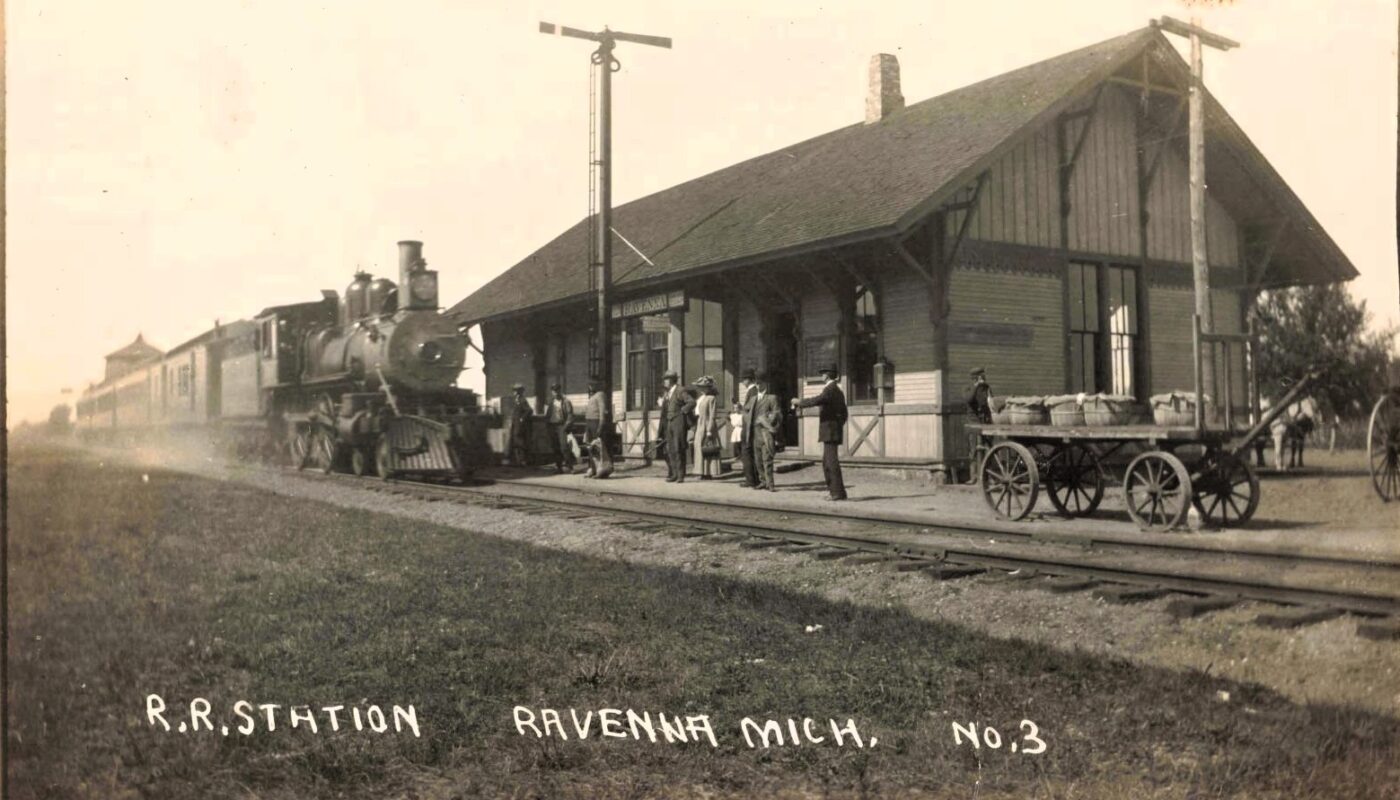
At first glance, the early photographs of Ravenna look familiar: a mill, a dirt Main Street, a railroad depot, a few modest homes. But taken together, these images tell a more important storyRavenna Michigan history is one about how small towns in Michigan survived a major economic shift.
By the early 1900s, Ravenna was no longer a frontier outpost. It had become a working agricultural town, tied to regional markets by rail and shaped by the people who adapted when the lumber economy collapsed.
That transition did not happen overnight. It unfolded in places like Ravenna, one wagonload, one storefront, and one train shipment at a time.
From Forests to Farmland
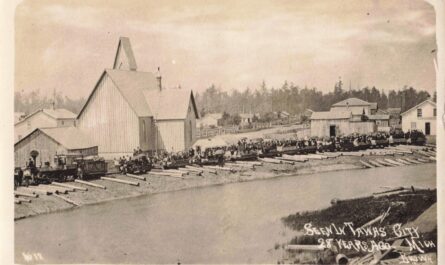
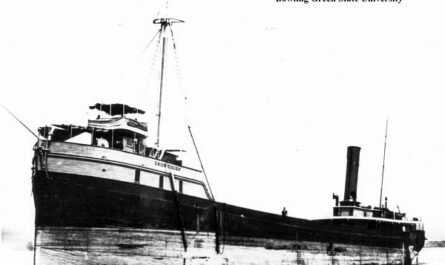
Like much of western Michigan, Ravenna’s earliest growth was tied to timber. The region’s dense pine forests fueled a booming lumber industry in the mid- to late-1800s. Logging camps, sawmills, and river transport defined daily life.
But by the turn of the century, that era was ending. The forests were largely cut over. What remained was land—cleared, uneven, but usable. Across Muskegon County, farmers began to take over where loggers left off.
Ravenna Michigan history became part of that second chapter. The surrounding countryside shifted to crops and orchards. Wheat, corn, and other grains became reliable sources of income. Farming required different skills, different infrastructure, and different types of businesses. It also created stability.
Unlike logging, which moved as forests disappeared, agriculture anchored people to the land.
The Mill as the Center of Town Life
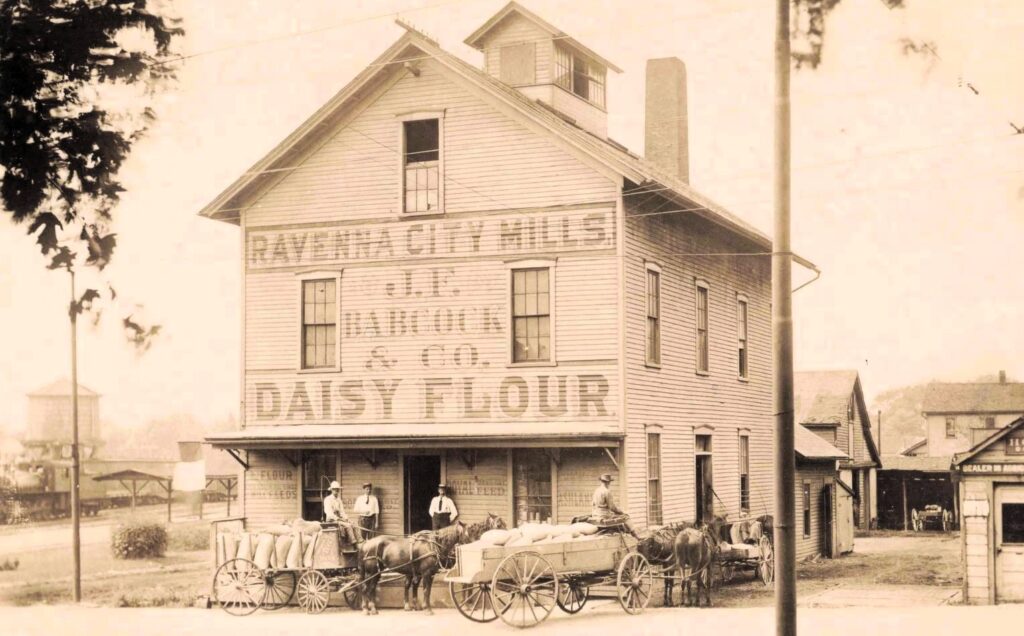
The Ravenna City Mills stands as one of the clearest symbols of this transition.
The building itself is large but practical—wood-framed, multi-story, and positioned for access. Painted across its side are the words “J.T. Babcock & Co.” and “Daisy Flour.” Those markings matter. They show that Ravenna was not just producing for itself. It was producing for others.
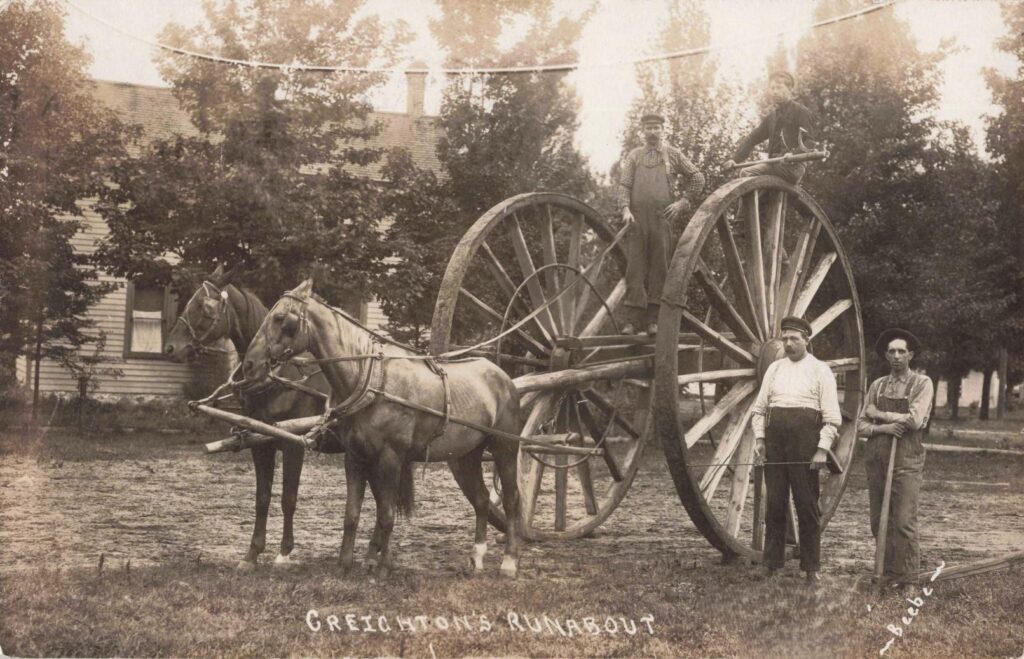
Farmers hauled grain to the mill using horse-drawn wagons. The mill processed it into flour, which could then be shipped out. That step—turning raw crops into finished goods—added value and connected Ravenna to a broader economy.
The scene outside the mill captures this system in motion. Teams of horses wait beside loaded wagons. Workers stand nearby, likely coordinating deliveries or preparing shipments. This was not a quiet operation. It was a steady flow of goods and labor.
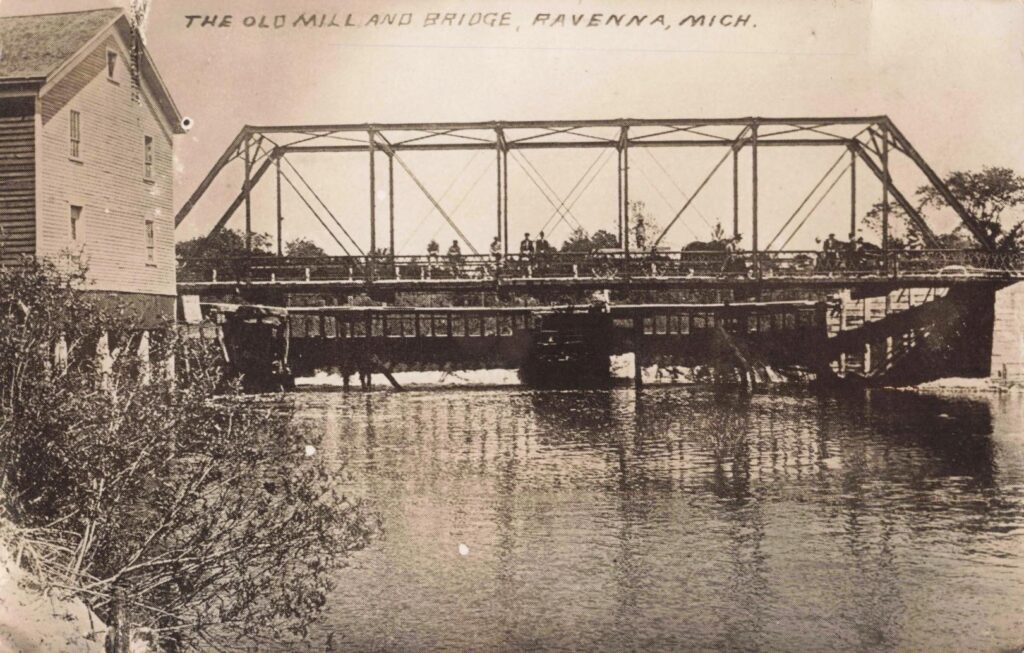
In many small towns, the mill functioned as both an economic engine and a gathering place. News traveled there. Prices were discussed. Decisions were made. In Ravenna Michigan history, it was where agriculture met industry.
Railroads: The Lifeline of Small-Town Growth
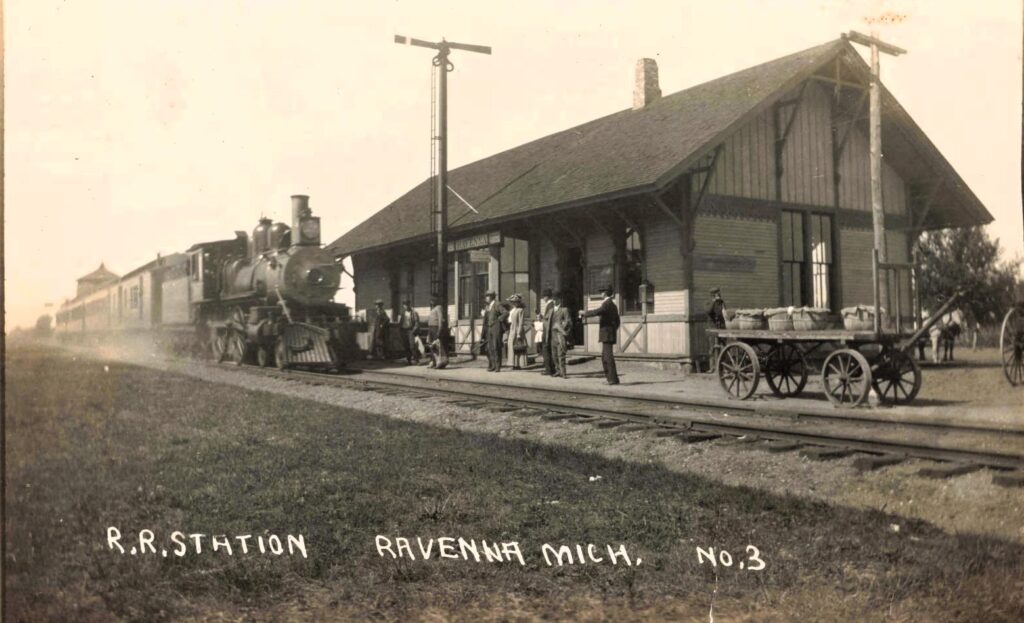
If the mill was the heart of Ravenna’s economy, the railroad was its lifeline.
The Ravenna depot, captured in early photographs, shows a steam locomotive stopped at the platform, with men gathered nearby. Some are waiting. Others appear to be working. All are connected to what the railroad represents.
Before rail access, moving goods was slow and unreliable. Rivers could be used, but only under the right conditions. Wagons worked for short distances, but not for regional trade. Railroads changed that. They allowed flour from Ravenna to reach markets in Muskegon, Grand Rapids, and beyond. They brought in supplies that local stores depended on. They carried passengers—farmers, salesmen, travelers—who kept the town connected.
Across Michigan, towns that secured rail access often survived and grew. Those that did not were left behind. Ravenna Michigan history with a secure depot, suggests it was firmly on the map.
Main Street: A Town in Transition
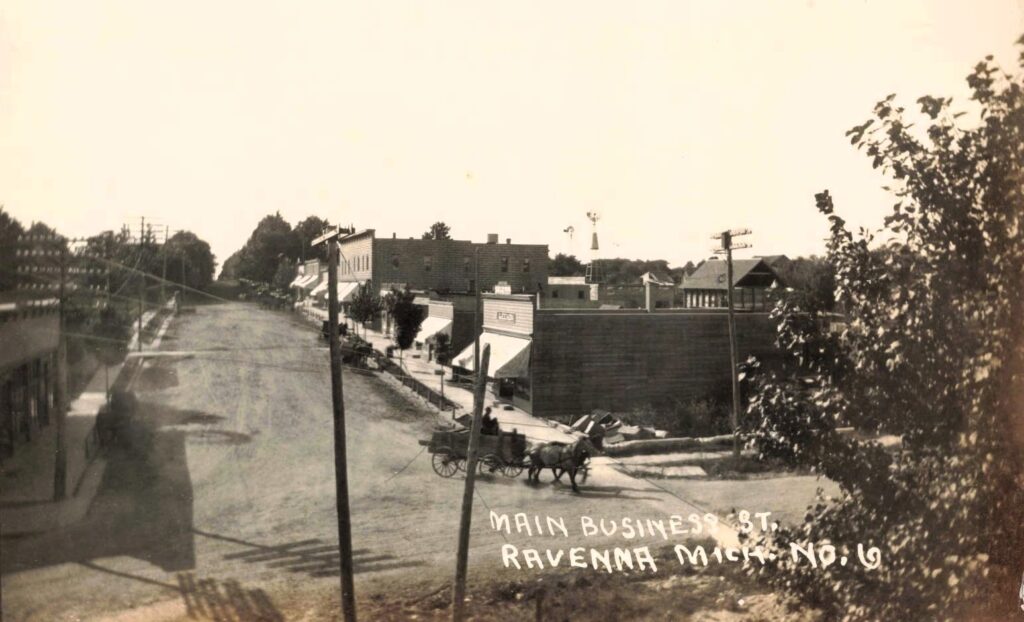
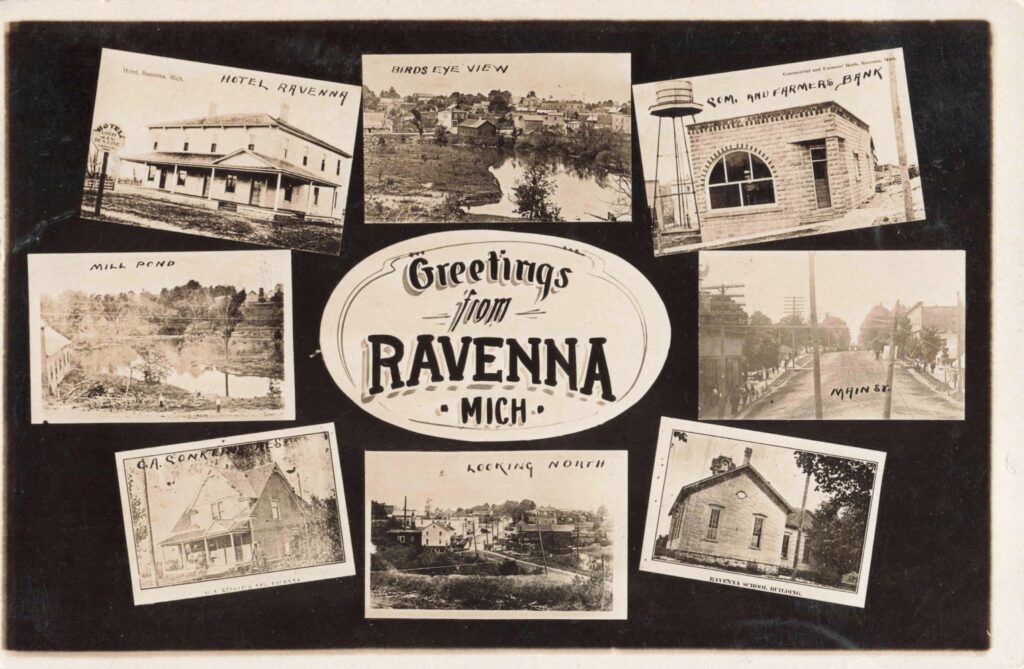
Photographs of Ravenna’s Main Street offer a close look at daily life during this period of change.
The road is unpaved, wide enough for wagons and early automobiles to pass. Wooden storefronts line the street, some with awnings to shield customers from sun and rain. Signs mark businesses—meat markets, general stores, and service shops.
People stand along the sidewalks. Some are gathered in small groups, talking. Others appear to be watching the activity in the street.
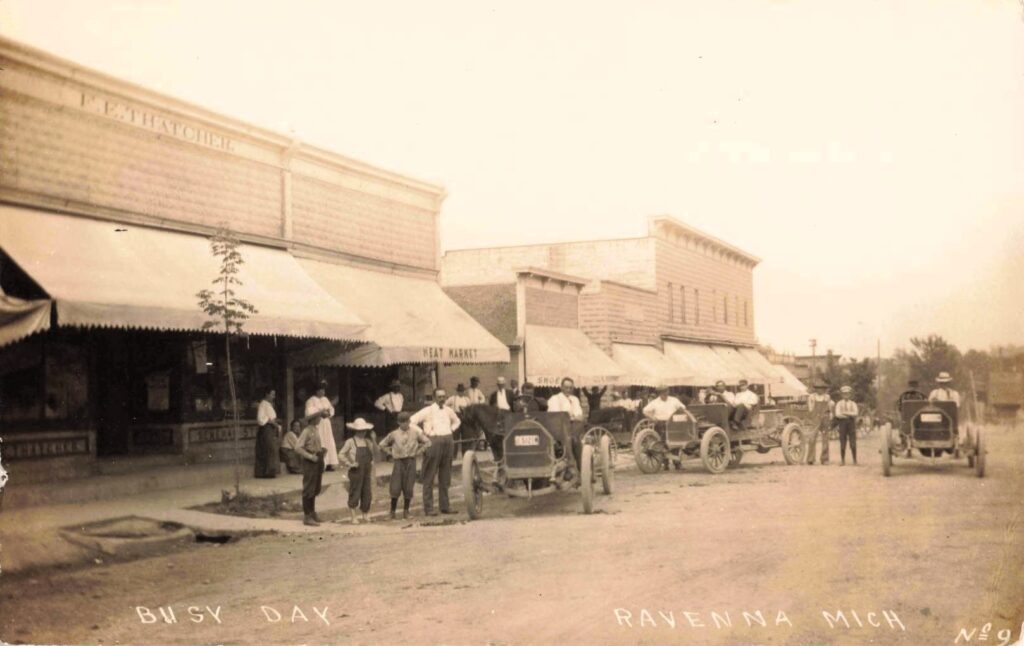
And then there are the vehicles. Horse-drawn wagons are still common, but automobiles have begun to appear. Early cars sit beside teams of horses, creating a scene that feels transitional—neither fully old nor fully modern.
This overlap of Revenna Michigan history is important. It shows that change in small towns did not happen all at once. New technology arrived gradually, often coexisting with older ways of doing things for years.
Ravenna’s Main Street captures that moment clearly.
Hotels, Livery Stables, and the Movement of People
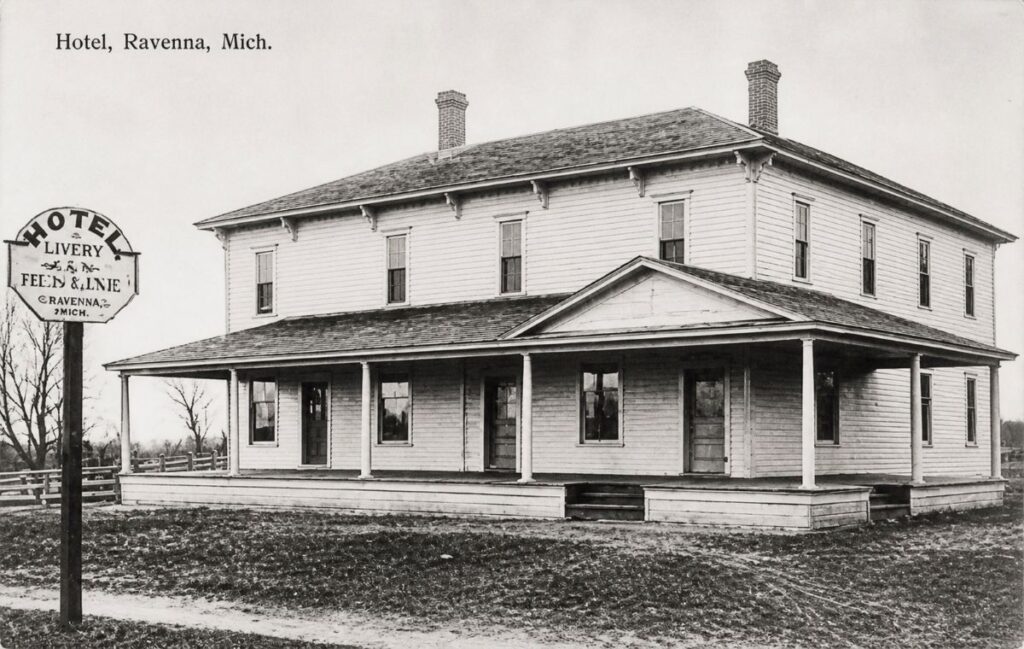
Travel in the early 1900s depended on infrastructure that is easy to overlook today. The hotel in Ravenna served as a central point for visitors. Whether they were traveling for business, trade, or personal reasons, they needed a place to stay.
Nearby, the livery stable played an equally important role. Before automobiles became widespread, travelers relied on horses. Livery stables provided fresh teams, cared for animals, and supported the movement of goods and people.
Together, these businesses made Ravenna a functional stop along regional routes. They also reinforced the town’s connection to the outside world.
Fraternal Halls and Social Structure
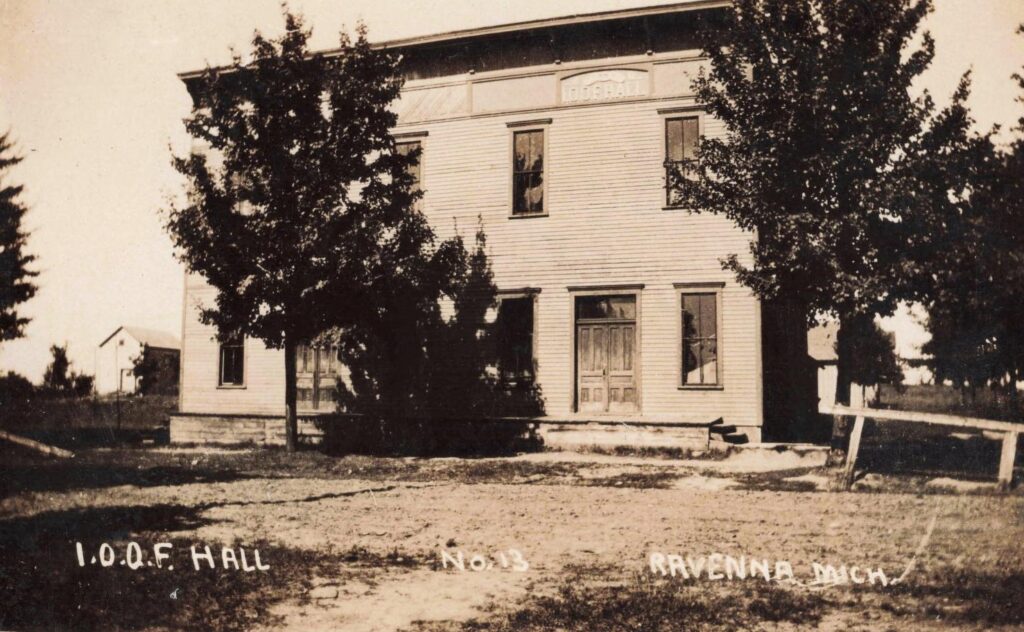
One of the more understated but important buildings in the collection is the I.O.O.F. Hall—the meeting place of the Independent Order of Odd Fellows. Fraternal organizations were a key part of life in small-town America during the early 20th century. They offered more than social gatherings. They provided mutual aid, financial support, and a sense of belonging.
In a time of Ravenna Michigan history before modern insurance and social safety nets, these groups helped members navigate illness, death, and hardship. The presence of an I.O.O.F. Hall in Ravenna suggests a community that valued structure and cooperation.
It also reflects a broader national trend, where civic organizations helped stabilize towns during periods of change.
The Mill Pond and the Role of Water
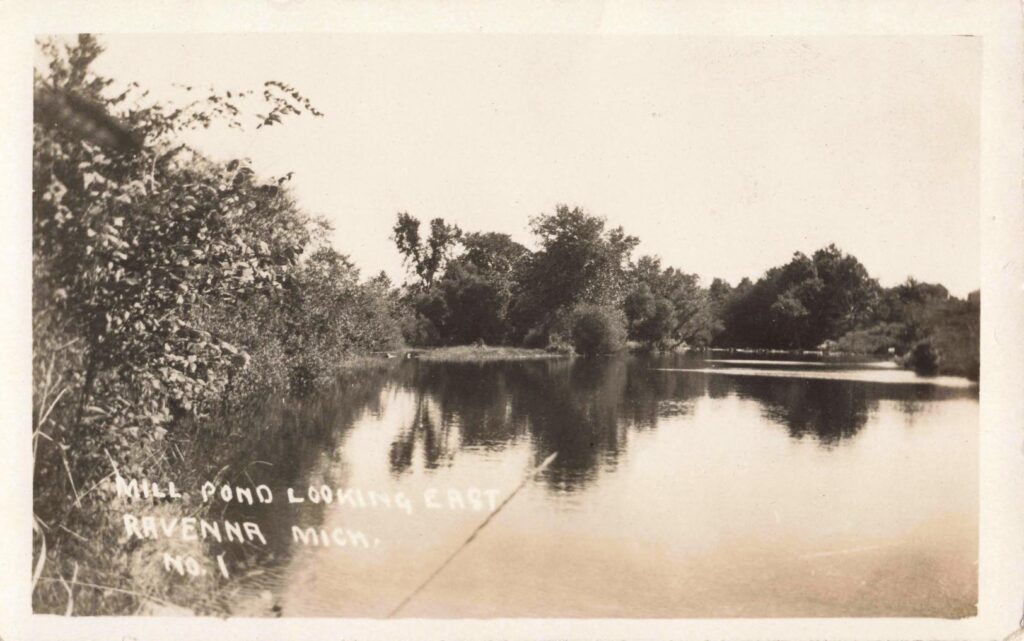
Water shaped Ravenna in practical ways. The mill pond, visible in several images, was not just a scenic feature. It powered machinery, supported local industry, and influenced where buildings were constructed.
Mills often depended on water power before widespread electrification. Even as technology advanced, access to water remained important. The pond also served as a visual center of the town. Homes and buildings clustered nearby. It was part of both the economy and daily life.
In many ways, it tied Ravenna to its earlier roots, even as the town moved forward.
A View from Above: Understanding the Whole Town
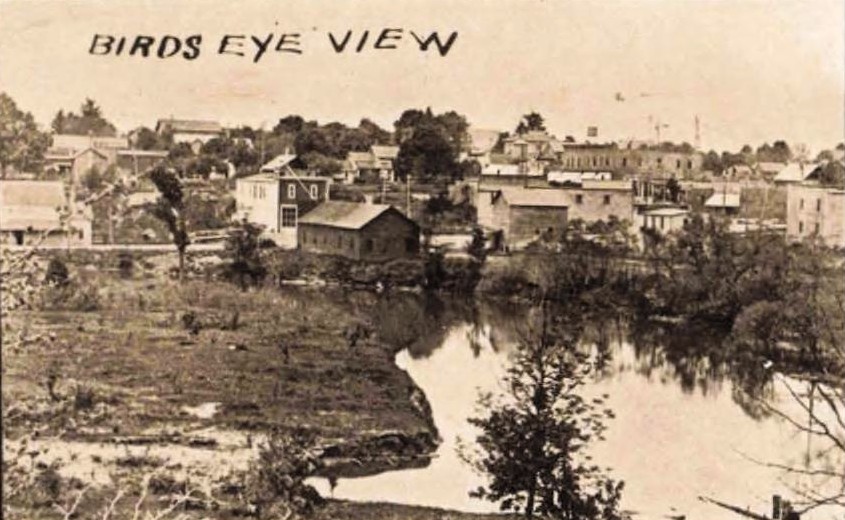
Bird’s-eye views of Ravenna show a compact but organized community. Buildings are clustered along key roads. The railroad runs through the area. The mill pond sits as a central feature. Houses and small farms extend outward.
From this perspective, Ravenna Michigan history appears modest. But its layout reveals something important: efficiency. Everything is placed with purpose—close enough to support daily interaction, but spread out enough to allow growth.
This was not accidental. It reflects how small towns developed during this period, balancing agriculture, trade, and transportation.
A Town That Found Its Place
Ravenna’s early 1900s history is not defined by a single event. It is defined by adaptation.
When the lumber industry declined, the town did not disappear. It changed. It turned to farming, built up local industry, and relied on the railroad to stay connected. The images preserved from that time capture a community in motion—not rushing forward, but steadily adjusting to new realities.
That may be the most important takeaway.
Small towns like Ravenna did not simply endure change. They shaped it, one decision at a time. And in doing so, they became part of a larger story—one that stretches across Michigan and into the broader history of the American Midwest.
FAQs About Ravenna Michigan History
What is Ravenna, Michigan known for historically?
Ravenna, Michigan is known for its role in the transition from the lumber industry to agriculture in the late 1800s and early 1900s. The town became a regional hub for grain production and milling, supported by businesses like the Ravenna City Mills. Its railroad connection also helped link local farmers to larger markets across Michigan.
Did Ravenna have a railroad in the early 1900s?
Yes, Ravenna had an active railroad depot in the early 1900s. The railroad was critical to the town’s economy, allowing goods like flour and crops to be shipped to nearby cities such as Muskegon and Grand Rapids. This connection helped Ravenna remain economically stable after the decline of the lumber industry.
How did Ravenna, Michigan change after the lumber era?
After the lumber industry declined, Ravenna shifted toward agriculture and local industry. Farms replaced logging operations, and mills processed crops into marketable goods. The town’s infrastructure—including railroads, Main Street businesses, and community buildings—developed to support a more stable, long-term economy.
Works Cited for Ravenna Michigan History
“Ravenna, Michigan.” Wikipedia, Wikimedia Foundation, https://en.wikipedia.org/wiki/Ravenna,_Michigan.
“Muskegon County History.” Muskegon County Historical Society, https://muskegonmuseum.org/.
Dunbar, Willis F., and George S. May. Michigan: A History of the Wolverine State. Wm. B. Eerdmans Publishing, 1995.
“Railroads in Michigan.” Michigan History Center, State of Michigan, https://www.michigan.gov/mhc.
“Flour Milling in America.” National Park Service, https://www.nps.gov/articles/flour-milling.htm.
“Odd Fellows in American Communities.” Independent Order of Odd Fellows, https://www.ioof.org/.
“Early Agriculture in Michigan.” Michigan State University Extension, https://www.canr.msu.edu/.
“Historic Postcards Collection.” Central Michigan University Clarke Historical Library, https://www.cmich.edu/library/clarke.
“Michigan Railroads and Economic Growth.” Library of Congress, https://www.loc.gov/.
“Michigan County Histories and Atlases.” University of Michigan Library, https://quod.lib.umich.edu/.