 by
by 
The history of Holt Michigan reflects the broader story of rural development in Ingham County during the late 19th and early 20th centuries. Located in Delhi Township near Lansing, Holt began as a farming settlement and gradually evolved into a local trade center supported by railroads, early electrification, and small-town commerce.
Video – Brief History of Holt Michigan
Early Settlement in Delhi Township
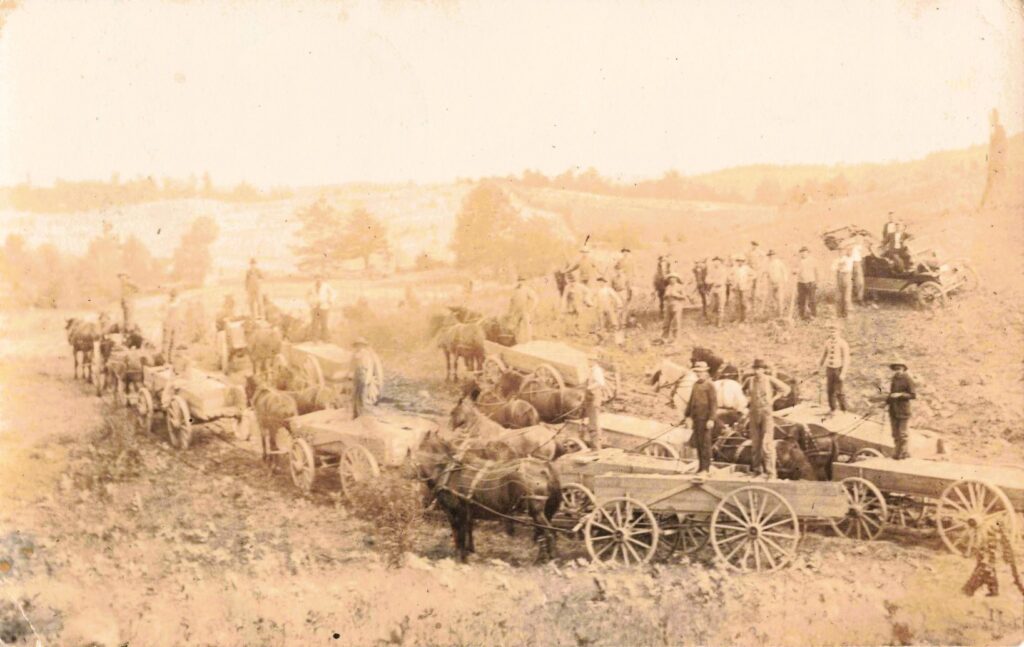
The area was part of the 1819 Treaty of Saginaw. Initial settlers in the late 1830s included Frederick R. Luther, John Norris, and the North family. Native American tribes, including the Potawatomi, Chippewa, and Ottawa, inhabited the area, with Chief Okemos having a notable presence in the region.
The area was originally known as Delhi Center. Schools were established early, with the first log schoolhouse built around 1840 near present-day Hope Middle School.
Unlike boomtowns built around a single industry, Holt developed through steady agricultural settlement. Families cleared land, built farms, and established a network of roads connecting fields to local trading points.
This slow and practical beginning shaped the town’s identity for decades.
The Rise of Main Street in Holt Michigan
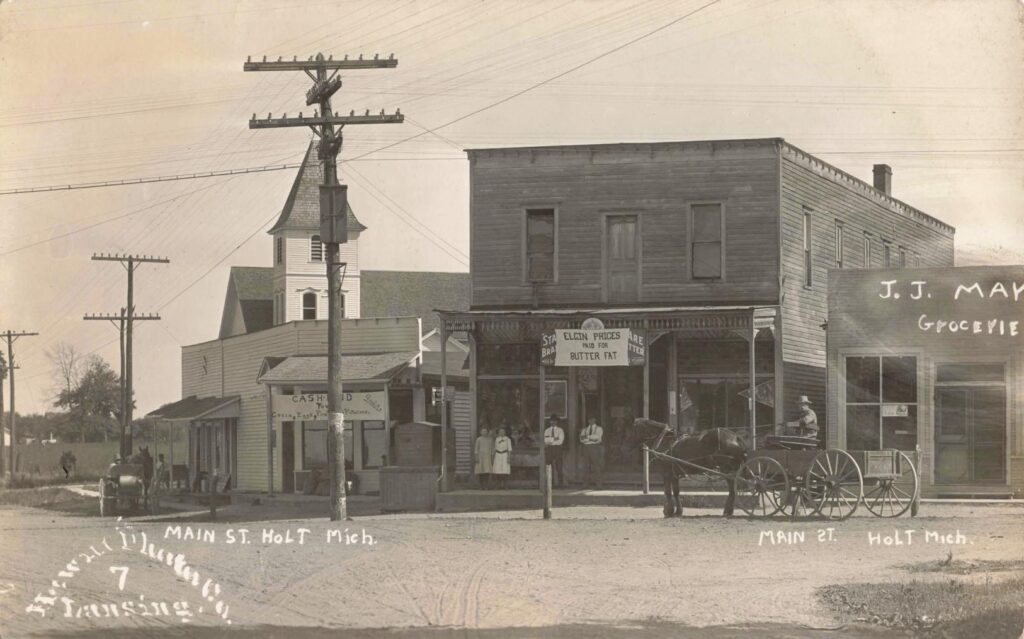
By the late 1800s, Holt had formed a recognizable town center.
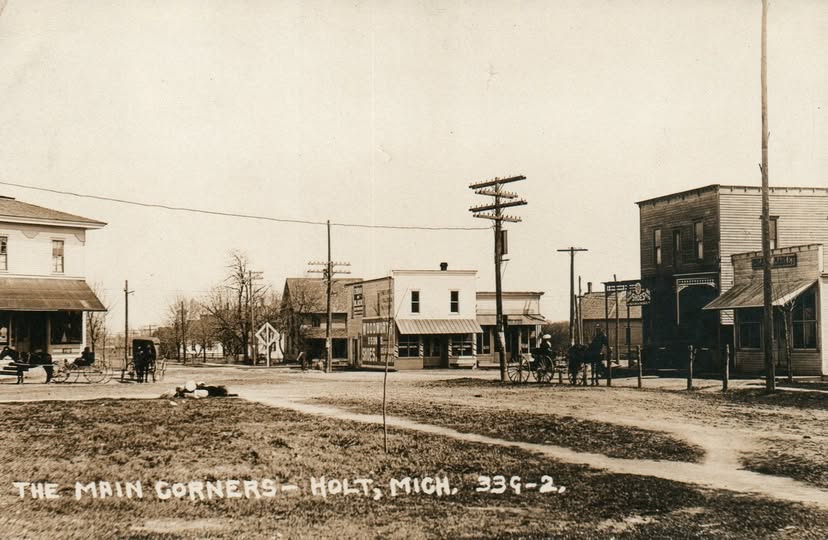
Wooden storefronts lined the road, housing general stores, supply shops, and service businesses. These stores were central to daily life. Farmers depended on them for tools, food, and news.
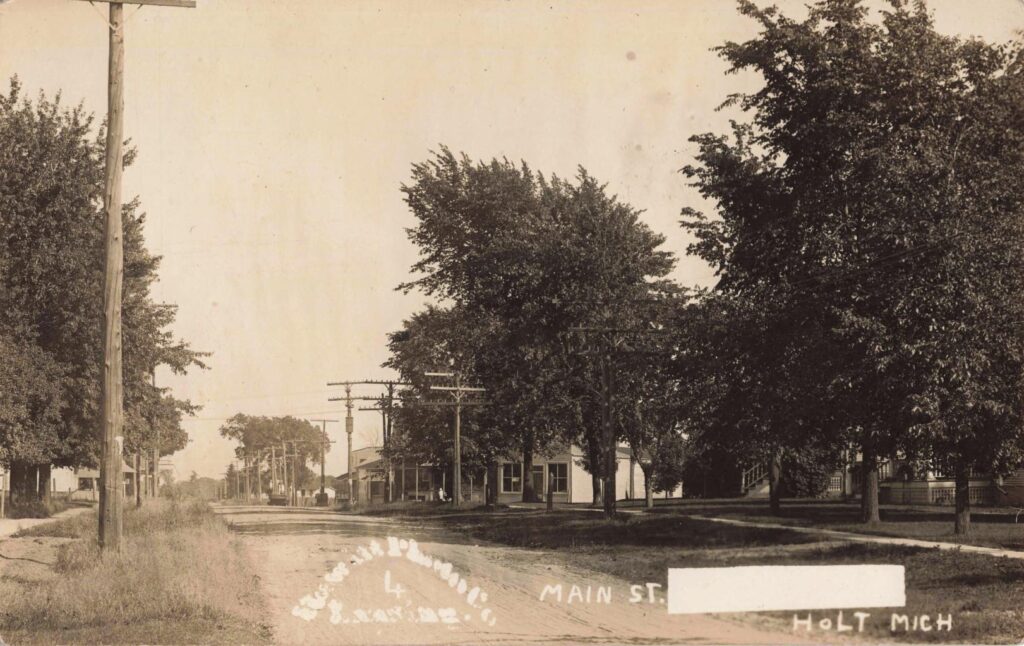
Handwritten on the photo: “Main St. Holt Mich.” And it delivers — a dirt road lined with wooden storefronts, a church steeple rising behind them, and utility poles carrying a web of wires overhead.
Look closely at the signs. One storefront advertises “Elgin prices … paid for butter fat,” a reminder that dairy money helped keep small-town businesses going. Dairy farming was a key part of the local Holt economy, and those posted numbers told farmers what their work was worth each day. On the right, a painted wall sign reads “J. J. May … Groceries” while a horse-drawn wagon waits at the curb.
This was not abstract economics. It was immediate and personal.
Railroads and the Interurban Era in Holt
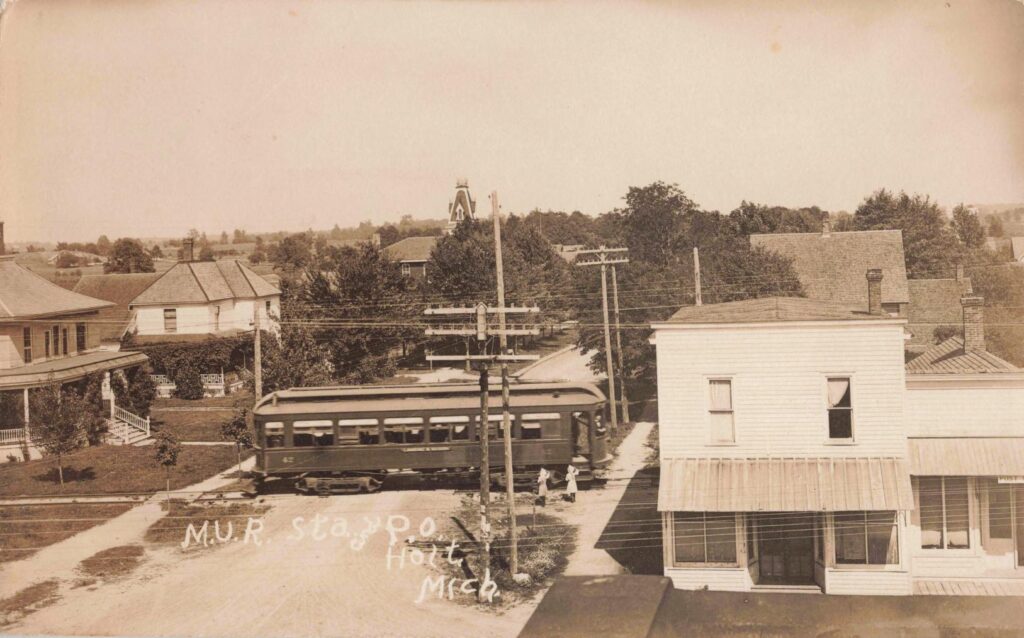
One of the most important developments in the history of Holt Michigan came with rail access.
By the early 1900s, the Michigan United Railways (M.U.R.) interurban system connected Holt directly to Lansing. This electric rail system allowed:
- Daily commuting
- Faster shipment of goods
- Greater access to markets and services
Most towns connected to a capital city by rail quickly shifted toward suburban growth.
Holt did not.
Instead, it remained primarily agricultural. The rail line supported the town’s economy rather than replacing it. That decision—intentional or not—kept Holt grounded in its original purpose longer than many similar communities.
Agriculture and the Local Economy
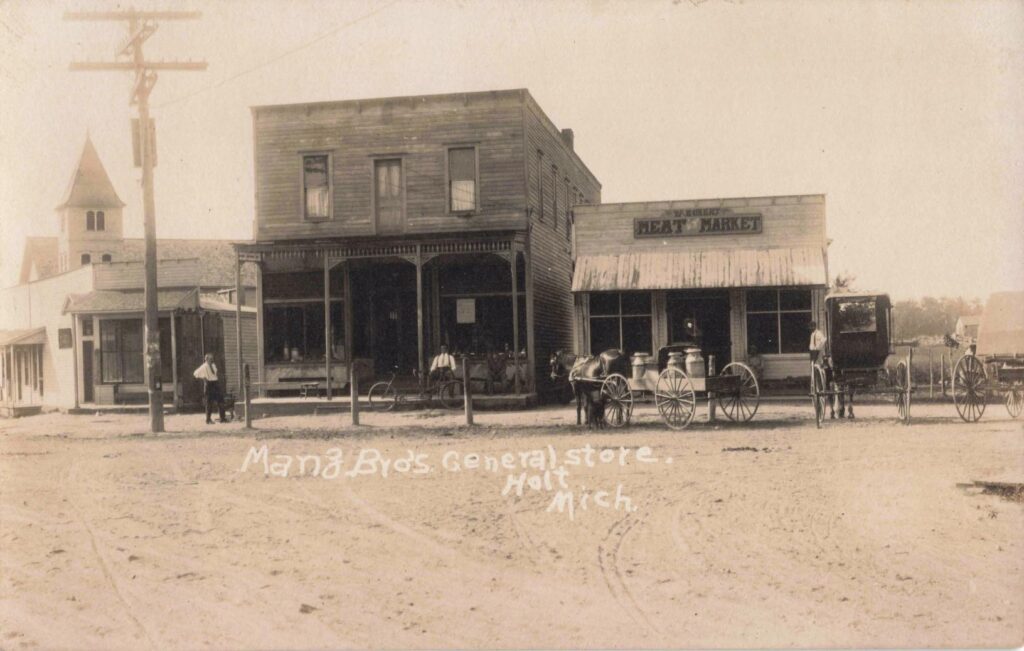
Holt’s economy was built on farming, especially dairy production.
Farmers brought:
- Milk
- Butter
- Livestock
- Grain
into town regularly. The town functioned as a local trade hub. Goods moved in and out, but the system stayed regional. This created stability, even when outside markets fluctuated.
Churches and Community Life
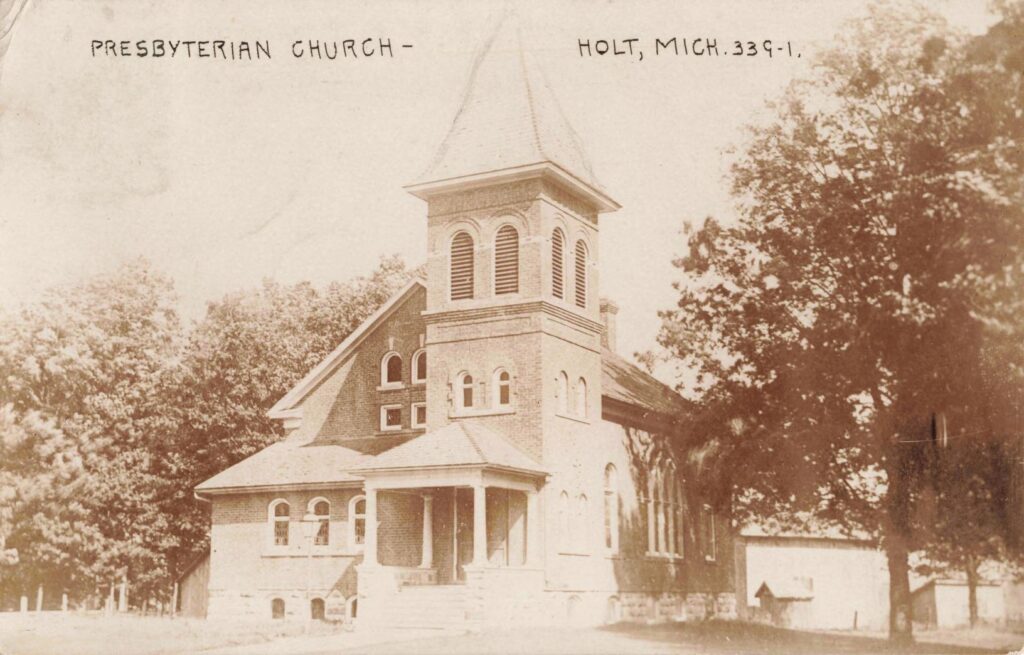
The Presbyterian church shown in the historic images reflects the town’s early organization. Churches were more than religious spaces. They were where:
- Social events took place
- Community decisions were discussed
- Families marked life milestones
They helped bind the town together.
Education and Investment in the Future
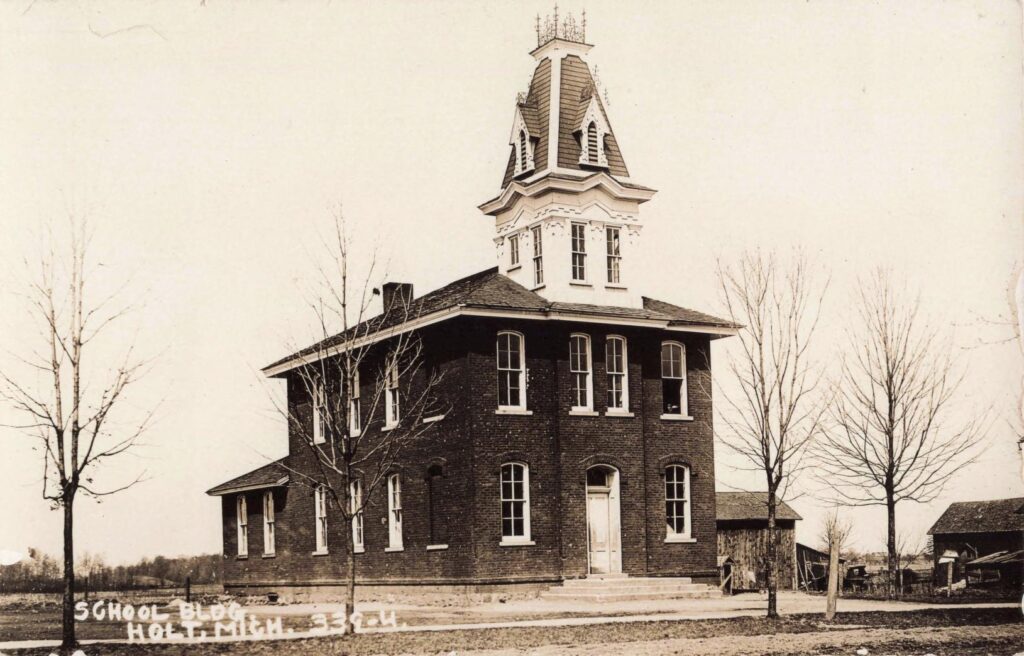
By the early 20th century, Holt had grown enough to support a substantial school building.
This signaled confidence in the town’s future. Education became part of Holt’s foundation, preparing younger generations to either remain or move outward with skills shaped by small-town life.
Number Please? – The Telephone Comes to Holt
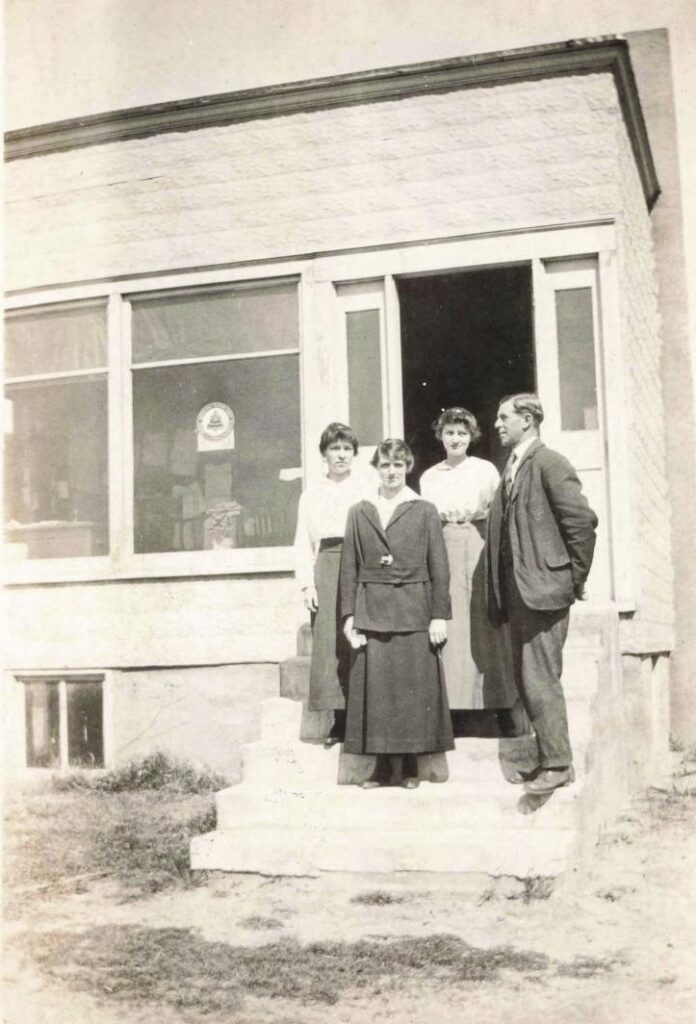
Three women and a man pose on the steps outside what’s identified as the Holt telephone exchange in this early photo. A note written on the back is dated Oct. 1, 1918 and mentions “the Holt exchange” and “Claud” as the manager.
So when did telephone service arrive in Holt? What we can confirm from local records is that Holt had a telephone exchange by 1919 — an Ingham County history from that year notes, “The Bell Telephone has an exchange at Holt,” and the Holt-Delhi Historical Society says the Holt exchange was being operated locally in 1919. (That means service came no later than the 1910s, and likely earlier.)
Transition to the Automobile Era
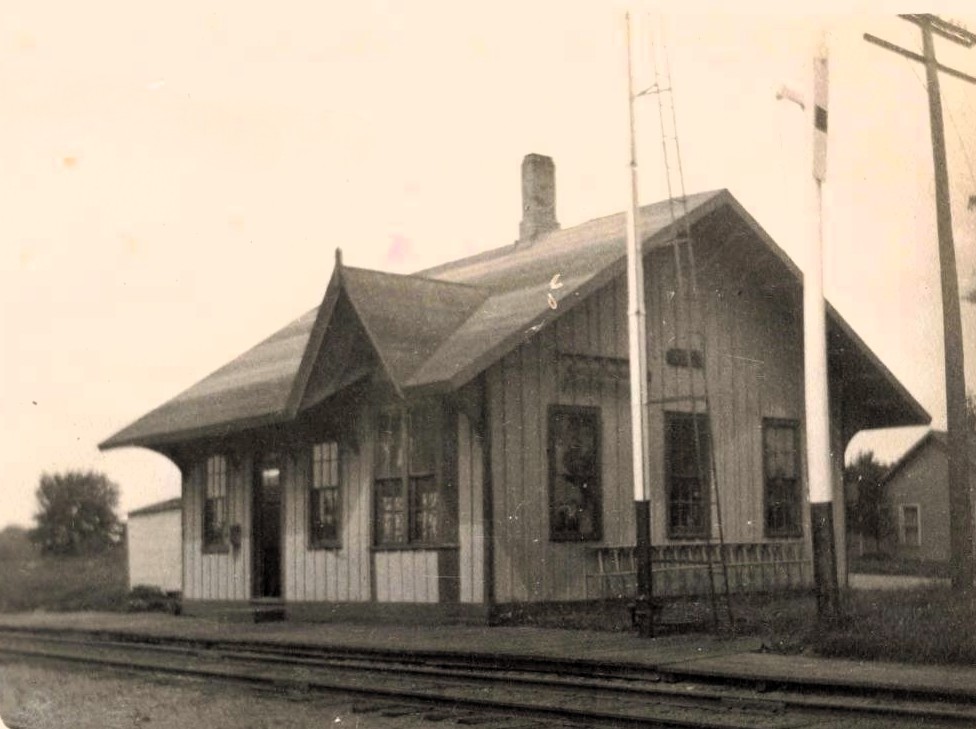
By the 1920s and 1930s, change began to accelerate.
- Automobiles replaced wagons
- Roads improved
- The interurban rail system declined
Despite these shifts, Holt adapted without losing its identity. It continued to serve as a local center for surrounding farms while gradually integrating into a broader transportation network.
Why the History of Holt Michigan Still Stands Out
The history of Holt Michigan is not defined by rapid growth or dramatic events. It is defined by consistency. Even with early access to:
- Electric power
- Rail transportation
- Proximity to Lansing
What makes the history of Holt Michigan stand out is not rapid expansion, but stability. Even with rail access and proximity to a growing capital city, Holt remained rooted in farming and small-town life. That balance between progress and tradition defines the history of Holt Michigan and explains its lasting identity in Ingham County today.
FAQ: History of Holt Michigan
When was Holt Michigan founded?
Holt developed in the mid-1800s as part of Delhi Township in Ingham County, growing steadily through agricultural settlement. Initial settlers in the late 1830s included Frederick R. Luther, John Norris, and the North family.
What role did railroads play in Holt?
The Michigan United Railways interurban system connected Holt to Lansing, improving transportation for people and goods in the early 1900s.
Was Holt ever a railroad town?
The Michigan United Railways interurban system connected Holt to Lansing, improving transportation for people and goods in the early 1900s.
Why didn’t Holt become a suburb earlier?
Despite its proximity to Lansing, Holt retained a strong agricultural base, which slowed suburban-style development.
Works Cited for the History of Holt Michigan