
 by
by 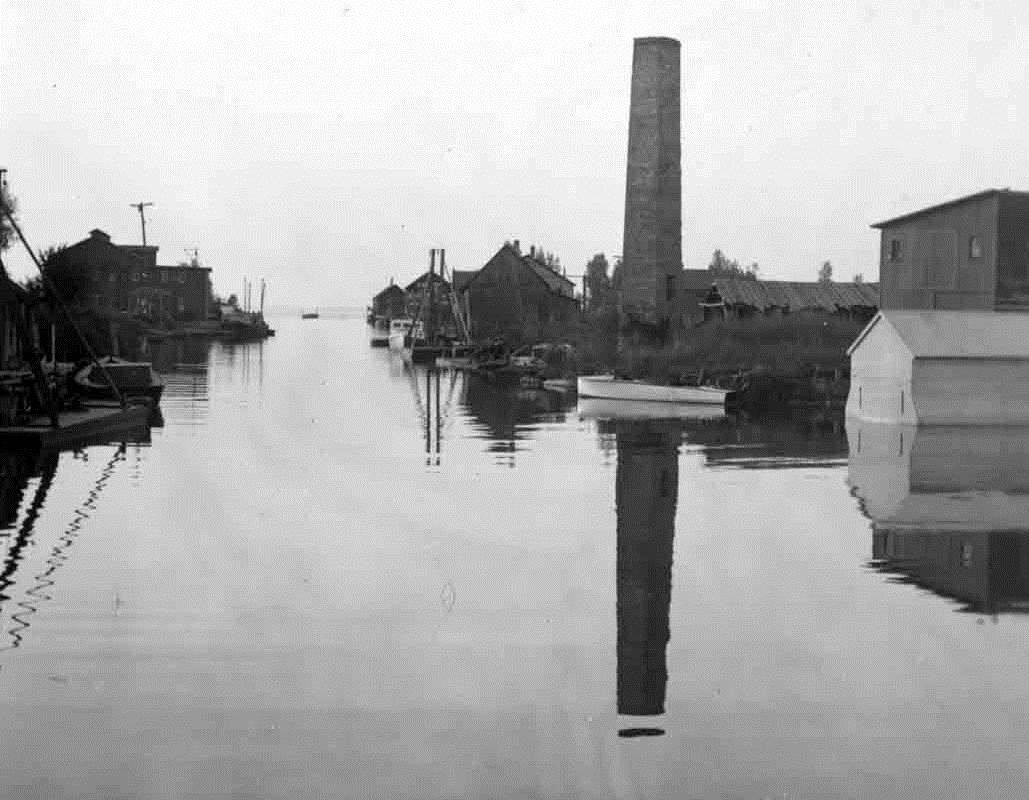
The history of Caseville Harbor begins long before marinas, charter boats, and summer festivals defined the Saginaw Bay community. During the 1800s, the Pigeon River waterfront supported sawmills, shipbuilding, salt production and shipping. Historic photographs show how the harbor later changed into a commercial fishing center before becoming the recreational boating and tourism destination familiar today.
Before any marinas were created, it was a series of industrial buildings along the Pigeon River. Buildings from the iron foundry and Caseville‘s salt block still stood from Caseville’s Days as an industrial powerhouse.
Ship Building in Caseville
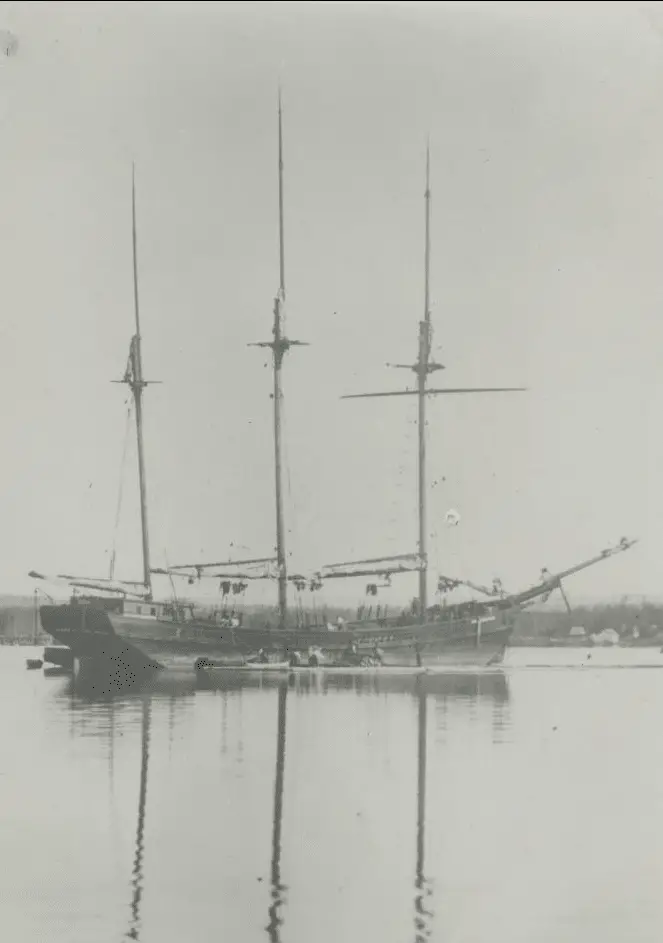
In the 1800s, Caseville, Michigan was home to small-scale shipbuilding operations that supported the region’s booming lumber industry. Located on the Pigeon River with access to Saginaw Bay, the town’s mills supplied white pine and hardwood used in constructing wooden schooners, steam barges, and scows designed to haul timber and goods across the Great Lakes. Local lumber firms, including the McKinley Brothers, often commissioned or built vessels to transport their products.
One vessel was the Frank Crawford, built with local timber. Though records are limited, several two-masted schooners were launched from Caseville during the late 19th century. By the 1890s, the shipbuilding trade in Caseville had declined as timber supplies dwindled and larger yards in Bay City and Detroit took over vessel construction.
Caseville’s Last Days Lumbering
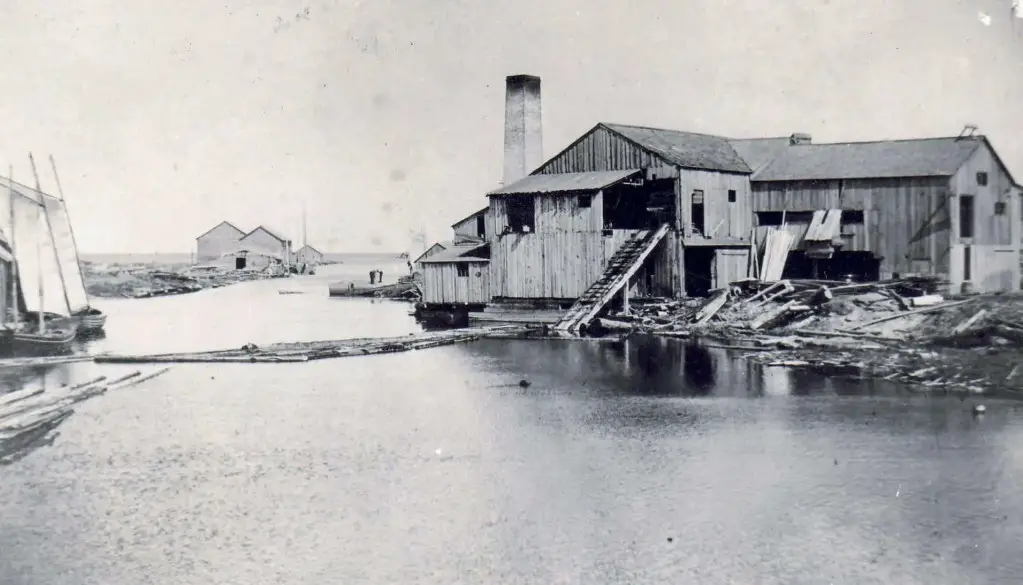
Like most villages in the Upper Thumb, Caseville was built on a river, an ideal spot to place a sawmill. This is a rare shot from the railway bridge, showing the sawmill still in place on the Pigeon River.
Caseville Fisheries
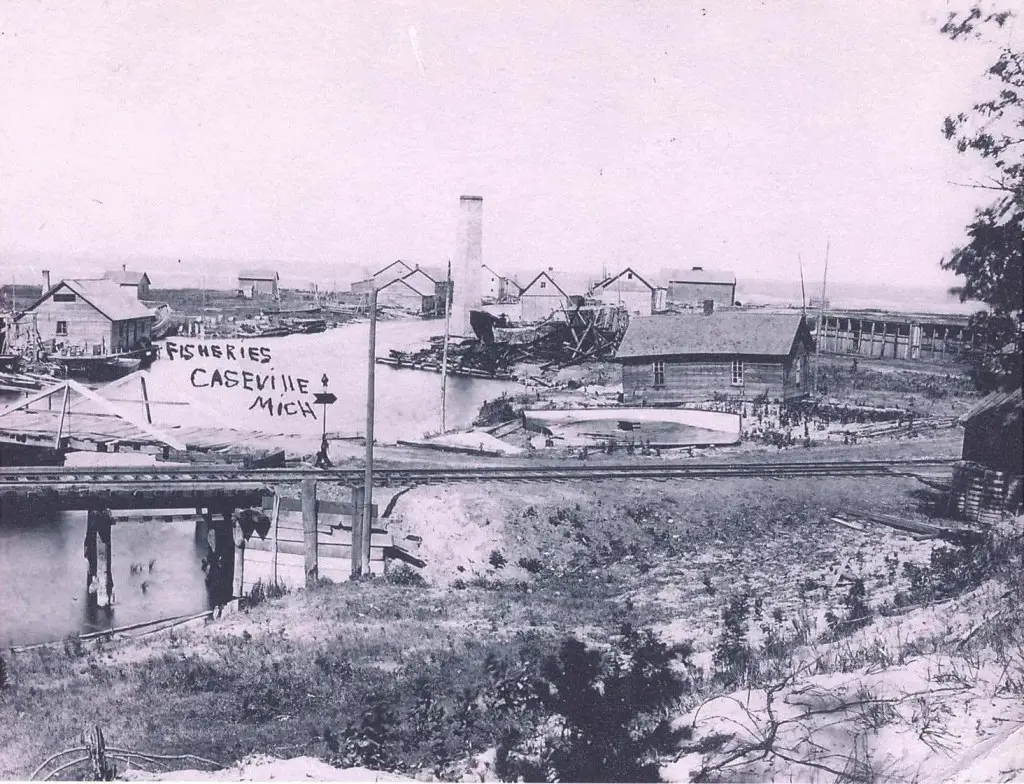
This sort of depressing shot shows that Caseville’s sawmill is now torn down. It was common practice to repurpose building materials for other projects. The transformation from industry to fishery to tourism has already begun.
Caseville Harbor 1930s
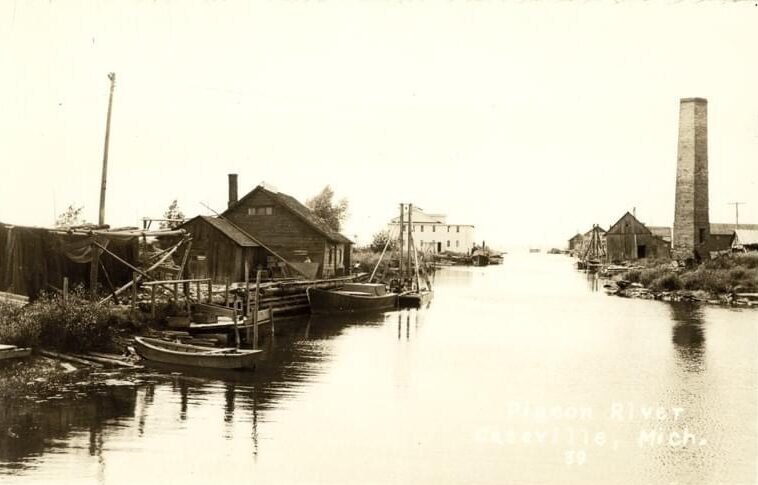
This shot taken from the train trestle bridge over the river from the 1930s shows the remains of the salt block on the left bank of the Pigeon River. The white building beyond was owned by J.G. Gillingham, which the plat map show as owned in 1904. In 1931 Bob Gillingham rebuilt the fishery. This is, I expect, why it looks relatively new. This fishery closed operations in 1955.
1940s
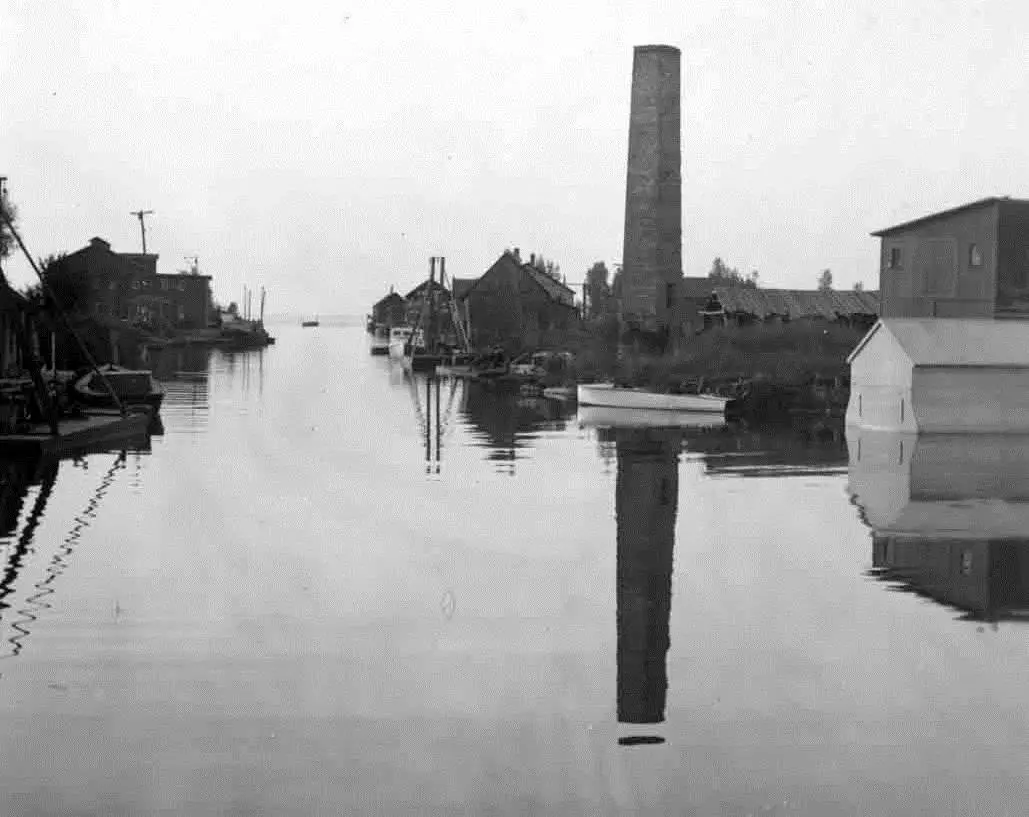
This picture shows the rapid transformation of Caseville’s harbor. The shot looked out to Saginaw Bay from the interior dock on the Pigeon River in 1941. The chimney remained from the old sawmill. The Huron Yacht Club is on the left. The Bay Post Fish Company dock on the far right was torn down in 2017 to make way for updates to the Saginaw Bay Marina.
This picture postcard from 1943 shows that the chimney from the sawmill was taken down, and Saginaw Bay Marina was in operation.
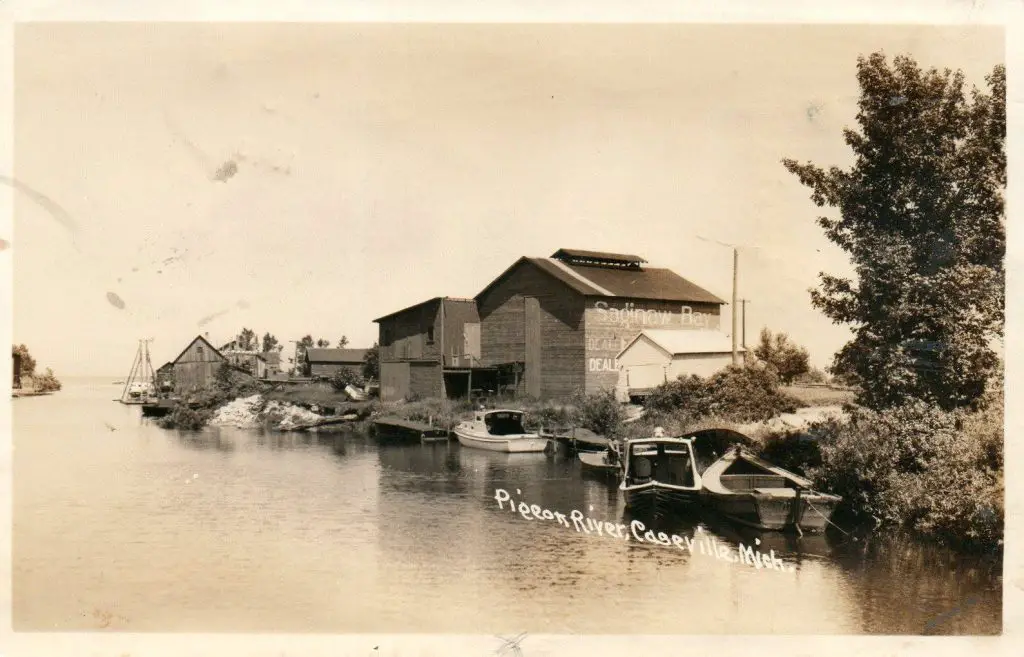
The shot has remarkable similarities to the famous Fishtown in Leland County in Northwest Michigan. Caseville Harbor was home to a lumber mill, salt block, an iron foundry, and several fishing companies.
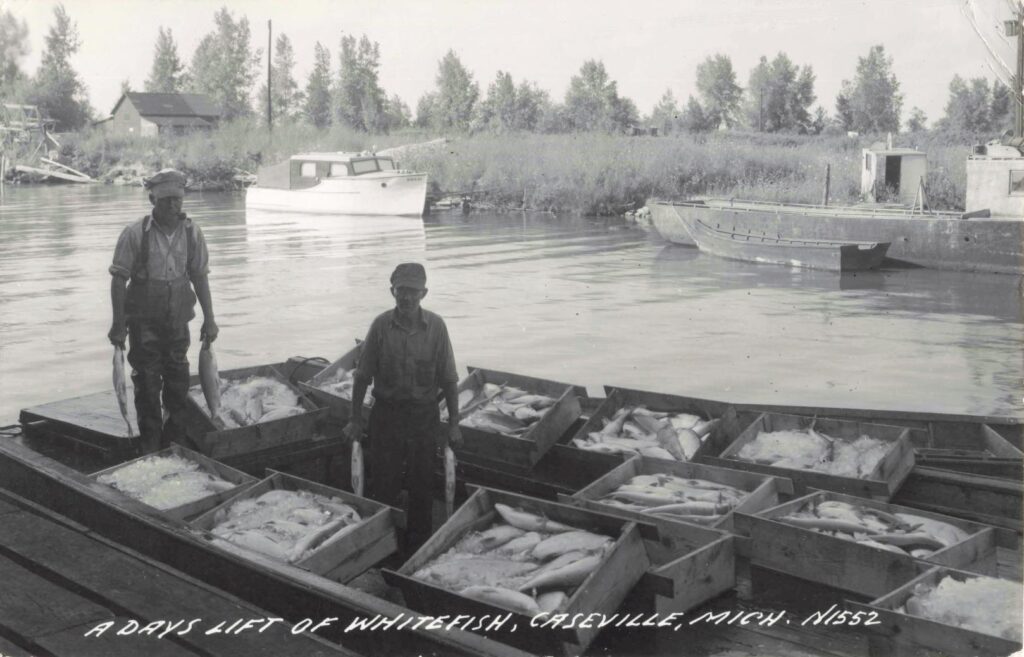
This final shot in 1949 shows Caseville Harbor as an important fishery. ChatGPT said:
In the 1940s, Caseville, Michigan, supported a small but active commercial fishing industry centered on the Pigeon River and Saginaw Bay. Local fishermen, many operating family-run outfits, harvested lake trout, whitefish, perch, and chubs using gill nets and small boats. These catches were processed in nearby ice houses and smoke shacks, then shipped by truck or rail to markets in Detroit and Cleveland. Notable individuals like Carl Peets, who later became known for charter fishing and tourism, likely began commercial fishing during this period. By the late 1940s, overfishing, pollution, and invasive species such as the sea lamprey began to take a toll, marking the start of a long decline in small-scale commercial fishing along Lake Huron.
Caseville’s Main Street at the Turn of the Century
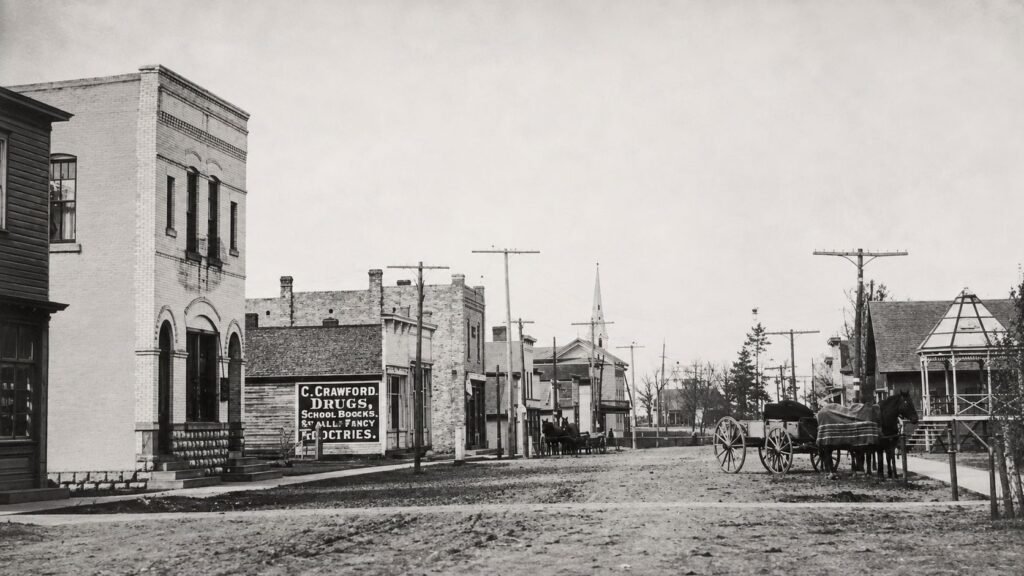
This photograph, taken around 1900, shows downtown Caseville during the transition from its industrial past to a more settled commercial community. The broad dirt street, horse-drawn wagons and rows of utility poles place the scene before automobiles and paved roads changed the village.
The tall masonry building on the left is the Caseville Masonic Temple. Its brick construction and arched entrance made it one of the more imposing buildings in the downtown district. Nearby wooden storefronts show how Caseville’s business center developed in stages, with newer masonry buildings standing beside older frame structures.
A large painted advertisement identifies C. Crawford Drugs, which sold drugs, schoolbooks and “fancy toilet articles.” Like many small-town pharmacies of the period, the business probably carried a wider range of merchandise than a modern drugstore. Such stores commonly served as places to buy books, stationery, household goods and patent medicines.
The church steeple visible near the center belonged to the Caseville Methodist Episcopal Church. Reverend Manasseh Hickey and 12 local settlers organized the congregation in 1868. Early services were held in a schoolhouse before the congregation built its Gothic-inspired church. The building, distinguished by a 70-foot steeple, was dedicated on Nov. 15, 1874.
The open, gazebo-like structure on the right marks the area that later became closely associated with Caseville’s Civil War memorial. In 1910, the park became home to the Union Memorial Statue, a soldier monument erected by local residents and Nancy Smalley Circle No. 7. The memorial honored Huron County men who served during the Civil War from 1861 to 1865.
Horse-drawn wagons stand along the unpaved street, while telephone or telegraph poles run through the village. Those details show Caseville caught between two periods. Transportation still depended on horses, but modern communications and more permanent commercial buildings were already changing daily life.
Although the photograph does not show the harbor itself, it adds context to Caseville’s waterfront history. The mills, fisheries, and shipping businesses along the Pigeon River depended on the stores, churches, civic groups, and tradespeople based in the village center. The harbor and downtown grew as parts of the same community.
Caseville’s Waterfront
The Caseville Harbor featured image photo was likely taken from the railroad bridge that once crossed the Pigeon River. The plat map below was from a 1935 WPA project that shows the village and railroad lines leading into the area known today as Caseville Beach. In 1964, the Caseville Harbor break wall was built. It was made with huge boulders and rubble, extending 1,780 feet into Saginaw Bay. The break wall protects the harbor from Lake Huron’s prevailing northeast wave action.
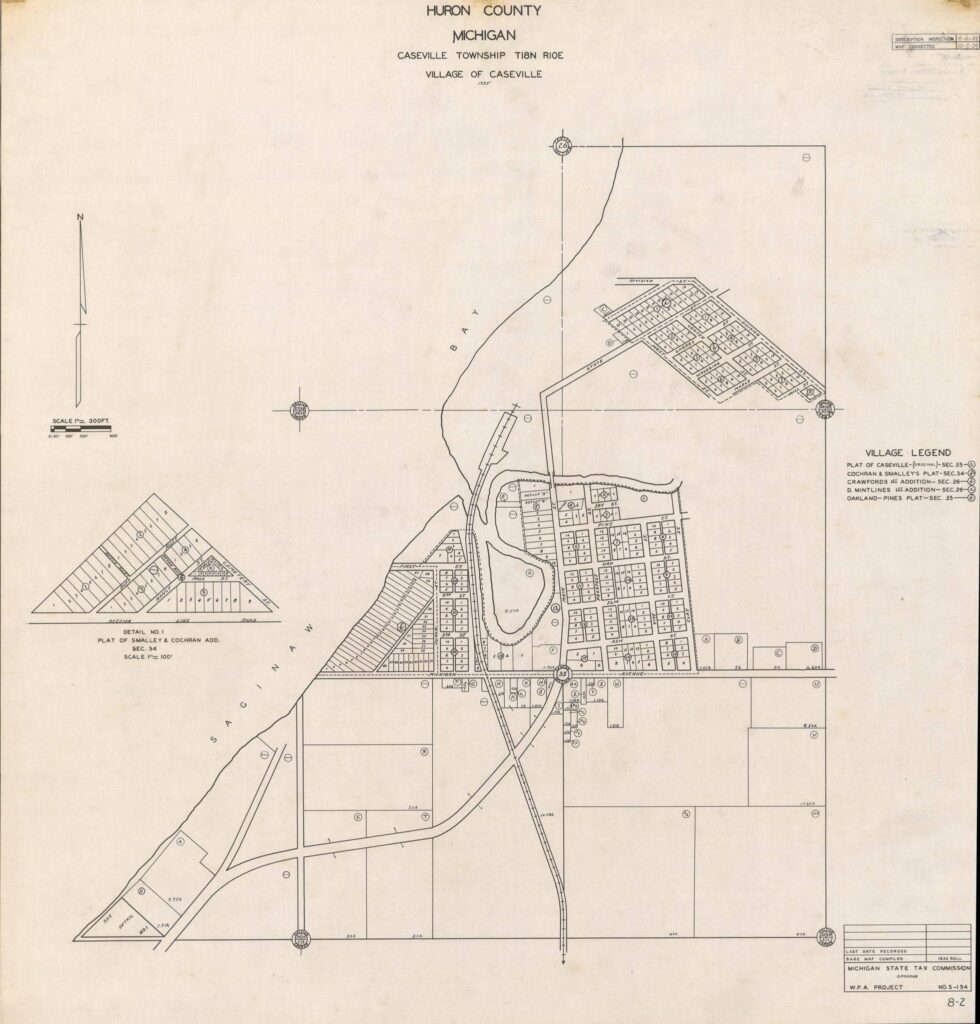
Caseville’s path to the present day is not unlike many of the beach towns along the Great Lakes. However, very little is left of the original waterfront of Caseville in the 1800s. In fact, only the Huron Yacht Club remains.
Frequently Asked Questions About Caseville Harbor
What industries first developed around Caseville Harbor?
Caseville’s early waterfront supported lumber mills, salt production, shipbuilding, shipping and related businesses along the Pigeon River. Commercial fishing later became a major part of the harbor economy.
Were ships built in Caseville?
Yes. Small-scale shipbuilding took place in Caseville during the 1800s, when local lumber and access to Saginaw Bay supported the construction of schooners, scows and other working vessels.
When did Caseville Harbor become a tourism destination?
The change developed gradually during the 20th century as industrial operations and commercial fishing declined. Marinas, sport fishing and recreational boating became more important after harbor improvements.
What does the downtown Caseville photograph show?
The photograph shows Caseville around 1900. Visible landmarks include the Masonic Temple, C. Crawford Drugs, the Caseville Methodist Episcopal Church steeple, horse-drawn wagons and the park that later held the Union Memorial Statue.
What historic harbor building remains today?
The Huron Yacht Club is identified as the primary surviving building from Caseville’s older working waterfront.
Related Caseville Mi Reading
Caseville Helping Hands Thrift Store – Some time ago, we posted a picture of Caseville Mi. Mercantile. The shHarbor’srom the late 1800s, and we had a hard time placing it until someone mentioned that the general store was now the Helping Hands Thrift Shop on Main Street in Caseville. ThIt’ss a mission of the Caseville United Methodist Church and is one of the most highly rated thrift shops in the region, according to ratings on Yelp and Google.
A Harbor’s Late Season in Caseville – The Fall in Michigan seems incredibly short this year. Boats are Austin’s the water as November rolls in. Will we be the last one out of the water? It’s sad and a bit lonely to be one of the last ones out of your slip in the Fall in Caseville harbor. Last year we were one of the diehards it’s ice beginning to form a weekend or two after we got our sailboat out and winterized for the season water.
Port Austin’s Farm Market Mornings – Each Saturday morning during the summer, the Port Austin farm market offers locally grown produce, crafts, and flea market items from all over the thumb. The weekly event is not hard to miss as it’s only a block away from the harbor. You can park just about anywhere in town and figure out wBay’sto go.
Michigan Day Trip Around the Thumb – Part Two – In Part One of our Michigan Day Trip Around the Thumb, we traveled from Port Huron up the eastern shore of Lake Huron to the tip of the Thumb. Our starting point for the second half of our fun day trips in Michigan adventure is in Grindstone City. Then, we will begin heading west along Saginaw Bay’s shore of sugar sand beaches and interesting coastal towns and villages.


Wow, we drove right through here on route 6 back in September on the first leg of our journey out west. We camped just up the way in Sandusky, OH. Amazing the difference of then to now.
I remember two fish places,,,, the one we use to go to was Giliahams or something…. use to love walking thru the place wiht all kinds of fish on ice… we use to get Herring .. and take them home and clean them and freeze them……. caught our own perch of course. as a kid in scouts we fished off the dock or channel there and got a mess of fish,,,,,,, never knew what happened to all the ones we caught, I bet our den mother kept them for themselves lol.
That was my great grandpa and uncle my grandmas madden name was Gillingham ?
*Maiden
You will have to fill in the blanks with the history!
Hi Kala, at least I was close to the spelling lol. loved that place
Hi Ken. You are referring to the Gillingham Fish Company.?
Tami,
Do you have any pictures of the Gillingham Fish Company? I think it would be interesting to alot of people.
Mike
My family goes there frequently. It is such a cool destination…fishing…camping….beaches and more…