 by
by Au Gres, Michigan lies at the mouth of the Au Gres River on Lake Huron’s Saginaw Bay. Its story is woven through lumber booms, lakeside life, and deep Native American roots. This article explores the History of Au Gres, Michigan – especially the pivotal years from the late 1800s through the 1940s – using archival photographs and historical records to bring the past into focus.
Video – History of Au Gres Michigan: 7 Surprising Photos That Changed Everything
Early History and Indigenous Heritage
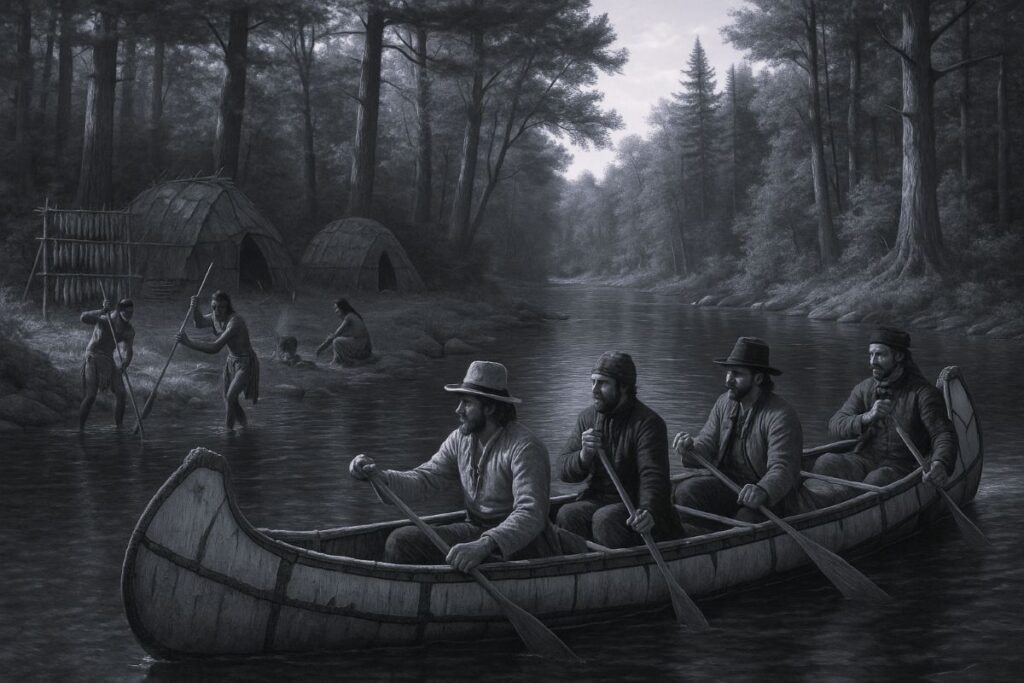
Long before settlers, the Au Gres area was home to the Ojibwe (Chippewa), Odawa (Ottawa), and Potawatomi peoples, often collectively called the Three Fires Confederacy. These Anishinaabek communities fished Lake Huron for whitefish, harvested maple sugar in spring, and moved their wigwam villages to follow game. Lake Huron’s shoreline at Au Gres was rich in fish and waterfowl, making it a natural gathering spot.
In the 1700s, French explorers and fur traders traveled this bay. They named the river “Au Grès,” meaning “gritty stone” in French, because of local sandstone along the river’s mouth. Through the 1700s and early 1800s, Michigan changed hands between European powers and the young United States, but Au Gres remained a quiet native place, mostly untouched by forest and marsh. The Anishinaabek here spoke their languages and followed seasonal rounds of hunting, fishing, and gathering, living in harmony with the lake.
The Logging Era (1830s–1900s)
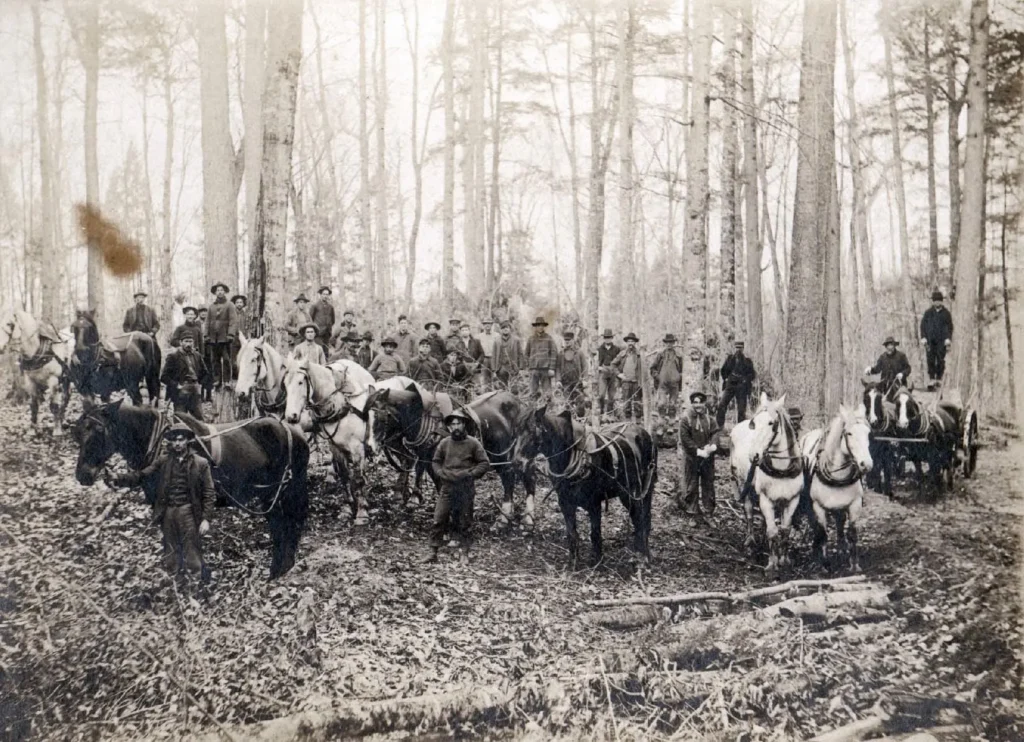
Everything began to change in the mid-1800s when Michigan’s great white pine forests caught settlers’ eyes. By 1838 Au Gres was already linked to the booming lumber industry, which floated logs down the Saginaw and Au Sable Rivers into Saginaw Bay. But shipping lumber was hazardous. The waters off Au Gres were filled with hidden reefs and shallow bars, especially around Charity Island, a small island ten miles east of shore.

To keep ships safe, the U.S. government built a lighthouse on Charity Island in 1857. This first Charity Island Light was a 39-foot white brick tower with a lamp visible 13 nautical miles. The lighthouse had a wooden keeper’s house attached, where the lightkeeper and family lived. For decades, the lighthouse beam guided steamships and sailing vessels bringing lumber, supplies, or fish to Au Gres and points along the Thumb of Michigan. (Charity Island’s isolated ruins still stand there today.)
Meanwhile, the Au Gres River was a natural spot to collect logs. Early settlers arrived as logging camps followed the trees. In 1862, workers cleared woods for the Saginaw–Au Sable State Road (today’s route connecting Saginaw to the Lake Huron shore). John Edward Bradley became the first year-round settler, building the Bradley House in 1866. In 1867, the U.S. Postal Service opened a post office at Au Gres, with Bradley as postmaster. This marked Au Gres’s first official recognition as a place. The town was still tiny – rough shanties on either side of a dirt road – but it had begun.

As the 19th century wore on, more sawmills cropped up along the river. One key player was H. M. Loud’s Sons Company, a powerful lumber outfit based in Oscoda. Around the 1870s–1880s, Loud’s company managed timber in the region and likely ran mills in Au Gres. By the early 1900s, Loud’s men advertised the “Industries of the H.M. Loud’s, Au Gres,” including a “Band Mill” on the riverbank. A century-old postcard (below) shows thick smoke stacks and massive logs stacked high. The water in front, fed by the river, allowed logs to float in from upstream. Men in heavy clothes labored all winter and spring, feeding logs into steam-driven saws.

The photo above captures this scene. Workers in suspenders posed for the camera as their steam engine roared in the background. Barges and flumes carried cut boards and railroad ties out to Lake Huron. Much of Au Gres’s prosperity in the late 19th century came from such lumbering. Logs were shipped to mills farther down the bay or across the Great Lakes. By 1905, the small community had grown enough to incorporate as the City of Au Gres. Still, the population remained modest, only about 252 in 1910, dipping to 199 in 1920, as the lumber industry began to ebb.
Main Street and Community Life (1900s–1930s)

Through the late 1800s and early 1900s, a cluster of buildings took shape around the river’s mouth. There was a one-room schoolhouse (now gone), a Methodist church, and a few stores. Families waited all week for the general store’s delivery of mail and goods. One such store was Noggle’s General Store, pictured here (below). In this 1930s-era photograph, a long white wooden building has signs for “Beer & Wine” and “Noggle’s General Store.” Two vintage cars and a pickup truck are parked out front. This was a typical roadside general store on US-23, selling groceries, feed, gasoline, and liquor to farmers and travelers.
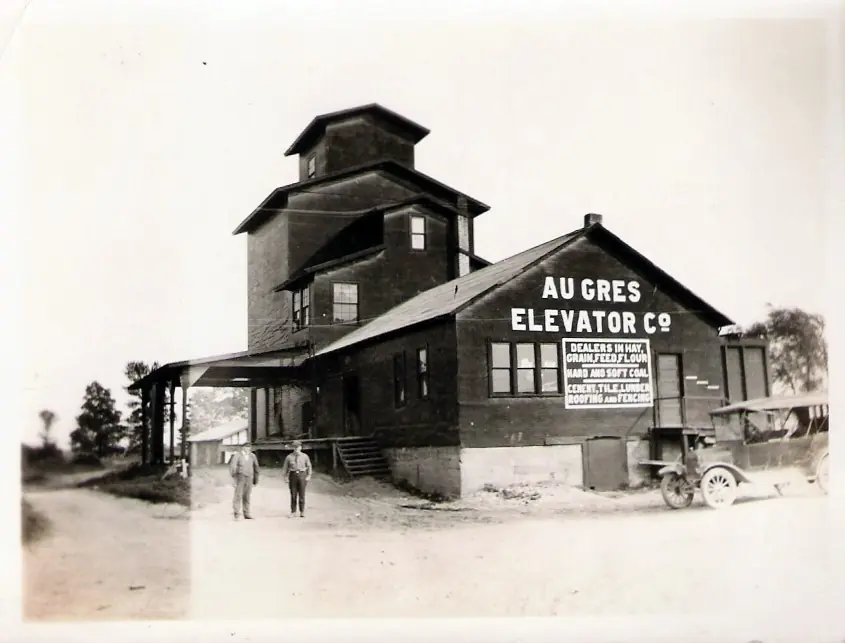
Across the street might stand other businesses. Local newspapers mention a grain elevator and even an automobile agency by the 1930s. But Au Gres never grew into a city of brick skyscrapers. Its buildings were mostly wood, on shallow concrete or stone foundations. People say the town had a friendly, “small-town” feel: neighbors helped neighbors rebuild after fires or gather for Fourth of July picnics by the river.

One notable landmark was the Club House Hotel. Opened by the Lagness family in the early 1900s, it advertised “homelike rooms and reasonable rates” in its ad. The photo below (circa 1911) shows the Club House – a two-story frame hotel. Several servers in aprons stand on the broad front porch, greeting visitors. Hotel guests arriving by steamer or car could sleep here, eat home-cooked meals, and plan their fishing trips. For decades, this was one of Au Gres’s main lodgings (across from the Sunset Tavern on the corner of Main Street).

Life in these decades was simple. Children swam in the river and practiced in a small basketball gym by the elementary school. Farmers in nearby townships grew potatoes and sugar beets. Some women canned the lake’s fish harvest (whitefish and perch) to sell regionally. One industry even famous to Au Gres was pickle-making: the Bessinger Pickle Company, founded in 1932, started canning dill pickles from local cucumbers. Though the company’s main era was later, its roots lie in this period of agricultural diversification.
Riverboats, Tourism, and Modern Times

With the decline of massive logging by World War I, Au Gres turned its gaze to the water for recreation. Long steamboats ferried passengers around Saginaw Bay. Families would load into open boats to visit the small island resorts and beaches. The photo above, marked “Pointe Lookout ’09,” illustrates that era. A steamer has tied up at the end of a narrow wooden pier. Dozens of men, women, and children in Edwardian dress are walking off the boat onto the plank pier. Likely, they were headed to the Booth’s Point Au Gres Hotel or a picnic on the spit. Such trips were how city dwellers escaped the summer heat – Au Gres was a cool lakeside getaway.

By the 1920s, roads were improving. The highway along the thumb of Michigan (modern US-23) brought in tourists too. Gasoline stations and cafés sprang up to serve travelers on road trips. Still, in the Depression years, life was hard for many. Anecdotes tell of families trading eggs or produce for clothing. The town had a single state road, electricity by the late 1920s, and one or two cars per family if they were lucky.

The census reflects slow growth. Au Gres had about 203 people in 1930, rising to 317 by 1940. A photo of Au Gres’s 4th Grade class from 1932 shows a dozen kids grinning in front of the wooden schoolhouse. The WPA (a New Deal program) may have even fixed up some buildings – one record notes a PWA project for a sewer system in the late 1930s. After World War II, more changes came: the old steamboats were retired, replaced by highway bridges, and the lakeshore became less remote as cars could now easily come and go.
Au Gres by Mid-Century
By 1950, Au Gres still numbered only a few hundred residents (442 in 1950). Its industry had shifted from lumber to tourism and small business. Many older buildings – like the original Charity Island Light – had faded away. (Charity Island’s tower was decommissioned in 1939 and fell into ruin. Today a restoration stands on that site.) Yet the history of Au Gres, Michigan was not forgotten. Local schools taught students about Ojibwe heritage and the logging era. The Arenac County Historical Society collects photos like these, and the City of Au Gres highlights landmarks on its trail maps.
The Au Gres River still bends through low pine woods. Fishermen cast into its bends for bass as they did a century ago. The Point Au Gres breakwall (with a new light) marks where the old dock once was. General Store facades have changed, but you can still find old postcards of Noggle’s or the Sunset Tavern sign by the water. In the modern era, residents call Au Gres a quiet resort town – but its roots remain evident in its old pictures.
“`html
Watch More Michigan Town Stories From This Region
These Michigan Moments episodes feature communities tied to Saginaw Bay, Lake Huron, railroads, farming, fishing, tourism and small-town change. Watch another nearby town story and see how each place fits into Michigan’s larger past.
Tawas
A Lake Huron town shaped by waterfront travel, regional trade and the pull of Michigan’s sunrise coast.
Watch TawasAu Gres
A Saginaw Bay community tied to fishing, boating, shore life and changing coastal commerce.
Watch Au GresOmer
One of Michigan’s smallest cities, with a story tied to rail service, river traffic and Arenac County life.
Watch OmerPinconning
Famous for cheese, Pinconning also reflects farming, highways and small-town trade near Saginaw Bay.
Watch PinconningWest Branch
A northern Michigan crossroads shaped by rail lines, highways, shopping and regional travel.
Watch West BranchLinwood
A Saginaw Bay town tied to shoreline life, fishing, boating and the working communities of Bay County.
Watch LinwoodSources: History of Au Gres is pieced together from city and county records, historical society archives, and primary sources. Census data and contemporary news articles also inform the timeline. Archival photos were provided by the Arenac County Historical Society’s collection. (See references cited in text.)