


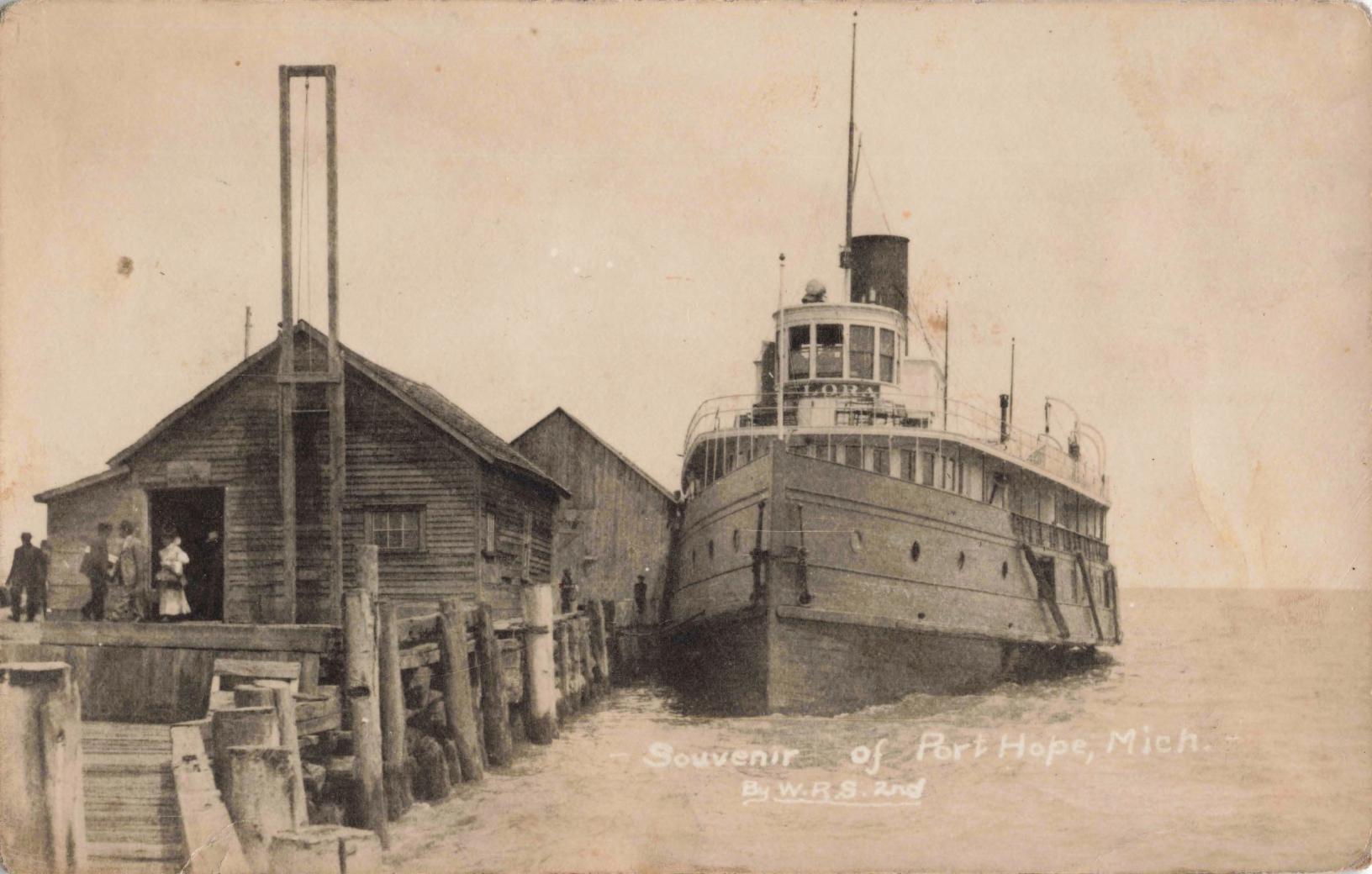
Steamer at Port Hope Dock, Mich., c.1910

We’re standing at the crowded dock in Port Hope, Michigan, sometime around 1905 to 1913. A Great Lakes steamer, its name on the bow blurred but appearing to read “Flora” or “Lora,” presses so close to the pier it almost scrapes the warehouse wall. Families in long coats and hats wait on the rough plank wharf, framed by the simple wooden freight sheds that once lined this Lake Huron village.
This harbor grew out of William R. Stafford’s lumber empire. In the 1850s, his mill and 1,000-foot dock turned Port Hope into a shipping point for timber and, later, for farm products bound for ports like Detroit and Cleveland. Today, only the brick chimney from that mill remains, but in this view, the dock is still busy, and the lake is the town’s main road.
The postcard caption, “Souvenir of Port Hope, Mich. By W.R.S. 2nd,” hints that a Stafford descendant likely commissioned or published this card, marketing the town as a working port rather than a resort. It’s advertising and everyday life frozen in a single frame.