

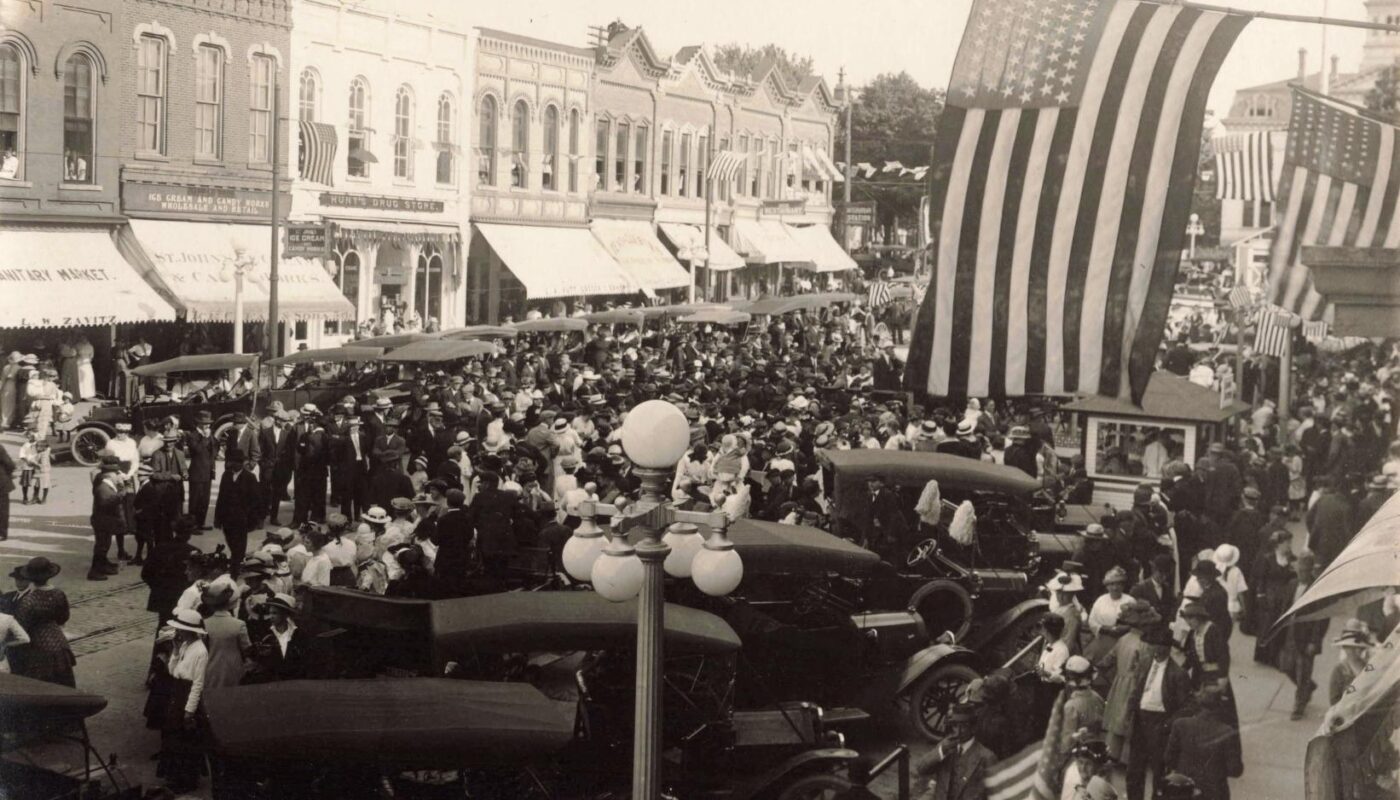
St. Johns, Michigan, has long been the place in Clinton County where the official business gets done. It is the county seat, and for much of the late 1800s and early 1900s, it was also a hub of commerce—a place where farm goods met freight schedules and where a courthouse day could fill a street with customers.
The History of St. Johns, Michigan, in the 1890–1940 period is best told through what people built: schools, banks, hotels, public-safety services, and a community hospital. The postcard views capture those priorities at street level.
Video – History of St. Johns Michigan – 2 Surprising Events that Defined a Small Town

Table of Contents
The History of St. Johns, Michigan, begins with Transportation choices

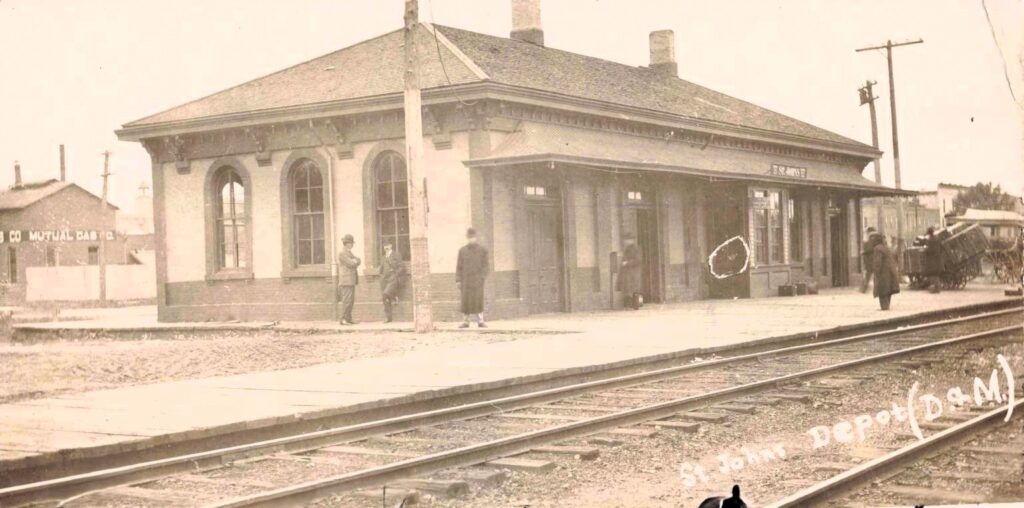
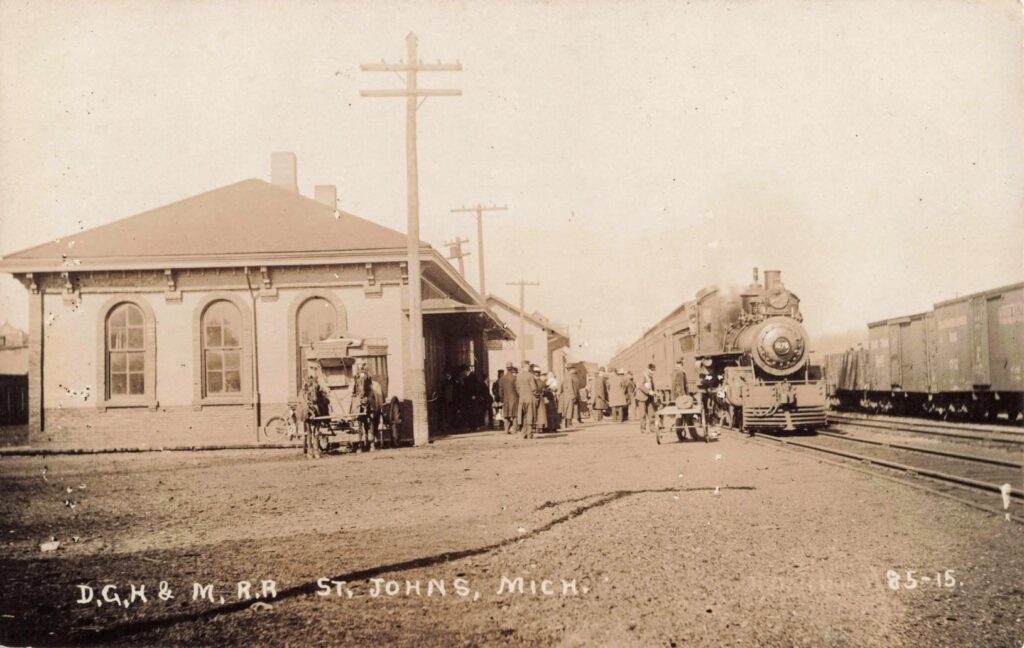
People wait along the platform outside the St. Johns depot, with railroad tracks in the foreground and wagons lined up at right. The image is titled “St. Johns Depot (D. & M.)” — shorthand for the Detroit and Milwaukee Railroad, which reached St. Johns in 1857.
This card is postmarked 1907 (per the note with the image), placing it years before the 1920 tornado that local histories say destroyed St. Johns’ depot and led to the construction of a replacement station. At far left, a building tied to Mutual Gas Co. is noted in the background, a reminder that rail lines and utilities grew up together.
Local historical writing describes the town site as being selected on high ground and near the midpoint of a planned rail line between Detroit and Lake Michigan.
St. Johns – DeWitt – Lansing Interurban Railway

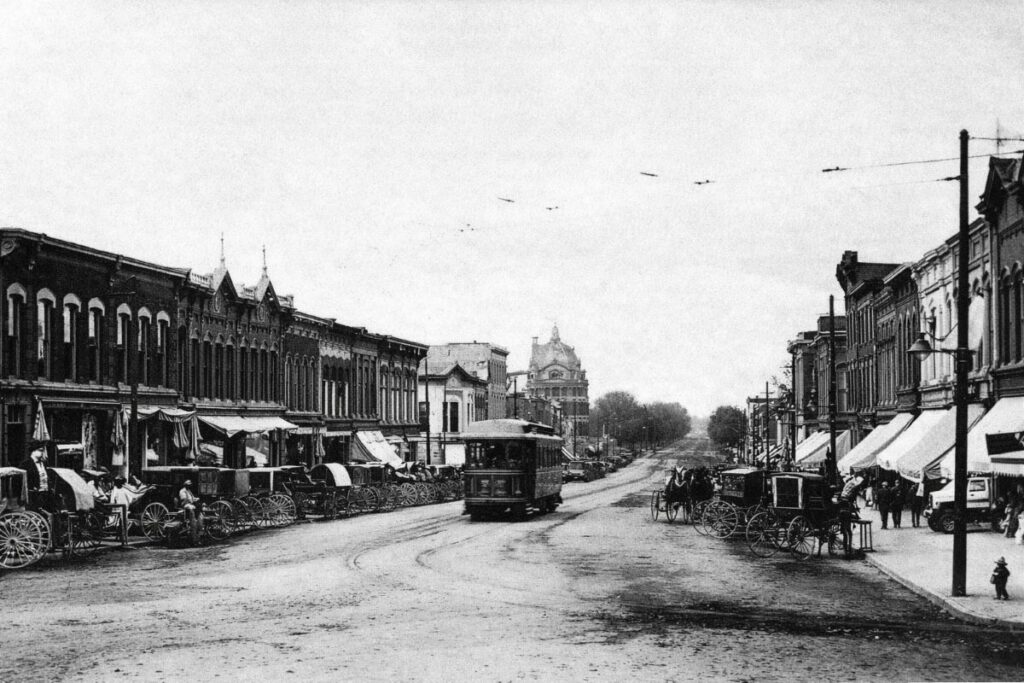
An electric interurban car rolls down a busy main street lined with brick storefronts, horse-drawn wagons, and overhead wires. The scene matches how interurban cars ran down the center of Clinton Avenue in St. Johns in the early 1900s.
The Lansing, St. Johns, and St. Louis Railway built an electric interurban line north out of Lansing through DeWitt and into St. Johns, with service reaching St. Johns in 1902. The interurban carried passengers, mail, and light freight, and the St. Johns line ended in 1929 as cars and roads took over.
Downtown St. Johns – Courts, Stores, and Credit

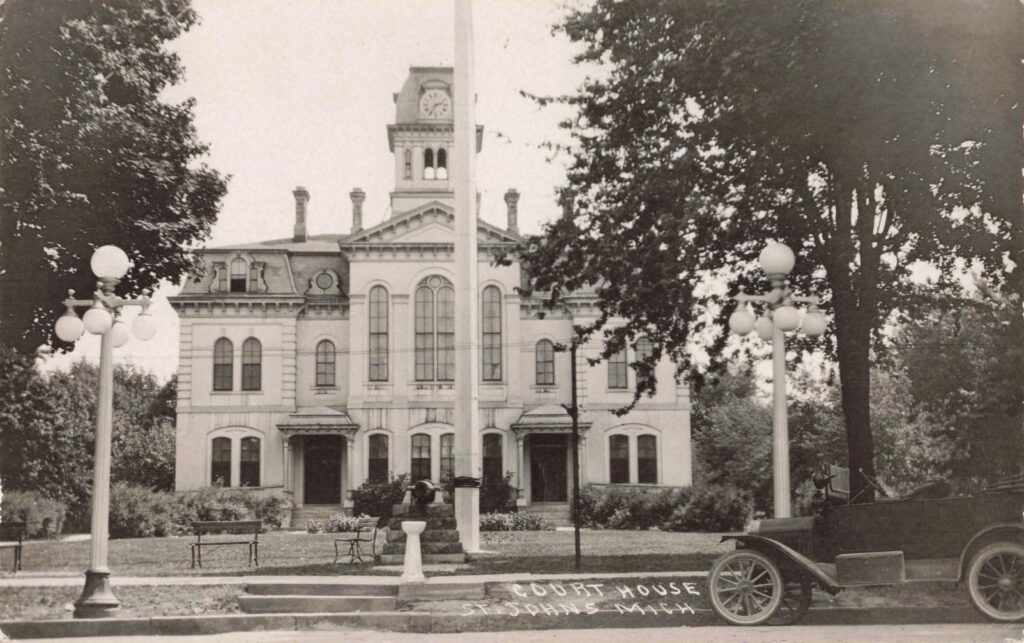
A courthouse town depends on more than law. It depends on foot traffic. County history notes that construction of the original courthouse began in 1869, was completed in 1872, and served for about a hundred years. That long run made the courthouse a constant—and a steady reason for people to travel into town to file papers, sit on juries, or settle disputes.
Clinton Avenue Was the Main Street of St. Johns

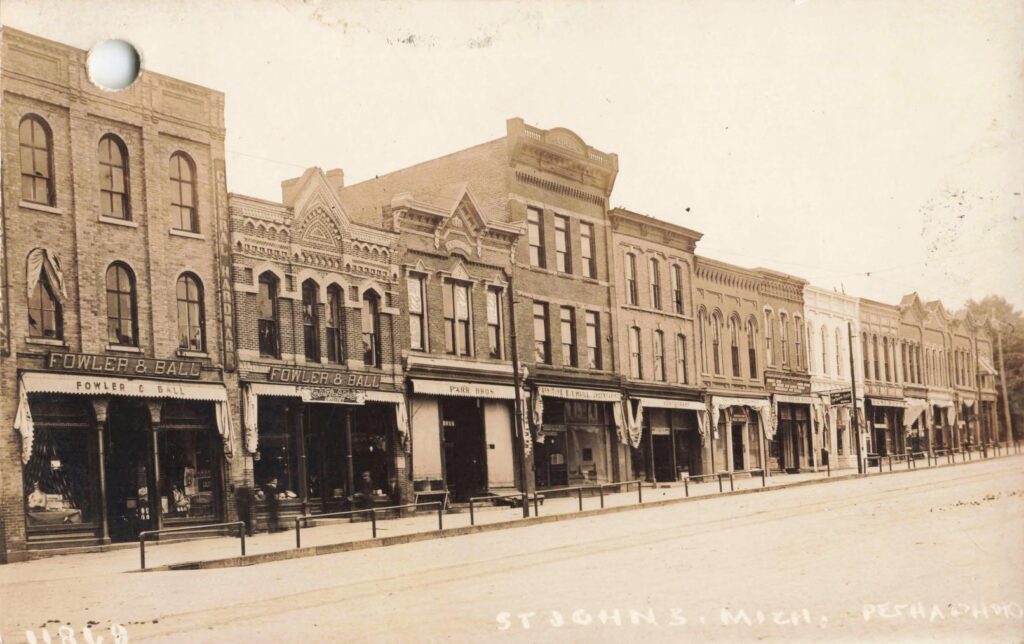
A Clinton County Historical Society article about rail-era St. Johns reports large passenger totals and heavy freight movement for 1879 and describes grain as the dominant outbound shipment. The exact year is earlier than our main window, but it clarifies the economic system St. Johns carried into the early 1900s: farms produced, freight moved, and downtown handled the selling and financing.

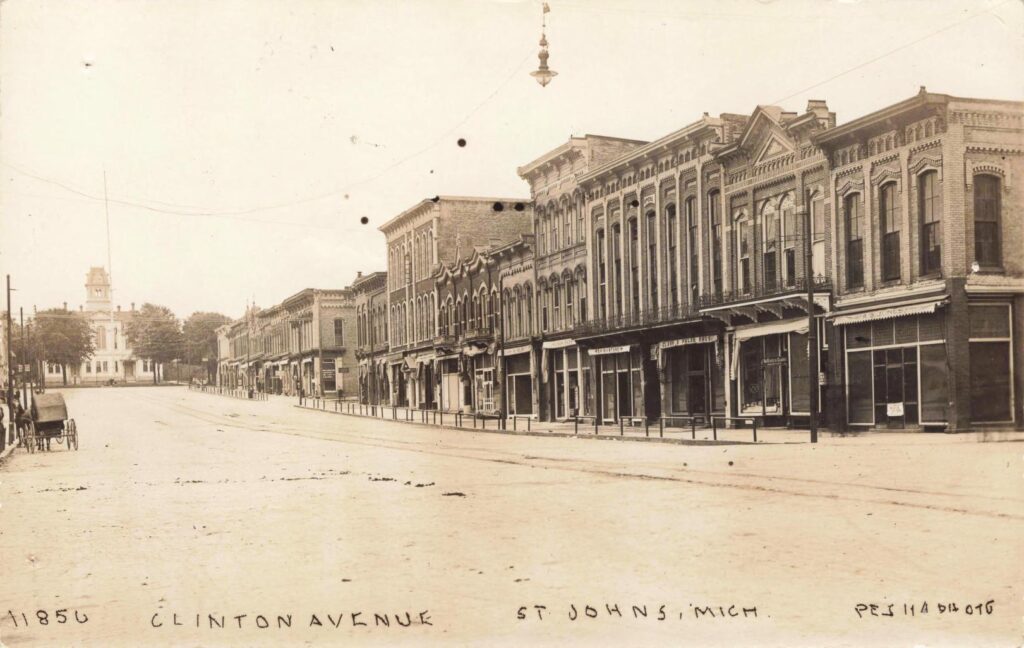
Brick storefronts line Clinton Avenue in downtown St. Johns, Michigan, in this early 1900s street scene, with a horse-drawn buggy at left and utility wires stretching overhead. The photo itself is labeled “Clinton Avenue, St. Johns, Mich.” and is often dated to about 1911 (not independently confirmed).
St. John’s became Clinton County’s seat in 1857, and Clinton Avenue was the town’s main commercial spine. By 1902, an electric interurban line, the Lansing, St. Johns and St. Louis Railway, reached St. Johns from the Lansing area — powered by overhead lines like the ones visible here.
Clinton Theater & Chapman Building
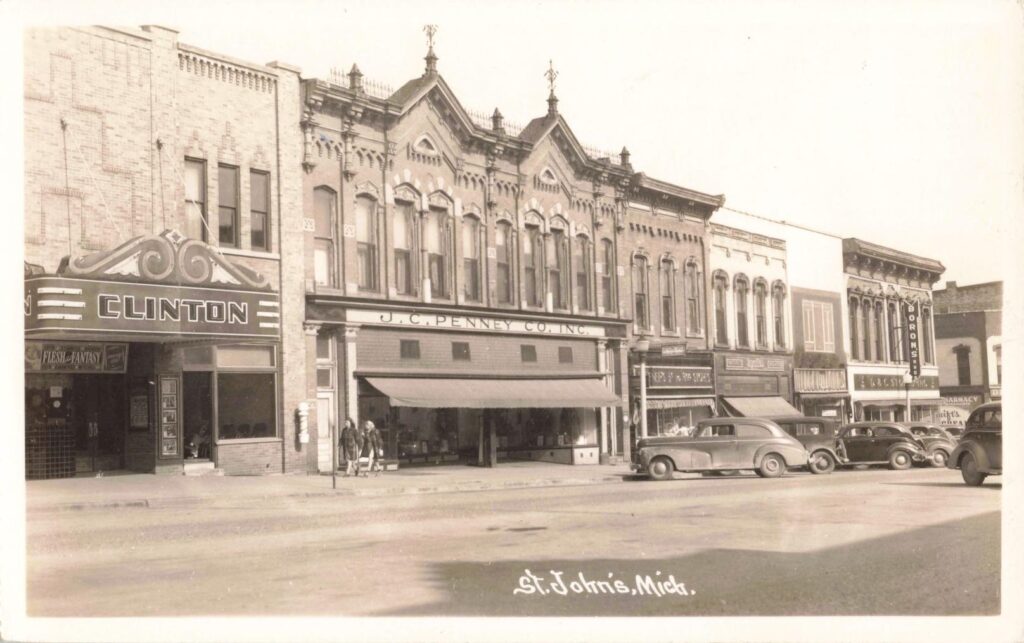
The Clinton Theatre marquee and a big J.C. Penney Co. Inc. sign dominate this downtown St. Johns street scene, with several 1930s-era cars parked along the curb. The photo is labeled “St. Johns, Mich.” and notes that the view dates to around 1935.
A Clinton County Historical Society walking tour says the Clinton Theater building was built in 1935, replacing the Iris Theater, and that J.C. Penney operated in the Chapman Building from 1927 to 1992. A vertical sign reading “BORONS” is also visible, matching a St. Johns rug-and-flooring business listed in later local directories.
Spaulding & Co.’s General Hardware

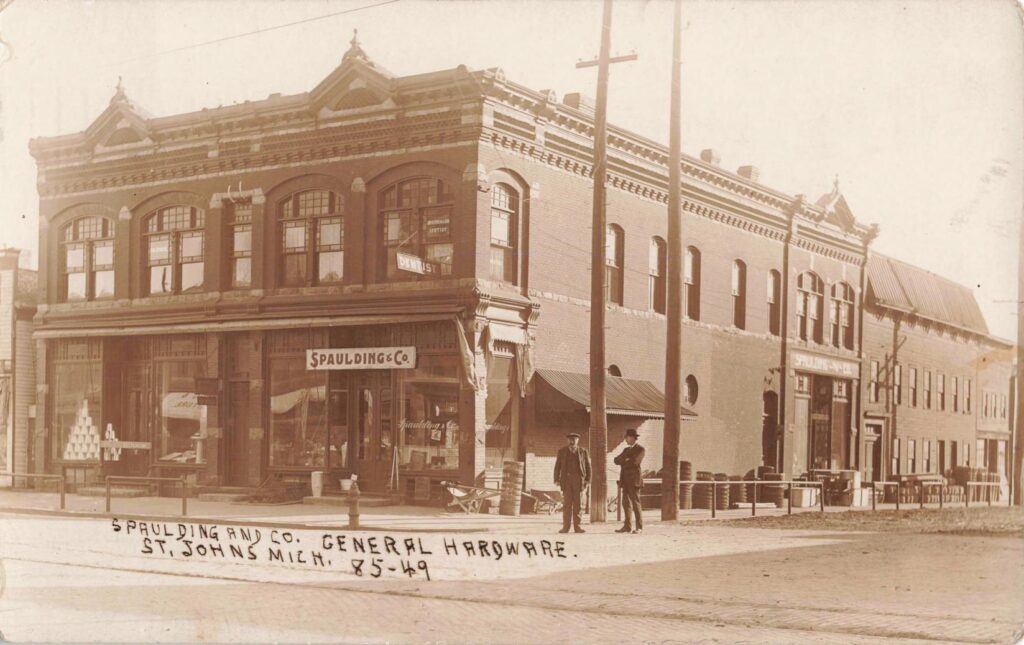
Spaulding & Co.’s General Hardware is shown in this 1912 real-photo postcard from downtown St. Johns, Michigan. The big storefront sign reads “Spaulding & Co.,” and a second-floor sign advertises a “Dentist” — a hint that many Main Street buildings mixed retail downstairs with professional offices upstairs.
A Clinton County Historical Society walking tour identifies this as the old Spaulding Hardware building at the corner of N. Clinton Avenue and Higham Street (300 N. Clinton Ave.). That tour says Frank M. Spaulding ran hardware here from about 1890 to 1945, before the store later became Alan R. Dean Hardware and, eventually, Gill-Roy’s.
Schools and the Town’s Long View Bet

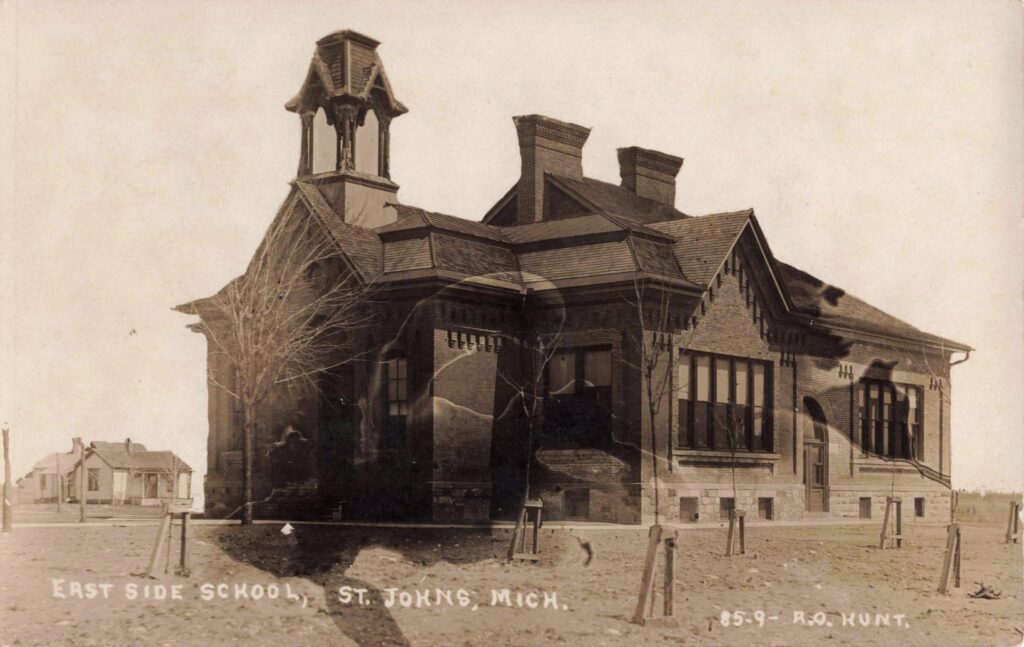
St. Johns invested early in brick school buildings, a signal that residents expected the town to last. A Clinton County tour identifies the East Side school as a large 1876 brick building designed from plans by Bay City architect Oliver Hidden. It was later associated with educator Teresa Merrill, who would become tied to local civic projects.
The Depot and the Tornado that Changed Downtown
The sharpest breakpoint in the History of St. John’s, Michigan, during this era is Palm Sunday, March 28, 1920. A Clinton County Trails article says a tornado struck St. Johns around 5:15 p.m., damaged porches, roofs, windows, and chimneys, and destroyed the depot. It also describes dramatic damage to the Fowler and Ball Hardware store, where the upper story was torn off and dropped into the street.
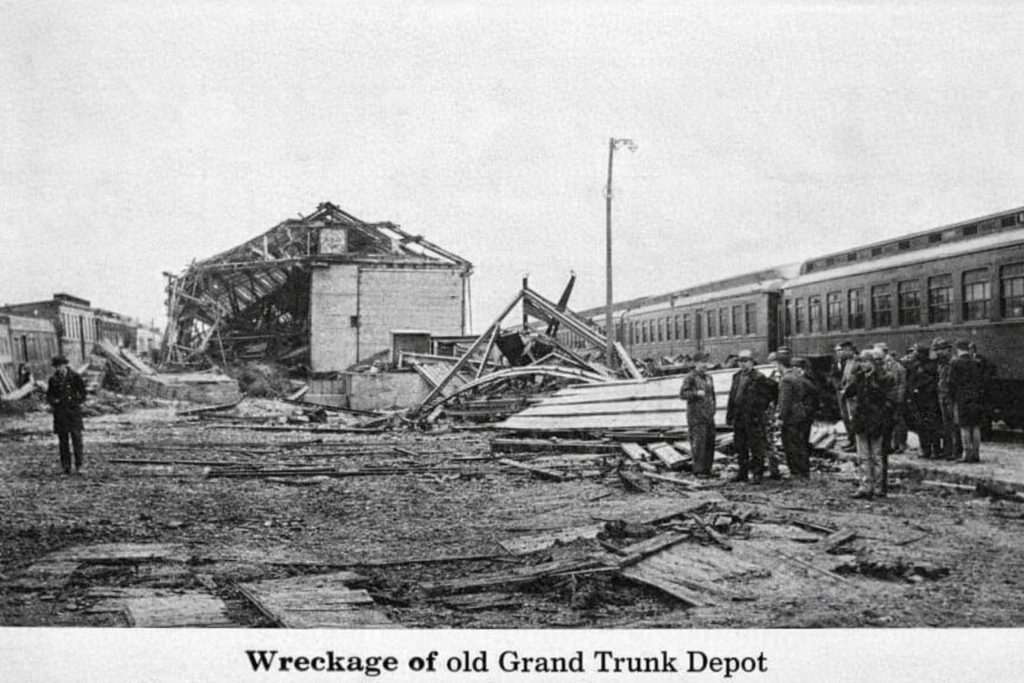
Here is the surprise detail residents still repeat: the station master, Harry W. Buck, had his first Sunday off in five years when the tornado smashed the part of the station where he normally worked.

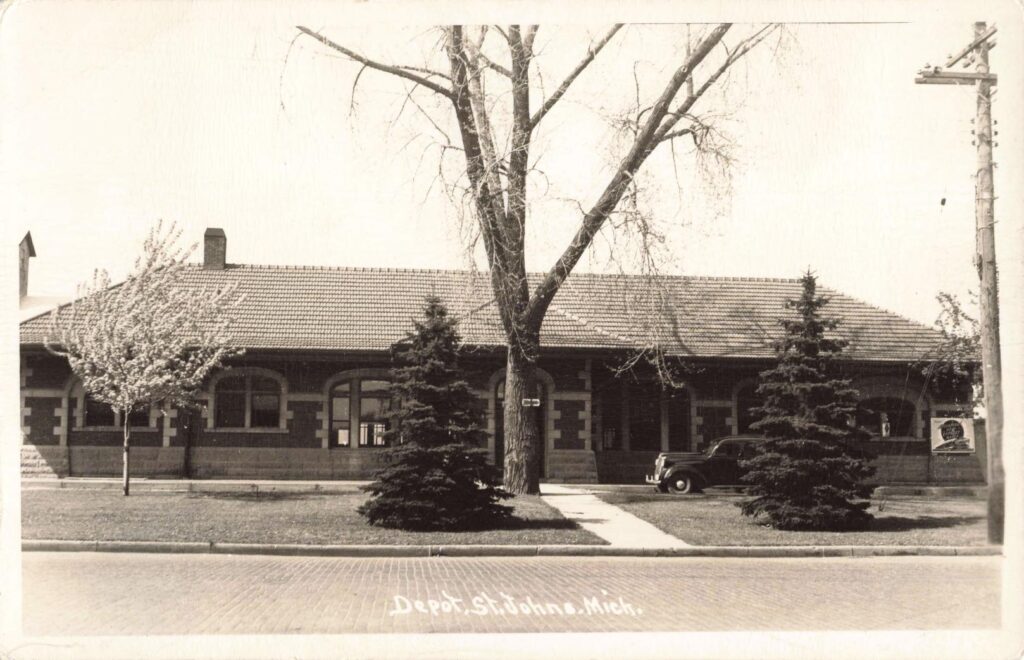
St. Johns had pushed for a better depot for years. The railroad was delayed. The tornado ended the argument. The same local account says a new depot opened on March 17, 1921. The improvement arrived through disaster, not through steady planning.
Public Safety as Civic Pride
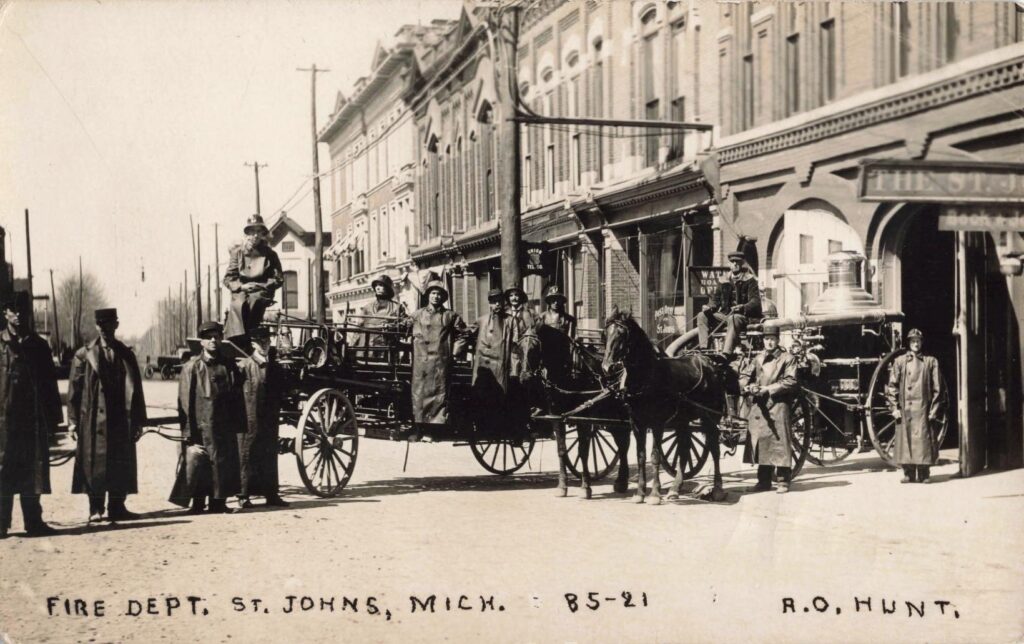
After the 1920 tornado and during the early 1920s, towns across Michigan upgraded public services. In St. Johns, the fire department’s view dated Aug. 5, 1921, reads like a public statement: “We are here, we are organized, and we are ready.”
Banking and Trust on Main Street
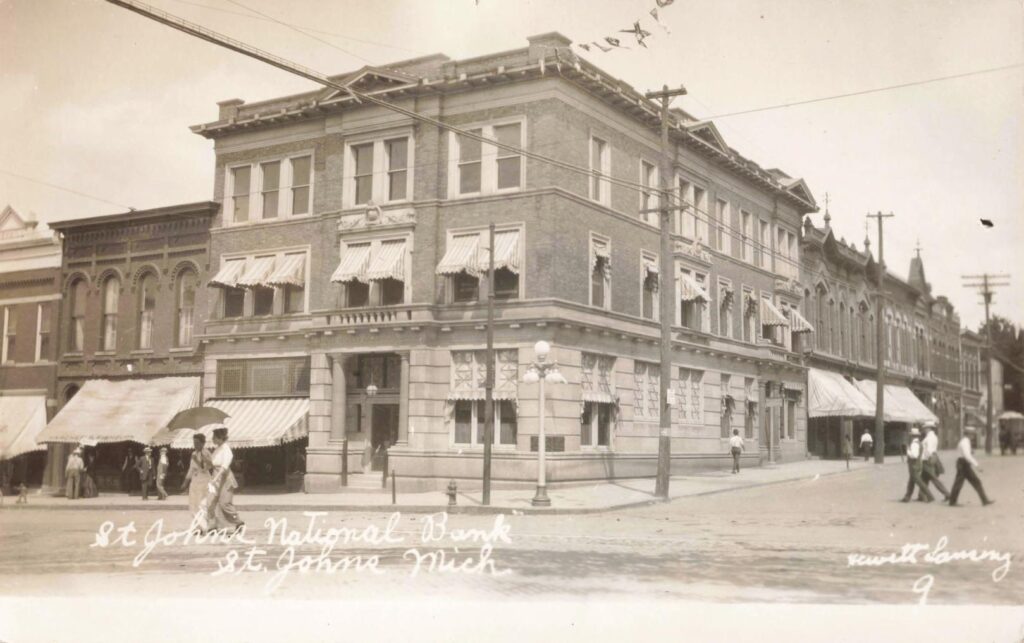
Local banking was not distant finance. It was intertwined with merchants and farm commerce. A Clinton County narrative notes an early national bank organized in the 1860s, and the county atlas lists merchant John C. Hicks as president of St. Johns National Bank. That style of leadership carried weight: the same people who sold dry goods and bought grain were often the ones approving loans.
Hotels and Travelers: Why the Steel Hotel existed

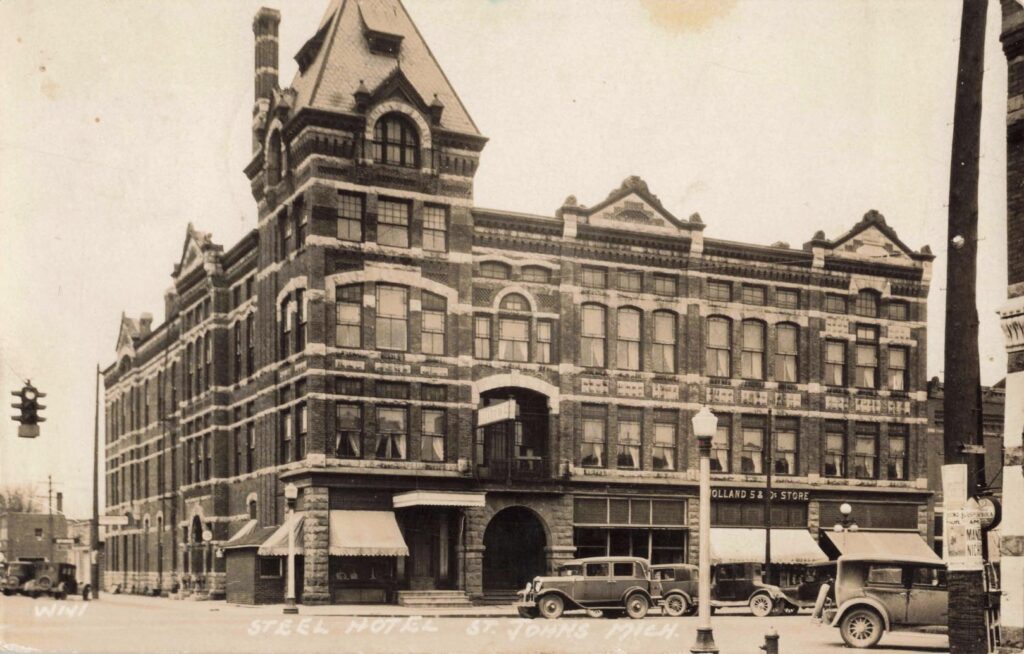
St. Johns needed lodging for out-of-town visitors. Historical society records link Robert M. Steel to rail contracting and to major local enterprises, including a hotel that bore his name. Clinton County tour materials note that he built the Steel Hotel in 1887. For decades, it stood as a marker of what St. Johns expected from itself: fewer one-night rooms above a store, more purpose-built lodging for rail-era travel.
Leisure Arrives: A Golf Club in a Small Town

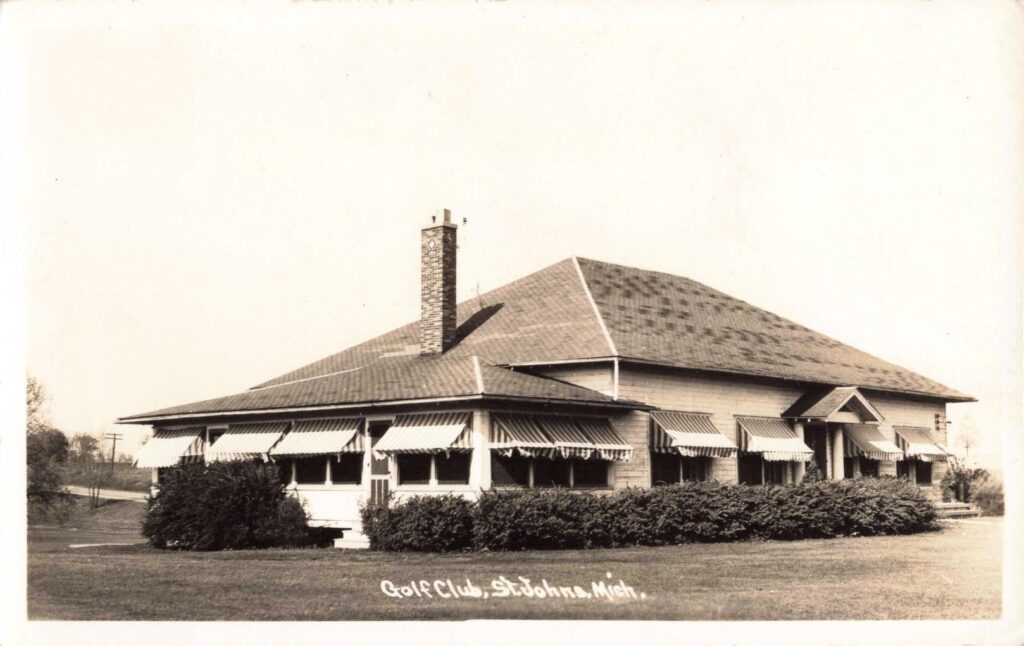
One supplied view is simply labeled “Golf Club.” Even without a roster of members, the existence of a dedicated club building suggests a town with a growing professional class—bankers, lawyers, doctors, and merchants—who had time and money for organized recreation. In the early 1900s, that was a sign of stability and aspiration.
How St. Johns Built a Hospital with Neighbors’ Dollars

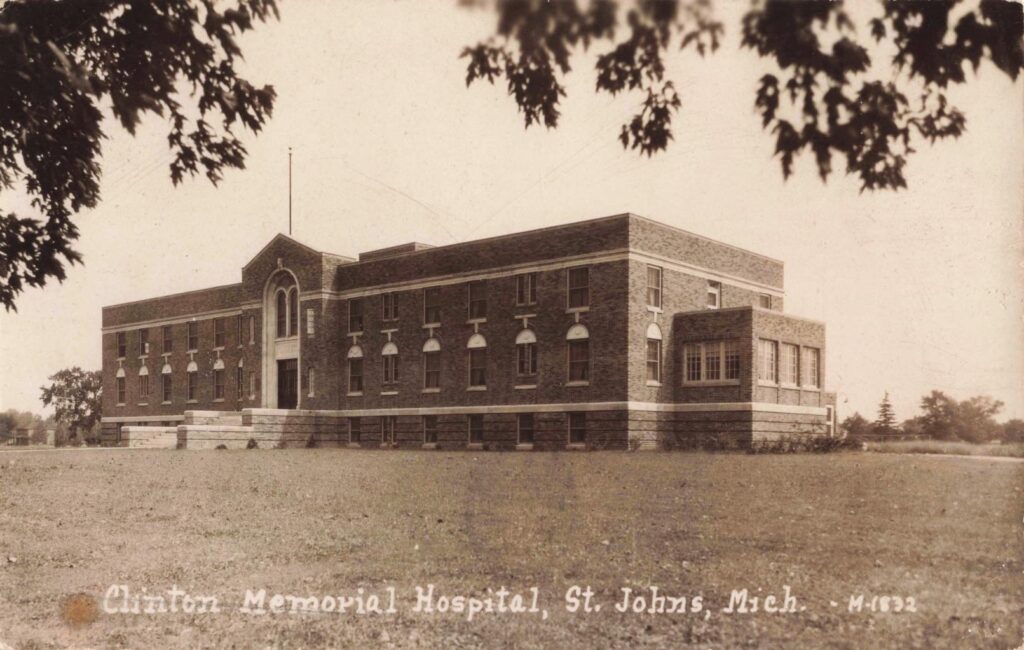
The late 1920s brought a different type of project: health care. A Clinton County historical article reports that a public subscription campaign began on May 5, 1926, to fund a hospital, with land donated by Oliver L. Spaulding. It states that the hospital was dedicated on Nov. 11, 1927, and describes its early operations and capacity.
A later St. Johns Independent archive report adds a striking statistic: more than 1,600 residents contributed to the campaign, with gifts ranging from $1 to $10,000. That range suggests a rare coalition—farm families, shop owners, and civic leaders pooling resources for a facility most of them hoped they would not need often.
History of St. Johns Michigan, is also the history of farm change

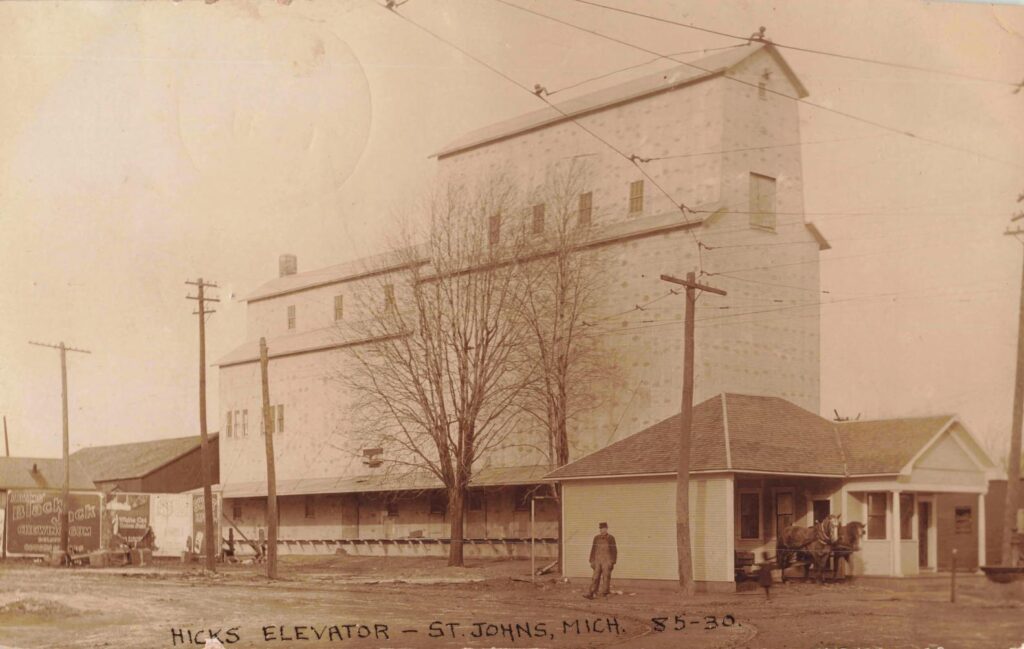
St. John’s did not stop being a farm town because it built banks and hospitals. It stayed a farm town and changed what it grew. A Clinton County educational history notes that mint became important in the county’s black soils, stating that the first mint farm began in 1913, with oil removed in a still. Michigan State University provides a broad context on Michigan’s historic scale in peppermint oil production and the commercial demand for mint oil.
And there are names tied to that mint story. WKAR reported that Crosby Mint Farm was established in 1912 and continues to highlight its long family operation.
This is where the key phrase needs to be said plainly: the History of St. Johns Michigan is not only about downtown streets. It is also about the rural money that came in with grain and mint, and the families who kept planting through hard years.
A last look at what the town chose to show

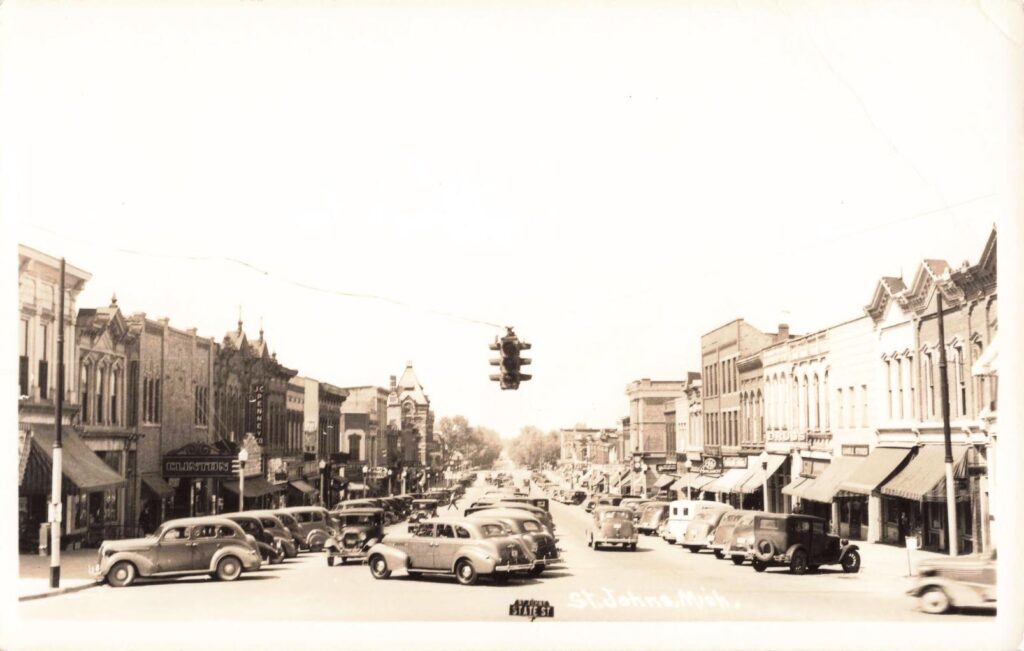
Public buildings tell you what a place values. A school suggests the town expects children to stay. A bank suggests that people expect to borrow and repay. A courthouse suggests disputes will be settled on paper and in public, not privately. A fire department suggests neighbors expect to show up when the bell sounds.
A tornado in 1920 tested all of that. A hospital in 1927 reinforced it. And by the late 1930s, St. Johns was living in the America we recognize: cars alongside older systems, school buildings that looked permanent, and a downtown built to serve both everyday needs and official duties.
In the History of St. John’s, Michigan, this era offers a clear arc: rails build the town, a storm forces a major rebuild, and the community answers by funding a hospital and continuing to invest in schools, safety, and farm commerce.
Works Cited for the History of St. Johns Michigan
Clinton County, Michigan. “New Courthouse.” Clinton County. Accessed 5 Mar. 2026.
Clinton County Historical Society. “1900’s Clinton County.” OpenNet, Accessed 5 Mar. 2026.
Clinton County Historical Society. “Railroad Construction and St. Johns Railroad Men.” Clinton County Trails, vol. 35, issue 4. OpenNet, Accessed 5 Mar. 2026.
Clinton County Historical Society. “St. Johns Naming and Early Growth.” Clinton County Trails, vol. 30, issue 3. OpenNet, Accessed 5 Mar. 2026.
Clinton County Historical Society. “St. Johns Township Tour – North.” OpenNet, https://opennet.us/cchs/Tours/St.%20Johns%20Tour2.pdf. Accessed 5 Mar. 2026.
Clinton County Historical Society. “The Great 1920 Clinton County Tornado” and “Miracle on Railroad Street.” Clinton County Trails, vol. 35, issue 3. OpenNet, https://opennet.us/cchs/news/cct35-3.pdf. Accessed 5 Mar. 2026.
Fink, Maralyn. “The East Ward Story, Teresa Merrill.” St. Johns Independent, 26 Feb. 2015, https://stjindy.com/archive1/eastward-4/. Accessed 5 Mar. 2026.
Library of Michigan. “Clinton.” Michigan.gov, Accessed 5 Mar. 2026.
Michigan State University. “Mint in Michigan.” Geog 101: Geography of Michigan, . Accessed 5 Mar. 2026.
Spaulding, Oliver Lyman. “Biography.” History, Art & Archives, United States House of Representatives, https://history.house.gov/People/Listing/S/SPAULDING%2C-Oliver-Lyman-%28S000706%29/. Accessed 5 Mar. 2026.
University of Michigan Library Digital Collections. “Standard atlas of Clinton County, Michigan: Patrons Directory.” Accessed 5 Mar. 2026.
Wesnock, Ross. “The Crosby Mint Farm still smells sweet after 100 years.” WKAR, 13 Nov. 2012, . Accessed 5 Mar. 2026.