


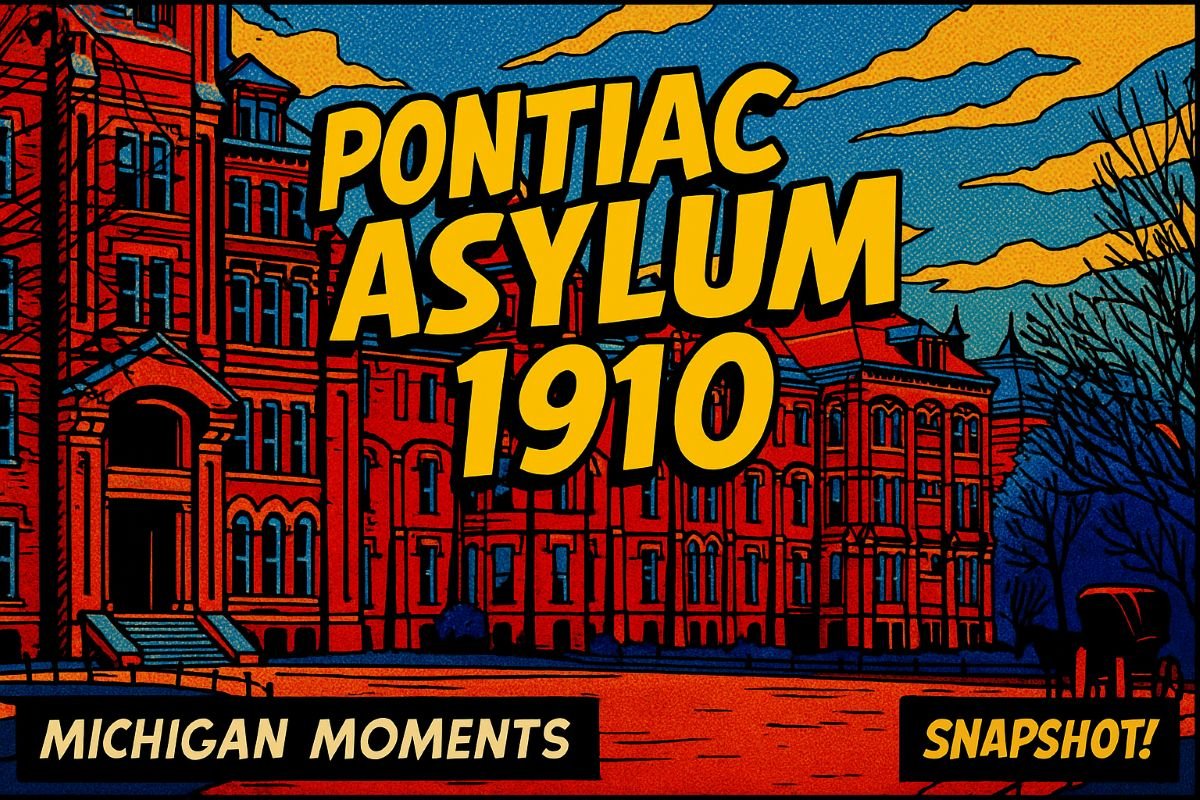
The Pontiac Asylum for the Insane – Michigan’s Grand Psychiatric Experiment
In the 1910 postcard, the Eastern Michigan Asylum for the Insane looms over a bare yard in Pontiac. The Pontiac Asylum had tall brick towers, steep roofs, and long wings stretch across the frame. It looks more like a grand hotel than a hospital. Yet this huge complex on Elizabeth Lake Road was Michigan’s second state psychiatric institution and a key part of how the state handled mental illness in the early 20th century.

Building a second state hospital

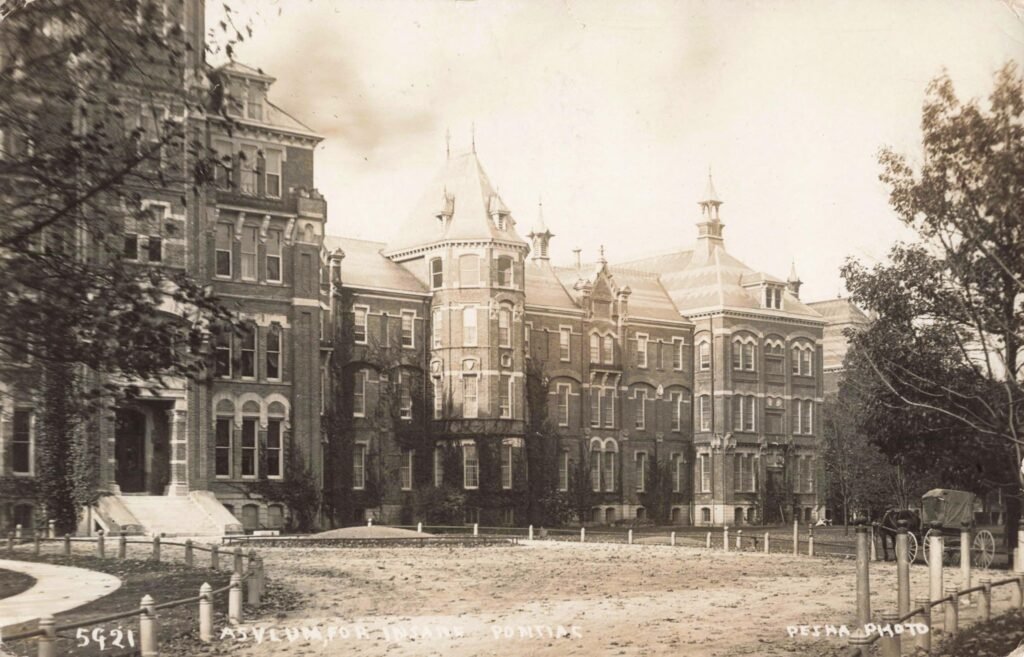
By the 1870s, Michigan’s first asylum in Kalamazoo was so crowded that lawmakers approved $400,000 to build a second hospital in the eastern part of the state. Several cities competed for the project. Pontiac won after local residents offered land and support, and construction began on a campus that eventually grew to more than 400 acres.
The state hired architect Elijah E. Myers to design the main building. Myers was already well known in Michigan; he designed the current state Capitol in Lansing. For Pontiac, he produced a long, red-brick structure in the Kirkbride style, with a central administration block and long, staggered wings for male and female patients.
The Eastern Michigan Asylum opened on Aug. 1, 1878, with 222 patients. Over the next few decades, the state added more wings and service buildings as patient numbers climbed. Major expansions came in the 1880s and 1890s, with further additions in 1906 and 1914.
Life inside around 1910

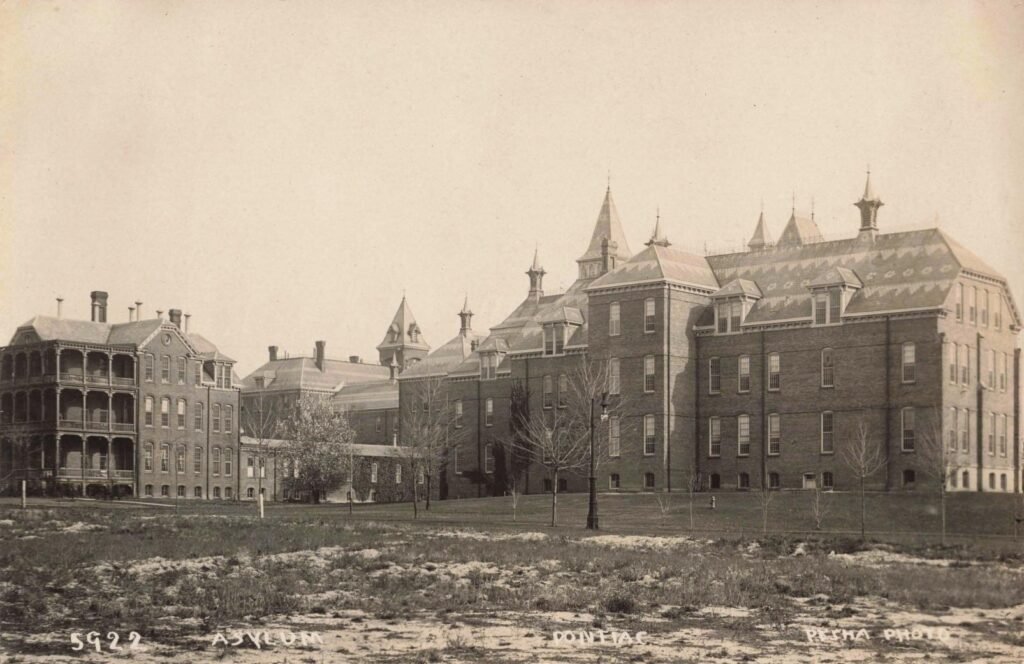
The 1910 date on the postcard places us just before an important change. In 1911, the state dropped the old “asylum” name and rebranded the facility as Pontiac State Hospital.
Early superintendents, including Henry Mills Hurd, promoted what they saw as modern treatment. Hurd discouraged physical restraints and encouraged occupational therapy, farm work, and recreation. Patients worked in on-site barns, kitchens, and laundries. By 1910, there was even a “modern dairy barn” tied to the hospital farm.
But the postcard view also hints at the institution’s rigid structure. Men and women lived in separate wings. Most patients stayed for long periods, sometimes for life. As numbers increased, the hospital shifted toward a custodial role—keeping people housed and managed rather than offering true medical cures. By the mid-20th century, Pontiac would hold more than 3,000 patients at its peak.
From Pontiac State Hospital to Clinton Valley Center

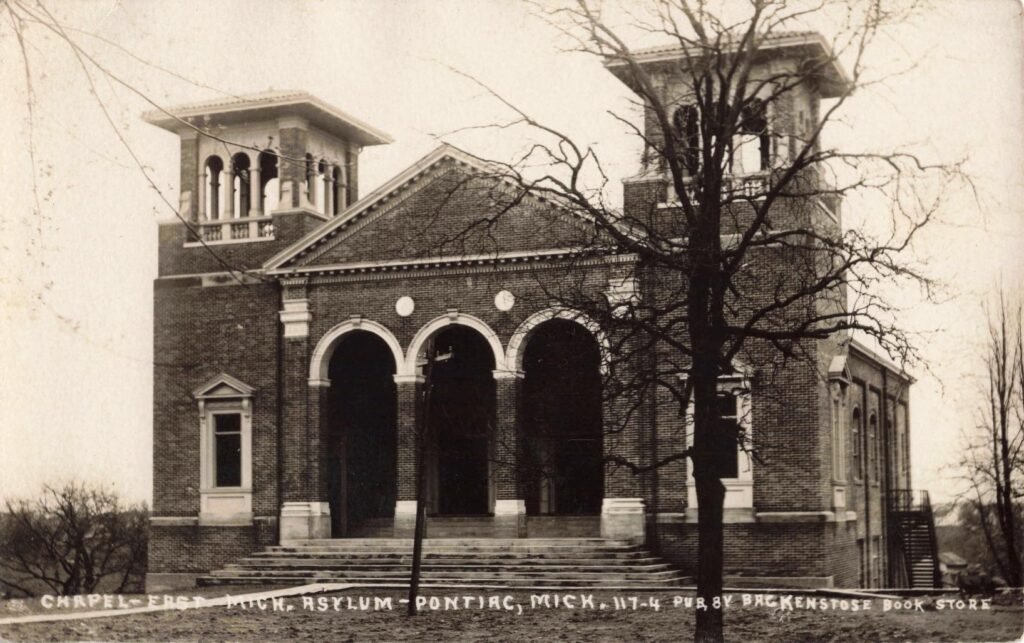
The institution changed names and missions several times. In 1973, it became Clinton Valley Center as mental health policy moved toward community-based care. Patient numbers dropped through the 1970s and 1980s.
Even as it shrank, the site gained official recognition. Michigan named it a State Historic Site in 1974, and it was added to the National Register of Historic Places in 1981 as the Eastern Michigan Asylum Historic District.
That status did not save the main building. The state closed Clinton Valley Center in 1997, and the sprawling Victorian structure was demolished in 2000. Today, a subdivision stands where the asylum once dominated the skyline west of downtown Pontiac.
What the 1910 postcard of the Pontiac Asylum shows us today

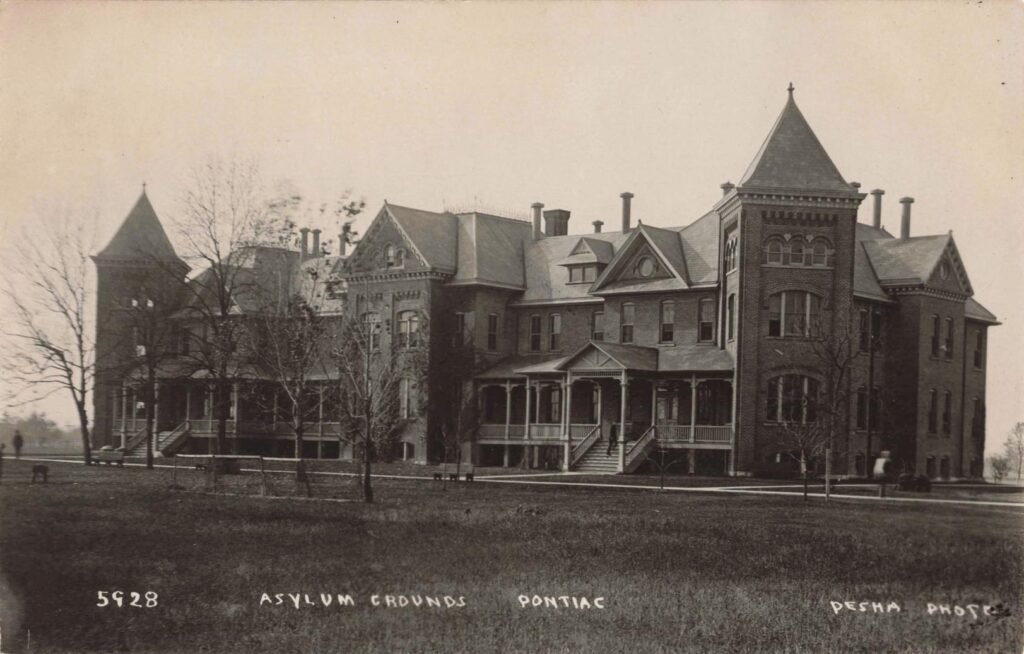
The postcard labeled “Asylum for Insane, Pontiac 1910” captures a moment when this institution sat near the center of Michigan’s approach to mental health. It shows a city that beat out Detroit to host a major state project and an architect who used the same grand style seen at the Capitol in Lansing. The building is gone, but its image continues to raise questions about how the state treated some of its most vulnerable residents—and how communities like Pontiac lived alongside a massive psychiatric campus for more than a century.
Pontiac Asylum Became the Clinton Valley Center
The Pontiac Asylum, originally opened in 1878 as the Eastern Michigan Asylum, was officially renamed the Clinton Valley Center in 1973. The historic facility was permanently closed in 1997 and subsequently demolished in 2000. Here are the key details regarding the name change and demolition:
The Name Change (1973): Throughout its century of operation, the facility had several names. After being called the Eastern Michigan Asylum and later the Pontiac State Hospital (1911), it was rebranded as the Clinton Valley Center in 1973 to reflect a shift in mental health treatment and to reduce the social stigma historically associated with “asylums.”
Why It Was Torn Down: By the late 1990s, Michigan—like many states—heavily downsized its large psychiatric hospitals in favor of community-based support systems, outpatient care, and halfway houses. The sprawling, 19th-century complex was expensive to heat, run, and maintain. After decades of heavy use, the buildings fell into severe disrepair and needed major, cost-prohibitive renovations.

