


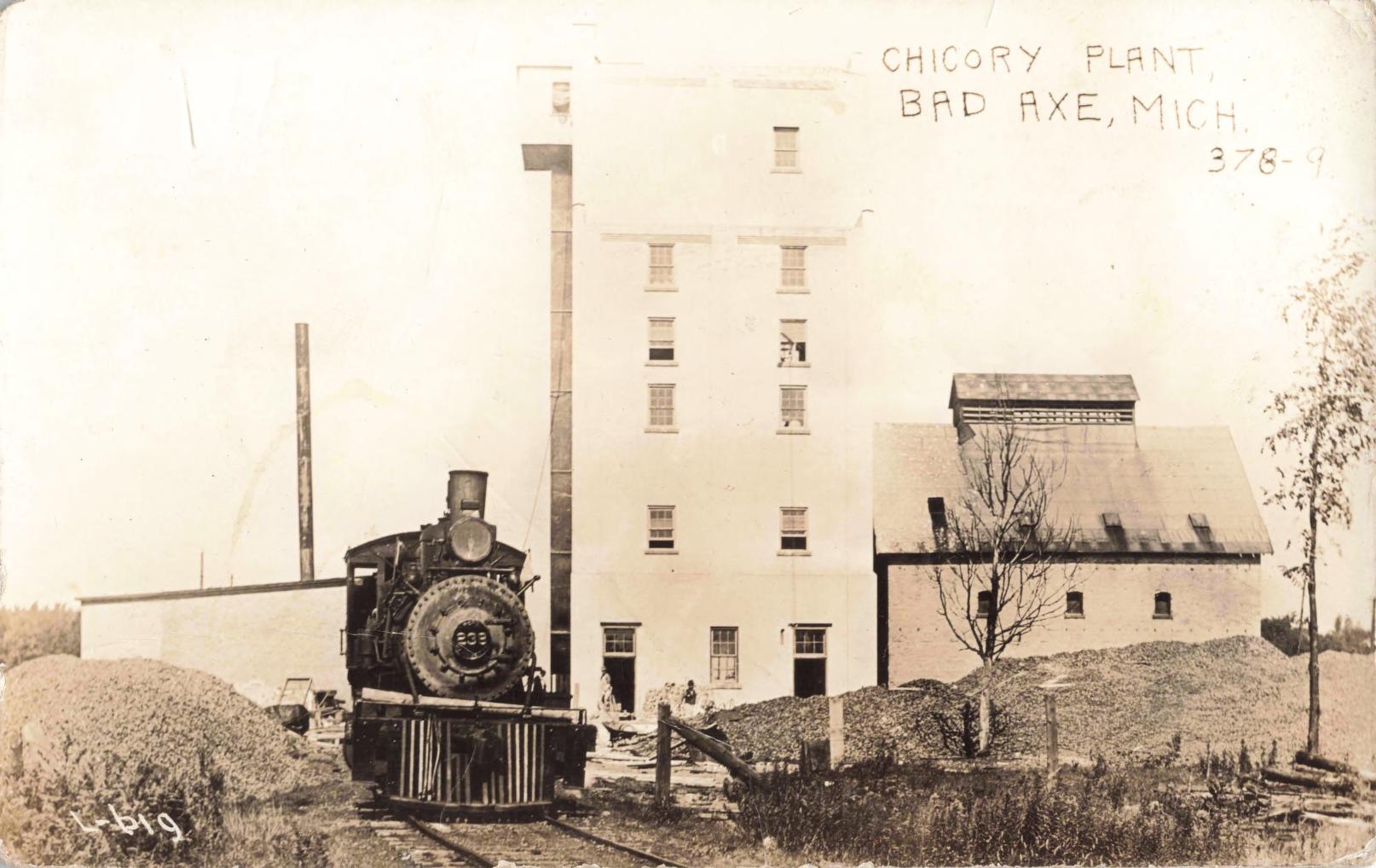
Short History of the Bad Axe Chicory Plant and the Muller Coffee Substitute Era, c. 1909–1912
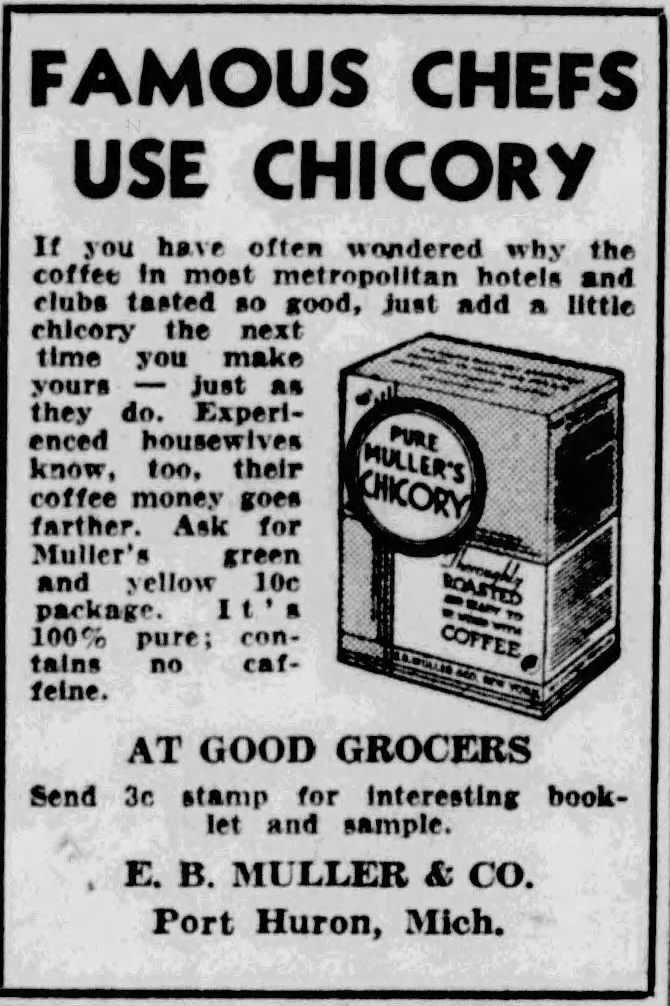
This view shows the Bad Axe chicory works in the early 1900s, when Huron County farmers raised chicory root for roasting and blending with coffee. Sanborn Fire Insurance Maps confirm a “Chicory Plant” here in April 1909, operated by E. B. Muller & Co., a Port Huron-based firm that ran several Michigan plants.

Chicory’s history in Michigan coffee is rooted in necessity, especially during the Civil War and Great Depression, when it was roasted and used to stretch coffee supplies, becoming a local staple, particularly in the Port Huron/Thumb region, where companies like E.B. Muller & Co. and Heinr. Franck Sons Inc. was a major player, creating “Port Huron” chicory blends that added depth, sweetness, and body to coffee, a tradition that linked Michigan to the broader U.S. practice of using this common roadside plant as a coffee extender and flavor enhancer.
The Bad Axe Chicory Plant

The tall white processing block and adjacent dryer building anchor the site. At the same time, a steam locomotive sits on plant trackage with root piles stacked nearby—typical of harvest-season delivery before washing, slicing, and drying. Sanborn mapping places the complex beside a railroad wye north of Hilton Street to speed inbound roots and outbound dried product to markets.
The Bad Axe Chicory Plant Diversified Thumb Agraculture
Chicory helped diversify the Thumb’s farm economy after the lumber era. E. B. Muller’s Michigan network—including Bad Axe—met national demand for a caffeine-free coffee extender used heavily during wartime and tight commodity periods; newspapers and trade accounts document the company’s multi-plant footprint in the 1910s–1930s. Production at Michigan chicory works waned mid-century as tastes and markets shifted.
History of Chicory in the U.S.
The history of chicory as a coffee substitute is closely tied to periods of conflict and economic hardship on both sides of the Atlantic. The practice first took hold in Europe during the Napoleonic era, when blockades restricted coffee imports and pushed consumers toward roasted chicory root as an alternative. It later spread to North America and gained particular prominence during the American Civil War, when Union naval blockades caused widespread coffee shortages.
In places like New Orleans, chicory became especially popular and eventually famous as part of the city’s coffee culture. The Great Depression brought another wave of interest, as families once again turned to chicory as a cost-effective way to stretch precious coffee rations during hard times.
Chicory in Michigan
In the early 20th century, Port Huron emerged as a regional “coffee capital” for chicory processing, home to major firms such as E.B. Muller & Co. and Heinr. Franck Sons Inc., which roasted and prepared chicory for use in coffee blends.
The crop itself was well suited to Michigan: chicory is a hardy roadside plant, related to the dandelion, that thrived in the state’s soils and climate. This made it an abundant, accessible local resource that could be cultivated, processed, and shipped from Michigan to meet national demand for coffee substitutes and extenders.
How It Was Used
Roasted and ground chicory root played a practical and flavorful role in Michigan’s coffee culture. Added to coffee, it contributed a toasty, nutty character, deepened the brew’s color, and gave the cup a richer body.
During lean times, chicory was frequently blended—sometimes in high proportions—with regular coffee to stretch limited supplies without sacrificing taste. Over time, this practice became a familiar part of everyday life, embedding itself in local coffee traditions and linking Michigan to broader American patterns of chicory use, especially across the Midwest and South.
Chicory Use In The United States Today
Today, while less common as a full substitute, chicory remains in some instant coffees and is used to enhance specialty coffee blends for its unique flavor and texture.
Cafe du Monde’s use of chicory coffee is rooted in both French tradition and wartime necessity. French settlers introduced chicory to Louisiana in the 18th century, but its widespread use followed the American Civil War. Union naval blockades in the 1860s sharply reduced coffee imports through the Port of New Orleans, driving up prices and limiting supply. Residents turned to roasted chicory root, derived from the endive plant, to stretch what little coffee they had. Founded in 1862, Cafe du Monde continued serving the coffee-and-chicory blend after the war, even as beans became available again, because customers had come to prefer its taste.
The house blend typically uses about four parts coffee to one part chicory, producing a darker, smoother cup with lower acidity and no added caffeine from the chicory itself. The flavor is deep and earthy, softening the bitterness of dark-roasted beans with mild nutty or chocolate-like notes. At the French Market stand, the coffee is traditionally served as café au lait, mixed evenly with hot milk and paired with powdered-sugar-covered beignets. The blend’s reach extends beyond New Orleans, with its orange-and-yellow tins sold worldwide and commonly used in Vietnamese American households for iced coffee preparations.
Notes on dating: The exact year of the photo is not printed, but the plant is mapped in April 1909 and another RPPC identifies a Bad Axe Muller chicory factory in 1912; the image likely falls in this 1909–1912 window