


History of Berne Michigan – A 1900 Snapshot of this Forgotten Ghost Town
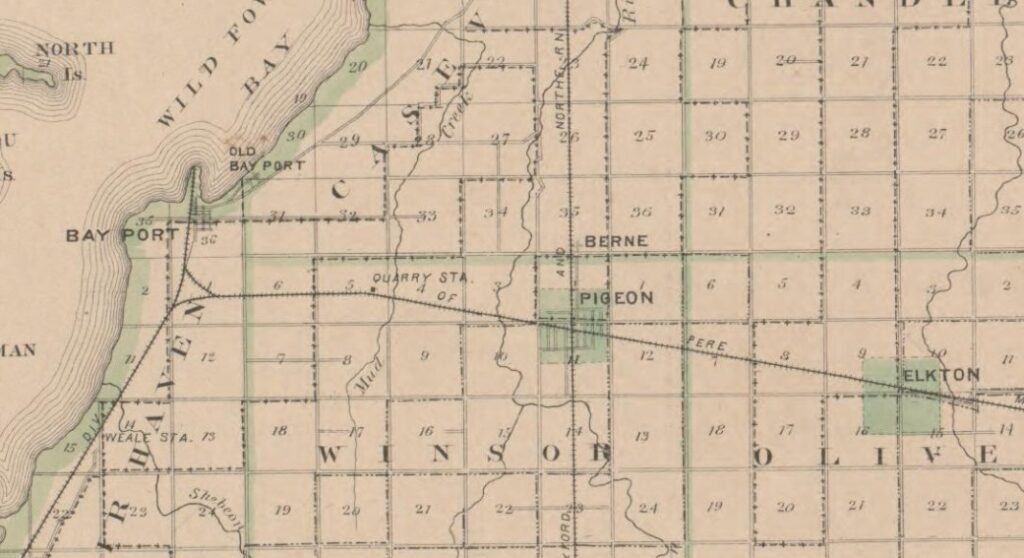
Berne was a tiny settlement in the far northern Thumb of Michigan. Founded around 1878 as a railroad village in Winsor Township, it lay a few miles north of Pigeon in Huron County. By 1900, the townsite was little more than a junction of dirt roads amid farms – a cluster of houses, a church, and a general store. The depot on the Pontiac, Oxford & Port Austin Railroad (milepost 93.0) once put Berne on the map, but its real life revolved around fields and farm families. In short, the history of Berne Michigan, is more a story of people living off the land.
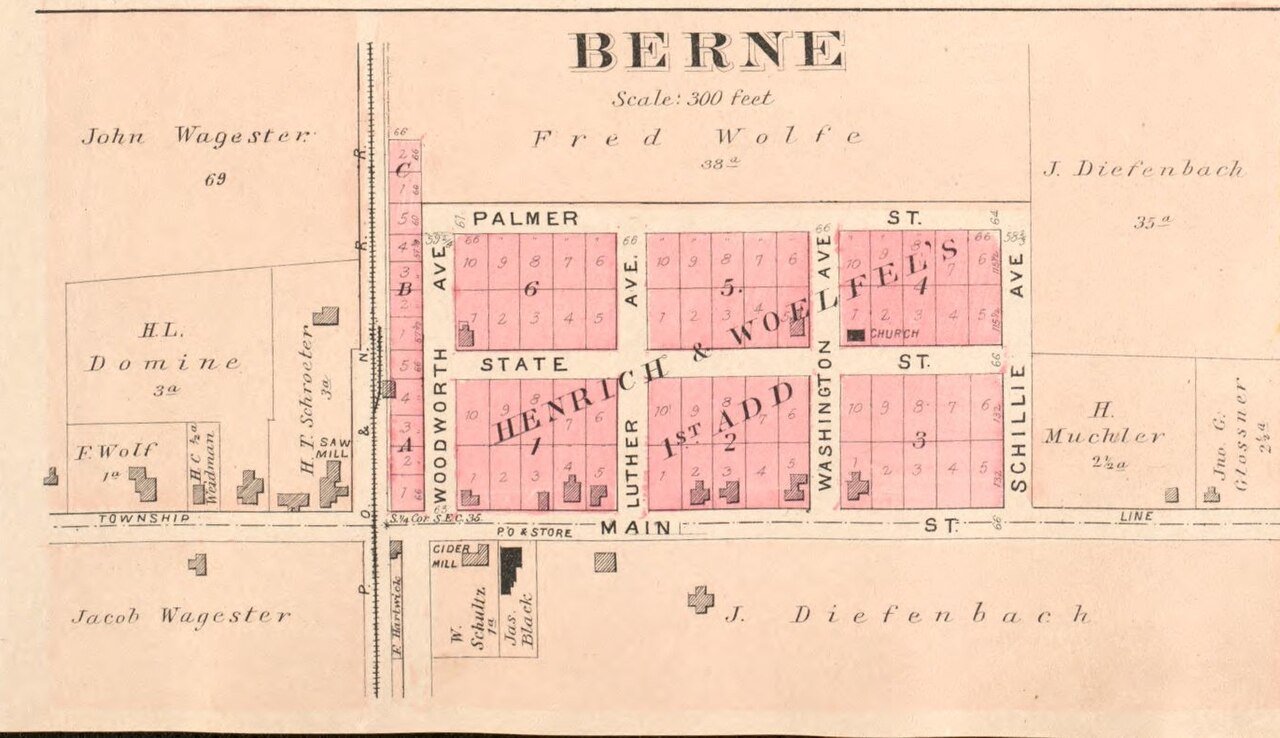
Unfortunately, we found few photos of Berne Junction. I’m sure there are some tucked away in old photo books or in a historical society filing cabinet. Until we find a good primary source, we will utilize photos from nearby communities in our story.
Table of Contents
Farming and Land in Berne

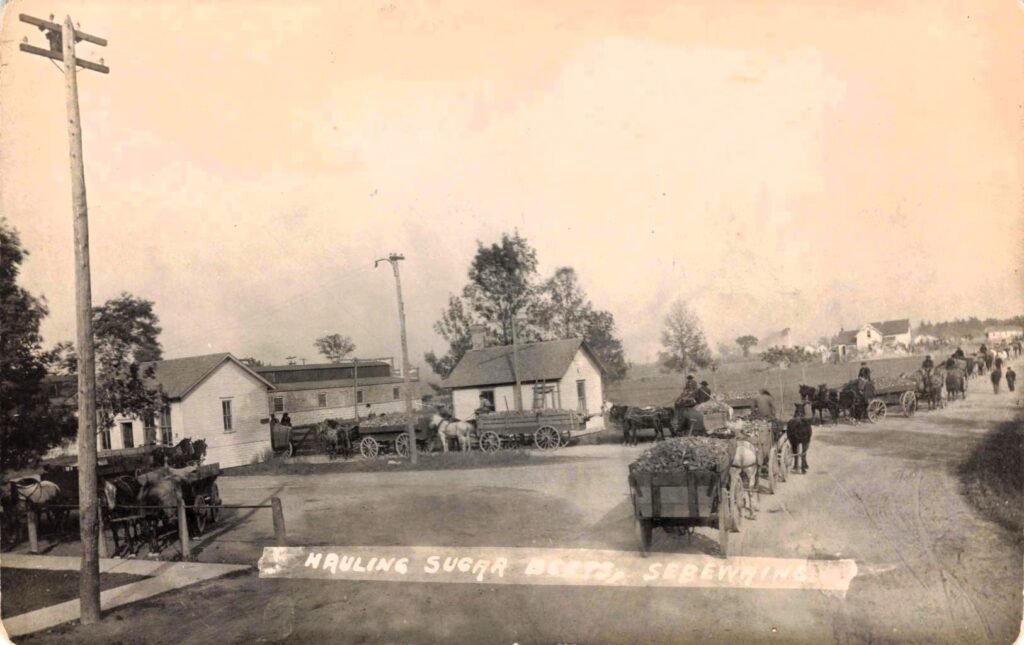
In the late 1800s, Huron County was almost entirely farmland, and Berne’s outlook was flat, with cleared fields. Local farmers grew grains and vegetables on modest plots. One railroad history notes that by 1889, “freight was primarily driven by local farm production, namely wheat, beans, and sugar beets”. Barns and granaries stood behind every farmhouse, and orchards and vegetable gardens provided food for families. Most farms were about 40 to 80 acres. Even the Mennonite settlers – Swiss?German immigrants around Berne – reported bringing seed potatoes and planting fields of wheat and oats on land cut from the forest.
Farm work set the rhythm of daily life. In spring, men plowed and planted; in summer, they mowed hay and tended crops; in autumn, they harvested beans and grain to ship out. A county history recalls children helping with chores: chopping wood, bringing in firewood in winter, gathering eggs, and chores on the family farm.
Beekeeping was also common in Huron County, and many Berne-area families kept hives for honey (though we lack specific records for Berne). By 1900, there were few full-time businesses in Berne itself: the farms were largely self-sufficient. Residents still drove their produce to larger grain elevators in nearby towns. General trends in Huron County – flat soils, row crops, and sugarbeet processing just over the county line – held true here. In fact, Huron County’s economy was overwhelmingly agricultural, a fact reflected in the freight that rolled through Berne’s depot.
Prominent Family Names in Bern, Michigan

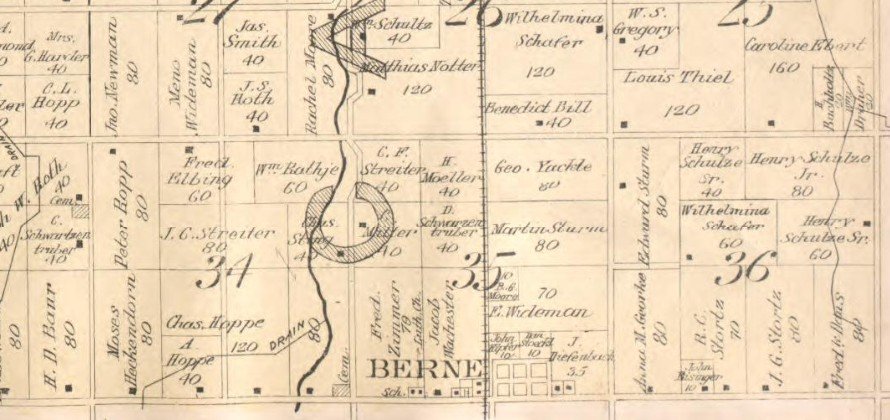
Family names on the maps and censuses show who lived in the fields. The pioneer history of Huron County lists schoolchildren by family: for example, “the Heineman brothers, who later moved to Saginaw,” and “Fred and Henry Zimmer, Mrs. Anna Baur, Charles and Louis Mair, Henry Moeller and John Deifenbach” as local pupils. In other words, farms around Berne were owned by families named Heineman, Zimmer, Baur, Moeller, Deifenbach, and others.
A 1900 atlas of Winsor Township (where Berne lay) shows dozens of property holders around Berne, including Julius Diefenbach, Conrad Zimmer, Albert Kleinschmidt, Wesley Schafer, Frank Heineman and many more. These names – German and Dutch in origin – hint at the community’s roots. Many had come from Ontario or Pennsylvania in the late 1800s. By 1900, their farms, houses and barns defined the landscape around Berne.
Berne’s Schools and Churches

Social life in Berne revolved around its schools and churches. The first classes were informal. Early on, lessons were held in a neighboring church: records note that teacher Herman Roedel led a school session in a German Methodist Episcopal church by the Pigeon River. In 1878, the school district bought that little frame building from the Methodist society and erected a new church-school at Berne Corners (the crossroads settlement). Florence M. Morse (later Mrs. Richard Gwinn) taught there for two years, and at least five months of school were held each winter. Books and supplies were scarce, so older children and parents helped teach the younger ones. By 1900, all local children went to that one-room schoolhouse in Berne Corners.
Religious worship was equally important. The same frame building at Berne Corners doubled as a church on Sundays. In 1894, a Mennonite congregation organized among the Swiss-German settlers and, by 1897, had constructed Berne’s first dedicated church. (That Mennonite meetinghouse became the area’s gathering place for worship and prayer.)
Meanwhile, Berne Corners remained a Methodist community; families attended services or circuit preachers there or in nearby Pigeon. Church calendars show Sunday school events and picnics. Many of the schoolchildren above, like the Zimmer boys and the Baur daughter, attended Sunday school at that little church as well. Evening prayer meetings or quilting bees were occasions to socialize. In short, the church-school building at Berne Corners anchored the village’s community life and helped bring scattered farm families together.
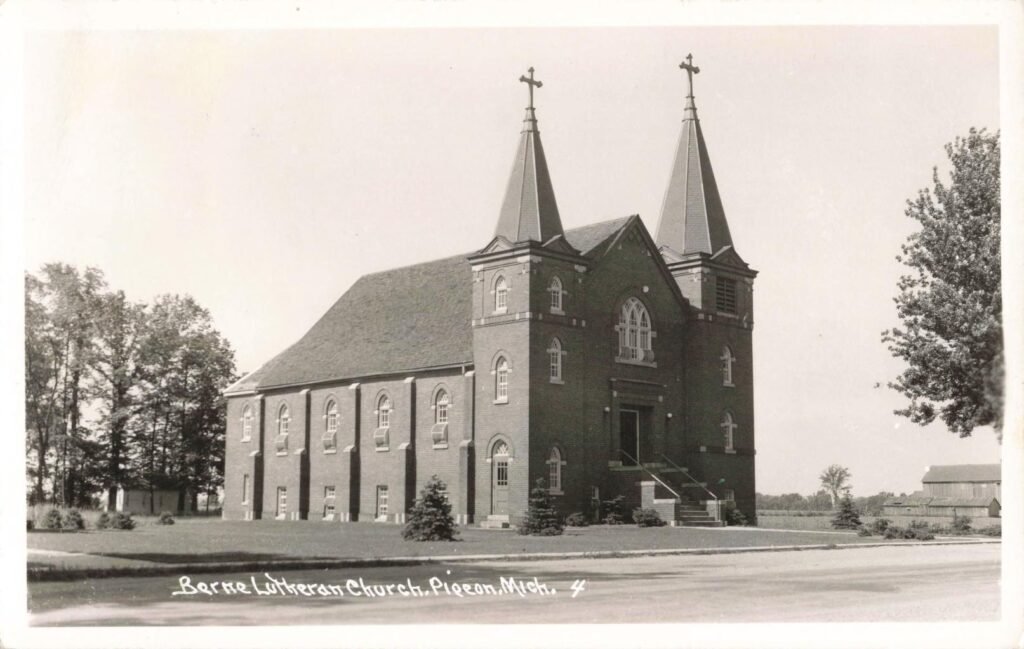
Later on, other denominations joined the mix. Church records and photos from the 1900s mention an Evangelical (Lutheran) congregation in Winsor Township that used Berne Corners for worship. A post-1900 photo (above) shows the Berne Lutheran Church (eventually moved a mile south to Pigeon).
Baptists in Huron County tended to gather in larger towns, but local Protestants of all stripes often met at Berne’s church or at the one-room schools for revivals. A visiting preacher might come once a month. The schedule was simple: Sunday morning worship and perhaps a Sunday-school class in the afternoon. Religious faith and Sunday morning service gave rhythm to the week in Berne, just as in other country villages of the era.
The General Store and Daily Trade near Berne

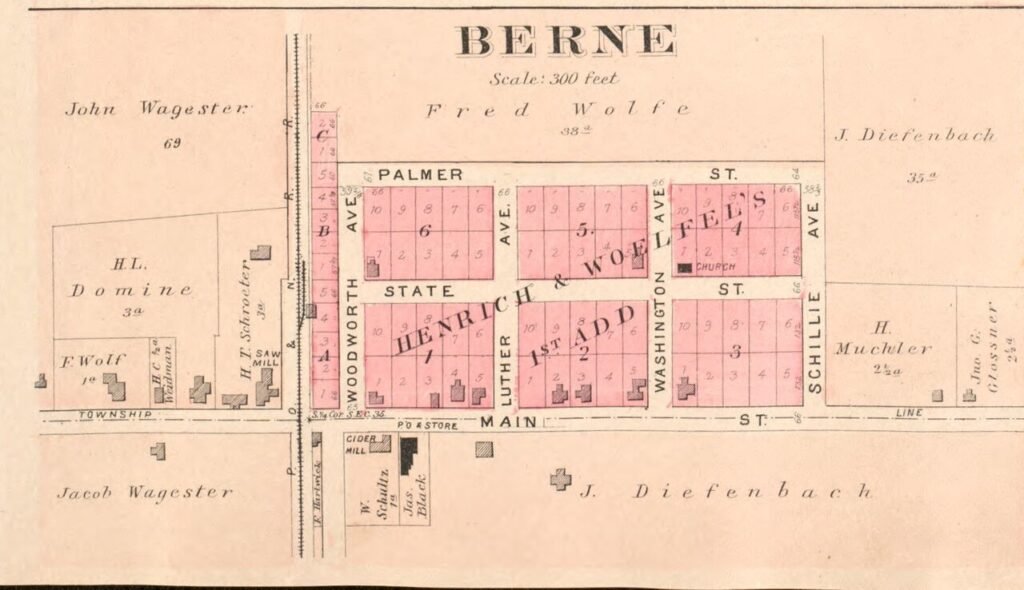
Berne’s central civic and business functions were clustered along Main Street and near the railroad. The town supported a general store and post office, a cider mill, a sawmill, a wagon-making shop, and a church. These buildings reflect a functional agricultural village: one dependent on local produce, simple manufacturing, and shared religious and commercial spaces. Most services were practical and tied to local needs: cider from orchards, wagons for farming, sawmill timber for barns, and the church-school for worship and education.
Berne’s only store doubled as its post office. Early guides and reminiscences mention a small general store at Berne Corners by the 1880s. A handwritten genealogy notes that “Berne had a mill, general store, and hotel” in its heyday. This likely refers to Berne Corners on the Pigeon River (before the town moved north), but the store building continued into 1900. Farmers would haul grain and produce there by wagon; men filled sacks of flour and barrels of kerosene. The store kept basic goods: sugar, coffee, kerosene lamps, milk barrels, nails and tools, and fabric. Families from the wider township also picked up their mail here.
Life in Berne, Michigan, in 1900

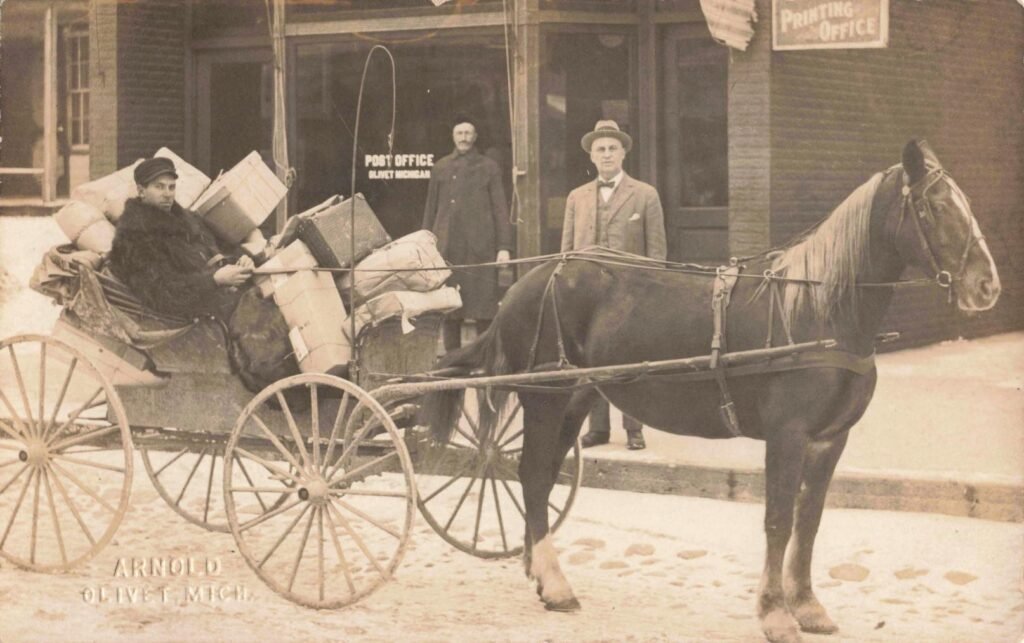
Life was fairly self-sufficient. One local doctor in Pigeon made weekly house calls by horse and buggy. Villagers would send word ahead by telephone operator or sprint over when he came to buy medicine. If there was no doctor, folk remedies and home births were common. Neighbors helped each other: a barn raising or a harvest party might be announced by word of mouth. In winter, neighbors called on each other with sleighs. By 1900, without a hotel, visitors either found lodging with local families or camped out. (The old Berne hotel had closed sometime in the 1890s.) Anything not available in Berne was bought in Pigeon or the county seat, Bad Axe.
Despite the isolation, some comforts existed: paper news arrived a few times per week by mail. Families read the Detroit Free Press or the Huron County Republican aloud. A phonograph brought music from town every few years; otherwise, they sang hymns or fiddled tunes by lamplight. Children played games like hoop-rolling or marbles in front yards. Winters were hard and long: neighbors tapped trees for maple syrup on March weekends, and livestock were kept in barns.
Berne Families

The community of Berne around 1900 was defined by its families. Besides the Zimmer, Baur, Moeller and Heineman families already mentioned, Mennonite names were common: Heckendorn, Schaaf, Kretchmer and others. For example, Moses Heckendorn (age 26) left Ontario and moved onto an 80-acre farm near Berne in 1900. The 1904 Huron County plat book praises his homestead: it describes “a large frame house, good barn and a fine farm” on his parcel. (Descendants recall that the 16-by-16 farmhouse had a big family garden and orchard.) Widows or married daughters of the earlier settlers – people like Mrs. Anna Baur or Mrs. A. Conrad – continued to live on inherited farms. These families worked the land through the decades.
By 1900, Berne’s peak days were fading. When a second railroad – the Saginaw, Tuscola & Huron line – crossed the first line a mile south in 1886, the new junction became the village of Pigeon. Over the next decade, Berne lost population as some businesses and residents moved to Pigeon. The Berne Corners post office closed in 1889. But a few hardy families stayed in place. In 1900, the township’s census shows just a few dozen Berne households (farmers, their wives, and children). Everything changed with the seasons: planting in April, harvest in October, and church on Sundays. That was daily life.
Final Thoughts on the History of Berne Michigan
At the turn of the 20th century, Berne was a sparsely populated farming hamlet defined by its land and faith. Nearly every family grew crops or raised animals on their plot. Their livelihoods flowed through the steam trains that stopped at Berne’s depot. The schoolhouse and church at Berne Corners were the village halls of the day, where children learned reading and neighbors met on Sunday.
A Mennonite chapel built in 1897 and the small general store rounded out life’s necessities. By 1900, the story of Berne was one of small farms and quiet routines – an example of rural Michigan life. Its fields and buildings (some still standing today) bear witness to the era when Berne played its modest role in Huron County.
Sources Cited for the History of Berne Michigan
Sources: County histories and plat books for Huron County; a 1895 county history; railroad records; a Michigan History Trail marker; and local Mennonite church archives.
- Standard Atlas of Huron County, Michigan. Geo. A. Ogle & Co., 1904. Plat map of Berne, Winsor Township. Public domain historical atlas.
- Jenks, Bertine E. History of Huron County, Michigan: Its Progress and Development, and a History of the People Who Have Lived Here. Huron County Pioneer and Historical Society, 1922.
- “Railroad Map and History Notes of the Pontiac, Oxford and Northern Line.” Michigan Railroads History Archive, Clarke Historical Library, Central Michigan University. Accessed January 2026.
- “Mennonites in Huron County.” Michigan Mennonite Historical Bulletin, vol. 32, no. 1, 2004, pp. 18–25.
- Annual Report of the Michigan Department of Agriculture, 1899–1901. State Printer, Lansing, MI.
- Twelfth Census of the United States, 1900. Winsor Township, Huron County. National Archives and Records Administration, Record Group 29.
- “Berne Mennonite Church.” Michigan Historical Marker Database, Michigan Department of Natural Resources, 2003. https://www.michigan.gov/mhc