


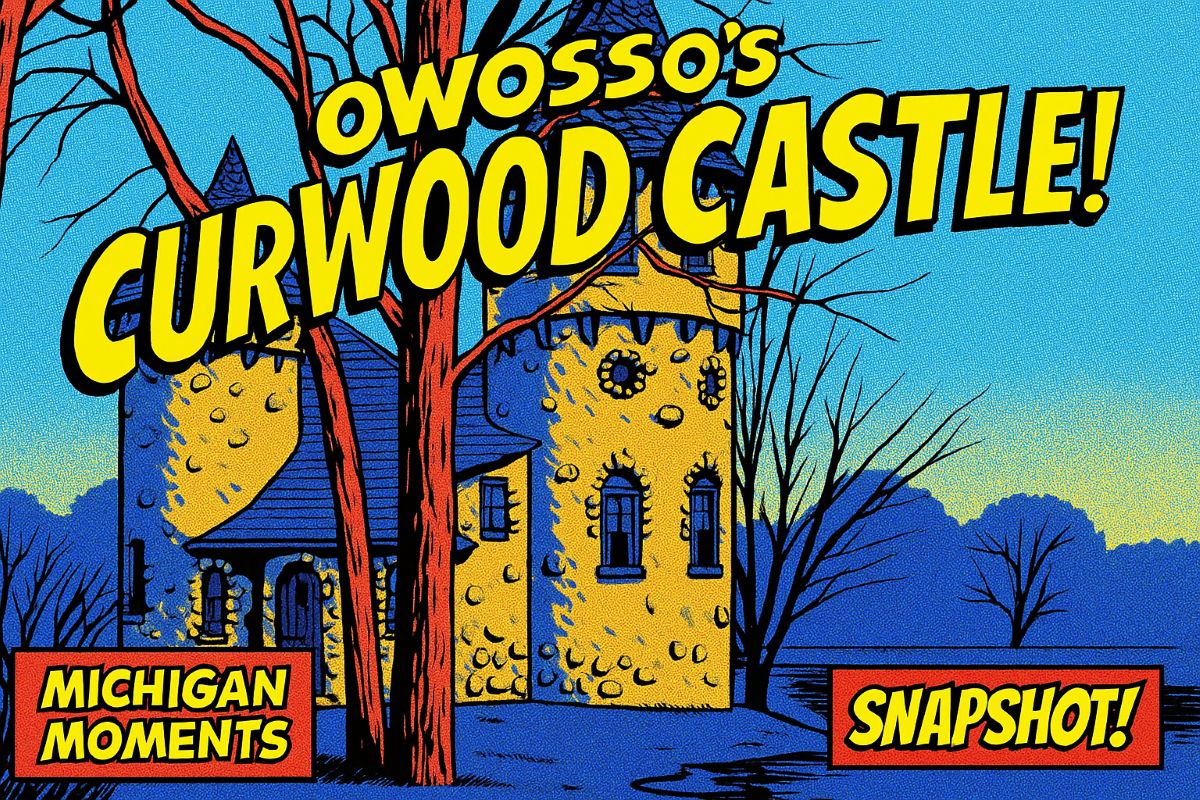
Curwood Castle, Owosso MI, c. 1925 – An Unsurpassed Writer’s Riverfront Studio in Owosso
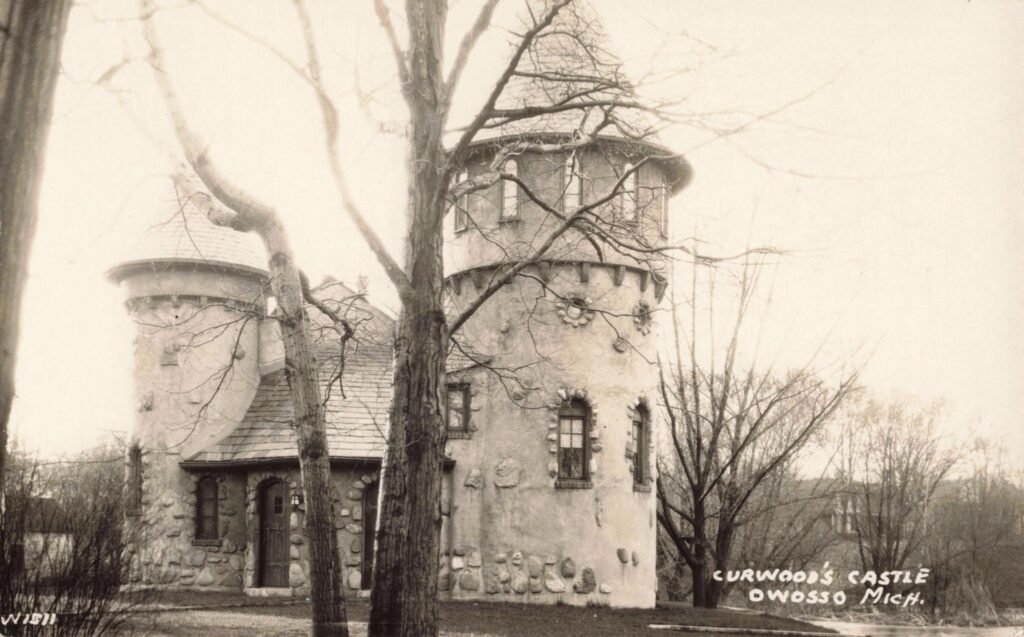
In the reel image from about 1925, Curwood’s Castle rises behind bare trees along the Shiawassee River. The small stone-and-stucco building looks like something lifted from a European story, yet it stands in Owosso, a mid-Michigan city about 40 miles northeast of Lansing. The Curwood Castle was never a fortress or a home. It was a working studio, built so one of the state’s best-known authors could write within sight of his hometown river.

Building the Curwood Castle in Owosso

James Oliver Curwood was born in Owosso in 1878 and made his name writing adventure novels set in the northern wilderness. By the early 1920s, his books sold in large numbers and drew Hollywood’s attention. At least 180 films were based on or inspired by his stories.
With that success, Curwood commissioned a studio that matched his imagination. Construction began in 1922 and finished in 1923 on a small plot along the Shiawassee, near his family home on Williams Street. The building is a romantic take on a Norman or French chateau, with round towers, narrow windows, and a steep slate roof. Its yellow stucco walls are studded with fieldstones Curwood personally selected from area farms, and trimmed with copper.
The postcard-style photo used for your reel likely captures the castle not long after completion. There are no leaves on the trees and no crowds along the riverbank, only the compact studio and its towers edging the water.
Inside a working studio

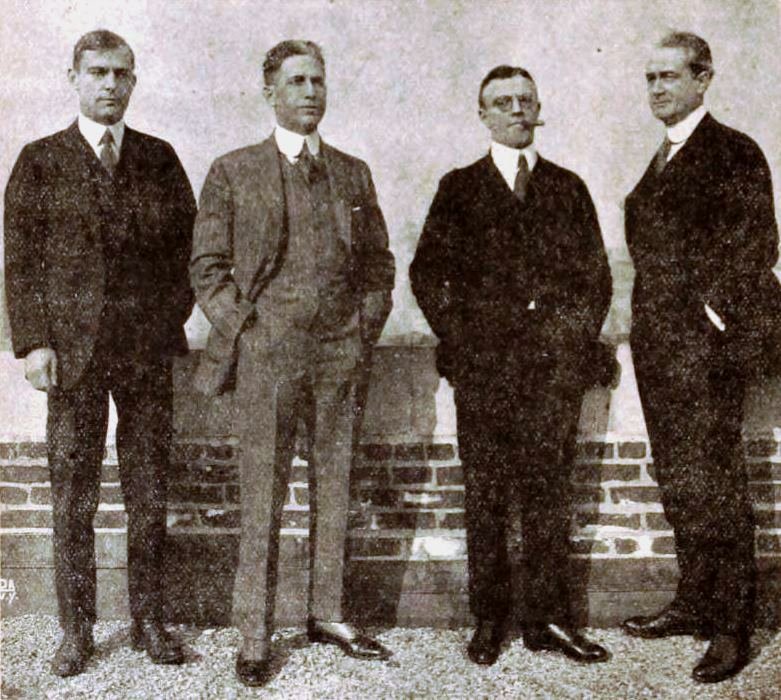
Curwood did not live in the castle. Instead, he walked across the river from his house to work here. One turret held his writing room, with views up and down the Shiawassee. From this spot he continued to turn out popular novels that reached readers across the United States and abroad.
Curwood was also becoming more outspoken about conservation. Once an avid hunter, he shifted toward protecting wildlife and served on the Michigan Conservation Commission in the 1920s. The studio on the river gave him a visible platform in his hometown, where local residents could see the success of one of their own.
From private retreat to public museum
Curwood died in 1927 at age 49 and left the castle to the City of Owosso. The building did not stay frozen in time. During World War II it served as a youth center, and later it housed the local school board offices until about 1969.
Officials eventually recognized its value as a historic building. The state designated Curwood’s Castle a Michigan Historic Site in 1970, and it joined the National Register of Historic Places the next year. Today it operates as a city-run museum within Curwood Castle Park. The Owosso Historical Commission oversees the site along with the Comstock Pioneer Cabin, the Woodard Paymaster Building, and the Amos Gould House, which together make up the Curwood Collection.
Curwood’s Castle today
Modern visitors can walk the riverfront, tour the small castle, and see exhibits on Curwood’s books and the film adaptations that once made him a household name. Each June, the city stages the Curwood Festival, a community event launched in 1978 to honor the author’s life and work.
For viewers of your reel, the 1920s image offers a quiet moment at the start of that story. The towers are new, the river is calm, and Curwood is likely inside, drafting another northern adventure. A century later, his studio still stands on the Shiawassee in Owosso, tying a local riverfront park to a once worldwide writing career.