


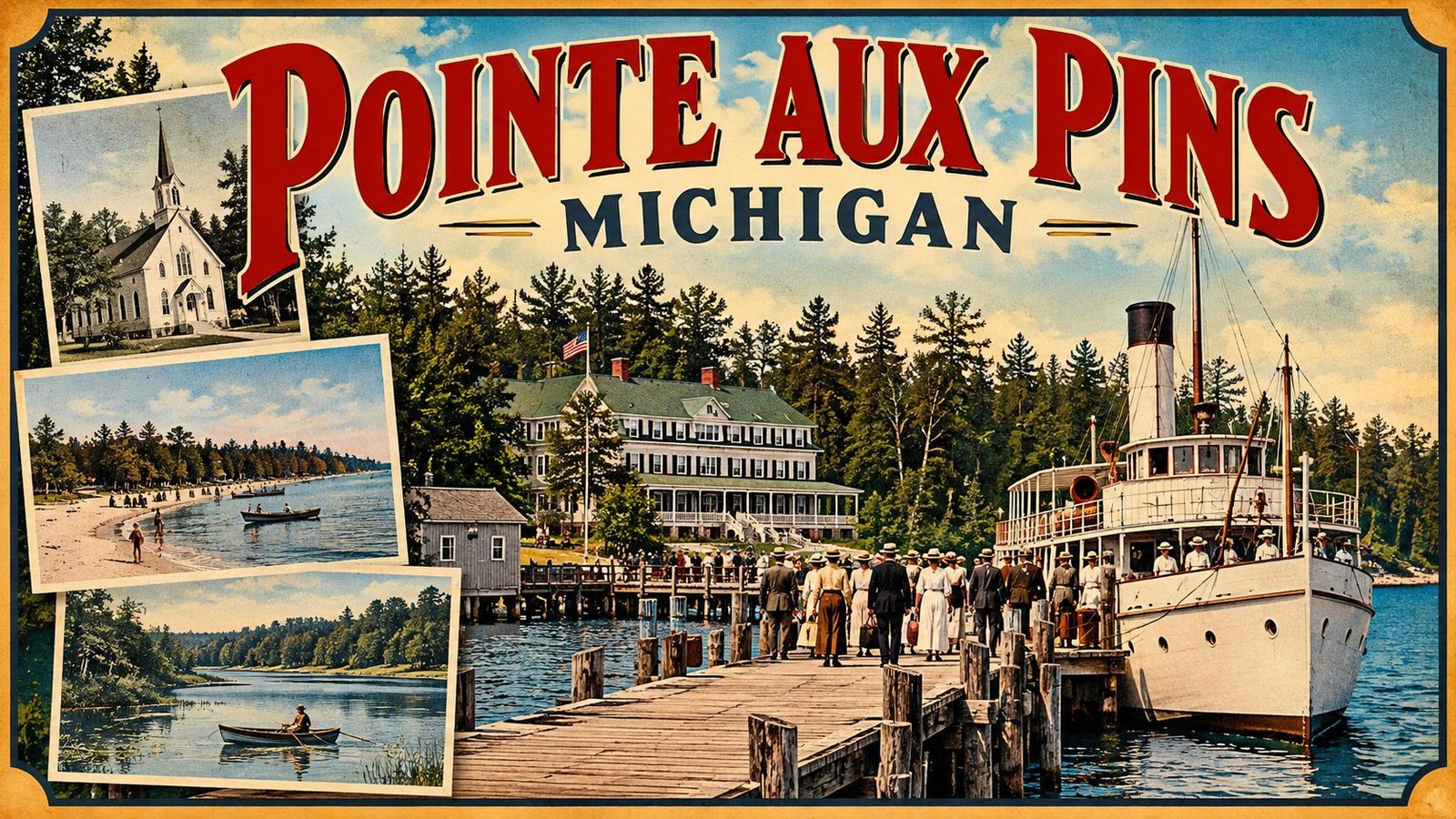
History of Pointe Aux Pins Michigan – 15 Vintage Photos Show How a Simple Lake Huron Dock Became a Summer Colony
On a winter day in 1910, a photographer stood outside the post office in Cheboygan and recorded an unusual mail route.
A driver sat behind a team of dogs hitched to a sled. Children gathered nearby. Painted across the photograph were the words “U.S. Mail Leaving P.O. at Cheboygan for Pointe Aux Pins and Walkers Point, Mich.”

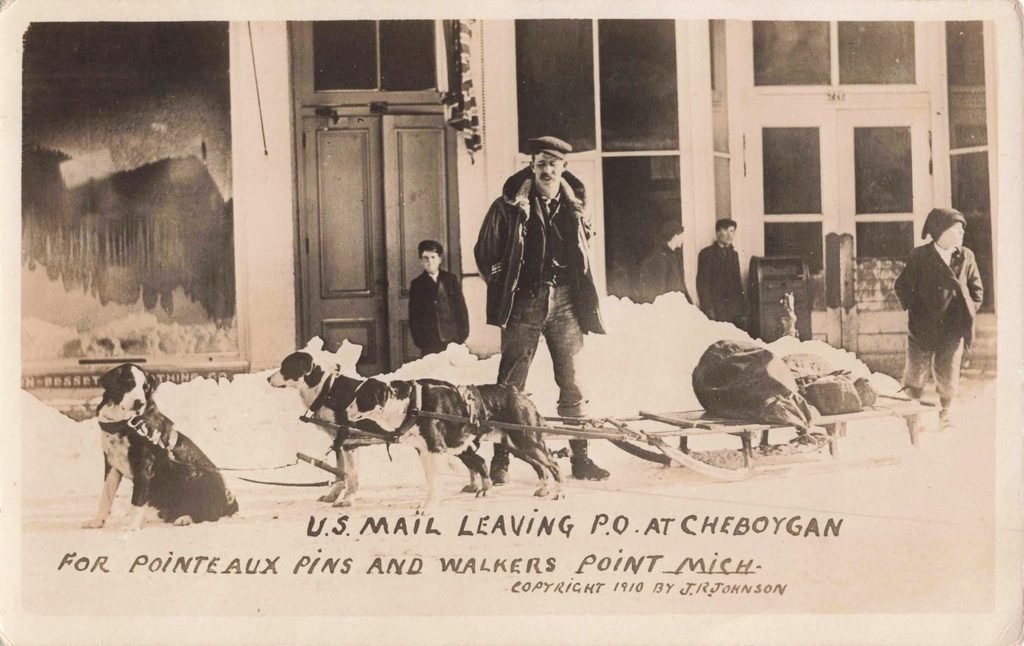
The postcard survives in the University of Michigan’s David V. Tinder Collection. A message written on it explained the scene simply: that was how the mail was carried in winter.
It is a useful starting point for the History of Pointe Aux Pins, Michigan.
For generations of summer visitors, Pointe Aux Pins was a place of cottages, dances, swimming, and boats. But getting there was always part of the story. Bois Blanc Island sits in Lake Huron, east of the Straits of Mackinac. The water that made the settlement attractive also separated it from the mainland.
Pointe Aux Pins became successful because its residents learned how to build a community around that separation.
Table of Contents for the History of Pointe Aux Pins Michigan
Watch: Pointe Aux Pins, Michigan – Summer Memories on Bois Blanc Island

Bois Blanc Opens to Settlement in the 1880s

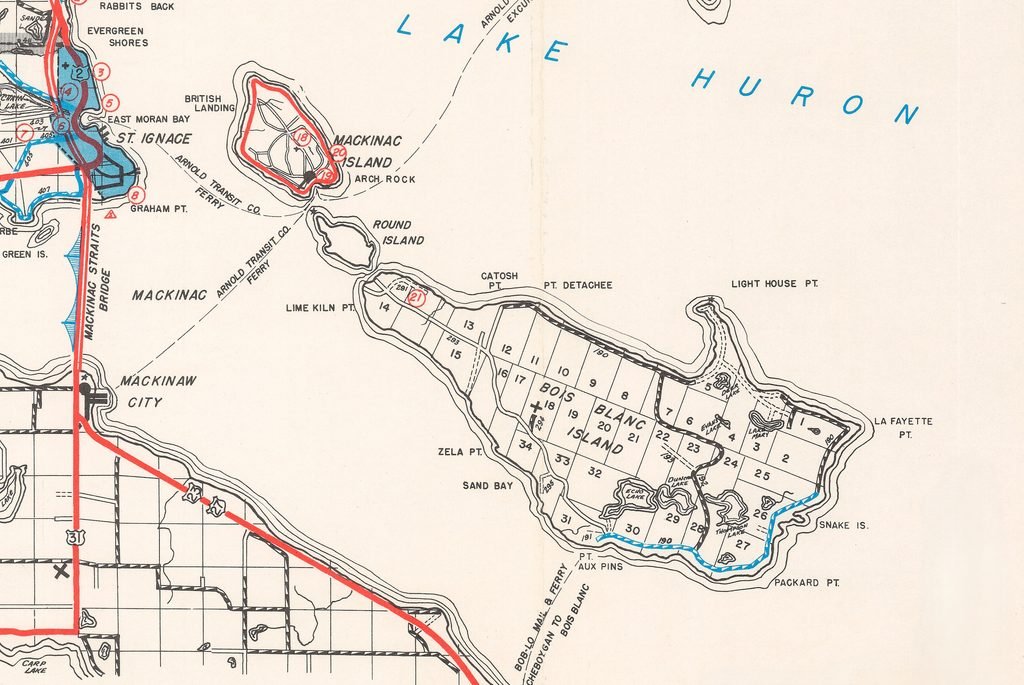
For much of the 19th century, Bois Blanc Island was closely tied to the federal government and Fort Mackinac. That changed rapidly during the 1880s.
The U.S. government opened Bois Blanc to settlers in 1884. A local history compiled by the Bois Blanc Island Association, citing the Cheboygan Democrat, reports that 71 families settled on the island during the first year. Farming appeared on the east end, sawmills operated elsewhere, and homesteader J.C. Blanchard began what the association describes as the first commercial ferry service between Bois Blanc and Cheboygan.
The resort idea followed quickly.

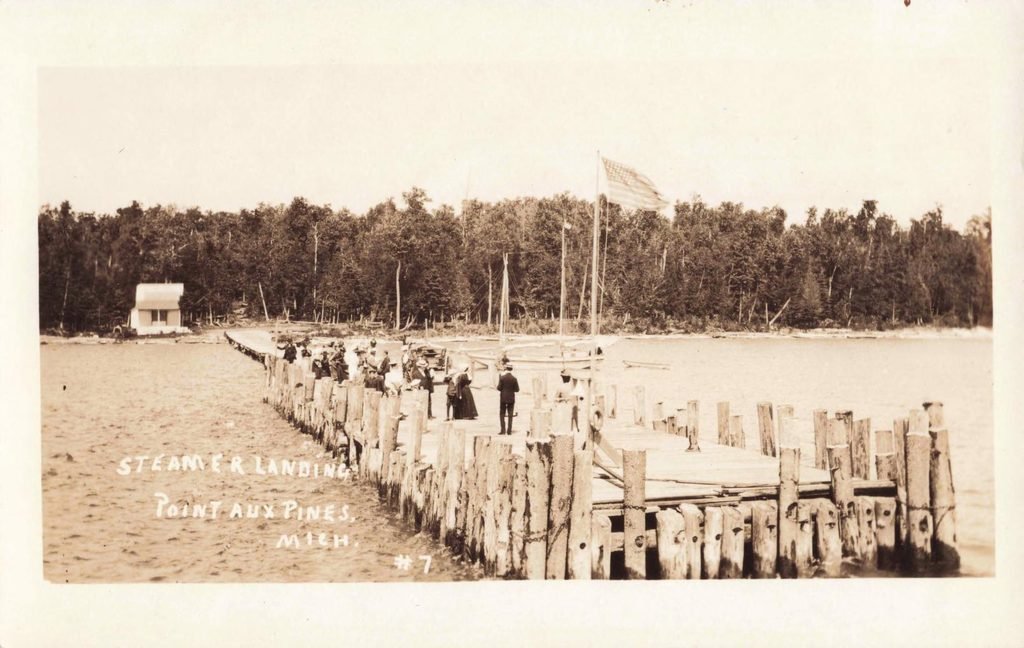
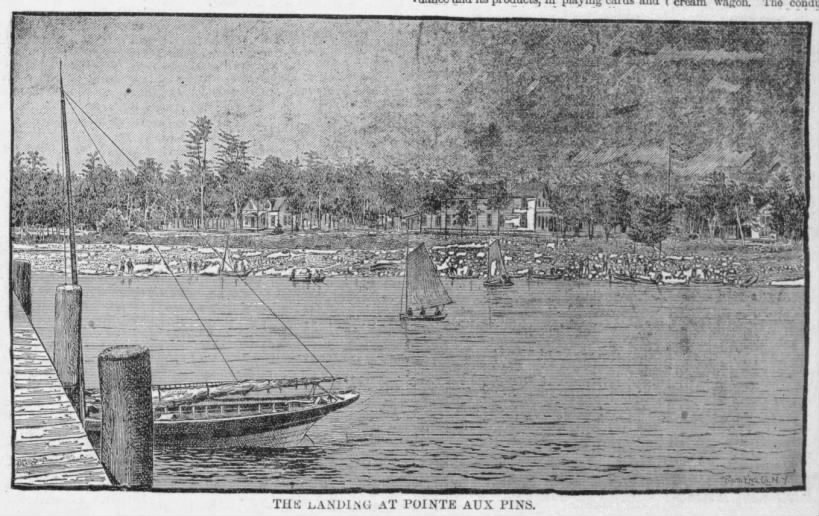
In 1887, a dock was built at what later became known as the Association dock. The following year, the Bois Blanc Island Land Company acquired the steamer, Jennie King. By August 1888, the boat was making two trips a day on a route connecting Cheboygan, Pointe Aux Pins, and Mackinac Island.
The dock was more than a place to meet a boat. Lumber, furniture, food, mail, luggage, and people all had to pass over it.
The Pines Hotel Changes the Island’s Direction
Construction of the Pines Hotel began in May 1888. According to the Bois Blanc Island Association history, it was ready to open on July 9.
That date marked an important turn. Pointe Aux Pins was no longer simply a place where a few settlers had cottages along the water. It was becoming a planned vacation community.

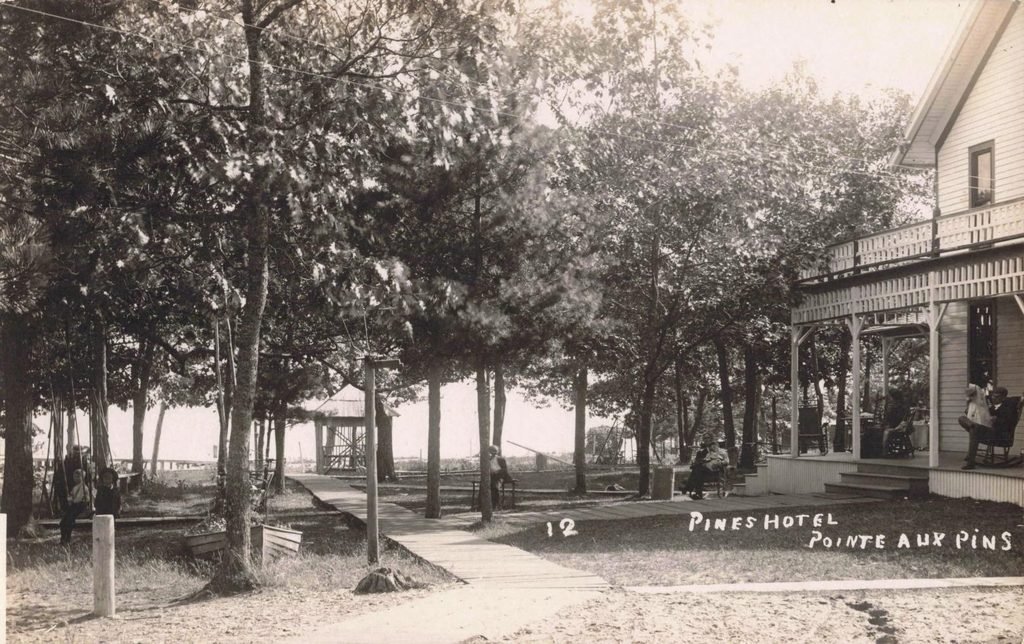
The state historical marker calls Pointe Aux Pins the first resort community on Bois Blanc Island. It also records that the Pointe Aux Pins Association was formed in 1891. In 1908, association President Walter B. Webb hired Detroit’s Mason L. Brown Company to survey and formally record the Pointe Aux Pins subdivision.
The hotel became the center of this new community.
By 1904, the Pines Hotel had 41 rooms, yet local history records evenings when about 125 people came for dinner. Many were staying in surrounding cottages rather than hotel rooms.
There was a business reason for that crowd.
The Bois Blanc Island Land Company offered cottages in nine floor plans, priced at roughly $200 and $500. The unusual part was what the cottages lacked: kitchens. E.T. Webb wanted summer residents eating at the hotel. The plan centered much of Pointe Aux Pins’ social life around a single dining room.
That arrangement helps explain why the Pines Hotel appears so prominently in period photographs.
History of Pointe Aux Pins Michigan Was Also a Story of Recreation
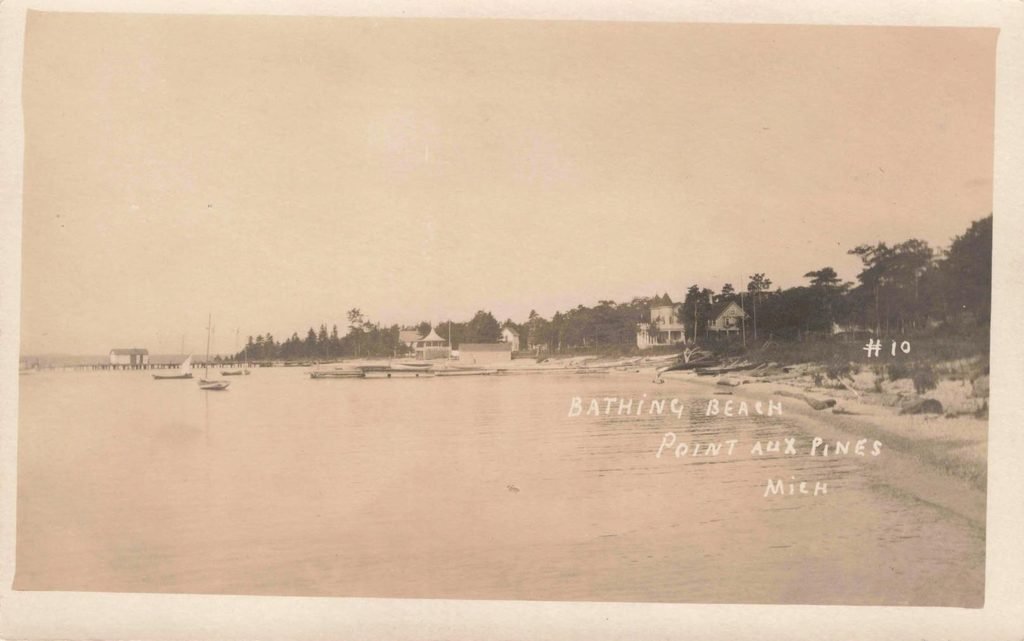
The surviving postcards make clear that Pointe Aux Pins promoters were not selling only a room or a cottage. They were selling a way to spend the summer.
Local accounts record sailing regattas, swimming, hiking, horseback riding, and berry picking. Dances were frequent, with a gazebo near the Association dock serving as a bandstand.
A 1910 promotional booklet makes the sales strategy even clearer.
Published by the Pointe Aux Pins Association, the four-page brochure advertised The Pines as a family hotel with cottages. It contained a beach photograph, cottage-lot information, a map, and an Inland Route steamer schedule. Resort promoters also made a claim common to vacation advertising of the period: “As a hay fever resort, Bois Blanc Island has no equal.”
Transportation, health, recreation and real estate were being sold together.
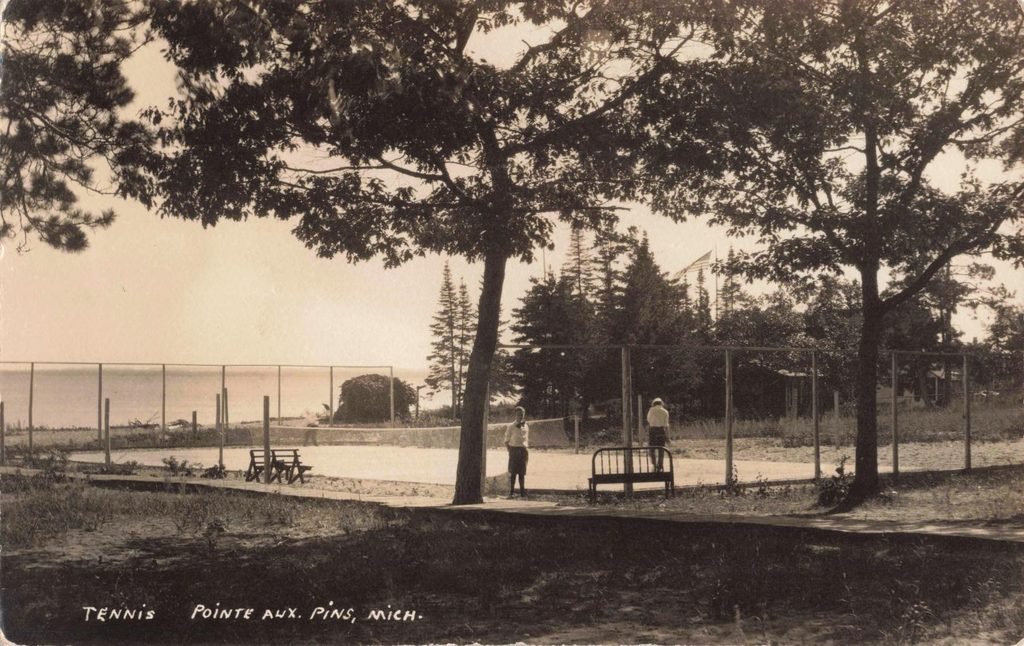
One postcard in the Drive collection shows something even more specific: a fenced tennis court along the water.
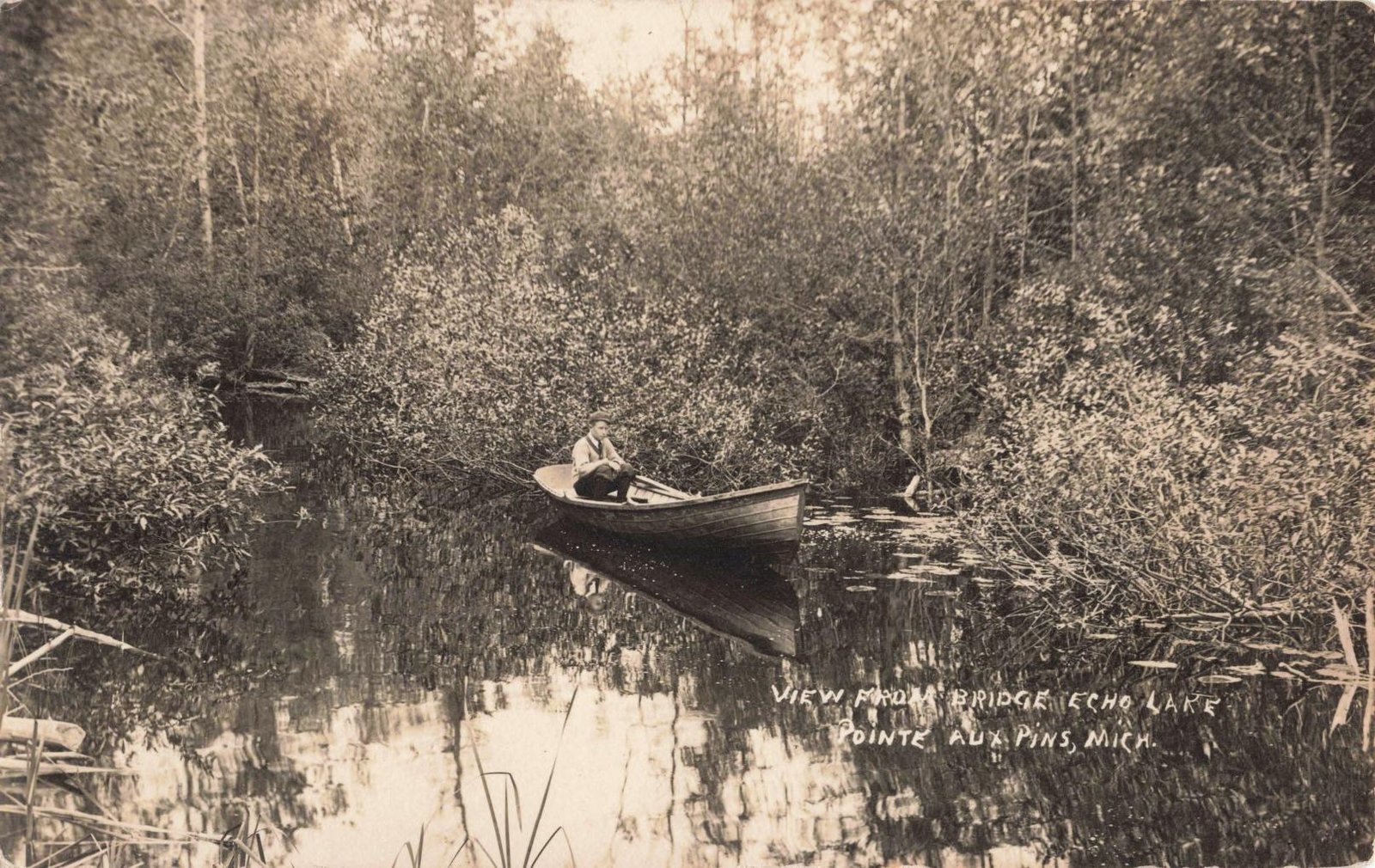
Another postcard records an inland boating scene identified as Echo Lake.

A Boardwalk Through the Pines Linked the Community
One of the strongest photographs is also one of the simplest.
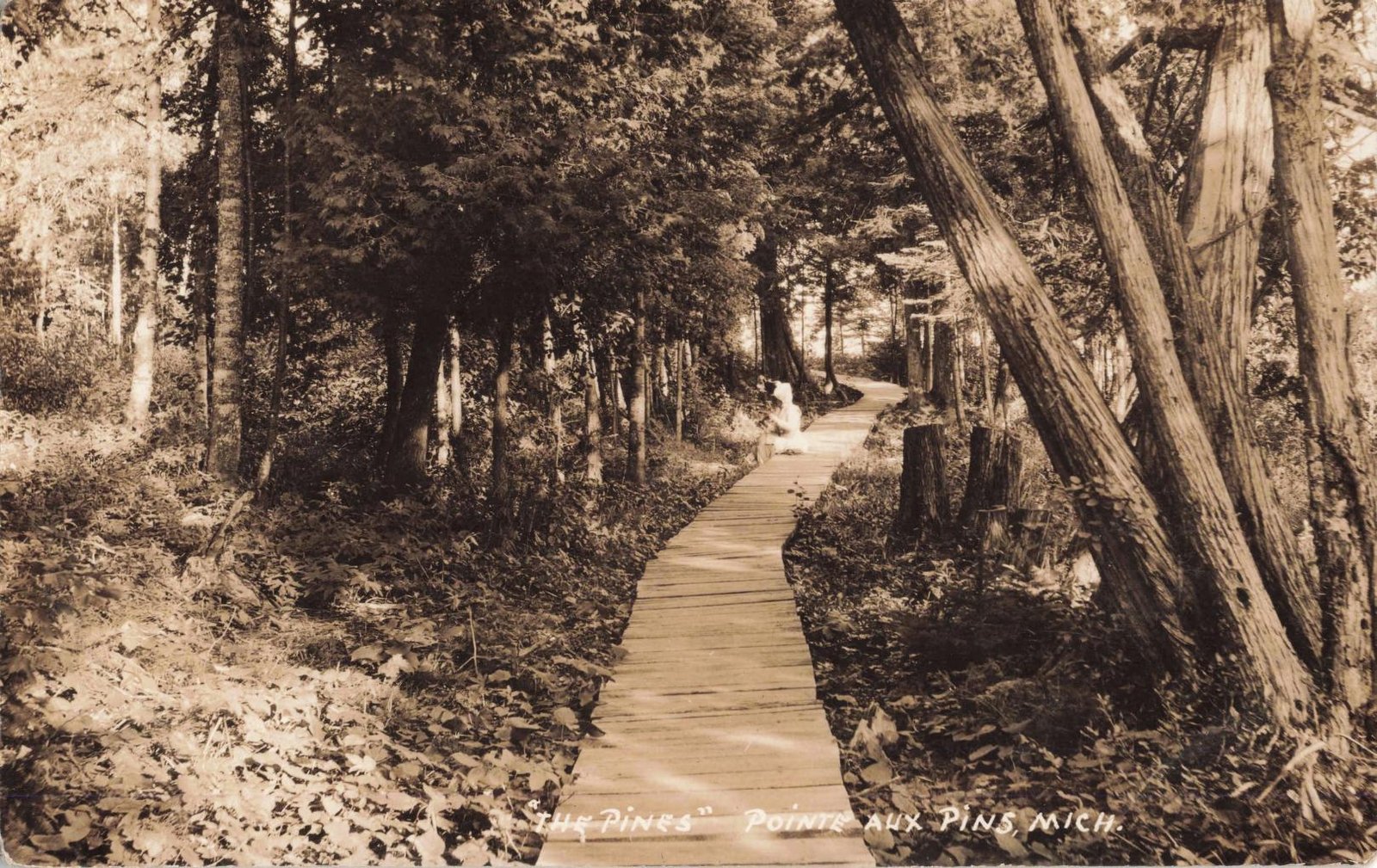
A narrow plank sidewalk runs through the trees. There are no crowds and no hotel dominating the scene. The postcard is labeled simply “The Pines, Pointe Aux Pins, Mich.”

The photograph matches the written record.
After the resort’s first years, local organizations took increasing responsibility for community improvements. The Bois Blanc Island Association’s history notes that sidewalks were built, the old dock was maintained, and activities were organized, with much of the island’s social activity centered in Pointe Aux Pins.
These wooden walks solved a practical problem. Pointe Aux Pins was not an urban resort transplanted onto an island. Roads and paths were basic. The boardwalk helped tie cottages, hotel grounds, church, and waterfront together.
Church Services Began Before There Was a Church
Religion was woven into summer life surprisingly early.
The history of the Church of the Transfiguration states that the Rev. William Bulkley arrived in Cheboygan in 1889 and came to Bois Blanc with his college classmate, the Rev. Paul Ziegler.
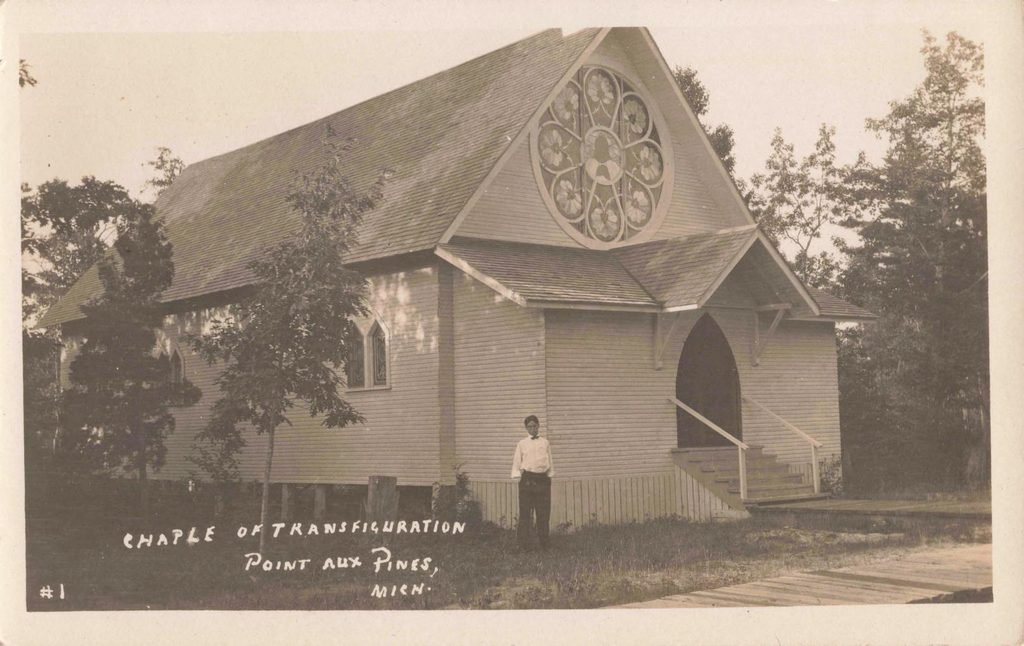
The first recorded service and first marriage associated with the Pointe Aux Pins mission were held Sept. 10, 1890.
By 1893, regular Sunday services were being held at the Pines Hotel and its Recreation, or Columbian, Hall.
Ground was broken for a permanent church in 1901. Wilfred Fox and a Cheboygan crew worked on the building from 1903 through 1905. Its windows came from Friedrich & Wolfram of Detroit.
The Church of the Transfiguration officially opened for services in 1905 on its namesake feast day, Aug. 6.
The photographs in the Drive collection capture its most striking feature: the large circular window filling much of the front gable.
The 1908 Fire Brought a Major Change
Pointe Aux Pins was growing at the same time Bois Blanc supported an active lumber industry.
By the early 1900s, sawmills operated around the island. A large steam mill was built at Sand Bay in 1908, supported by a narrow-gauge logging railroad.
Logging also left cutover areas vulnerable to fire.
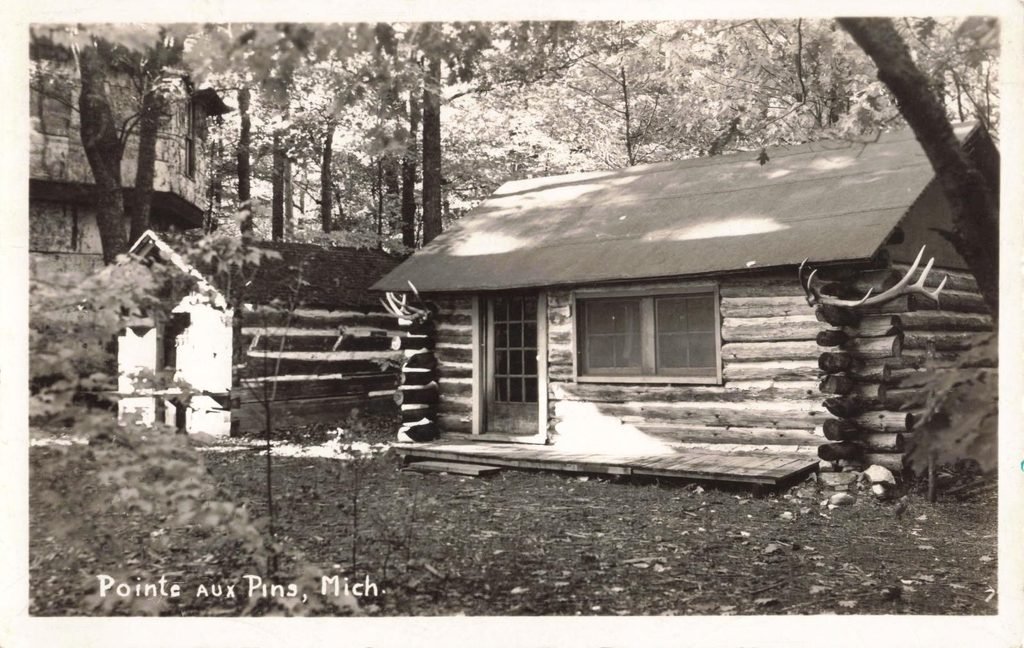
In 1908, a fire swept through logged sections of Bois Blanc, destroying several Pointe Aux Pins cottages. The land company subsequently sold its holdings, and property owners assumed a larger role in running community affairs.
That same year, the Pointe Aux Pins subdivision was formally surveyed and recorded.
The event helped define the community that followed: privately owned cottages organized around shared docks, walks, services, and summer activities.
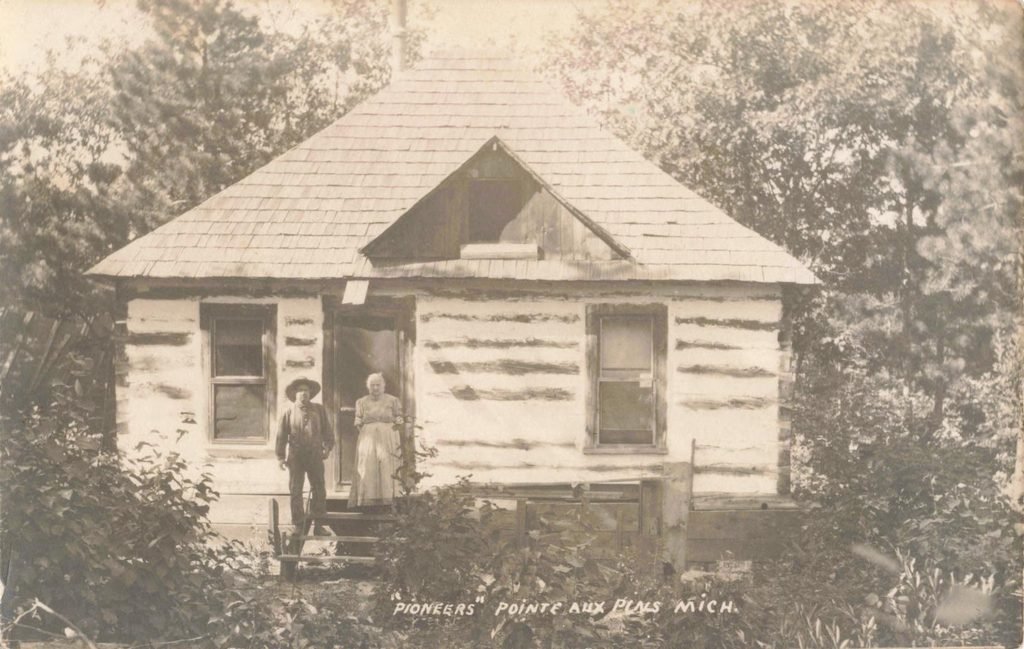
Some postcards also show that the island was not populated solely by resort guests in pressed summer clothes.
One image in the Tinder series is labeled “Pioneers, Pointe Aux Pins, Mich.” It shows an unidentified man and woman standing outside a small log house.

Winter Changed Everything — Including the Mail
Summer photographs can make early Pointe Aux Pins appear almost effortless.
Winter tells a different story.
The 1910 J.R. Johnson postcard preserved by the University of Michigan shows U.S. mail preparing to leave Cheboygan for Pointe Aux Pins and Walker’s Point by dog team.
The University identifies it as a photographic postcard dated 1910. The handwritten correspondence on the card explicitly refers to the winter mail system.
For an island community dependent upon boats, ice was not a minor inconvenience. It changed how people, messages and supplies moved.
The dog-sled photograph may be one of the most revealing images connected with Pointe Aux Pins because it shows the other side of island isolation.
Plaunt Transportation Opens a New Ferry Era
By the 1930s, the name Plaunt was becoming closely tied to Bois Blanc transportation.

A 2007 Congressional Record tribute says Charles Plaunt began carrying supplies and as many as eight passengers aboard the Margaret in 1932. That same year, he acquired the mail contract between Cheboygan and Bois Blanc.
The Adventure entered service in 1934 with room for about 20 passengers. According to that congressional history, the Ada M replaced the Adventure in 1937 and was named for Charles Plaunt’s wife. His son Ray began working with him that same year.
A local Bois Blanc history provides an earlier date for the Ada M, placing it in service in 1934. Because the Congressional Record provides a year-by-year vessel sequence, this article uses 1937 while noting the conflicting local account.
The Drive photograph of the Ada M puts a face on that transportation story.


What Made Pointe Aux Pins Different?
The History of Pointe Aux Pins, Michigan, is unusual because the settlement was not primarily built around a mine, factory, railroad junction, or county seat.

It was built around summer.
A hotel opened near a dock. Cottages followed. The lack of kitchens pushed cottage residents toward a common dining room. A bandstand encouraged evening gatherings. Tennis, swimming, and boating filled the day. Church services that began inside the hotel eventually led to the establishment of their own chapel. Residents built sidewalks and maintained their landing.
Even the transportation system became part of the community’s identity.
A summer visitor could arrive by steamer. A winter letter might come behind a dog team. By the late 1930s, the Ada M was making the crossing.
That combination helps explain why the period photographs feel unusually complete. They do not show just buildings. They show how Pointe Aux Pins functioned.
One final postcard makes the resort’s purpose particularly clear.
History of Pointe Aux Pins Michigan Lives in Its Photographs

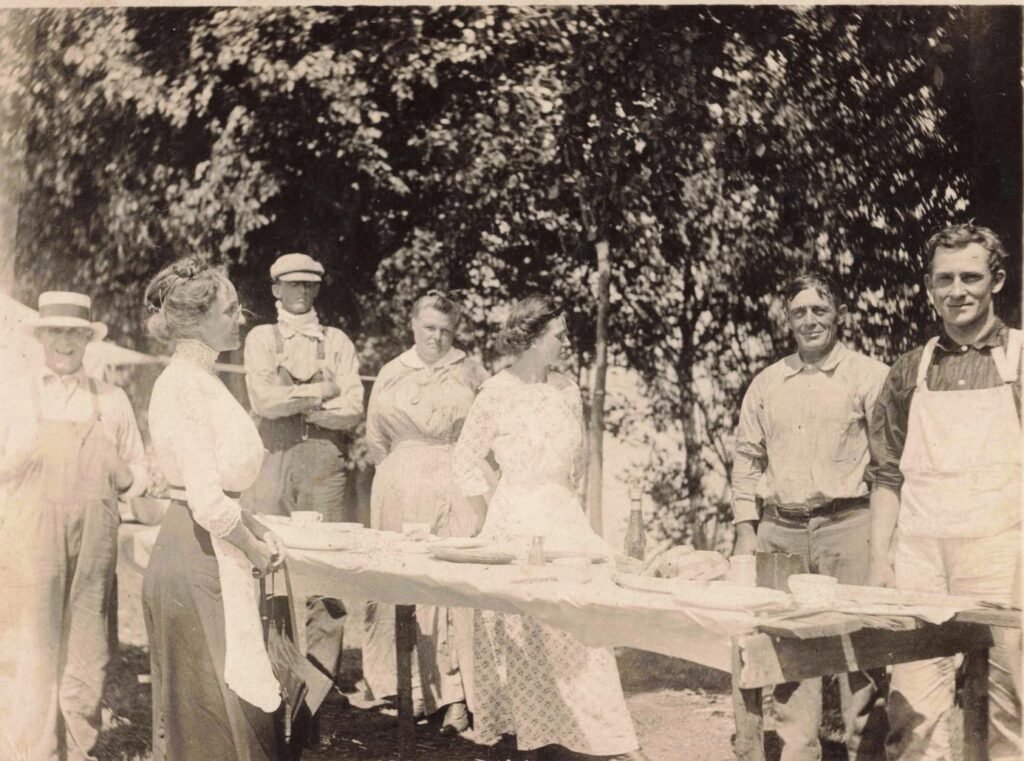
By 1940, Pointe Aux Pins had spent more than half a century developing from an ambitious resort venture into an established summer community.
Its early years can still be reconstructed with unusual clarity because the written record and photographic record reinforce each other.
The photographs show the hotel porches, dock, boardwalk, church, tennis court, beaches, cottages and boats. Historical records explain why those things were there.
Together they show a community shaped by one unavoidable fact: Pointe Aux Pins was an island destination.
Every cottage board, every dinner guest and every sack of mail had to make the trip across the water — or, in the hardest part of winter, find another way.
That may be the most important fact in the History of Pointe Aux Pins Michigan. Its isolation did not prevent the community from growing. It dictated how the community grew.
When was Pointe Aux Pins established?
Development began during the late 1880s. A dock was built in 1887, and the Pines Hotel opened July 9, 1888. The Pointe Aux Pins Association was organized in 1891.
Why did early Pointe Aux Pins cottages lack kitchens?
The Bois Blanc Island Land Company intentionally built many cottages without kitchens. Cottage owners were encouraged to eat at the Pines Hotel dining room, helping make the hotel the social center of the community.
Is Pointe Aux Pins still there?
Yes. Pointe Aux Pins remains a seasonal community on Bois Blanc Island, and historic cottages and community structures continue to reflect its early resort years.
Works Cited for History of Pointe Aux Pins Michigan

