


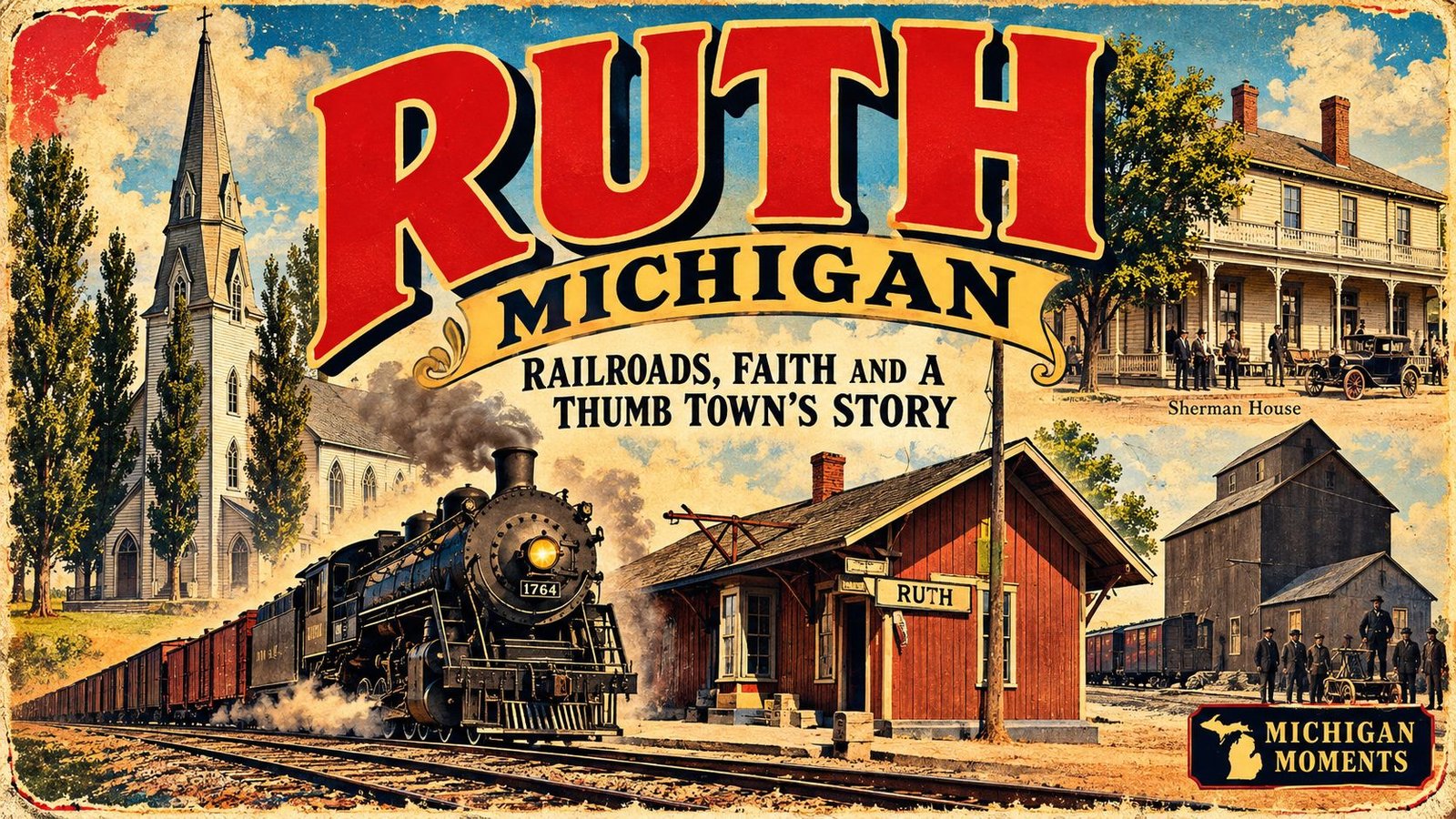
Ruth Michigan History – 7 Remarkable Stories From a Thumb Railroad Town
Rare photographs show a Huron County crossroads shaped by German immigrants, railroads, grain elevators, Catholic parish life and the businesses that once kept a rural town humming.
Ruth Michigan History can be read in a handful of remarkable old photographs. One shows a horse-drawn sleigh stopped along a snowy Main Street. Another captures railroad workers beside a grain elevator. There is the old Pere Marquette depot, the Sherman House, a towering Catholic church, and even the aftermath of a train wreck. Together, the images show a Huron County farming community that was once far busier than its size might suggest today.
Table of Contents
Ruth Michigan History Began Before Its Name
Look closely at the old winter photograph of Ruth, Michigan.

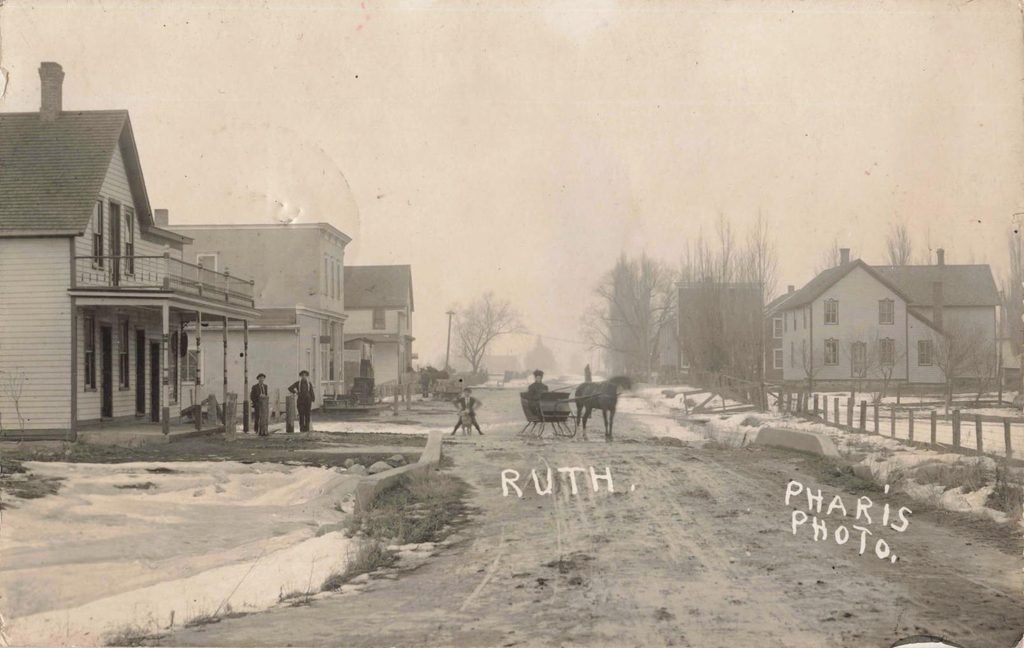
A horse and sleigh have stopped in the middle of an unpaved street. Two men stand outside a wooden storefront. Snow lies in the drainage ditches. Farther down the road, buildings fade into the cold morning haze.
There are no traffic lights, paved parking lots, or neon signs. Yet this was not an isolated place.
By the early 1900s, Ruth was connected by rail to the rest of Michigan. Farmers brought grain into town. Salesmen stepped off trains. Church bells regulated Sunday mornings. Blacksmiths, merchants, and hotel keepers made a living from people who arrived from farms stretching for miles around.
The photographs accompanying this story capture Ruth during that period — not as a sleepy dot on a map, but as a working agricultural town.
Ruth Michigan History Began With a German Settlement
Ruth sits in Sherman Township near the Sanilac County line in southeastern Huron County.

Accounts differ slightly on the exact beginning. Later place histories identify John Hunsanger as an early settler who arrived in 1855, followed by families from Baden in 1856 and from Westphalia in the early 1860s. An 1884 Huron County history gives 1856 and names Joe Willy and John Huersanger among the first settlers. The spelling of Hunsanger’s name also varies in early sources.
What is clear is that German immigration strongly shaped the community.
So many German-speaking families settled here that the district became known simply as the German Settlement.
Another name soon appeared: Adams Corners, after landowner August H. Adams, who became the first postmaster. When a post office was established in October 1880, however, the community was named Ruth. Local histories say it honored Michael Ruth, an early settler who provided property for a railroad depot.
That railroad connection would prove crucial.
In 1884, This Was Already a Serious Business Town
One of the best descriptions of early Ruth comes from the 1884 Portrait and Biographical Album of Huron County. At the time, Adams Corners was already sometimes called Ruth.
The account describes Robert Campbell’s general store, which reportedly handled about $75,000 in business annually. The settlement also had a shoemaker and blacksmith. Sherman Township had four schools, as well as Catholic and Lutheran churches.
Most importantly, the account plainly states that Adams Corners was the township’s railroad station. That makes the old photographs easier to read.
The wooden buildings were not merely scattered structures beside a dirt road. They formed a service center for hundreds of farm families who needed everything from horseshoes and flour to lumber, farm tools, mail service, and transportation.
Ruth was small. But small did not mean inactive.
Watch: Brief History of Ruth Michigan: Tracks, Faith, and Small-Town Life

The Railroad That Put Ruth on the Schedule
The arrival of rail service changed the economics of Huron County.

The Port Huron & Northwestern Railway built a network of narrow-gauge lines through Michigan’s Thumb beginning in the late 1870s. The system was sold to the Flint & Pere Marquette in 1889 and eventually became part of the Pere Marquette Railway.
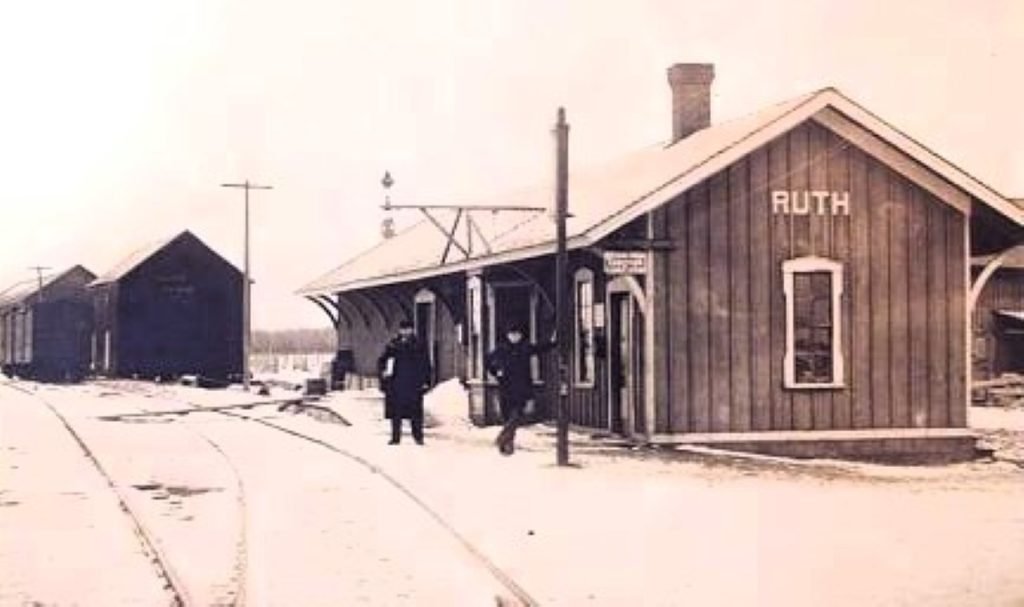
By 1898, Ruth was a flag stop with a siding capable of holding about 10 cars. There was no regular station agent.
That makes the surviving depot photograph especially interesting.
It was hardly Grand Central Station. Ruth’s depot was a plain wooden building standing only a few feet from the rails. Yet this modest structure represented the fastest connection most local residents had with places far beyond Huron County.
A Michigan Railroad Commission inspection in 1909 was almost comically unsentimental about it.
The inspector found Ruth Station small, with one waiting room. The passenger bulletin board had not been properly marked. Track condition was considered fair, ties were being replaced, and weeds along the right-of-way had not been cut. It sounds mundane.
But that little waiting room meant mail, passengers, farm shipments, manufactured goods, and news could move in and out of Ruth with a speed unimaginable to the settlement’s first families.
Then Came the Wrecking Derrick
One photograph in this collection provides a much different view of railroad life.

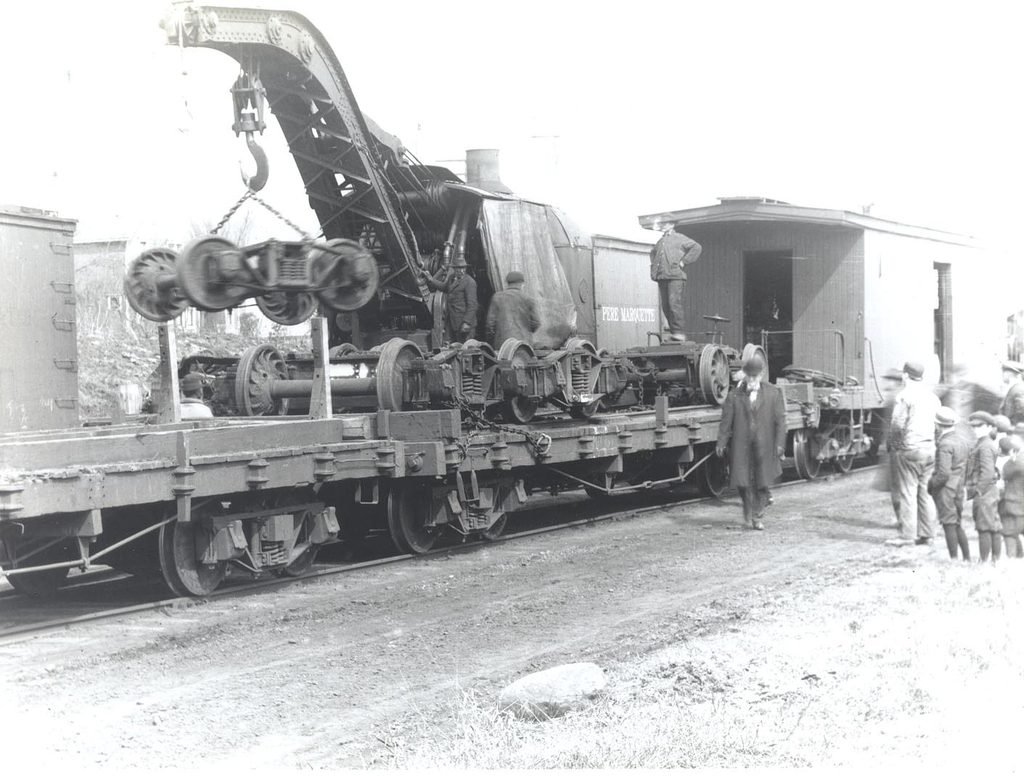
A Pere Marquette wrecking derrick towers over a flatcar. Suspended from its hook is a mangled railroad wheel assembly. Men work around damaged equipment while a group of boys watches from a safe distance.
The surviving description identifies it only as an unidentified train wreck near Ruth.
That uncertainty matters.
Without a newspaper account or railroad accident report tying the photograph to a specific date, cause or train number, assigning one would turn history into guesswork.
What the photograph does show is impressive enough.

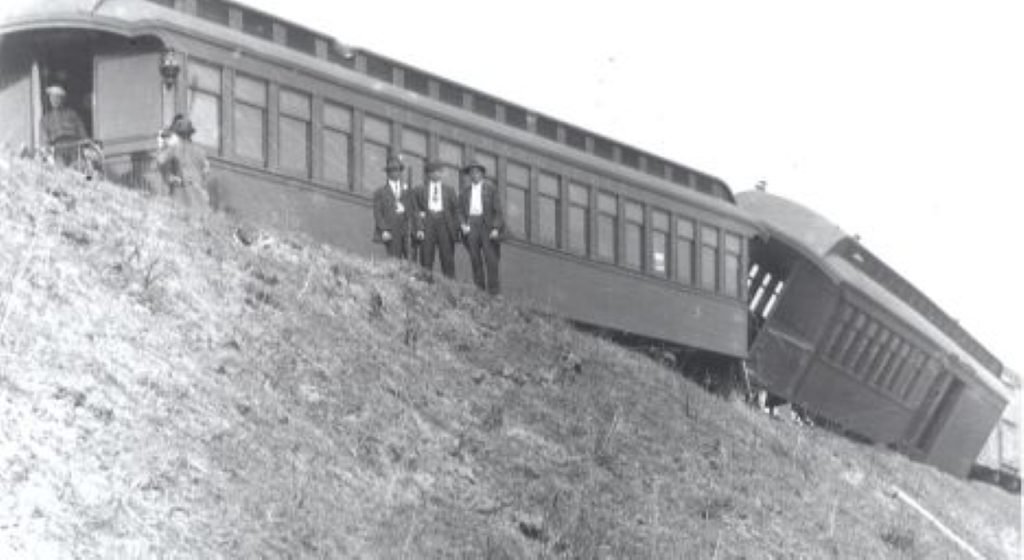
Railroad wreck crews were heavy industrial operations. Damaged cars had to be cleared, wheelsets recovered, and the line returned to service. In an agricultural community dependent on rail shipments, a blocked track was more than an inconvenience.
The boys standing nearby apparently understood something else: A wrecking crane at work was probably the biggest show in town.
The Steeple Above Ruth
If the railroad connected Ruth with Michigan, the church connected the community with itself.

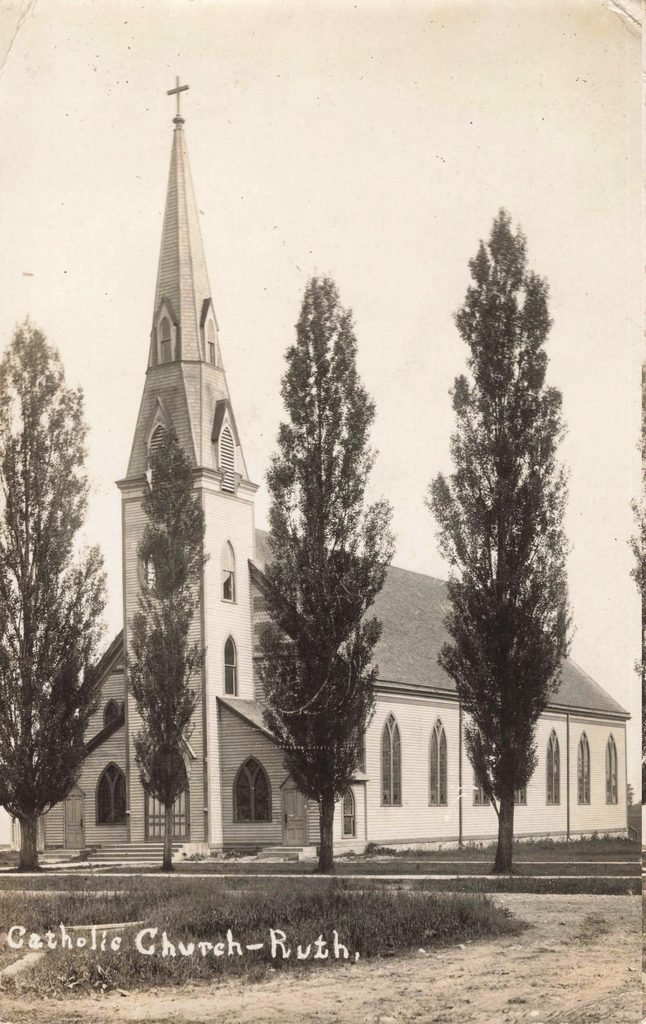
One of the finest photographs shows the old Sts. Peter and Paul Catholic Church, its narrow Gothic windows and tall wooden steeple dominating the scene.
The image says something about Ruth before a single church record is opened.
This was a substantial building for a very small community.
Catholic and Lutheran congregations were already documented in Sherman Township by 1884, reflecting the faith traditions brought by German settlers.
Another photograph shows the Catholic school with part of the church visible beside it.

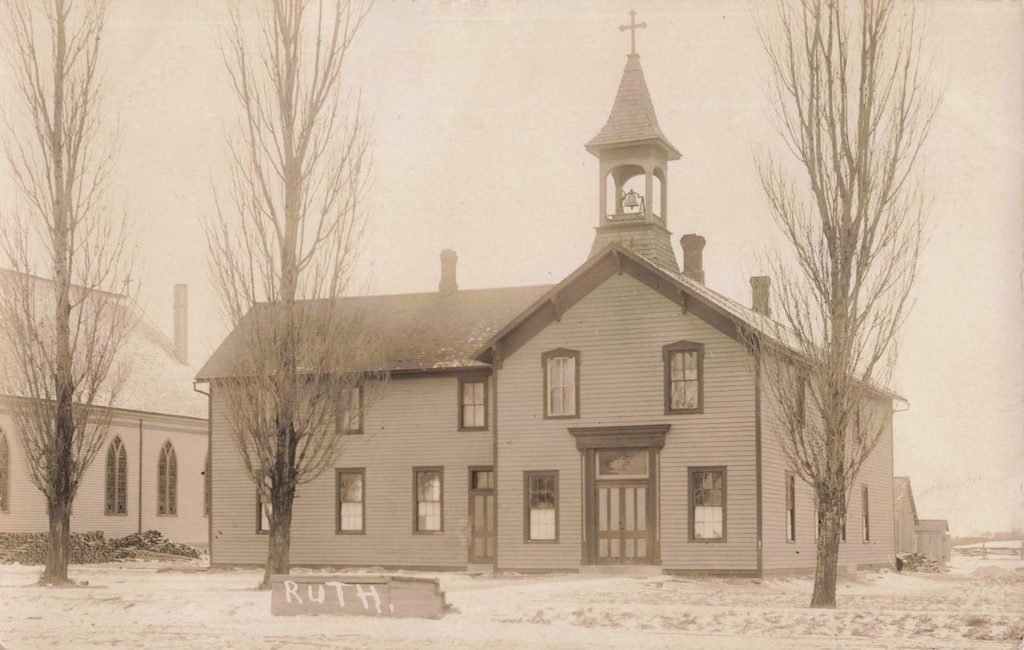
By the mid-20th century, Sts. Peter and Paul School served students through high school. Regina Emming, interviewed by the Huron Daily Tribune decades later, graduated there in 1967. She and her husband, Marvin, remembered basketball games against Ubly and Harbor Beach drawing packed crowds.
There was even a 6 a.m. Sunday Mass.
In farming country, an early service made practical sense. Cows, livestock and chores did not observe the Sabbath.
The Sherman House Offered a Porch and a Bed
Another postcard identifies a large two-story building as the Sherman House.

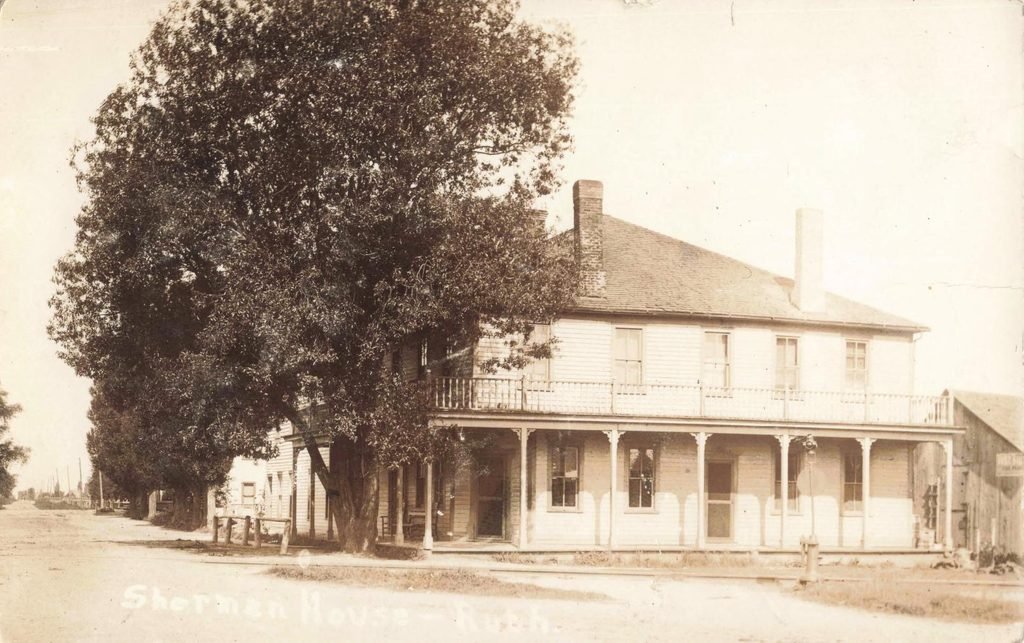
Its most striking feature is its porch.
The porch stretches across the front beneath an upper balcony, shaded by a massive tree. The building has the unmistakable appearance of the rural hotels and boarding houses that once stood near railroad stops across Michigan.
Period information about the Sherman House is frustratingly thin in readily available online sources, so its proprietor and operating dates remain worth further research.
Still, its location and architecture fit Ruth’s role perfectly.
A traveling salesman arriving by train needed a room. A visitor doing business with a merchant or grain buyer might need dinner. Relatives arriving for a wedding or funeral needed somewhere to stay.
Before motels lined Michigan highways, places such as the Sherman House filled that need.
Grain Was Ruth’s Rush-Hour Traffic
The railroad photograph showing the elevator may be the clearest statement of what kept Ruth alive economically.

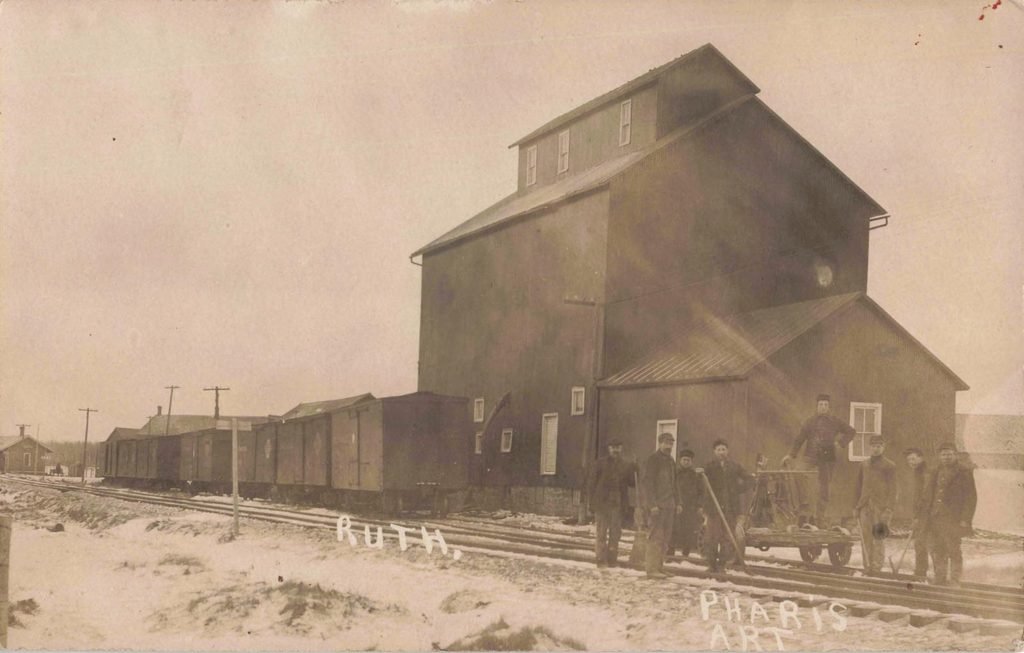
This was farm country. The 1884 county account praised Sherman Township’s productive soil and reported average wheat yields of about 25 bushels per acre, with exceptional fields producing considerably more.
Decades later, the scale had grown dramatically. Marvin Emming remembered farmers hauling grain into the Ruth elevator in wagons holding 100 bushels or less. At busy times, he said, the line of wagons could stretch a mile to a mile and a half, with farmers waiting as long as six hours to have grain ground for feed.
Imagine that scene along Ruth Road: horses, wagons, farmers swapping stories, dust in summer and mud during wet weather. That was Ruth’s version of a traffic jam.
Five Gas Stations, Three Bars and a Frozen-Food Locker
By the middle decades of the 20th century, horses had largely yielded to automobiles and tractors, but Ruth remained busy.
The Emmings recalled a town with five gas stations, four of which also repaired cars. There were three bars, a couple of restaurants, a funeral home and the Ruth Tile Company, which manufactured field drainage tile and cement blocks.
There was also something now largely forgotten: a community freezer locker.
Before home freezers became standard equipment, rural families rented refrigerated compartments to store meat and other frozen foods. Ruth had one of these facilities.
Holdwick Market served local families, and Regina Emming recalled the store briefly opening after Sunday Mass so farm families who came into town for church could pick up groceries before heading home.
Church and commerce operated on nearly the same schedule.
What These Ruth Photographs Really Show
None of these pictures records a governor’s visit, a famous battle or a major national event.
That is exactly why they matter.
A church photographer captured the steeple before it changed. Someone aimed a camera at the parish school. Another photographer stood in the cold as a horse-drawn sleigh paused on Main Street. Railroad men stopped long enough to pose beside the elevator. A camera recorded the unusual spectacle of a wrecking derrick cleaning up after an accident.
Together, these photographs show how Ruth worked.
The railroad supplied the connection. Farms supplied the business. Churches supplied much of the social calendar. Stores, taverns, repair garages, schools and the elevator filled the space between them.
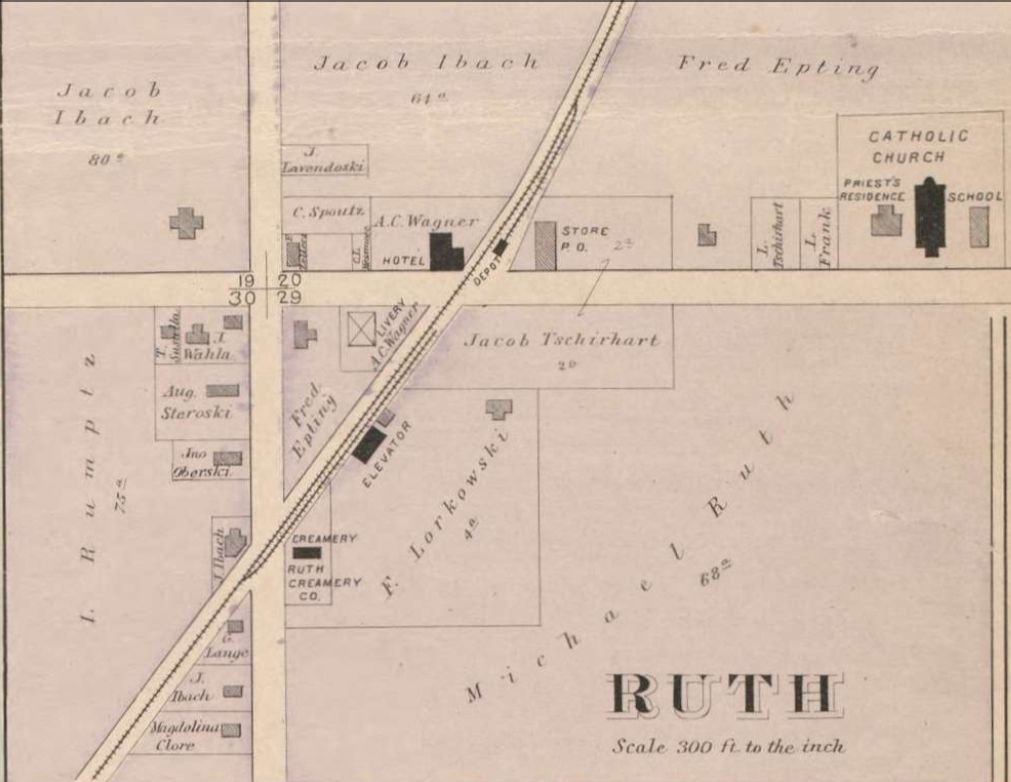
The 1904 Huron County plat book even preserved Ruth on paper, one small community among the county’s farm sections and rural roads. The original map survives through the Library of Congress collection.
Ruth never became a city.
It became something more typical of Michigan’s Thumb: a rural crossroads important far beyond its size.
And for a few decades, if you stood near the depot at the right moment, you could hear nearly everything that defined the place at once — a locomotive approaching, wagons moving toward the elevator, and a church bell carrying over the fields.

