


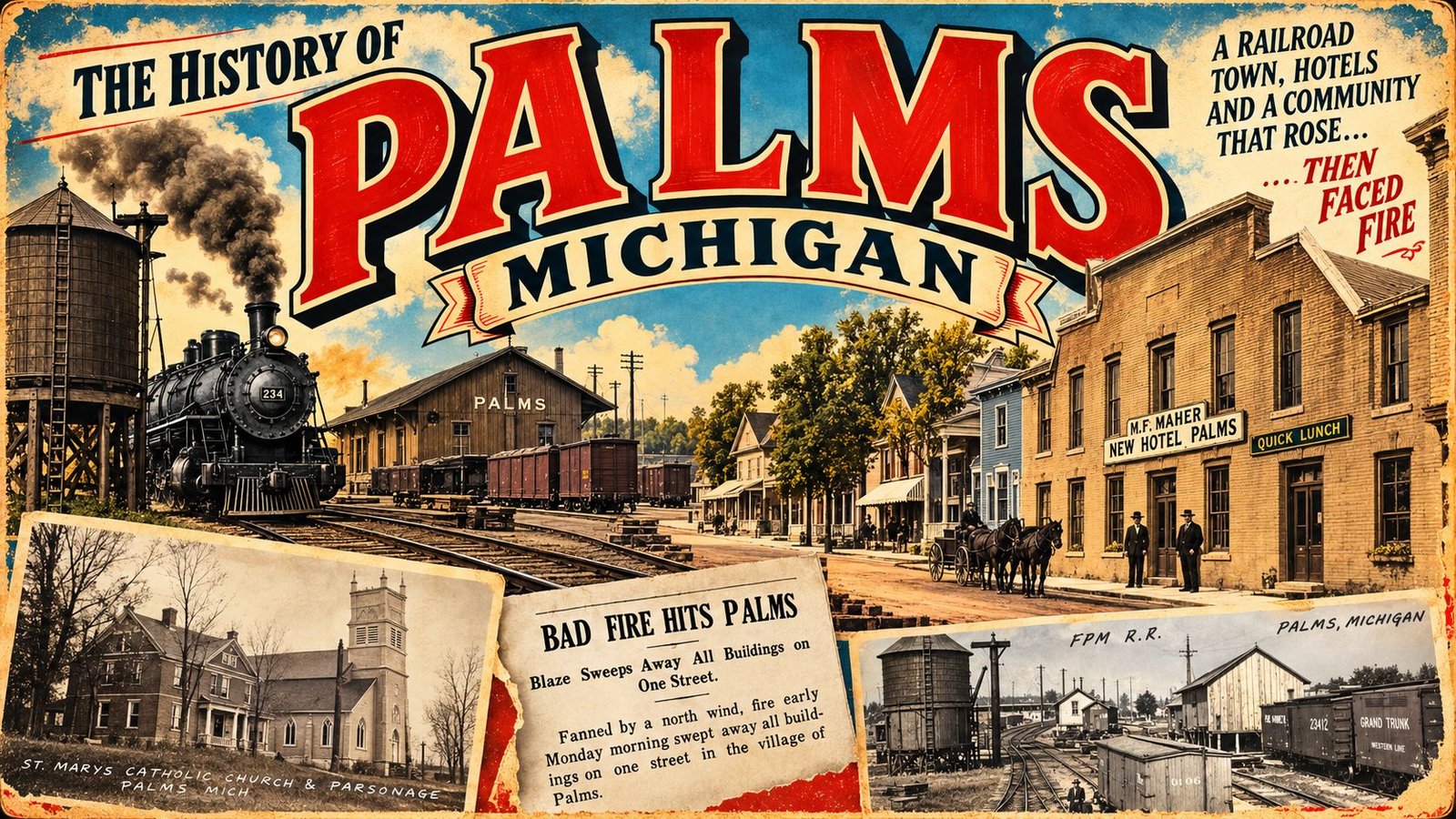
The History of Palms Michigan: The Surprising Railroad Town Nearly Erased by Fire in 1916
Vintage postcards of Palms, Michigan, show a surprisingly busy Sanilac County community where trains, hotels, stores, and churches shaped daily life before a devastating 1916 fire changed the village.
The History of Palms, Michigan, can be read in a handful of remarkable old postcards. They show a Sanilac County community where steam locomotives crowded the railroad yards, travelers stopped at the New Hotel Palms, horse-drawn wagons crossed dusty streets, and a large Catholic church served surrounding farm families. Palms was never a large town, but during the early 1900s it was an active railroad junction with hotels, stores, a bank, a post office, and businesses serving northern Sanilac County. Then, in 1916, fire swept through its commercial district and erased much of the town seen in these photographs.
There is an easy mistake to make when looking at Palms today.
Table of Contents
Watch: Palms, Michigan: A Boomtown Lost to Flames

The small crossroads in northern Sanilac County can seem like a place that was always quiet. But a remarkable group of early photographs tells another story. A railroad depot handled passengers and freight. Steam locomotives moved through a busy junction. Horse-drawn wagons crossed the tracks. A substantial brick hotel offered a “Quick Lunch.” Stores lined Railroad Street. Nearby, a large Catholic church and parsonage reflected the importance of religion to the surrounding farm families.
Palms was never a large town. But during the opening years of the 20th century, it was a working railroad community with an outsized role in this part of Michigan’s Thumb.
And for a short time, M.F. Maher’s New Hotel Palms stood near the center of it all.
The History of Palms Michigan Began Before the Railroad

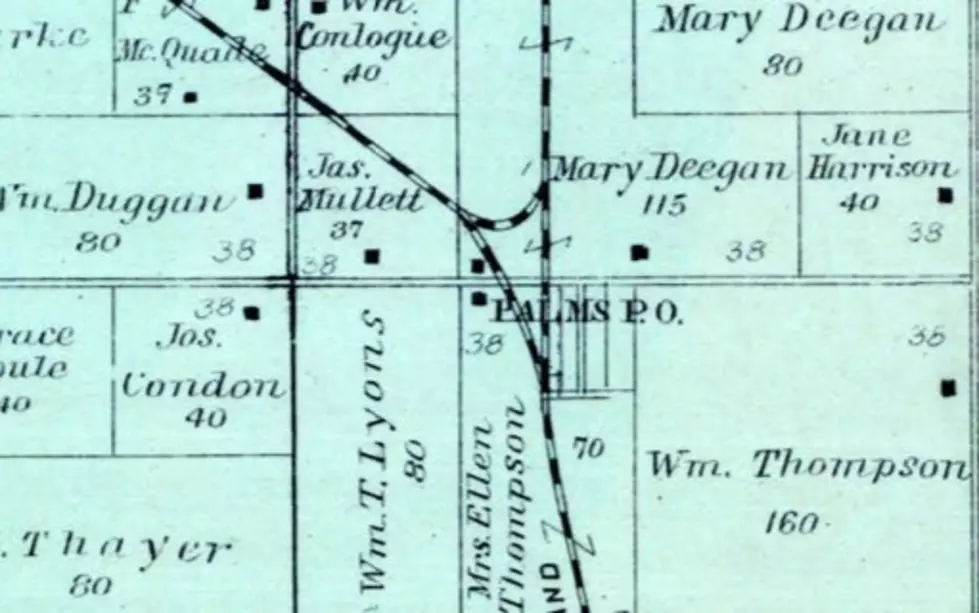
Palms is an unincorporated community in the southeast corner of Minden Township. Township history places its settlement in the 1850s and names John Smith and Michael Dyer among the first settlers. The community took its name from Francis Palms, who held substantial acreage in the area. A post office was established in 1882.
Francis Palms was no small-time local land speculator. A Detroit historical report describes him as an investor who bought and sold large tracts of outstate property, particularly pine lands, eventually becoming one of Michigan’s largest landowners.
The community’s postal name was originally Palm State. It became simply Palms in 1896. By then, however, another force had become far more important to the little settlement: the railroad.
How the Railroad Turned Palms Into a Busy Junction
One of the strongest images in the postcard collection is marked “P.M. Yards — Palms, Mich.”

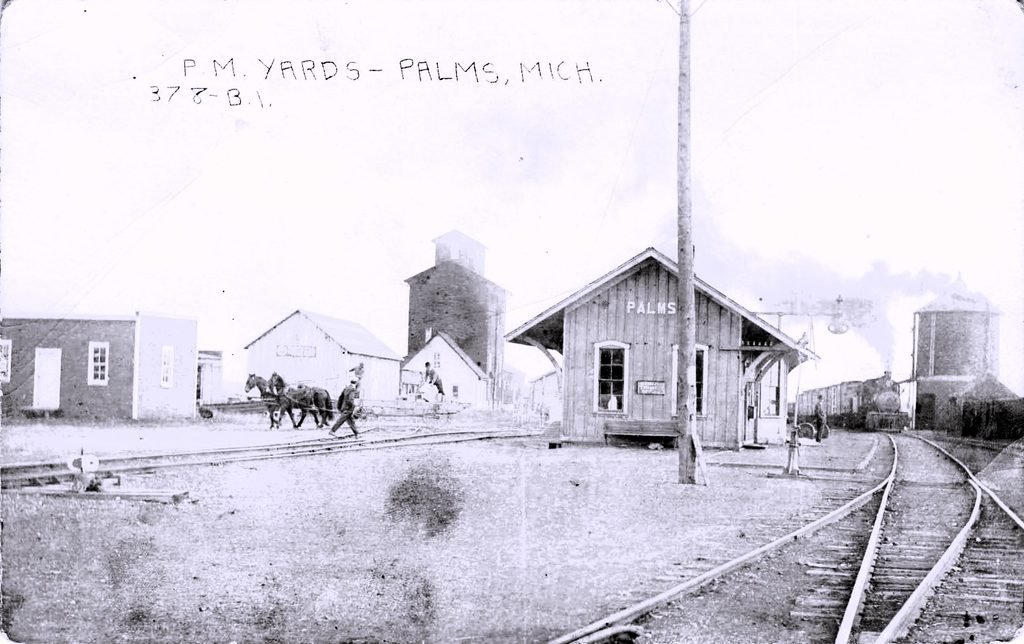
It is difficult to look at that photograph and call Palms an insignificant whistle-stop.
Tracks cross and divide through the scene. The depot marked PALMS sits beside the rails. A steam locomotive sends smoke into the air. Freight facilities and large wooden structures rise behind it. A horse team and wagon stand near the tracks, a reminder that rural transportation was still powered as much by horses as by steam.
Palms had become a junction.
The original Port Huron & Northwestern Railway reached the area during the great railroad-building period of the early 1880s. A branch from Palms Junction to Port Austin opened Dec. 11, 1882, giving Palms a strategic position where rail traffic could move toward Bad Axe and Port Austin or toward Harbor Beach.
The Port Huron & Northwestern was a narrow-gauge railroad. It was sold to the Flint & Pere Marquette Railroad in 1889, and the system became part of the Pere Marquette network in 1899.
That history helps explain two of the photographs.
One is labeled “F.P.M. R.R. — Palms, Michigan,” using the initials for Flint & Pere Marquette. Another refers to the P.M. yards, the later Pere Marquette name. The captions do not necessarily tell us exactly when each photograph was taken — old images were often copied and labeled years afterward — but they document the railroad identities associated with Palms.
By 1898, Palms had a daytime railroad agent. Two passenger and mail trains operated daily in each direction on the line through Palms, except on Sunday. Another service ran from Palms toward Grindstone City through Bad Axe.
This was a town where people planned their day around the train.
Life Around the Pere Marquette Railroad Yards

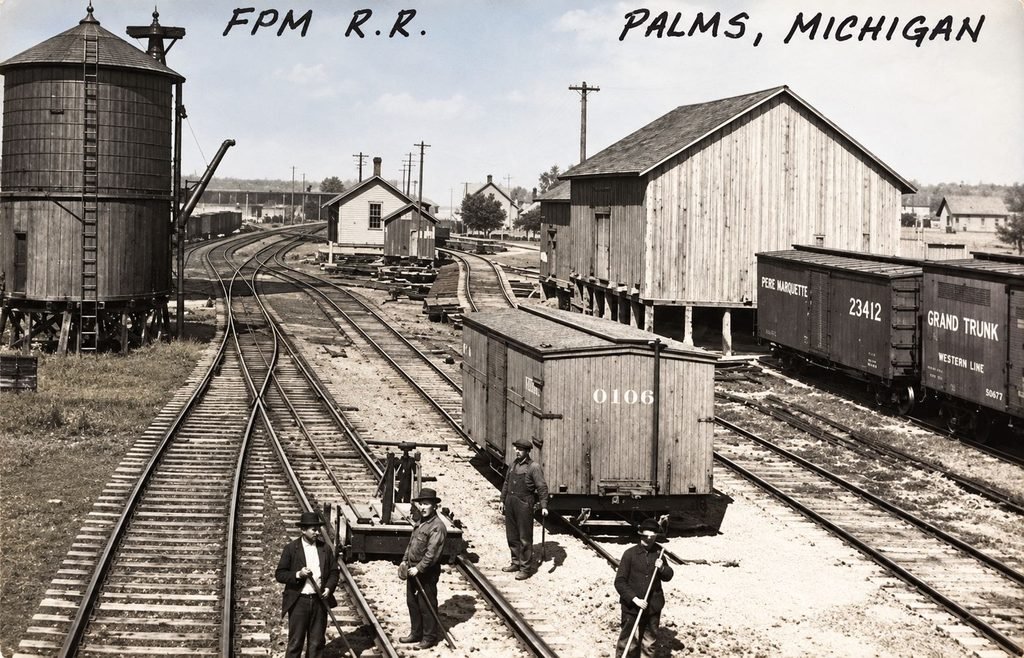
The railroad did much more than carry passengers.
Across the Thumb, rail lines moved grain, lumber, sugar beets ,and other farm products to market while bringing manufactured goods, mail, and travelers into rural communities. Unlike Great Lakes shipping, trains could operate through the winter.
That mattered in Palms.
The Sanilac County economy had been changing rapidly from logging to agriculture. An 1893 county atlas said the railroad had been a major convenience for both freight and mail and noted the enormous growth of agricultural exports from Sanilac County.
A farmer could bring produce or livestock into the rail network. A merchant could receive goods from Detroit or Port Huron. A traveling salesman could step off a passenger train and walk into town.
And waiting only a short distance away was a hotel.
M.F. Maher and the New Hotel Palms
Perhaps the most intriguing photograph in the collection is labeled “Railroad St. — Palms, Mich.”

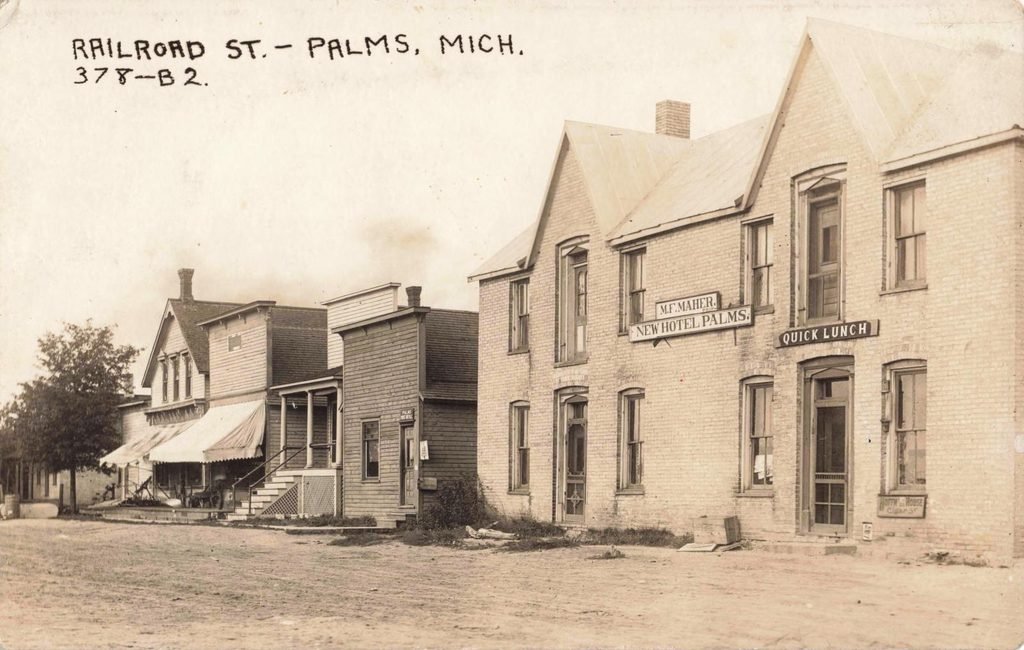
On the right side stands an imposing two-story brick building. Three signs leave little doubt about its purpose:
M.F. MAHER
NEW HOTEL PALMS
QUICK LUNCH
For anyone studying Palms, that photograph is an unusually valuable piece of evidence.
The hotel looks substantial compared with its neighboring wood-frame businesses. Its long brick facade, numerous upper-floor windows and multiple street-level entrances suggest an establishment built to handle more than an occasional overnight guest.
Its location is just as important. A hotel on Railroad Street in a junction town would have been positioned to serve train passengers, railroad employees, traveling salesmen, farmers in town on business, and visitors waiting for connections. The “Quick Lunch” sign is especially revealing. This was not merely a place where someone rented a bed. Food was clearly part of the business.
That short phrase almost brings Railroad Street back to life.
Imagine a train arriving, passengers gathering baggage, horses tied nearby, a salesman carrying sample cases, and someone crossing the dusty street because there was just enough time for lunch before the next train.
There is, however, a frustrating gap in the record. I could not find a dependable digitized source that expands M.F. Maher’s initials, establishes when he acquired the hotel, or provides a biography. For now, the photograph itself is the strongest evidence connecting Maher with the New Hotel Palms.
That makes the postcard more than a nostalgic picture. It may preserve information that has otherwise largely disappeared from the historical record.
Palms Had More Than One Hotel
M.F. Maher’s establishment was not operating in isolation.
Minden Township’s historical summary says Palms at its peak had three hotels, along with a bank, blacksmith, candy store, cemetery, church, stores, schoolhouse and railroad depot.
That is a remarkable commercial lineup for such a small place.
A 1910 Rand McNally directory estimated the population of Palms at only 300 people. That figure should be treated as a business-directory estimate rather than an official census count, but it gives a sense of scale.
Three hotels for a community of a few hundred residents only makes sense when the railroad is taken into account. The hotels were serving people moving through Palms as well as those who lived there.
The postcard of Railroad Street supports that interpretation. This was not merely a cluster of farmhouses. It had a recognizable commercial district.
Stores, Banking and Business Along Railroad Street
Another surviving record provides an unusually detailed glimpse into Palms commerce.
A 1913 Michigan Supreme Court case involved the Leszczynski-Clark Co., which operated a general mercantile business in Palms around 1909 and 1910. Court records describe employees, inventories and business dealings at the Palms store.
It is dry legal material, but historically it is useful.
It confirms that behind the storefronts seen in the postcards were real businesses carrying inventories, employing workers, and serving surrounding farm families.
Palms also had a bank operated by F.W. Hubbard & Co. A 1919 Rand McNally banking directory still listed the Palms Bank of F.W. Hubbard & Co. and gave Palms a directory population estimate of only 100.
That later listing raises questions because the bank building had already played a prominent role in the greatest disaster in Palms’ history.
Catholic Life in Early Palms Michigan And A Historical Mystery
The scene shows a substantial church beside a large rectory or parsonage. The church has a tall square tower topped by four narrow pinnacles, while the neighboring residence appears almost institutional in size.
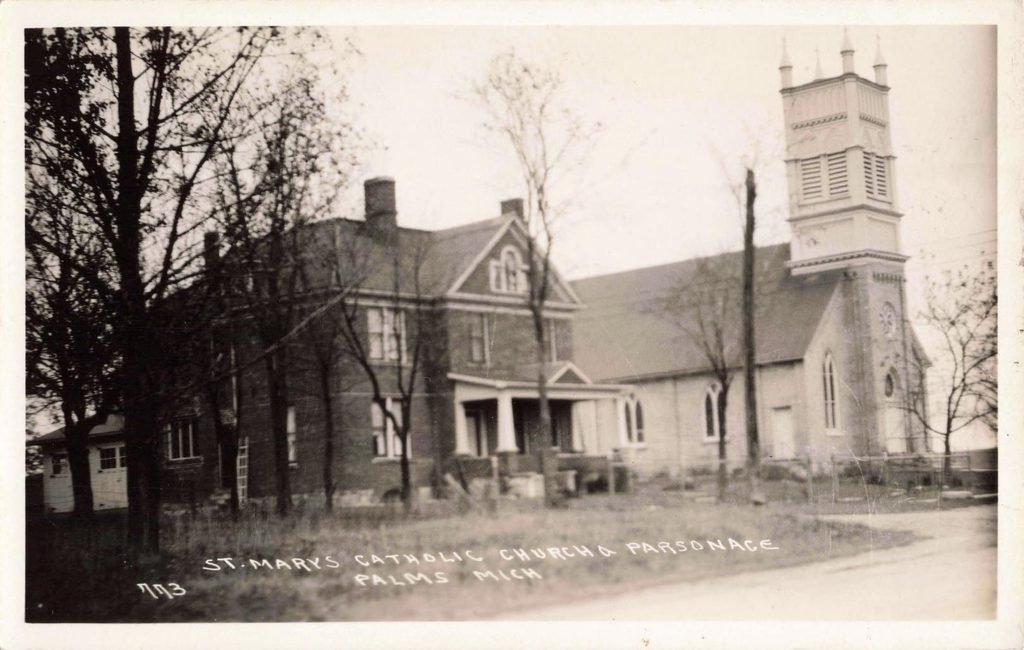
But there is a problem with the caption. Modern Diocese of Saginaw records identify the Catholic church in Palms as St. Patrick Church, now part of St. Isidore Parish. The same parish includes St. Mary Church in Parisville, several miles away.
Historical records also indicate that St. Patrick’s in Palms was founded by Irish Catholic settlers in the 1850s.
So why does the postcard say St. Mary’s?
At this point, the safest answer is that we do not know. The postcard could have been incorrectly captioned. The building’s name might have changed. The photographer or publisher may have confused nearby Catholic institutions. Another explanation may be buried in parish records that have not yet been digitized.
What can be said with confidence is that Catholic life had deep roots in the Palms area, and the church complex shown in the photograph was a major physical presence in the community.
The discrepancy is worth preserving rather than quietly correcting. Old postcards are historical evidence, but they are not automatically accurate.
A 1909 Inspection Gives Us a Look Inside the Depot
One government-era railroad record makes the Palms depot photograph even more interesting.
A 1909 inspection of the Pere Marquette described the station at Palms as small, with one waiting room. Inspectors criticized its sanitary facilities and noted problems with its bulletin board. The same report examined the tracks from Bad Axe to Palms, from Palms to Harbor Beach, and from Palms to Port Huron.
That mundane inspection report confirms something the photographs strongly suggest: Palms was not simply beside the railroad.
It was an operating point in the system.
Trains came and went. Passengers waited inside that little station. Freight cars were switched. Telegraph and railroad employees worked nearby. Mail arrived. Farmers hauled goods in by wagon.
For a few decades, the rhythm of the railroad was the rhythm of Palms.
Then Came Monday Morning, 1916
The most dramatic evidence in the collection is not a postcard. It is a newspaper clipping. The Blade-Crescent and the Progress-Advance of Sebewaing reported the disaster on Feb. 3, 1916, under a blunt headline:

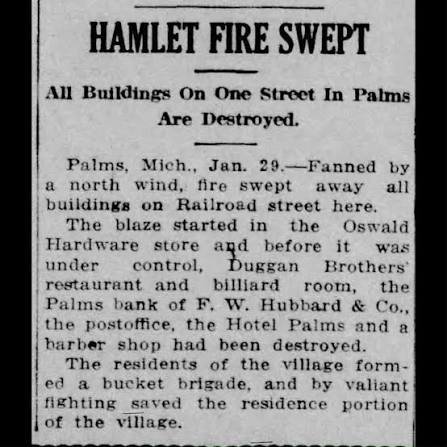
“BAD FIRE HITS PALMS.”
According to the report, a fire broke out early Monday morning in the Oswald Hardware Store.
A north wind did the rest.
The flames swept along the street and destroyed Duggan Brothers’ restaurant and billiard room, the Palms branch of F.W. Hubbard & Co., the post office, Hotel Palms, and a barbershop. Residents formed a bucket brigade and fought the fire themselves. Their efforts were credited with saving the residential portion of the village.
That contemporary report also settles an important question — or at least complicates a later version of the story. Modern accounts sometimes state that sparks from passing locomotives caused the fires that devastated Palms.
But the 1916 newspaper account provided with these photographs specifically says the major 1916 blaze began in Oswald Hardware Store. For that particular fire, the contemporary report deserves greater weight.
Was Maher’s Hotel the One That Burned?
The newspaper calls the destroyed building simply “Hotel Palms.”
The postcard identifies Maher’s establishment as the “New Hotel Palms.”
It is highly plausible that the newspaper was referring to the same hotel, particularly because both were associated with Palms’ commercial district. But the fire report does not mention Maher by name.
That distinction matters.
Based on the evidence now available, it is fair to say M.F. Maher’s New Hotel Palms appears to have been the Hotel Palms destroyed in the 1916 fire, but further documentation would be needed to state that identification as absolute fact.
If they were the same building, the postcard may show one of the last surviving views of Maher’s hotel before it disappeared.
The Fire Changed Palms
Minden Township’s current master plan says the 1916 fire destroyed much of the community and that only a handful of its historic structures remain.
The numbers in old business directories are suggestive.
Rand McNally estimated Palms at 300 residents in 1910. Its 1919 banking directory gave an estimate of 100. These are not official census totals and should not be treated as precise population counts, but the difference is consistent with a community whose commercial importance had sharply diminished.
The fire should not be treated as the sole explanation for everything that followed. Small railroad communities across Michigan would later contend with automobiles, improved highways, railroad consolidation and changing farm economics.
But losing a bank, post office, hotel, restaurant, billiard room, hardware store, and barbershop in one morning was a crushing blow to a community the size of Palms. Some of those businesses never returned.
These Photographs Show the Palms That Disappeared
Taken together, the old photographs reveal something that is difficult to see from Palms today. There was the railroad Palms, filled with tracks, freight cars, smoke and steam.
There was the commercial Palms, where businesses stood shoulder to shoulder along Railroad Street. There was M.F. Maher’s Palms, where a brick hotel advertised both rooms and a quick meal to whoever stepped off the train.
There was the religious Palms, represented by the striking Catholic church and parsonage — even if the “St. Mary’s” caption leaves an unresolved historical question. And then there was the Palms of 1916, when residents lined up with buckets while a north wind drove fire through the business district.
The photographs capture a town at the exact moment when horses, steam locomotives, farm commerce, and small-town business still depended on one another.
Palms may have been small. But in the early 1900s, it was certainly not sleepy.
Research note on M.F. Maher
The New Hotel Palms is the part of this story I think deserves more work. I found solid documentation for the railroad, commercial activity, bank, fire, and church history, but no reliable digitized record yet that identifies M.F. Maher’s full name or documents his years at the hotel. The sign in your postcard may be the best lead available.
A productive next round of research would include Sanilac County property records, 1900-1920 census schedules, Michigan business directories, Catholic parish records, probate files, and newspaper databases under the names Maher, Hotel Palms, New Hotel Palms, and Railroad Street. That could potentially establish who M.F. Maher was, his family, when he acquired the hotel, and whether he rebuilt or left Palms after the 1916 fire.
The History of Palms Michigan Survives in Old Photographs
The History of Palms Michigan is easier to understand when these photographs are viewed together. One shows a railroad yard filled with tracks and freight cars. Another shows Railroad Street and M.F. Maher’s New Hotel Palms. Another preserves the Catholic church and parsonage that served local families.
Then the newspaper record supplies the ending to part of that story.
In 1916, a fire tore through the commercial district, destroying the hotel, bank, post office, hardware store, restaurant, billiard room, and barbershop. Residents formed a bucket brigade and managed to save the residential section of town.
Palms continued to exist, but the community shown in these postcards was already changing.
Today, the photographs provide something maps cannot: a street-level look at the years when trains, horses, hotels, merchants, farmers and railroad workers made this small Sanilac County community a surprisingly active place.
Sources
Birdsall, Mark. “Ghost Towns of the Thumb: Palms.” Huron Daily Tribune, 2 Jan. 2024. Accessed 28 Sept. 2026.
City of Detroit. “Croul-Palms House Historic District Final Report.” City of Detroit. Accessed 28 Sept. 2026.
Cookingham, E. R., et al. Atlas of Sanilac County, Michigan: Containing Maps of Every Township in the County, with Village and City Plats, and Outline Map of the County, Also Maps of Michigan, United States and the World. J. L. Smith, 1894. Wikimedia Commons. Accessed 28 Sept. 2026.
Catholic Diocese of Saginaw. “St. Patrick Church — Palms.” Diocese of Saginaw. Accessed 28 Sept. 2026.
Genealogy Trails History Group. “Sanilac County Michigan Genealogy & History: Railroads.” Genealogy Trails. Accessed 28 Sept. 2026.
Michigan Railroads. “Port Huron and Northwestern Railway Company.” Michigan Railroads. Accessed 28 Sept. 2026.
Michigan Railroads. “Port Austin Sub — Pere Marquette — Bad Axe to Grindstone City via Port Austin.” Michigan Railroads. Accessed 28 Sept. 2026.
Michigan Railroads. “Physical Condition — Pere Marquette Railroad — 1909.” Michigan Railroads. Accessed 28 Sept. 2026.
Michigan Supreme Court. “Nelson v. Leszczynski-Clark Company.” Michigan Reports, vol. 177, 1913. Michigan Judicial Branch. Accessed 28 Sept. 2026.
Minden Township. “Minden Township Master Plan.” Minden Township, 13 Feb. 2025. PDF. Accessed 28 Sept. 2026.
Rand McNally and Company. “Rand McNally Bankers Directory: July 1910.” FRASER, Federal Reserve Bank of St. Louis, 1910. Accessed 28 Sept. 2026.
Rand McNally and Company. “Rand McNally Bankers Directory: July 1919 — Michigan.” FRASER, Federal Reserve Bank of St. Louis, 1919. Accessed 28 Sept. 2026.
Robinson, John. “Michigan Semi-Ghost Town: Palms, in Sanilac County.” 97.5 NOW FM, 9 Nov. 2018. Accessed 28 Sept. 2026.
Sanilac County Museum. “History of the Thumb: An America250MI Project.” Sanilac County Museum. Accessed 28 Sept. 2026.
Primary Historical Sources and Images
“Bad Fire Hits Palms.” The Blade-Crescent and the Progress-Advance, Sebewaing, Michigan, 3 Feb. 1916. Historical newspaper clipping supplied from the author’s collection.
“F.P.M. R.R., Palms, Michigan.” Early 20th-century historic photograph or real-photo postcard. Author’s collection.
“P.M. Yards — Palms, Mich.” Early 20th-century real-photo postcard showing the Palms railroad depot, yards, freight facilities and surrounding activity. Author’s collection.
“Railroad St. — Palms, Mich.” Early 20th-century real-photo postcard showing Railroad Street and M.F. Maher’s New Hotel Palms. Author’s collection.
“St. Mary’s Catholic Church & Parsonage — Palms, Mich.” Early 20th-century real-photo postcard. Author’s collection. The postcard identification should be treated cautiously because current Diocese of Saginaw records identify St. Patrick Church in Palms and St. Mary Church in nearby Parisville.

