


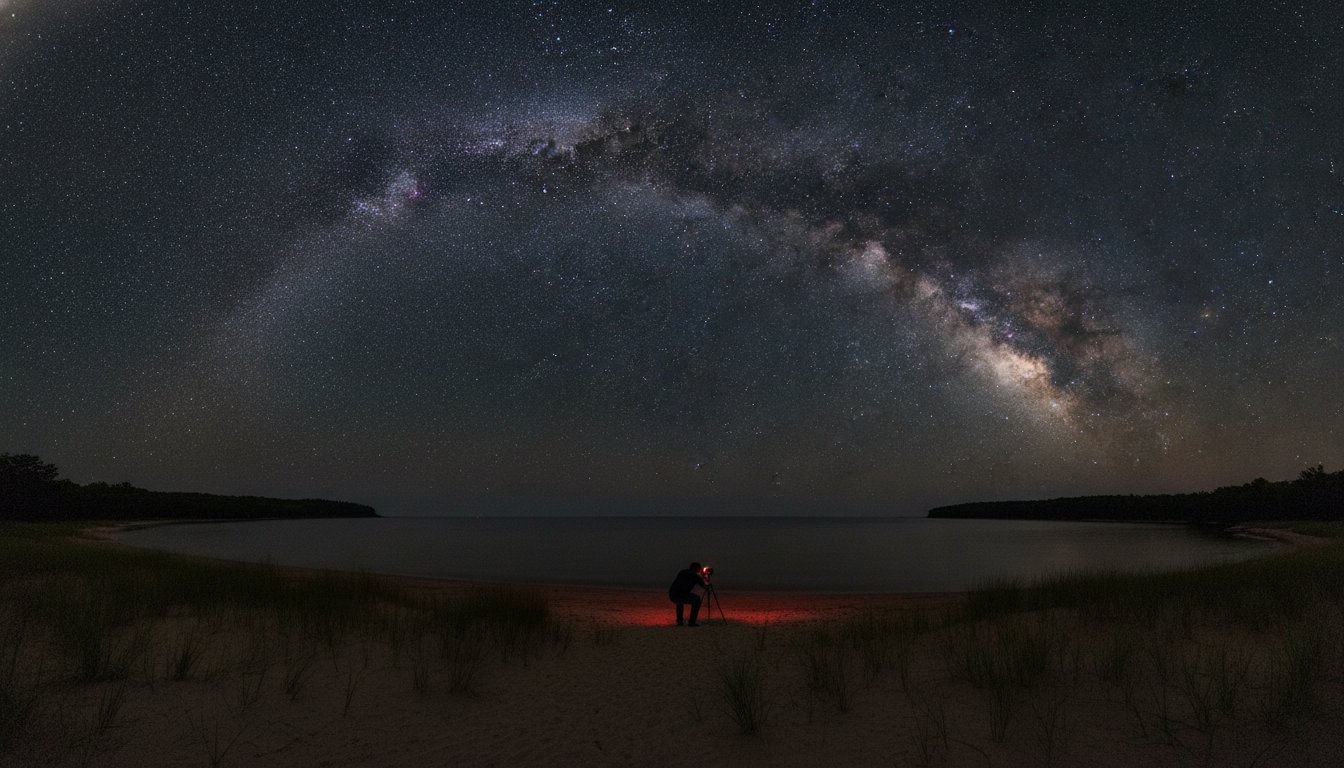
Michigan Dark Sky Parks: A 2026 Guide to the State’s Best Stargazing Locations
Driving six hours to the tip of the Keweenaw Peninsula doesn’t guarantee a view of the Milky Way if you aren’t prepared for the logistical realities of the Michigan wilderness. While the state boasts some of the darkest skies in the Midwest, a specific state law actually prohibits the creation of new state-designated dark sky preserves in the Upper Peninsula. This legislative hurdle means that finding a true dark sky park Michigan offers requires looking past the tourism brochures and understanding the strict distinction between international certifications and local state park designations.
It is frustrating to plan a trip around the lunar calendar only to find your chosen spot is washed out by the glow of a nearby city or a poorly placed streetlight. You likely want to see the stars without the guesswork. This Thumbwind guide provides the exact locations, 2026 entry fees, and technical requirements needed to ensure your equipment and timing align with Michigan’s unique environmental conditions.
We will break down every certified location across both peninsulas, including the international sanctuary on Beaver Island and the specific red-light ordinances you must follow to avoid a citation. You will also learn how to use the Bortle scale to gauge visibility and why the recent shift to 24-hour access at state preserves has changed the way you should plan your arrival.
Key Takeaways
- Navigate the tiered system of Michigan’s night-sky protections to choose the right location based on your specific equipment and viewing goals.
- Identify the premier stargazing spots in the state, from the flagship Headlands in Emmet County to the premier dark sky park Michigan offers in the Thumb at Port Crescent State Park.
- Master the logistical timing required for deep-sky viewing by aligning your trip with the lunar cycle and real-time weather monitoring tools.
- Understand the specific light-restriction ordinances and equipment needs, such as red-filtered flashlights, required to maintain night vision in protected areas.
- Explore how Michigan’s industrial growth and energy infrastructure are being managed to protect the remaining dark sky corridors for future generations.
The Science and Designation of Michigan’s Dark Sky Preserves
Michigan’s geography provides a natural advantage for stargazers. With more than 3,000 miles of Great Lakes coastline, the state possesses vast corridors of low-light territory where the water acts as a buffer against urban glow. A dark sky park Michigan residents visit is more than just a quiet campground; it’s a specifically managed zone where artificial light is strictly regulated to protect the nocturnal environment. This formal dark-sky preserve designation ensures that both wildlife and researchers have access to natural darkness.
To better understand the technical side of capturing these views, watch this helpful video:

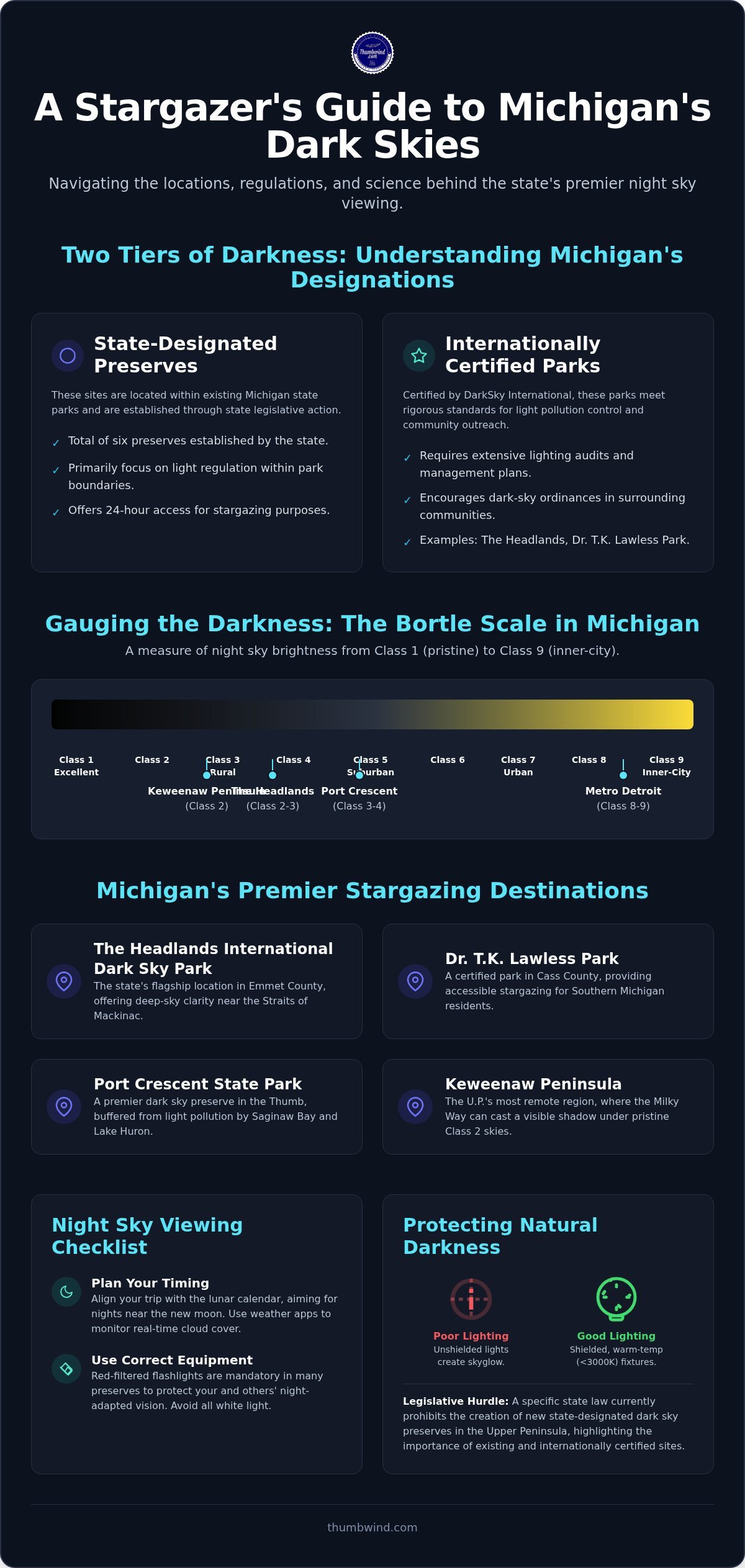
While the term “dark sky” is used broadly, there is a distinct difference between state-designated preserves and those certified by DarkSky International. Michigan has six state-designated preserves, established through legislative action, which are located within existing state park boundaries. In contrast, international parks like The Headlands or Dr. T.K. Lawless must meet rigorous lighting audits and community outreach requirements. These international sites often influence local zoning laws, encouraging nearby townships to adopt shielded, light-efficient fixtures that point downward rather than bleeding into the horizon.
International Dark-Sky Association (IDA) Standards
Earning an international certification requires a park to demonstrate a long-term commitment to darkness. This involves replacing standard mercury vapor or high-pressure sodium lamps with LED fixtures that have a color temperature of 3000K or lower. These standards don’t just affect the park itself. They often lead to “dark sky friendly” ordinances in surrounding communities, helping to curb the sprawl of light pollution that threatens Michigan’s rural character.
The Bortle Scale in Michigan’s Latitudes
Astronomers use the Bortle Scale to measure sky brightness on a scale from 1 to 9. A Class 9 sky represents the inner-city glow of Detroit, where only a few stars are visible. A Class 1 sky is a pristine, ink-black environment. In the Upper Peninsula, particularly in remote areas of the Keweenaw, you can still find Class 2 skies where the Milky Way casts a visible shadow on the ground. Even in the Lower Peninsula, the “Thumb” region, including sites like Port Crescent State Park, maintains significantly lower light levels than neighboring Metro Detroit. This is largely due to the Saginaw Bay and Lake Huron acting as natural barriers to light encroachment.
Primary Dark Sky Locations in the Lower and Upper Peninsulas
Michigan’s network of dark sky sites spans from the Indiana border to the northernmost tip of the Keweenaw. While many travelers focus on the northern reaches, Southern Michigan residents have access to Dr. T.K. Lawless Park in Cass County. This site serves as a certified dark sky park Michigan maintains to provide accessible stargazing for the population centers of the lower third of the state. It remains one of the few places in the Midwest where you can find true darkness within a short drive of a major metropolitan area.
The Headlands and Northern Michigan Preserves
The Headlands International Dark Sky Park is the state’s flagship location. Situated on 550 acres in Emmet County, the park sits just west of Mackinaw City along the Straits of Mackinac. Visitors often use the Guest House for overnight observation, though you must book months in advance. The site provides a rare combination of accessibility and deep-sky clarity. However, the proximity to Mackinaw City means some low-level glow persists on the eastern horizon. Preserving the Night requires constant monitoring of these nearby urban light sources to keep the certification active.
Port Crescent and the Thumb Region
In the Thumb, Port Crescent State Park serves as the premier stargazing destination for those near the Saginaw Bay. Located just outside Port Austin in Huron County, the preserve benefits from the vast, dark expanse of Lake Huron. The lake surface doesn’t just provide a dark horizon; it also helps stabilize atmospheric temperatures. This stability can improve clarity for those practicing long-exposure astrophotography. For the best vantage point, use the Port Crescent Steel Bridge Trail to reach the designated viewing areas away from the main campground lights.
U.P. Dark Sky Opportunities
The Upper Peninsula offers the most pristine conditions, even in areas without formal international designations. The Keweenaw Mountain Lodge recently secured IDA certification, providing a high-altitude viewing platform near Copper Harbor. This region is a primary target for those seeking the Aurora Borealis. The lack of light pollution along the Lake Superior shore makes the Northern Lights far more vivid than in the Lower Peninsula. If you plan to stay overnight, consult the Michigan State Campgrounds Guide to find sites that allow for 24-hour sky access. To stay informed on the best times for aurora viewing, you can sign up for our seasonal updates.

Logistical Planning for Stargazing and Astrophotography
Visiting a dark sky park Michigan provides requires more than just a clear calendar. Your success depends almost entirely on the lunar cycle. A New Moon is essential for deep-sky viewing because even a half-moon produces enough light to obscure distant nebulae and the finer details of the Milky Way. If you time your visit during a Full Moon, the sky will appear blue rather than black through a telescope or camera lens. The logistical realities of a dark sky park Michigan visit include managing your own light signature to avoid disrupting others.
Check the local forecast before committing to a long drive. Clear skies in Detroit don’t always translate to clarity in the Thumb or the Straits of Mackinac. You can use the Michigan Upper Thumb Webcams to verify cloud cover and visibility in real-time. This is particularly useful for spotting low-level fog that often rolls off the Great Lakes during the spring and autumn months. High-pressure systems typically provide the most stable air for high-magnification viewing.
Equipment needs are specific and non-negotiable in protected areas. White-light flashlights and cell phone screens are prohibited in viewing zones because they instantly reset the human eye’s adaptation to darkness. Use a dedicated red-filtered flashlight instead. This allows you to adjust your telescope or camera settings without blinding other observers. During the summer, the Milky Way core is visible in the southern sky, while winter offers crisper air and distinct constellations like Orion.
Park Rules and Etiquette for Night Visitors
While most designated preserves now offer 24-hour access, you still need a valid Michigan Recreation Passport for vehicle entry. When approaching a viewing area, turn off your headlights as soon as it’s safe to do so. Use your parking lights to navigate the final few yards. Professional astronomers often spend hours setting up sensitive equipment; bumping a tripod or flashing a bright light can ruin an entire night of work. Always follow a “no-trace” policy, ensuring all gear and refuse are removed before sunrise.
Basic Astrophotography Settings for Beginners
Capturing the night sky requires a sturdy tripod and a camera with manual controls. Start with an aperture of f/2.8 or wider and an ISO between 1600 and 3200. Exposure times should range from 15 to 30 seconds. If you go longer, the stars will begin to “trail” due to the Earth’s rotation. You should also watch for the Night Flight 760 effect, where commercial aircraft or satellites leave bright streaks across your frame. In Michigan, high humidity is a constant threat to your glass. Keep a small towel or an electronic dew heater handy to prevent lens fogging during long sessions.
Preserving the Night: Light Pollution and the Future of Michigan Skies
Michigan’s industrial growth presents a persistent challenge for every dark sky park Michigan manages. As manufacturing and energy infrastructure expand, the resulting skyglow can wash out celestial views hundreds of miles away. Modern developments, including the proliferation of Michigan Wind Farms, now utilize synchronized red flashing lights to meet FAA safety requirements while minimizing the impact on ground-level observers. Developers of Michigan solar installations are also increasingly adopting shielded security lighting to prevent upward light spill into the atmosphere.
Local leadership in the Thumb region has recognized that darkness is a finite resource. Communities like Caseville and Port Austin have begun auditing municipal streetlights to ensure they are fully shielded and utilize lower color temperatures. These efforts aren’t just about the stars; they are a response to the growing economic value of astro-tourism. Travelers who visit a dark sky park Michigan offers often stay in local hotels and eat at regional restaurants, providing a steady stream of revenue that depends entirely on a black horizon.
The Threat of Skyglow in Southern Michigan
The most significant threat to Michigan’s night skies remains the light bleed from the Grand Rapids, Lansing, and Detroit corridors. This artificial glow creates a dome of light that disrupts the natural rhythms of local wildlife and migratory birds. Many species rely on celestial cues for navigation during their seasonal travels along the Great Lakes coastlines. Reducing this glow through better urban planning is a practical necessity for maintaining the state’s ecological balance and the health of its avian populations.
Get Involved: Monitoring Michigan’s Night Skies
Amateur astronomers can take an active role in preservation through citizen science initiatives. Mobile applications allow users to measure and report local light levels, contributing to a global database used by researchers to track light pollution trends. Supporting the Michigan Chapter of the IDA is another way to advocate for stronger lighting ordinances at the county level. These local groups often work with townships to draft language that protects the night without compromising public safety.
To stay informed on these environmental shifts and receive updates on seasonal stargazing events, you can sign up for Michigan Moments. Joining a local astronomy club, such as those in the Saginaw or Grand Rapids areas, provides access to specialized equipment and a community of like-minded preservationists. These organizations are often the first to notice changes in sky clarity and serve as the primary advocates for Michigan’s remaining dark corridors.
Planning Your 2026 Stargazing Expedition
Michigan’s commitment to preserving its celestial views has created a unique network of protected zones. Whether you visit a state-designated preserve like Port Crescent or an internationally certified dark sky park Michigan manages, success depends on logistical precision. Success requires more than just clear skies; it demands an understanding of current entry requirements and local ordinances. Remember that 24-hour access is now standard across most state preserves, though you still need a valid Recreation Passport for your vehicle.
Preparation is the primary difference between a wasted trip and a clear view of the Milky Way. Align your travel with the New Moon and keep your equipment light-sealed to respect both the nocturnal environment and your fellow observers. As industrial growth continues, these small corridors of darkness become increasingly vital for regional wildlife and the local tourism economy.
Since 2009, we’ve provided independent Michigan journalism with a focus on detailed regional mapping and documented history. Exploring the state’s geography requires accurate data and a commitment to preservation. Pack your red-light flashlight and head into the wilderness; the stars are waiting.
Frequently Asked Questions
What is the best time of year to visit a dark sky park in Michigan?
Late summer and early autumn offer the best balance of clear skies and manageable temperatures for most observers. While winter provides the crispest air and best clarity for high-magnification viewing, the extreme cold and persistent cloud cover often limit visibility. Always plan your trip around the New Moon to ensure the lunar glow doesn’t wash out the stars.
Do I need a special permit to stay in a Michigan dark sky park after midnight?
You don’t need a special permit to stay after midnight at a dark sky park Michigan maintains. Since June 2022, state-designated preserves have been open 24 hours a day for stargazing and celestial observation. However, you must have a valid Michigan Recreation Passport on your vehicle for entry into any state park location, even during overnight hours.
Can I see the Northern Lights from a dark sky park in the Lower Peninsula?
Yes, the Northern Lights are visible from the northern shores of the Lower Peninsula during periods of high solar activity. Locations like The Headlands in Emmet County or Port Crescent in Huron County provide the necessary dark northern horizons over the Great Lakes. While the displays are more frequent in the Upper Peninsula, strong geomagnetic storms produce vivid colors across the entire state.
Are dogs allowed in Michigan dark sky preserves during night hours?
Dogs are allowed in Michigan dark sky preserves as long as they remain on a six-foot leash at all times. Owners must ensure their pets don’t disrupt other observers with noise or movement. Keep in mind that many viewing areas are crowded with sensitive telescopes and camera equipment, so keeping your dog close is a practical necessity for everyone’s safety.
Which Michigan dark sky park is closest to Detroit or Grand Rapids?
Dr. T.K. Lawless Park in Cass County is the closest internationally certified dark sky park Michigan offers to residents of Detroit or Grand Rapids. For those in the Detroit area, Port Crescent State Park in the Thumb is another viable option, located about 120 miles north of the city. Both sites offer a significant reduction in light pollution compared to the urban glow of southern Michigan.
What should I do if someone is using a white flashlight near me at the park?
Politely inform the individual that white light ruins the night vision of everyone in the area for up to 30 minutes. Most visitors use white lights because they don’t know the rules or the science of eye adaptation. Suggest they use a red-filtered flashlight or offer to let them borrow yours if you have a spare to keep the environment dark for everyone.
Disclaimer
Information published on Thumbwind.com is provided for general informational purposes. While we make reasonable efforts to keep articles accurate and current, details such as prices, hours, regulations, access conditions, and other information may change without notice. Readers should verify important details with the appropriate business, agency or official source before making travel, financial or other decisions. Thumbwind.com is not responsible for the content, availability or practices of third-party websites linked from our articles.