


The Amazing Story of Norvell Michigan History
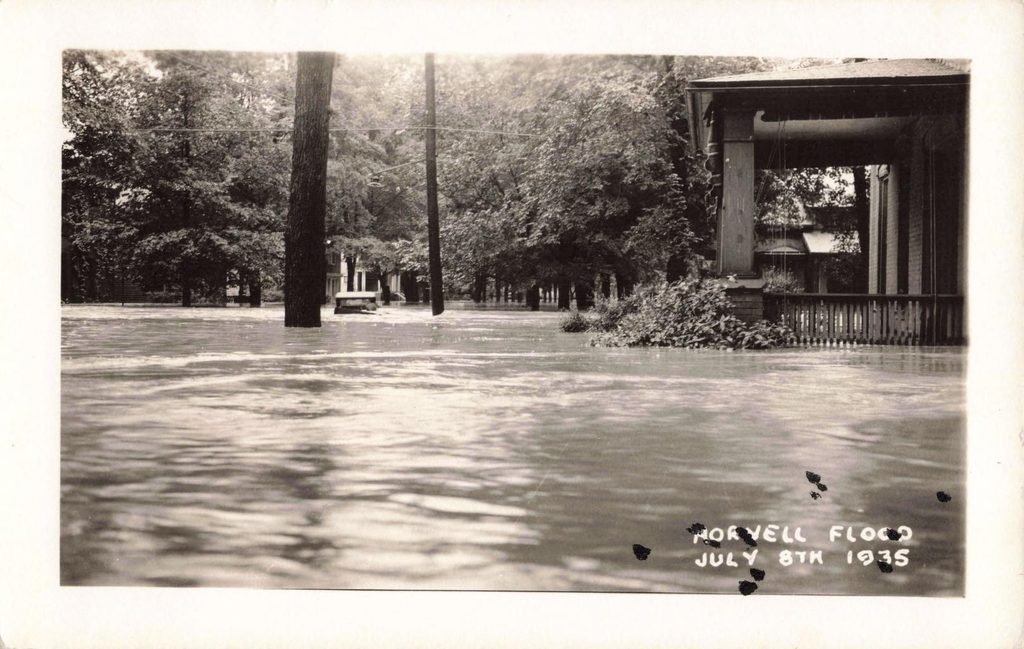
Floodwater reached the front porches in Norvell, Michigan, on July 8, 1935. A dated postcard records water surrounding trees and utility poles along a residential street. Norvell, Michigan, history was shaped by this close arrangement of homes, roads, and water, and by the work that drew people into a small Jackson County community.

Watch: Norvell, Michigan: A Senator’s Name, a Working Town

History of Norvell Michigan Begins Along Roads and Water
Euro-American settlement took shape in the early 1830s, with William Hunt among the earliest arrivals. Austin Road carried stagecoach traffic between Saline and Jackson. The township’s master plan places the first local post office, school, and church along that road and identifies Almon Fitzgerald’s dam-powered sawmill as an early enterprise.
A road brought travelers; a mill gave farmers and builders a reason to stop. Norvell’s post office opened March 17, 1838, with Harvey Austin as its first postmaster. These services connected scattered households and helped establish a business center.
Families often arrived in stages. Thomas Ashley moved from New York to Michigan in 1855, worked on rented farms near Ypsilanti, and bought land in Norvell Township in 1861. The 1881 county history also records the burial of his wife, Elizabeth, in Norvell’s cemetery in 1876, showing that the family’s move west had become a permanent local connection.
The Ayers family’s 1836 arrival required a more immediate adjustment. They spent their first summer in a small roadside shelter before moving into a log dwelling that fall. By 1881, Daniel B. Ayers occupied the family farm. That sequence gives the settlement years a household scale: they acquired land before building a more permanent home.
The Newspaper Editor Who Became a Statehood-Era Senator

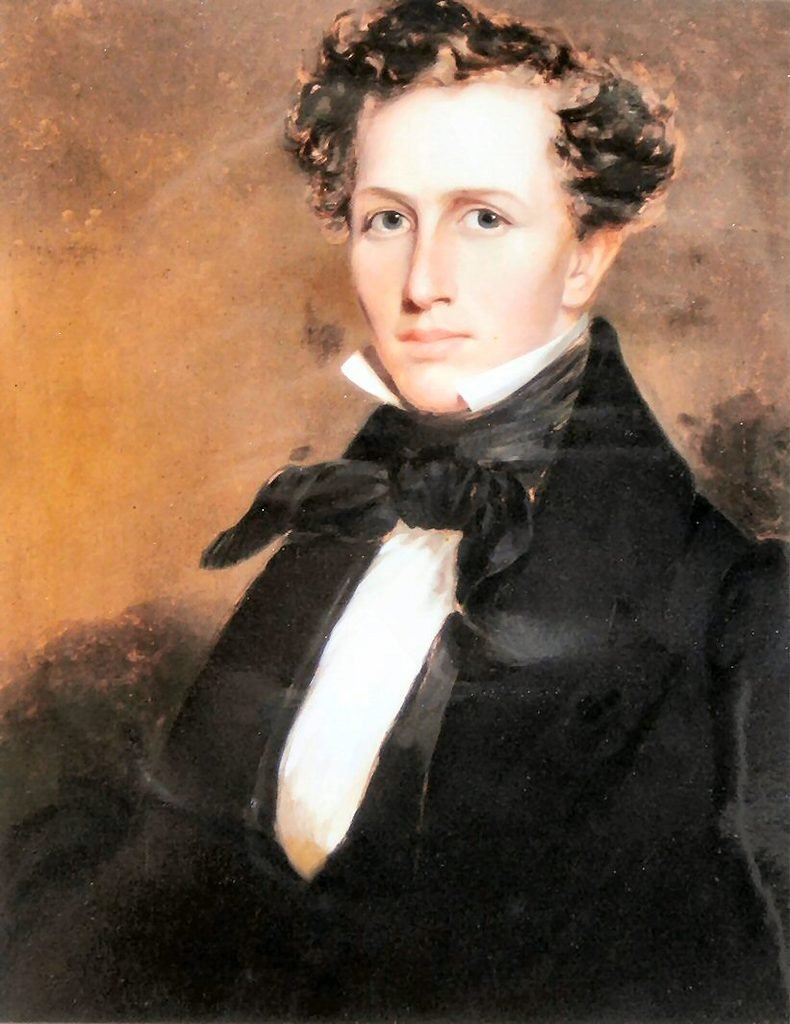
The community took its name from John Norvell, a printer, newspaper editor, and lawyer whose public career centered on Detroit. He helped found the newspaper that became The Philadelphia Inquirer and served as Detroit’s postmaster from 1831 to 1836. His career connected Norvell, Michigan, to the political arguments surrounding the new state.
As a young man, Norvell sought advice from President Thomas Jefferson. In a June 11, 1807, reply, Jefferson recommended a newspaper restricted to true facts and sound principles, then doubted whether it would find many subscribers. Norvell continued in the trade despite that unpromising assessment.
On Jan. 26, 1837, he and Lucius Lyon took their oaths as Michigan’s first U.S. senators. The next day, a drawing determined their Senate classes: Lyon’s initial term ended in 1839; Norvell’s ended in 1841. His name carried a statehood connection into a community whose own business centered on rural work.
Mills and a Depot Served the Surrounding Farms
By the late 1850s, the railroad route between Manchester and Jackson supplied another connection. Norvell became a station on the branch later operated by the Lake Shore & Michigan Southern Railway. Norvell railroad history belongs to this regional network, with the village between Manchester and Napoleon on the line.

The county history described a hotel, stores, schools, and a depot in 1881. It singled out the extensive mills operated by William Reynolds and described the village as a market for the surrounding country. Milling, retail trade and transportation supported one another: the village served farms well outside its few streets.
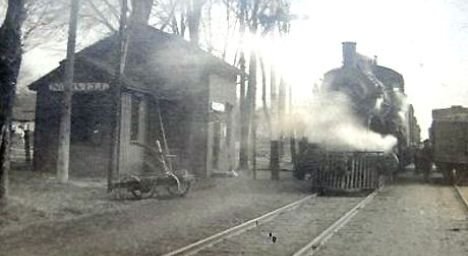
A 1916 railway station list assigned Norvell the telegraph call letters NO. Its position between Manchester and Napoleon made the hamlet one part of a closely spaced chain of stops. For railway employees, the village had an operational identity as well as a name: a location to be recognized in the movement of trains along the branch.

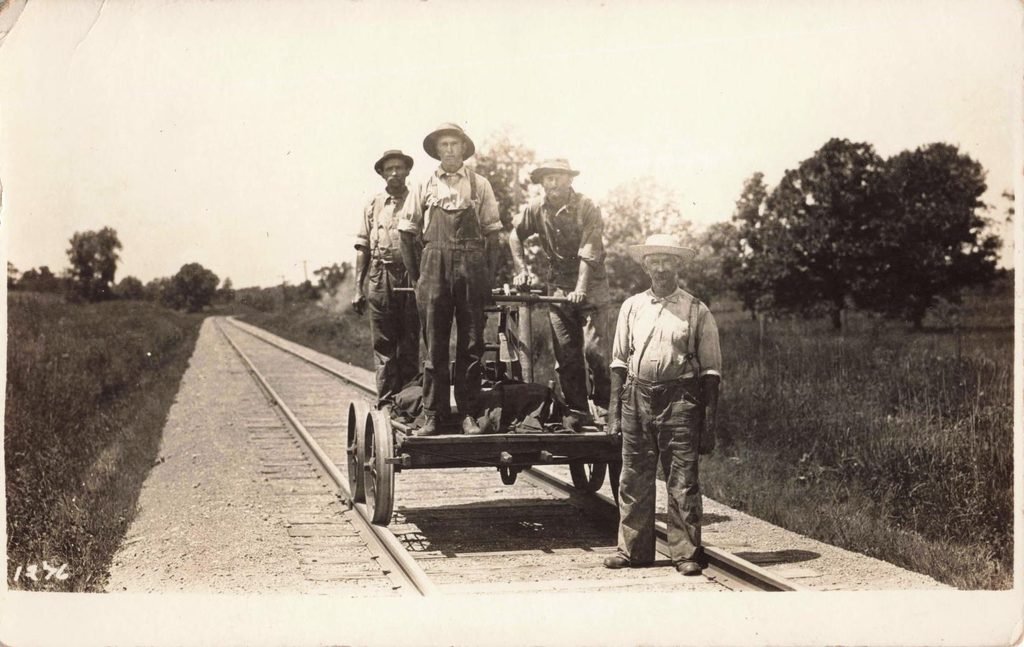
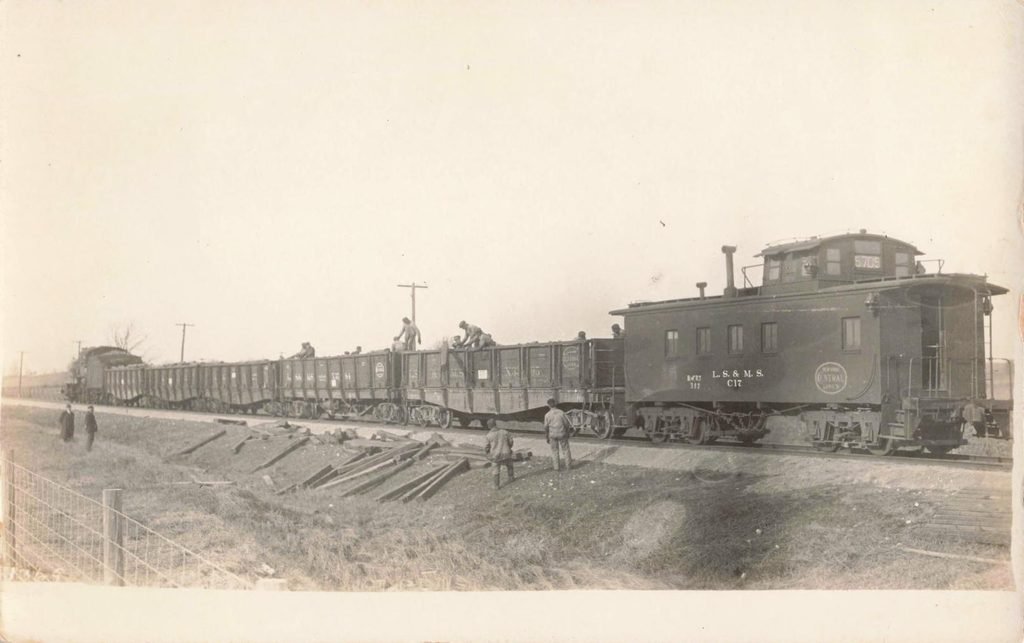
A handcar scene brings railway labor into view. Four men stand with the small rail vehicle on a straight section of track. Elsewhere, freight cars and a Lake Shore caboose record the equipment that moved through the community. Together, these views place workers alongside the machinery usually given most attention.
What did a flouring mill do?

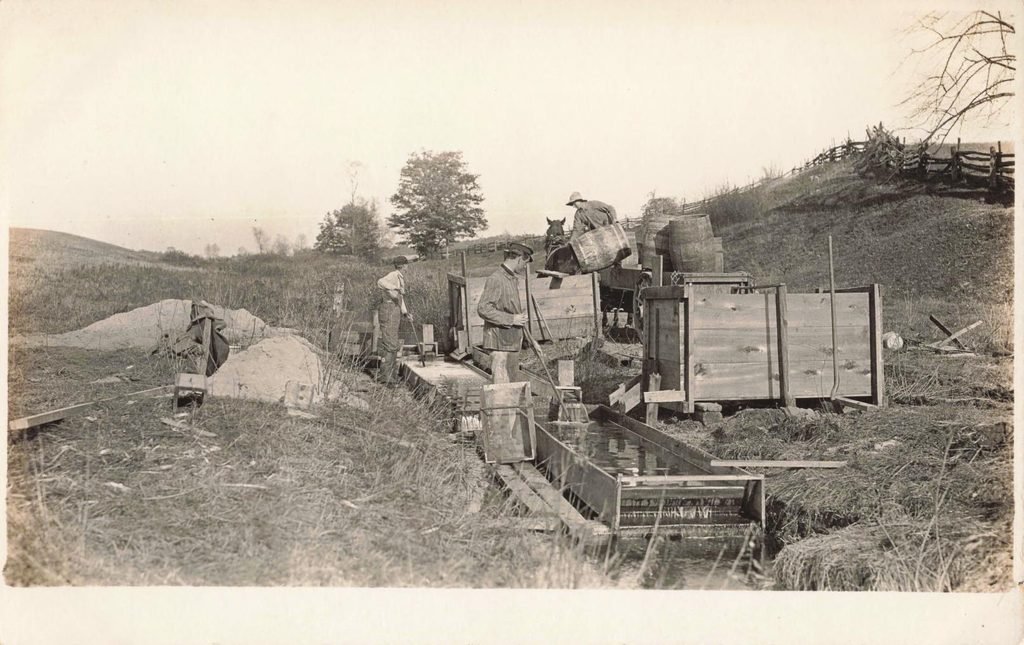
A flouring mill ground grain into flour. The county history’s use of the term connects Norvell’s milling business with the surrounding agricultural district.
A Church, School and Town Hall Brought People Together
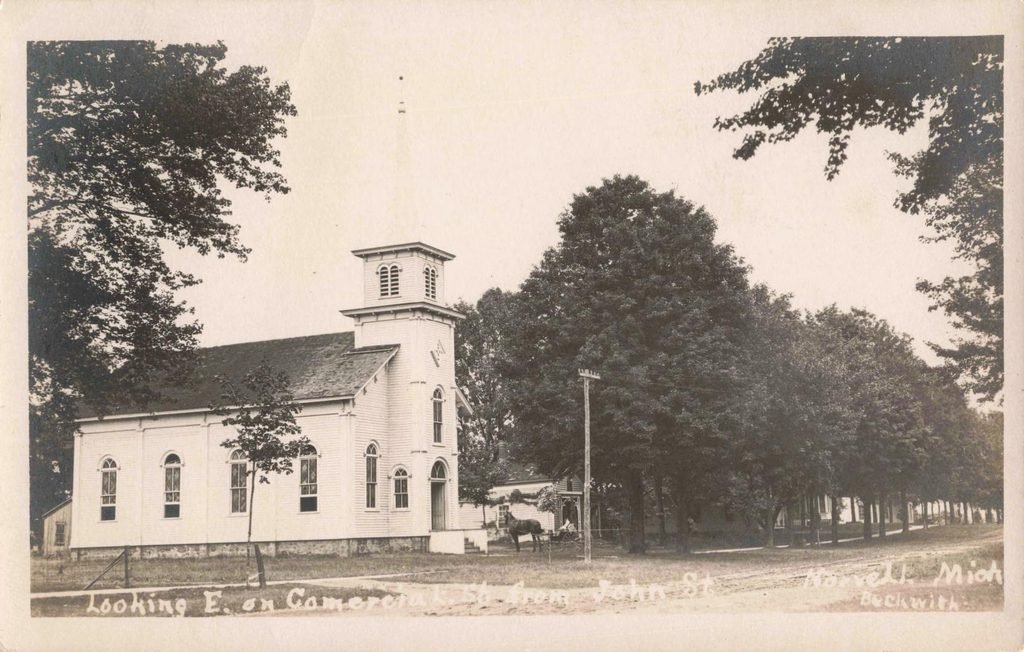
Norvell historical buildings reveal how residents organized public life. The Baptist congregation began in 1839 with 30 charter members and first met in the Norvell Plains School. Its historical marker dates the church building’s construction to 1871.

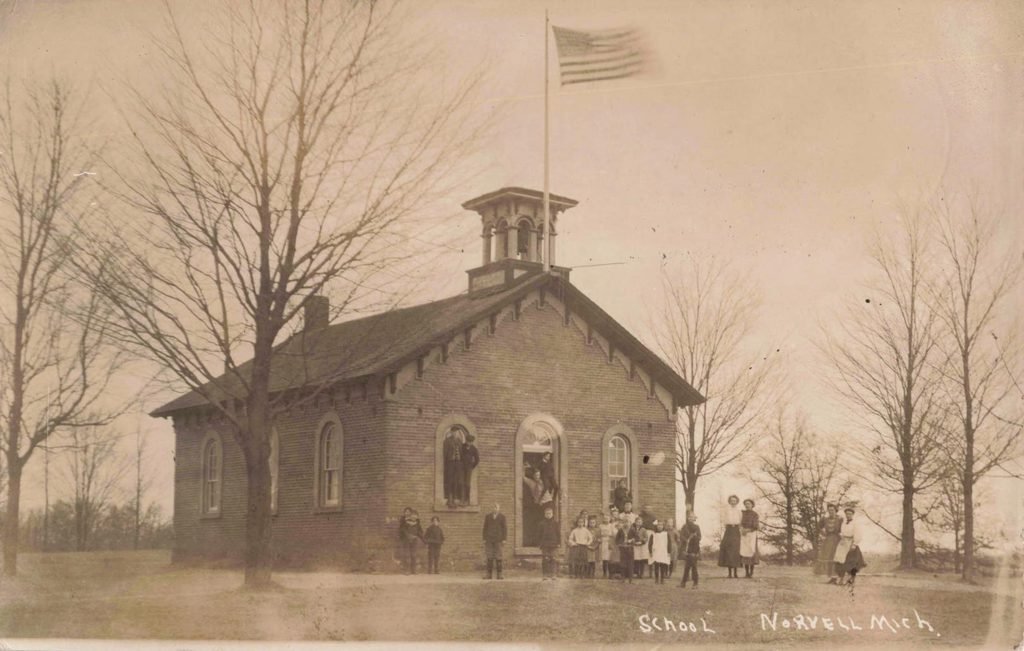
The school scene shows children gathered outside a building with a flag flying above it. A separate view of the town hall records the date 1894 on the gable. These buildings supplied recognizable places for education, worship and township business within walking distance of the village streets.

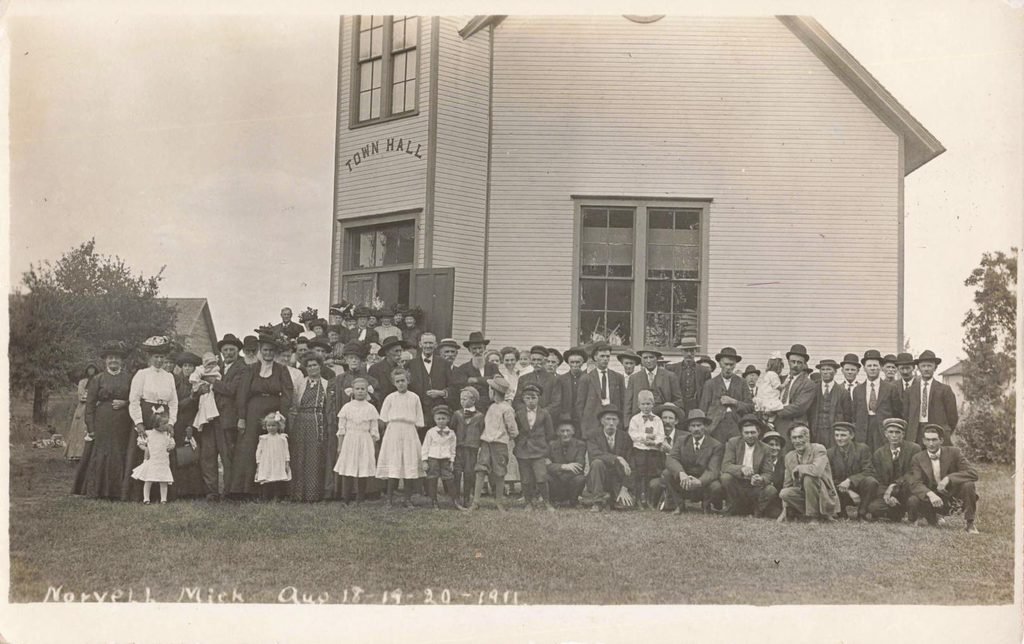
A gathering outside the hall in August 1911 includes adults and children, with several men seated on the grass. The arrangement gives the crowd a family scale that a list of township officers could never supply. Public life included the people waiting outside as well as the business conducted indoors.
Jackson County history also records connections between local households and institutions. Sylvanus B. Palmer farmed and, as a young man, taught school during winters. His family belonged to the Baptist church. Farming, teaching and church membership could appear in a single brief biography, linking activities that are often treated separately in accounts of a town’s past.

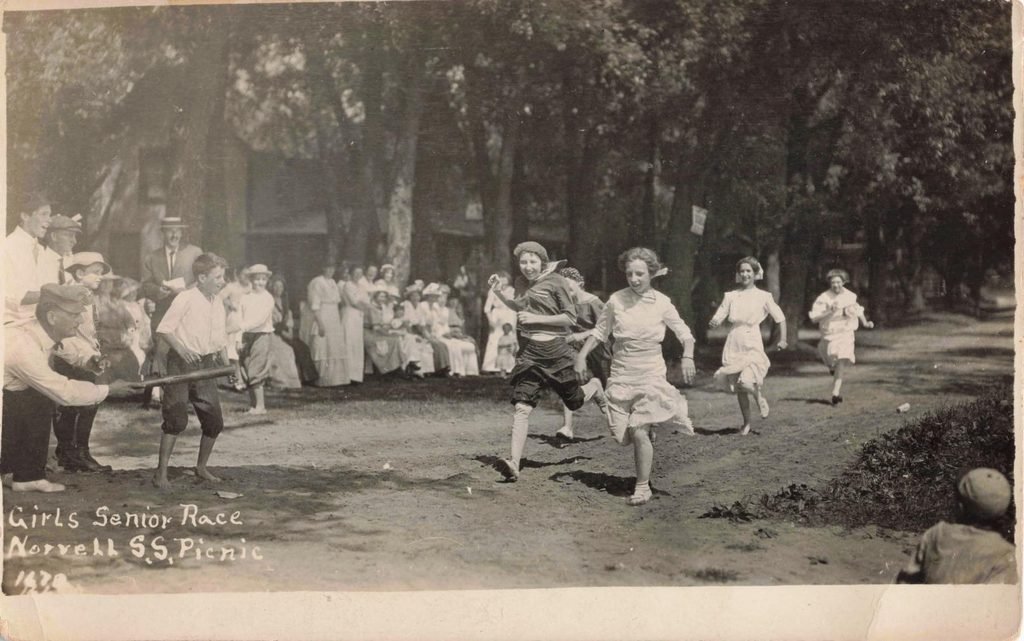
Recreation also brought neighbors together. At a 1913 Norvell Sunday school picnic, girls competed in a running race while spectators watched nearby. Another view records a potato race. Boats filled with people add a different sort of afternoon to the record of historic Norvell, Michigan.

A Mail Carrier Drove Into an Older Street Scene
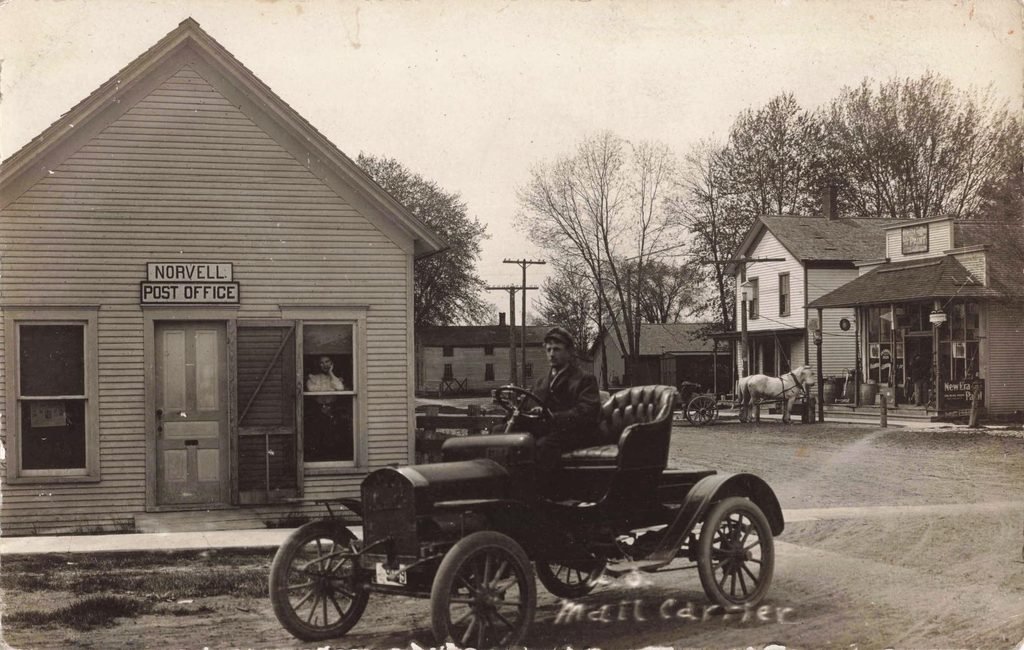
The history of Norvell, Michigan includes a useful image of technological change: a mail carrier seated in an early automobile outside the post office. Across the street, a horse stands beside a wagon. Motorized transport had arrived in a business district still serving horse-drawn traffic.

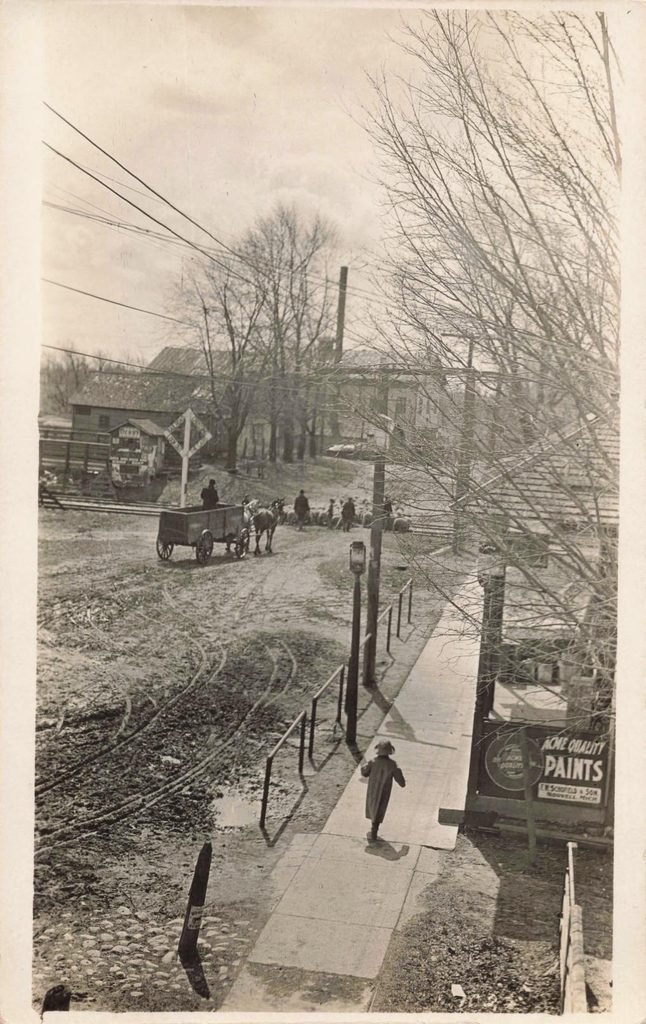
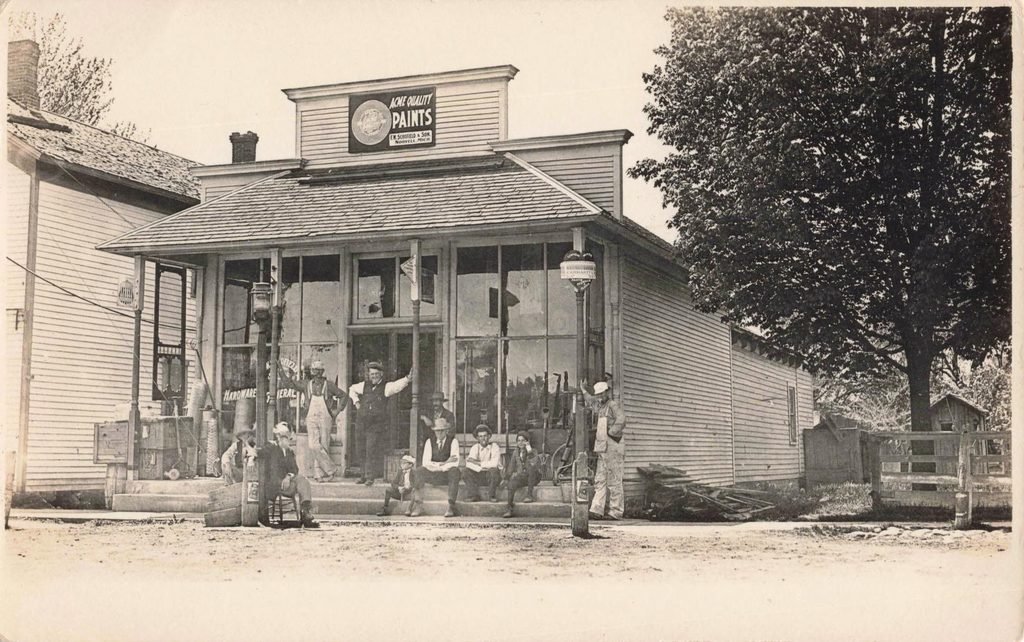
A tall street view clearly marks the division of space. Wagon wheels have cut tracks through wet ground; a pedestrian uses the raised sidewalk. Utility wires cross overhead, and a paint advertisement faces the street. The scene gives Norvell, Michigan, history a physical texture: local trade took place among mud, signs, crossing rails, and people making their way between them.
The carrier’s automobile had entered that same arrangement of modest buildings and nearby services. The post office sign remained the clearest statement of the building’s purpose. A person appeared in its window, while the driver faced the street. Changing equipment did not require an entirely new town center; here, the new vehicle fitted into the place where postal business was already conducted.

One Exchange Street Scene Came With Two Different Skies
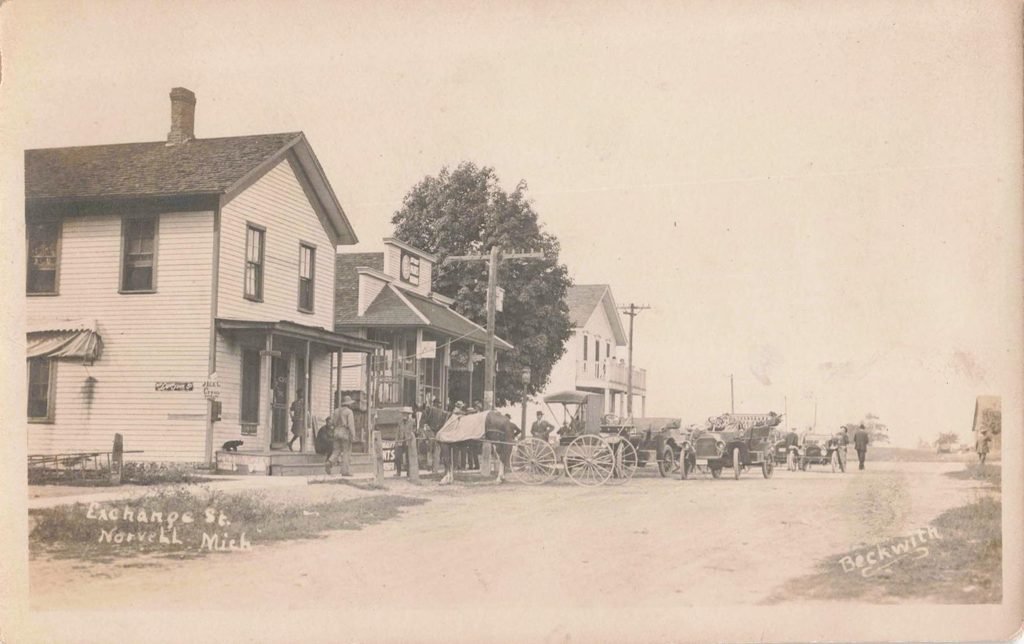
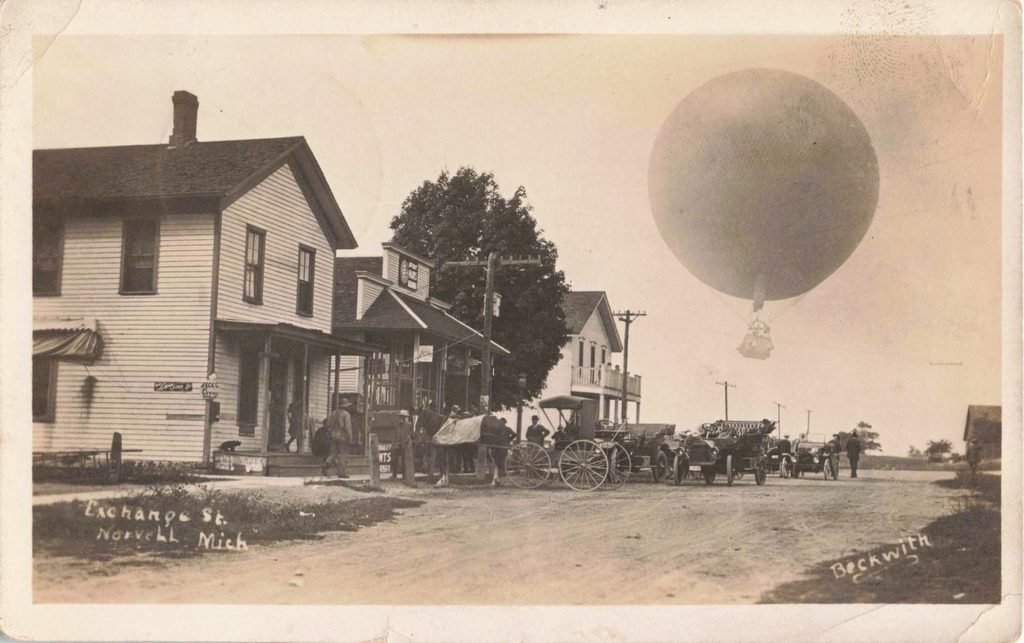
Local farmer and postcard maker Charles Earl Beckwith produced an Exchange Street scene with and without a hot-air balloon overhead. Both versions appear in the project collection, and David V. Tinder’s photographer directory documents the pair. The altered sky adds a small piece of showmanship to the town’s visual record.

Floodwater Occupied the Street in July 1935
The flood card shows a much more disruptive interruption. Its handwritten date, July 8, 1935, fixes a moment when water surrounded homes and covered a route residents normally used. The porches and street trees make the scale personal without requiring an estimate of financial losses.
In 1938, another change affected travel. The Southern Michigan Railroad Society dates the branch’s final scheduled passenger run to Sept. 14. Some riders arranged automobile pickups farther along the route so they could take the train one more time. The 1871 Baptist church remained part of Norvell after that passenger service ended.
Norvell, Michigan: Historical Timeline
Michigan Moments · Jackson County
Norvell, Michigan: Historical Timeline
John Norvell’s political career, village institutions and railway service in 14 dates.
1807–1938Open the historical timeline Close the historical timeline Select a date to read its historical context.
-
Jefferson answers the future namesake
On June 11, President Thomas Jefferson replies to young John Norvell’s request for advice about reading and conducting a newspaper. Norvell’s name would later be attached to the Jackson County community.
-
Early 1830s Farm settlement takes shape
Euro-American farm settlement develops in the area, with William Hunt among the earliest arrivals. Farms, roads and local services begin drawing households into a small rural center.
-
Michigan’s first two senators take office
Michigan becomes a state. John Norvell and Lucius Lyon present their credentials and take their oaths as its first U.S. senators.
-
Norvell’s post office opens
Harvey Austin becomes the first postmaster. The postal service gives the settlement an address and a point of contact with relatives and businesses elsewhere.
-
A Baptist congregation organizes
Thirty charter members organize the congregation. They first gather in the Norvell Plains School, using an existing community building for worship.
-
Late 1850s The railway connects Manchester and Jackson
The Manchester–Jackson route is in place. Norvell becomes a stop on the branch later operated by the Lake Shore & Michigan Southern Railway, connecting the farming district with a wider rail network.
-
The congregation builds its church
The Baptist congregation builds the church identified by its historical marker. The building gives worship a permanent place in the village after the congregation’s beginnings in a schoolhouse.
-
Mills and stores serve surrounding farms
The county history records a hotel, stores, schools, a depot and extensive mills operated by William Reynolds. It describes Norvell as a market for the surrounding country.
-
A date on the town hall’s gable
The date 1894 appears on the town hall’s gable in a historic view. The wooden building and its tower give township business a recognizable place in the village.
-
Neighbors gather outside the hall
A dated view records adults and children assembled outside the town hall. Its inscription lists Aug. 18–20, 1911, preserving a community gathering in the village’s visual record.
-
Picnic races bring neighbors together
Postcards record races at a Norvell Sunday school picnic. Girls compete in a running race while spectators watch; another view records a potato race.
-
The railway joins the New York Central
The Lake Shore & Michigan Southern becomes part of the New York Central Railroad. The corporate name changes while the branch continues serving communities along its route.
-
Floodwater reaches the front porches
A dated postcard records water covering a residential street and surrounding trees and utility poles. The water reaches the porches of nearby homes.
-
Scheduled passenger service ends
The branch’s final scheduled passenger run takes place. Some riders arrange automobile pickups farther along the route so they can take the train once more.
Why do settlement and township dates differ?
A settlement can exist before a civil township acquires its later boundaries or name. Norvell’s early settlement, changes to township boundaries, and town hall construction are separate events.
Questions About Norvell’s Name and Local Institutions
Where is Norvell, Michigan?
Norvell is an unincorporated community in southeastern Jackson County, in south-central Michigan.
Was John Norvell Michigan’s only first senator?
No. John Norvell and Lucius Lyon took their Senate oaths together on Jan. 26, 1837.
Which railroad served Norvell?
The village stood on the Jackson branch of the Lake Shore & Michigan Southern Railway, later part of the New York Central.
How old is Norvell’s Baptist church?
The congregation organized in 1839. The church building dates to 1871, according to its historical marker.
What is Your Family History with Norvell?
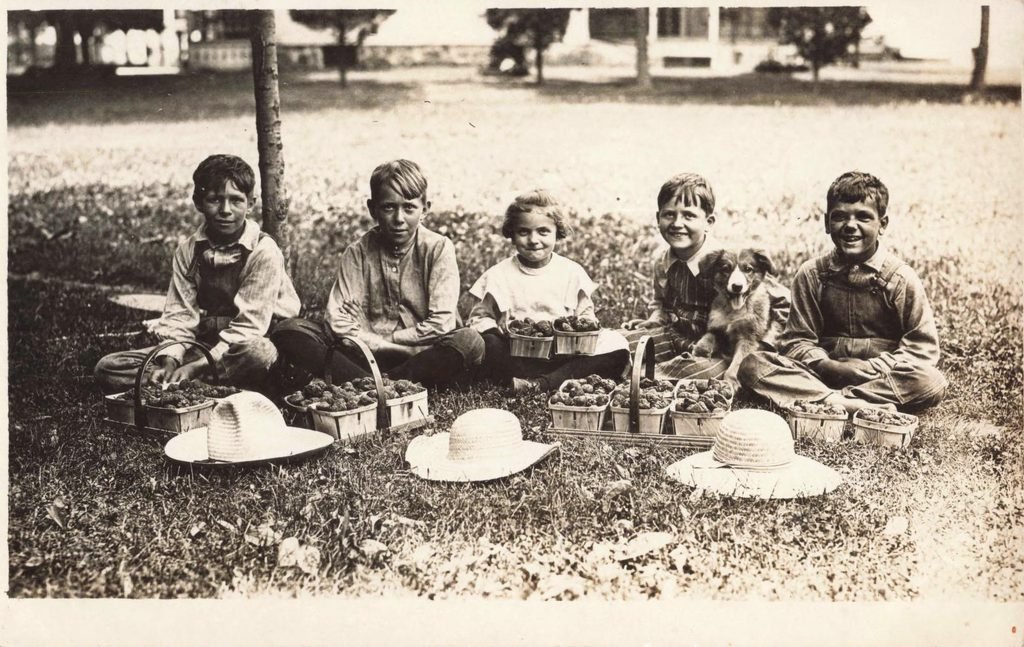
Do you have a family connection to Norvell Township Michigan, or names of people in the town hall and picnic scenes? Share a comment with the name, date, and any document or family record that supports the identification.
? Works Cited For Norvell Michigan History

<p style="padding-left:2em;text-indent:-2em;">
  Inter-State Publishing Company.
  “<a href="https://genealogytrails.com/mich/jackson/norvelltwp.html">Norvell Township.</a>”
  <em>History of Jackson County, Michigan</em>, 1881.
  Transcribed by Genealogy Trails. Accessed 23 Oct. 2026.
</p>

<p style="padding-left:2em;text-indent:-2em;">
  Jefferson, Thomas.
  “<a href="https://www.loc.gov/resource/mtj1.038_0592_0594/?sp=2&st=text">Thomas Jefferson to John Norvell, June 11, 1807.</a>”
  <em>Thomas Jefferson Papers</em>, Library of Congress.
  Accessed 23 Oct. 2026.
</p>

<p style="padding-left:2em;text-indent:-2em;">
  Library of Michigan.
  “<a href="https://mdoe.state.mi.us/legislators/Legislator/LegislatorDetail/3838">John Norvell.</a>”
  <em>Michigan Legislative Biography</em>.
  Accessed 23 Oct. 2026.
</p>

<p style="padding-left:2em;text-indent:-2em;">
  Maryland State Archives.
  “<a href="https://msa.maryland.gov/megafile/msa/speccol/sc3500/sc3520/013900/013914/html/13914bio.html">John Norvell (1789–1850).</a>”
  <em>Archives of Maryland, Biographical Series</em>,
  MSA SC 3520-13914. Accessed 23 Oct. 2026.
</p>

<p style="padding-left:2em;text-indent:-2em;">
  Michiganrailroads.com.
  “<a href="https://www.michiganrailroads.com/timetables-routes/337-new-york-central-and-former-lsms-cn-lines-timetables/5036-time-table-nyc-jackson-branch">Timetable: NYC—Jackson Branch—Lenawee Junction to Jackson.</a>”
  Accessed 23 Oct. 2026.
</p>

<p style="padding-left:2em;text-indent:-2em;">
  “<a href="https://www.hmdb.org/m.asp?m=226818">Norvell Community Baptist Church.</a>”
  <em>The Historical Marker Database</em>,
  submitted by Craig Doda, 26 June 2023,
  revised 30 June 2023.
  Transcription of the church’s historical marker.
  Accessed 23 Oct. 2026.
</p>

<p style="padding-left:2em;text-indent:-2em;">
  Norvell Township.
  <em><a href="https://norvelltwp-mi.gov/wp-content/uploads/2024/06/Norvell-Township-2024-Master-Plan-Reduced.pdf">Norvell Township 2024 Master Plan.</a></em>
  “History of Norvell Township,” p. 8.
  Accessed 23 Oct. 2026.
</p>

<p style="padding-left:2em;text-indent:-2em;">
  Norvell Township.
  “<a href="https://norvelltwp-mi.gov/history/">Township History.</a>”
  Accessed 23 Oct. 2026.
</p>

<p style="padding-left:2em;text-indent:-2em;">
  Southern Michigan Railroad Society.
  “<a href="https://southernmichiganrailroad.com/trackage.html">Trackage.</a>”
  Accessed 23 Oct. 2026.
</p>

<p style="padding-left:2em;text-indent:-2em;">
  Tinder, David V.
  <em><a href="https://clements.umich.edu/files/tinder_directory.pdf">Directory of Early Michigan Photographers.</a></em>
  Edited by Clayton A. Lewis,
  William L. Clements Library, University of Michigan,
  2013, online edition.
  Entries for Norvell and Charles Earl Beckwith.
  Accessed 23 Oct. 2026.
</p>

<p style="padding-left:2em;text-indent:-2em;">
  United States Senate.
  “<a href="https://www.senate.gov/states/MI/timeline.htm">States in the Senate: Michigan Timeline.</a>”
  Accessed 23 Oct. 2026.
</p>

