


Michigan Plug-In Solar: 7 Critical Facts That Could Help Cut High Electric Bills
Michigan residents frustrated by rising electric bills could soon have another option: a solar system small enough to plug into a household outlet.
House Bill 5764 would establish rules for Michigan plug-in solar, allowing qualifying systems of up to 1,200 watts to connect through a standard 120-volt outlet without advance utility approval. Instead, customers would notify their utility within 30 days.
The proposal comes as Michigan electricity rates continue to rise. It also arrives as inexpensive plug-in systems are appearing across Europe and, increasingly, the United States.
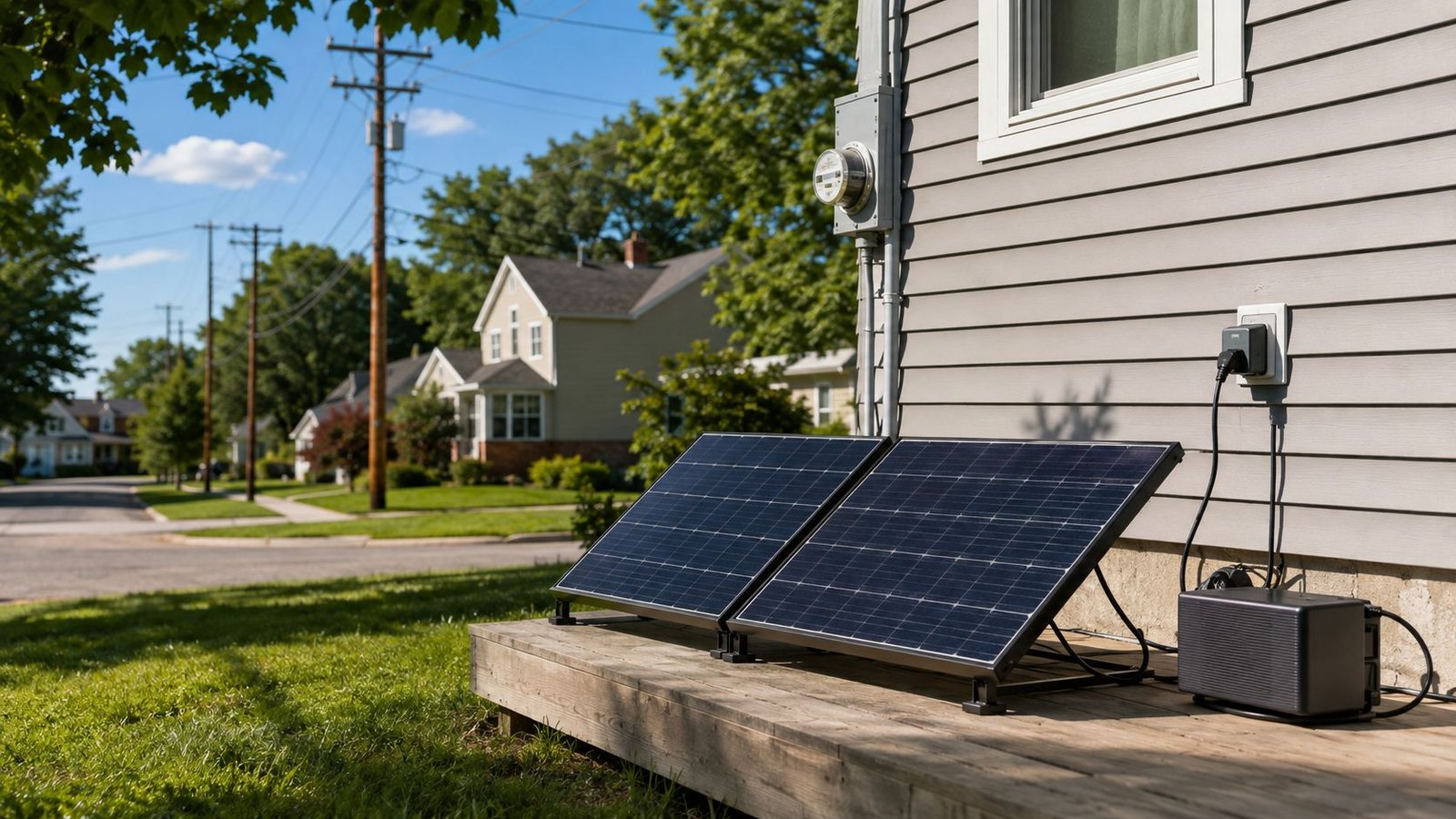
The concept looks simple. Buy several solar panels, connect them to a certified microinverter and plug the system into an outlet. Electricity generated outside flows into the house and reduces the amount purchased from DTE Energy, Consumers Energy or another utility.
But making plug-in solar simple enough to function like a household appliance raises some complicated questions about wiring, safety, utility regulation and who pays for maintaining the electric grid.
Michigan Plug-In Solar Could Change Current Utility Rules
Rep. Will Snyder, D-Muskegon, introduced HB 5764 on March 19, 2026, with Democratic and Republican co-sponsors.
Under the bill, qualifying equipment could produce no more than 1,200 watts and would connect through a normal 120-volt outlet. The system would primarily supply electricity for the customer’s own use.
Utilities could not demand advance approval, charge an interconnection fee, or require additional equipment beyond the safety equipment built into the system.
Customers would instead notify their utility within 30 days of installation.
That represents a major departure from existing Michigan policy. The Michigan Public Service Commission currently requires distributed-generation projects to be properly interconnected with the utility before operation.
As of Aug. 8, 2026, HB 5764 remains in the House Energy Committee with no recorded committee vote. The Michigan Legislature’s bill record shows the measure has not advanced to the House floor.
That also means Michigan residents should not assume plug-in solar is currently exempt from utility interconnection requirements.
What Is Plug-In Solar?
Plug-in solar, sometimes called balcony solar, is essentially a miniature grid-connected solar power plant.
A typical system consists of one to four photovoltaic panels connected to a microinverter. The inverter converts the panels’ DC power into 120-volt AC electricity synchronized with the home’s electrical supply.
If a house is consuming 1,000 watts and the panels are producing 600 watts, the solar electricity supplies part of that demand. The utility provides the remaining 400 watts.
The result is less electricity passing through the meter from the utility.
Unlike a traditional rooftop system, balcony solar systems can cost hundreds rather than tens of thousands of dollars. Some can also be moved when the resident moves.
There is one important catch: standard plug-in solar isn’t emergency backup power. Certified grid-connected inverters shut down during a blackout to prevent electricity from feeding utility lines while workers are repairing them.
HB 5764 specifically requires that protection.
Where Balcony Solar Systems Are Already Being Used
Germany provides the strongest evidence that plug-in solar can become more than a niche product.
Germany added about 430,000 registered plug-in installations during 2025, according to the country’s federal network regulator. The International Energy Agency’s photovoltaic program reports about 1.24 million balcony installations operating in Germany.
Germany generally limits qualifying plug-in inverter output to 800 volt-amperes.
The idea has begun moving into the United States.
Utah adopted plug-in solar legislation in 2025. Maine, Virginia, Maryland, Colorado, Connecticut, Vermont and New Hampshire followed with legislation in 2026, although effective dates vary.
That makes Michigan part of a broader debate over whether very small solar systems should continue to be regulated in essentially the same manner as much larger rooftop installations.
Why Would Utility Companies Resist It?
There are two separate issues: money and safety.
Every kilowatt-hour a customer produces and consumes at home is electricity the utility does not sell.
At low adoption rates, the difference is tiny. With hundreds of thousands of installations, however, customer-owned generation can reduce electricity sales while utilities continue maintaining generating plants, substations, poles, wires and other infrastructure.
HB 5764 would also remove much of the utility’s control over installations. The customer could install qualifying equipment first and report it afterward.
Yet utilities have raised legitimate electrical concerns in states considering similar legislation.
UL Solutions has identified potential problems involving branch-circuit overloading, backfeeding, exposed electrical contacts and ground-fault protection. The organization created UL 3700 testing requirements specifically for plug-in photovoltaic equipment.
I found no recorded evidence as of Aug. 8 that DTE Energy or Consumers Energy has formally opposed HB 5764. Describing either company as fighting the Michigan legislation at this point would go beyond the public record.
Michigan Plug-In Solar Costs Can Be Surprisingly Low
The biggest argument for the technology is its price.
Current advertised plug-in solar costs vary widely:
| Seller | System | Advertised price |
|---|---|---|
| Bright Saver | 180 watts | About $285 for members |
| Bright Saver | 360 watts | About $414 for members |
| U.S. Solar Supplier | 1,080 watts | About $869 sale price |
| CraftStrom | 800 watts | About $2,031 |
| EcoFlow STREAM | Various configurations | Varies by inverter/battery package |
These figures are equipment prices. Mounting hardware, electrical work, permits, shipping or other costs can raise the final price.
Consumers also need to be careful when comparing tax-credit claims. The federal Residential Clean Energy Credit is no longer available for expenditures made after Dec. 31, 2025, according to the IRS.
Some solar sales pages still contain outdated references to the former 30% credit.
Michigan Plug-In Solar Could Reduce Electricity Purchases
The economics become more interesting when compared with current Michigan electricity rates.
The U.S. Energy Information Administration reported Michigan’s average residential electricity price at 22.01 cents per kilowatt-hour in May 2026, compared with 20.23 cents a year earlier.
Consider a well-positioned 1,200-watt system producing roughly 1,200 to 1,600 kilowatt-hours during a year.
At 22 cents per kWh, that electricity would have a retail value of about $264 to $352.
Actual bill savings may be lower. Customers still pay fixed utility charges, and electricity generated when the home isn’t using it may flow back onto the grid without receiving full retail compensation.
Shade, snow and panel direction can also make a dramatic difference.
Still, the sponsor’s claim that a system could cut electricity consumption by as much as 20% is mathematically possible for some households. It should not be treated as a guaranteed 20% reduction in the total bill.
The 1,200-Watt Limit Raises an Important Safety Question
One aspect of HB 5764 deserves particularly close scrutiny.
Germany’s widely used systems generally have an 800VA inverter operating on roughly 230-volt residential electricity. That amounts to only about 3.5 amps.
A 1,200-watt Michigan system operating at 120 volts could supply about 10 amps.
That’s significant on a conventional 15-amp household branch circuit.
Electricity normally moves from the service panel through a circuit breaker and toward household outlets. A solar inverter introduces another source of electricity farther down that circuit. Under some conditions, the utility supply plus solar supply could create electrical loads the panel breaker alone doesn’t fully account for.
Modern safety equipment can address these risks. The question for lawmakers is whether HB 5764’s general certification requirements provide enough protection or whether Michigan should specifically require equipment tested to standards developed for plug-in photovoltaic systems.
Other Problems Consumers Should Consider
Plug-in solar has limitations beyond electrical safety.
Renters may still need permission to attach panels to balconies or buildings. Condo and homeowners association rules could also apply.
Panels must be securely mounted against Michigan winds, snow and ice.
A solar panel facing south in full sunlight will outperform the same equipment hanging vertically from a shaded balcony.
Customers should also determine whether their homeowner or renter insurance has requirements covering solar equipment.
Most importantly, buyers shouldn’t assume a solar product advertised online as “plug and play” is automatically legal for connection to a Michigan home.
Michigan Plug-In Solar Faces a Legislative Test
HB 5764 essentially asks Michigan lawmakers to decide when a solar generating system becomes small and safe enough that it should be treated more like a consumer appliance than a utility project.
That question will become harder to ignore as equipment prices fall.
The potential consumer benefit is substantial. Michigan plug-in solar could allow households to start generating electricity for hundreds of dollars instead of committing to a rooftop project costing $15,000, $20,000 or more.
The potential savings are credible, but they aren’t automatic. Good sunlight, high self-consumption, properly certified equipment and sensible installation rules will determine whether these small systems make financial sense.
HB 5764 therefore presents Michigan with a reasonable policy question rather than a simple solar-versus-utility fight: Can the state remove enough regulation to make small solar affordable without removing the electrical safeguards that make it safe?
Sources Consulted For Michigan Plug-In Solar
APsystems. “EZ1: Proven Portable Solar, UL 3700 Certified.” APsystems USA. Accessed 8 Aug. 2026.
Bright Saver. “Balcony Solar Kits.” Bright Saver. Accessed 8 Aug. 2026.
Bright Saver. “Is Plug-In Solar Legal?” Bright Saver. Accessed 8 Aug. 2026.
Bundesnetzagentur. “Bundesnetzagentur Publishes 2025 Renewable Energy Figures.” Federal Network Agency, Germany, 8 Jan. 2026. Accessed 8 Aug. 2026.
Bundesnetzagentur. “Plug-In Solar Devices and Balcony Power Plants.” Federal Network Agency, Germany. Accessed 8 Aug. 2026.
Consumers Energy. “Summer Time of Use Rate.” Consumers Energy. Accessed 8 Aug. 2026.
Consumers Energy. “Electric Rate Case.” Consumers Energy. Accessed 8 Aug. 2026.
CraftStrom. “800 Watt Plug & Play Solar Kit.” CraftStrom. Accessed 8 Aug. 2026.
Edison Electric Institute. “Disruptive Challenges: Financial Implications and Strategic Responses to a Changing Retail Electric Business.” Edison Electric Institute, Jan. 2013. Accessed 8 Aug. 2026.
EcoFlow. “STREAM Microinverter.” EcoFlow. Accessed 8 Aug. 2026.
FastDemocracy. “Michigan HB 5764.” FastDemocracy. Accessed 8 Aug. 2026.
International Energy Agency Photovoltaic Power Systems Programme. “Germany.” IEA PVPS. Accessed 8 Aug. 2026.
Internal Revenue Service. “Residential Clean Energy Credit.” Internal Revenue Service. Accessed 8 Aug. 2026.
Internal Revenue Service. “FAQs for Modification of Sections 25C, 25D, 25E, 30C, 30D, 45L, 45W and 179D Under Public Law 119-21.” Internal Revenue Service. Accessed 8 Aug. 2026.
LegiScan. “Michigan House Bill 5764: Introduced Bill Text.” LegiScan, 19 Mar. 2026. Accessed 8 Aug. 2026.
Michigan Department of Licensing and Regulatory Affairs. “Michigan Construction Code Books.” State of Michigan. Accessed 8 Aug. 2026.
Michigan Department of Licensing and Regulatory Affairs. “Currently Open Administrative Rules.” State of Michigan. Accessed 8 Aug. 2026.
Michigan House Democrats. “Snyder Introduces Bipartisan Bill to Expand Access to Residential Solar.” Michigan House Democrats, 18 Mar. 2026. Accessed 8 Aug. 2026.
Michigan House of Representatives. “House Energy Committee.” Michigan House of Representatives. Accessed 8 Aug. 2026.
Michigan Legislature. “House Bill 5764 of 2026.” Michigan Legislature. Accessed 8 Aug. 2026.
Michigan Legislature. “House Energy Committee Bill Records.” Michigan Legislature. Accessed 8 Aug. 2026.
Michigan Public Service Commission. “Distributed Generation.” State of Michigan. Accessed 8 Aug. 2026.
Michigan Public Service Commission. “Distributed Generation and Interconnection.” State of Michigan. Accessed 8 Aug. 2026.
Michigan Public Service Commission. “Michigan Interconnection and Distributed Generation Standards.” State of Michigan. Accessed 8 Aug. 2026.
Michigan Public Service Commission. “2024 Renewable Energy and Distributed Generation Report.” State of Michigan. Accessed 8 Aug. 2026.
Michigan Public Service Commission. “Residential Electric Rate Comparison.” State of Michigan, July 2026. Accessed 8 Aug. 2026.
Michigan Public Service Commission. “Commission Approves Additional $242M for DTE Electric Grid Upgrades.” State of Michigan, 19 Feb. 2026. Accessed 8 Aug. 2026.
Michigan Public Service Commission. “Commission Approves Additional Reliability Investments.” State of Michigan, 27 Mar. 2026. Accessed 8 Aug. 2026.
National Fire Protection Association. “NEC Enforcement Maps.” NFPA. Accessed 8 Aug. 2026.
National Renewable Energy Laboratory. “Regulatory Considerations Associated with the Expanded Adoption of Distributed Solar.” National Renewable Energy Laboratory, Nov. 2013. Accessed 8 Aug. 2026.
National Renewable Energy Laboratory. “PVWatts Calculator.” National Renewable Energy Laboratory. Accessed 8 Aug. 2026.
PV Magazine USA. “Hoymiles Introduces UL 3700-Compliant Plug-In Microinverter to U.S. Market.” PV Magazine USA, 15 July 2026. Accessed 8 Aug. 2026.
Solar United Neighbors. “What to Know About Plug-In Solar.” Solar United Neighbors. Accessed 8 Aug. 2026.
UL Solutions. “Safety Considerations for Plug-In Photovoltaic Systems.” UL Solutions. Accessed 8 Aug. 2026.
UL Solutions. “UL Solutions Debuts Testing and Certification Framework for Safer Plug-In Solar Across the United States.” UL Solutions, 8 Jan. 2026. Accessed 8 Aug. 2026.
U.S. Energy Information Administration. “Average Price of Electricity to Ultimate Customers by End-Use Sector.” U.S. Energy Information Administration. Accessed 8 Aug. 2026.
U.S. Energy Information Administration. “Average Monthly Residential Electricity Consumption, Prices and Bills by State.” U.S. Energy Information Administration. Accessed 8 Aug. 2026.
U.S. Solar Supplier. “1080W Plug-In Solar Kit with APsystems EZ1 Microinverter.” U.S. Solar Supplier. Accessed 8 Aug. 2026.
VDE Association for Electrical, Electronic & Information Technologies. “First Product Standard for Plug-In Solar Devices.” VDE. Accessed 8 Aug. 2026.
VDE Testing and Certification Institute. “Plug-In Solar Devices: New Product Standard and Certification.” VDE, 2026. Accessed 8 Aug. 2026.
WyoFile. “Lawmakers Pull the Cord on Plug-In Solar Bill.” WyoFile, 20 Feb. 2026. Accessed 8 Aug. 2026.

