


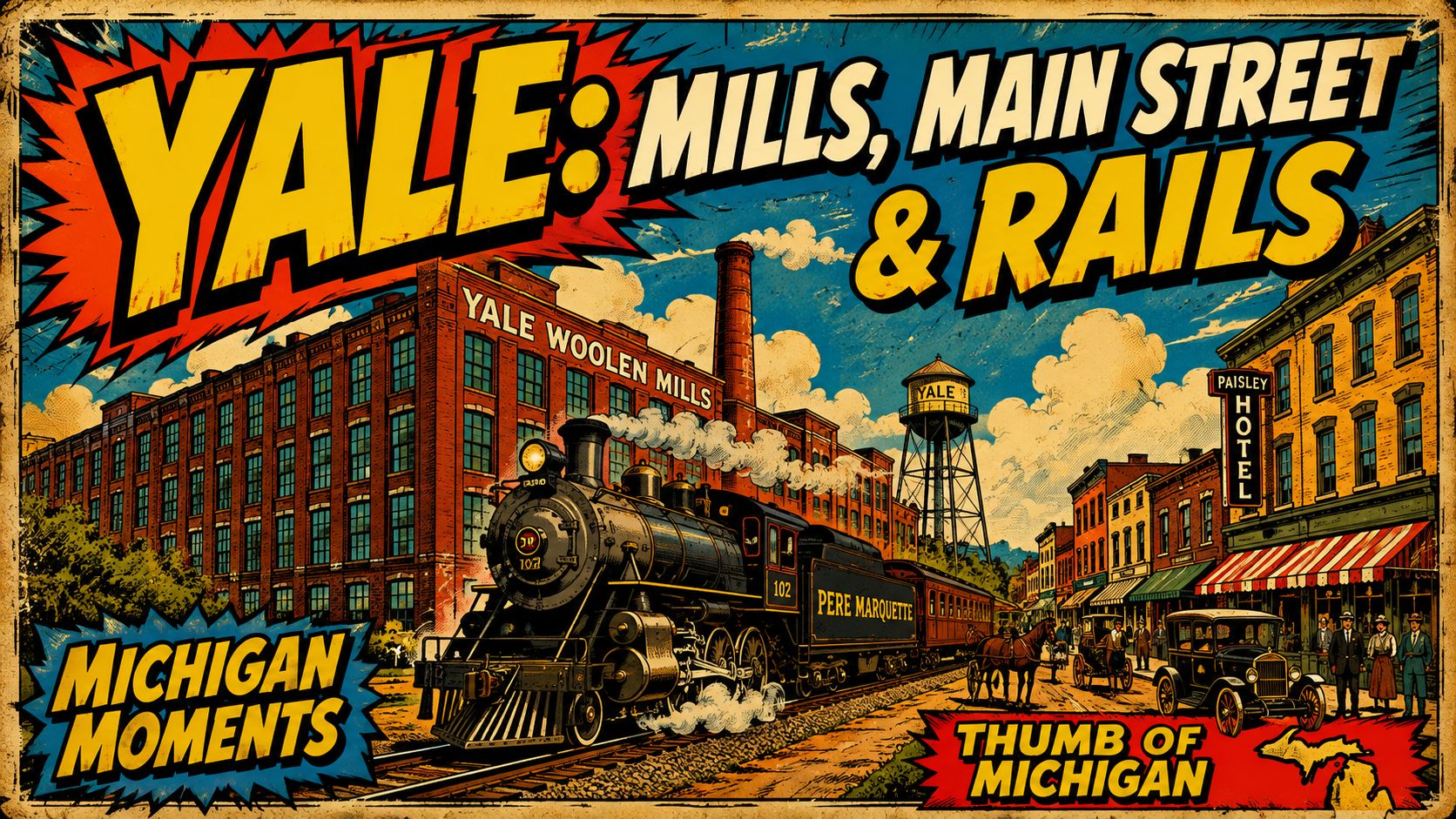
Video: Yale Michigan History: Main Street, Mills and Railroads

Yale Michigan History in the early 1900s begins with historic photographs showing how mills, stores, early automobiles and the railroad shaped this St. Clair County community during the early 20th century.
Yale, Michigan, entered the 20th century with an economy tied closely to agriculture, manufacturing and the railroad. Historic records list a flour mill, woolen mill, canning factory, grain businesses and other enterprises, while the Pere Marquette Railway connected the St. Clair County community with a much wider transportation network.
About This Video of Yale Michigan History
This Michigan Moments episode looks at Yale during a period when Main Street commerce operated alongside some of the community’s largest employers. A 1902 St. Clair County business directory listed the Yale Milling Co., Yale Canning Factory and several grain businesses. By 1922, a national newspaper directory described Yale as a Pere Marquette railroad town with flax, woolen and roller flour mills, a canning factory, bean plant and creamery.
The Yale Woolen Mills became one of the community’s best-known industrial operations. Historic material preserved by the Detroit Historical Society includes a 1915 postcard identifying the sprawling mill complex in St. Clair County. Local historical markers date the mill from 1881 to 1963 and note that it produced yarn, clothing, military cloth and automobile upholstery during different periods of its operation.
Downtown Yale also served travelers and residents. The building later known as the Yale Hotel was originally the Paisley Hotel. Historical research on Yale’s downtown district identifies the hotel as one of its prominent surviving commercial buildings.
Transportation helped support this local economy. Yale stood on a Pere Marquette route connecting Port Huron with Saginaw through communities including Marlette. That rail connection gave local businesses access to regional markets and provided passenger and freight service during the era shown in the video.
For more background on the region’s railroad era, read Thumbwind’s Rails Into the Thumb: Cass City and the Detroit and Huron Railroad . Another Michigan Moments article, Coal, Rails and Community: Akron Michigan History , shows how railroad access supported another Thumb-area agricultural community. You can also read Thumbwind’s feature on the Yale Woolen Mill and the 1881 Thumb Fire era .
Video Transcript
This is Michigan Moments, rediscovering the pioneering moments of the Great Lakes State.
In the early decades of the 20th century, Yale, Michigan, was an industrious town with local businesses and manufacturing. The town’s business district was active along Main Street, where the Paisley Hotel stood prominently, welcoming travelers and local residents. The hotel served visitors arriving during the transition from horse-drawn transportation to early automobiles.
Automotive history could also be seen in Yale’s early motor-vehicle era. The video depicts a Ford garage as part of the community’s transition to automobile travel, reflecting the rapid changes occurring across Michigan.
Industry shaped Yale profoundly. The Yale Milling Company processed grain from the surrounding agricultural area. The Yale Woolen Mills employed local workers and produced textiles that became an important part of the community’s industrial economy.
Yale also had a canning factory that processed agricultural products and provided another link between local farms and industrial production.
Transcript caution: The original narration attributes this factory to the W. R. Roach Company. That company attribution has not been independently verified for Yale and should be treated as unresolved.
Railroads connected Yale with larger markets and helped move passengers, agricultural products and manufactured goods. The Pere Marquette depot placed Yale on a rail network linking communities across eastern Michigan.
Transcript caution: The original narration next refers to a Harrington Hotel in Yale. This review could not verify a Yale hotel by that name. The documented downtown hotel was the former Paisley Hotel, later known as the Yale Hotel.
Through industry, agriculture, transportation and Main Street commerce, Yale reflected the economic changes affecting small Michigan communities during the early 20th century.
This has been Michigan Moments, offering bite-sized morsels of Michigan history.
Key Moments
- 0:00 — Introduction to early 20th-century Yale
- 0:15 — Main Street and the Paisley Hotel
- 0:32 — Yale’s early automobile era
- 0:46 — Yale Milling Company and Yale Woolen Mills
- 1:05 — Canning and the agricultural economy
- 1:20 — Pere Marquette railroad connections
- 1:38 — Yale’s small-town industrial legacy
Key Moment times are editorial estimates based on the supplied transcript and should be checked against the final YouTube playback before publication.
Related Reading

