


Beal City History – 7 Remarkable Stories Behind a Powerful Michigan Farm Community (Michigan Moments Video)
Old postcards show Beal City when church bells, dirt roads, bakery wagons and the Big 4 round barn defined daily life in this small Isabella County farm community a century ago.
Old photographs can mislead us about small towns. Buildings appear larger. Streets seem busier. People pose in their best clothing. The camera tends to record occasions rather than ordinary Tuesday afternoons.
But the photographs of Beal City, Michigan, reveal something that is hard to dismiss. This was a very small community that repeatedly built on a surprisingly large scale.
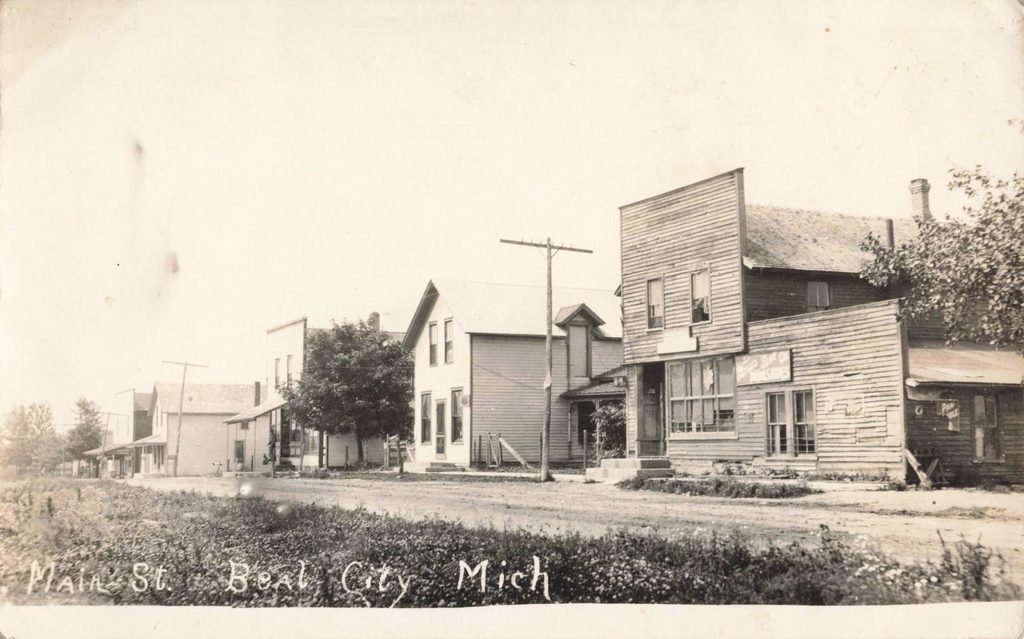
The Beal City history shown in these images is centered on farms, Catholic life, small businesses and a dirt Main Street where horses eventually began sharing space with automobiles. The pictures also preserve structures that have changed or disappeared entirely.
Taken together, they offer a rare street-level record of rural Isabella County between roughly 1890 and 1930.
Watch – Beal City – Stone Church, Round Barn and a Farm Town of Faith

1. Beal City History Started With a Store

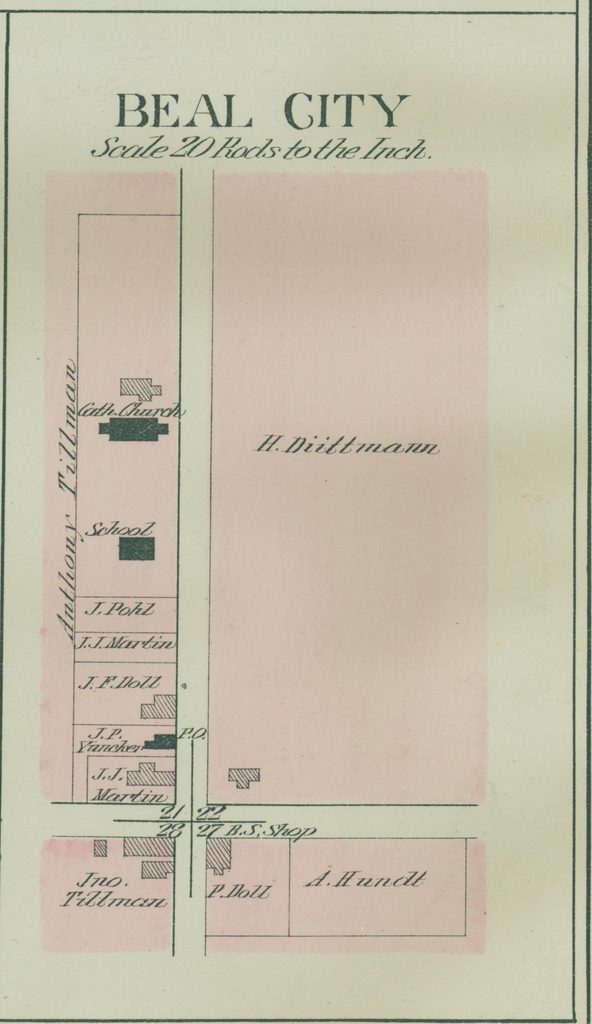
Beal City never became an incorporated city. It developed as a small settlement in Nottawa Township west of Mount Pleasant.
Local histories identify Nicholas Beal as the man whose name became attached to the community. An Isabella County family history says Beal built the first general store in 1881 on the northwest corner of Section 21. A second store followed in 1882. WCMU’s account of the community’s 150th anniversary also traces the settlement to a lumber camp and Nicholas Beal’s store and post office.
The timing mattered.
Logging had opened central Michigan to settlement, but farming increasingly offered the more durable economic base. German Catholic families arrived, many with ties to Westphalia, Michigan, while others came from Germany itself.
The official parish history says farming was their primary occupation.
Beal City, therefore, developed differently from a railroad boomtown or a county seat. There was little reason for grand commercial blocks. Farms provided the money. Main Street provided basic services. The parish provided much of the community structure.
2. St. Philomena Church Became the Town’s Center

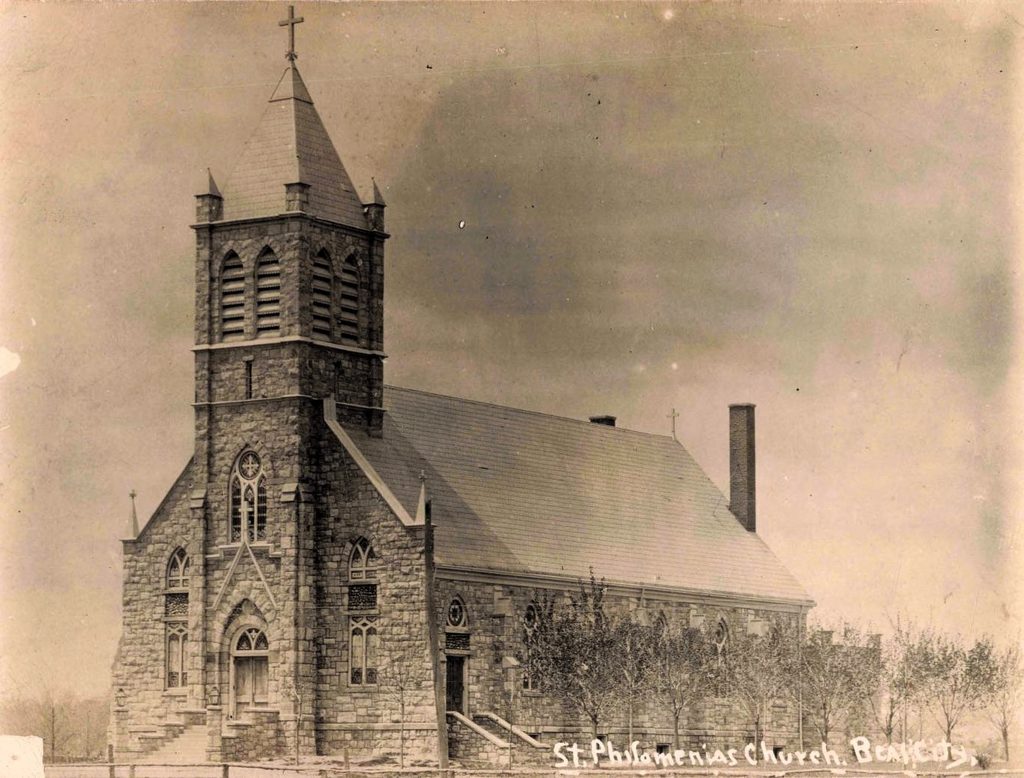
The strongest building in the old photographs is unmistakable.
St. Philomena Church rises above Beal City with thick stone walls, Gothic windows, and a high bell tower. Even without knowing the village’s population, the building seems unusually ambitious.
The parish dates its founding to 1882. Its school opened in 1883. Dominican Sisters arrived in 1901 and operated the school for more than a century. The parish says the present church was dedicated in July 1907. St. Philomena was renamed St. Joseph the Worker in 1961.
That history explains several photographs in the collection.
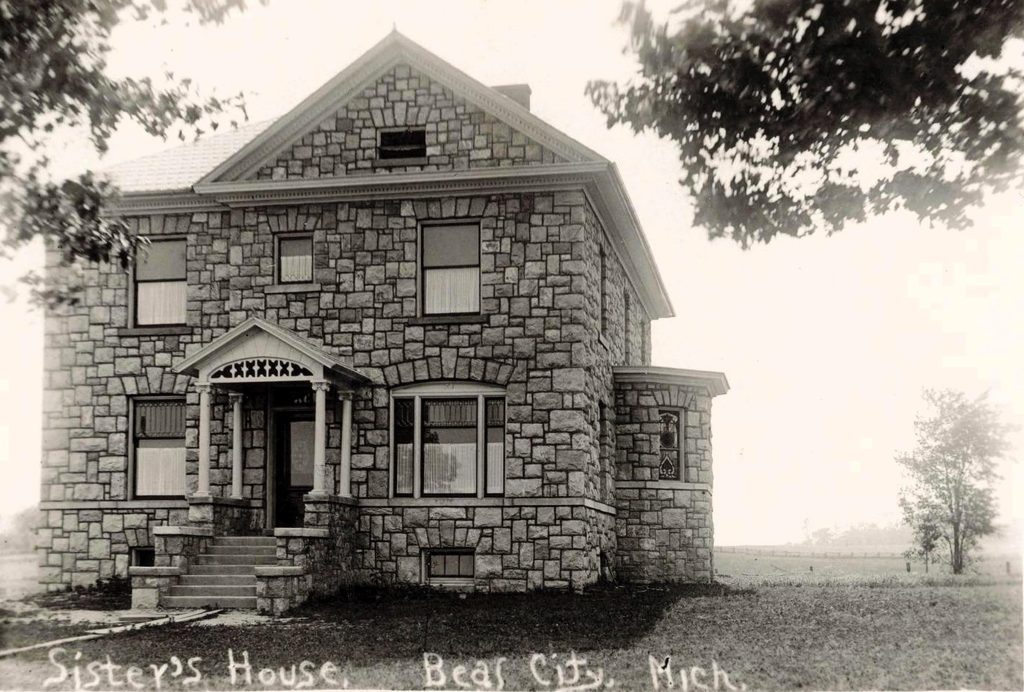
One shows the church alone. Another pulls back to include the Sisters’ House and nearby residences. A third looks across the church complex from a distance.
These were not simply religious buildings. They formed a physical center for education, social life and community identity.
For farm families living miles apart, that mattered.
3. A Church Fire Led to Something Much Bigger

The story becomes more striking when we consider what came before the stone church.
A source reproducing passages from Isaac Fancher’s 1911 Past and Present of Isabella County, Michigan says an earlier church was struck by lightning and burned. It also describes the German farming community as prosperous and records the construction of a substantial new church and related parish buildings in the early 1900s.
The parish places the dedication of the present church in 1907.
Instead of replacing the lost building with another modest frame structure, parishioners built in stone.
That provides one of the interesting points in Beal City history.
We tend to think larger towns produced larger civic institutions because they had more money and people. Beal City suggests another possibility. A small, closely organized rural population could concentrate its resources on a handful of buildings that mattered enormously to it.
The church looks oversized because, in one sense, it was. Its function reached far past Sunday worship.
4. Main Street Caught Between Horses and Automobiles

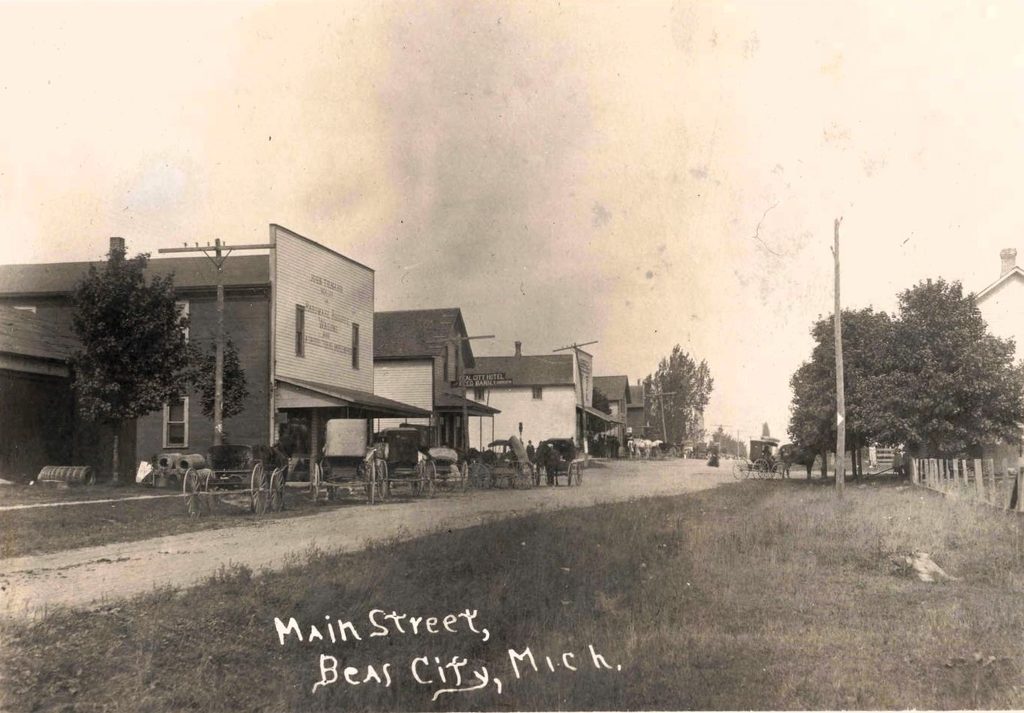
The Main Street photographs record another transition.
The road is unpaved. Wooden commercial buildings line its edges. Hitching areas, wagons and buggies remain common.
Then there are automobiles.
One photograph shows a crowd assembled around an early touring car. Men, women and children fill the porch and roadway. It is tempting to invent a reason for the gathering. Perhaps a parade. Maybe a political appearance. Perhaps a public demonstration of the automobile.
The photograph does not tell us.
That uncertainty is worth preserving. Historical photos often invite confident Facebook captions based on little more than someone’s guess. What the image does establish is more interesting anyway: Beal City had reached the awkward period when horses and automobiles occupied the same streets.
The automobile was not replacing the old system overnight. Both systems operated side by side.
5. The City Bakery Delivered to Farm Country

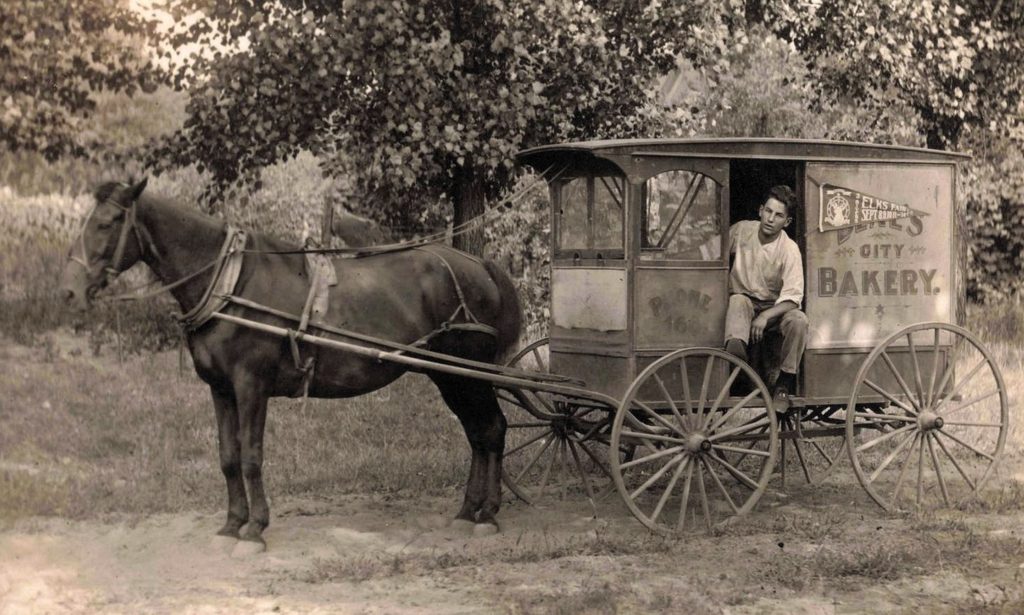
Another photograph offers one of the most personal views of daily commerce.
A horse stands hitched to an enclosed delivery wagon. A young man sits casually in the doorway. Painted lettering identifies a bakery operation, while advertising covers the side of the wagon.
The image makes early Beal City commerce easier to understand. Shopping did not always mean driving into town. Businesses could send goods outward. Bread, meat, groceries and other supplies could move along country roads directly to farms. Telephone service made that model even more useful as rural communications improved.
That small wagon may tell us as much about economic life as the larger Main Street photographs. It shows a system built around distance. Customers were scattered. Roads could be poor. Horses remained practical.
For merchants, delivery was not a luxury. It could be part of the basic business model.
6. Big 4 Farm Shows How Seriously Farmers Took Their Barns

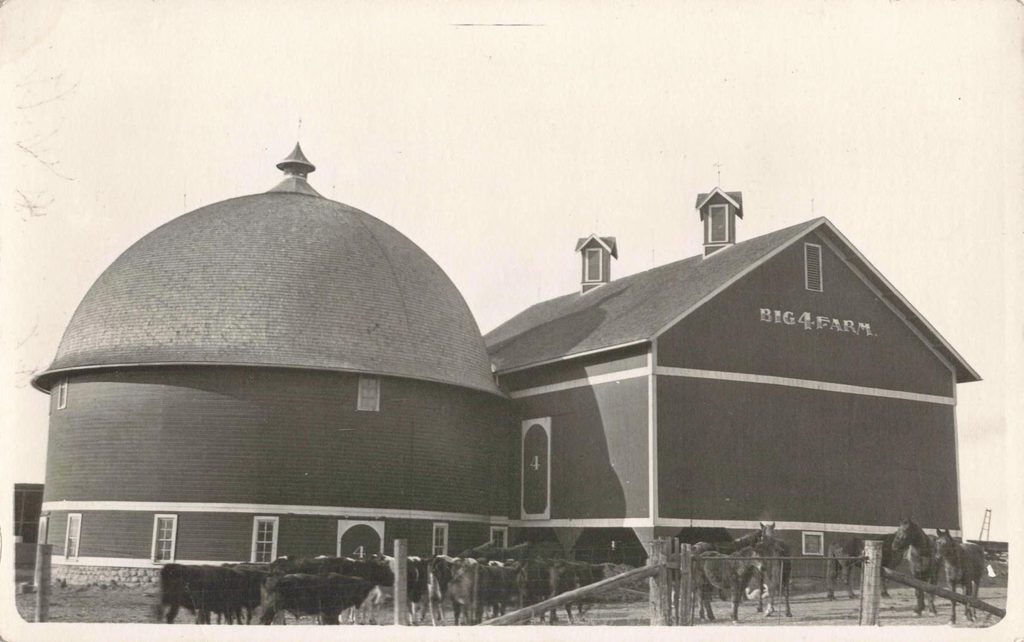
The most dramatic agricultural photograph is labeled Big 4 Farm. Its round barn dominates the image.
A broad, curved roof rises above a circular wall while cattle crowd the foreground. Horses stand near the adjoining barn. The result looks almost industrial compared with the smaller barns associated with many family farms.
Round barns became part of an agricultural movement that promoted more efficient livestock handling and storage. Lists of Michigan round barns confirm that Isabella County had several circular or polygonal agricultural buildings.
A current database includes a Beal City round barn, but marks it gone and notes uncertainty about its exact location and identification.
The photograph clearly identifies the farm as Big 4 Farm, but available online evidence does not justify attaching every later round-barn record to this exact building. What is clearly visible in the photograph is that someone invested heavily in a large, unconventional farm complex near Beal City.
The barn made agricultural architecture.
7. Why Beal City History Still Matters

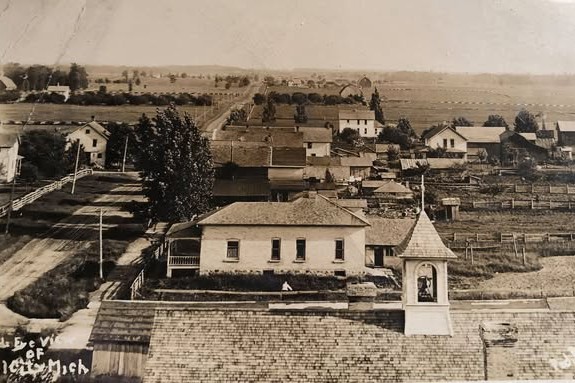
The bird’s-eye photograph may be the most revealing image of all. Beal City looks tiny.
A handful of roads pass between homes, barns and commercial buildings. Within a short distance, the settlement gives way to fields. There is no urban core.
That view puts the church, convent, Main Street and Big 4 Farm into proper proportion. These impressive buildings belonged to a community that remained geographically compact and closely tied to agriculture.
The Clarke Historical Library’s holdings show that Beal City has generated enough historical interest to warrant its own 1975 centennial history as well as academic work on St. Philomena Parish. Those materials form part of the larger record of Isabella County history.
The parish remains active today, reporting about 550 families. Its school traces its origins to 1883.
Meanwhile, WCMU reported in 2025 that residents raised about $80,000 for Beal City’s 150th-anniversary events, another sign that local identity remains unusually strong for a community of only a few hundred residents.
That may be the central lesson of Beal City history.
Population figures alone do not tell us how important a place was to the people who lived there.
Beal City had no courthouse. It had no skyline of commercial buildings. It never needed a city hall.
Instead, the old photographs give us a stone church, school buildings, storefronts, horses, early automobiles, a bakery wagon and one enormous round barn.
For a place that was never technically a city, Beal City certainly acted like it had something to prove.
Works Cited

- Fancher, Isaac A. Past and Present of Isabella County, Michigan. B.F. Bowen & Co., 1911. Clarke Historical Library, Central Michigan University.
- Genealogical Society of Isabella County. Isabella County, Michigan: Families & History 2003. 2003. Beal City section.
- St. Joseph the Worker Parish. “About Our Parish.” St. Joseph the Worker Parish of Beal City. About Our Parish
- Smahliuk, Masha. “Beal City Celebrates 150th Anniversary.” WCMU Public Media, July 31, 2025. Beal City Celebrates 150th Anniversary
- Travis, Dale J. “Michigan Round Barns & Other Round Structures List.” Dale J. Travis. Michigan Round Barns List

