


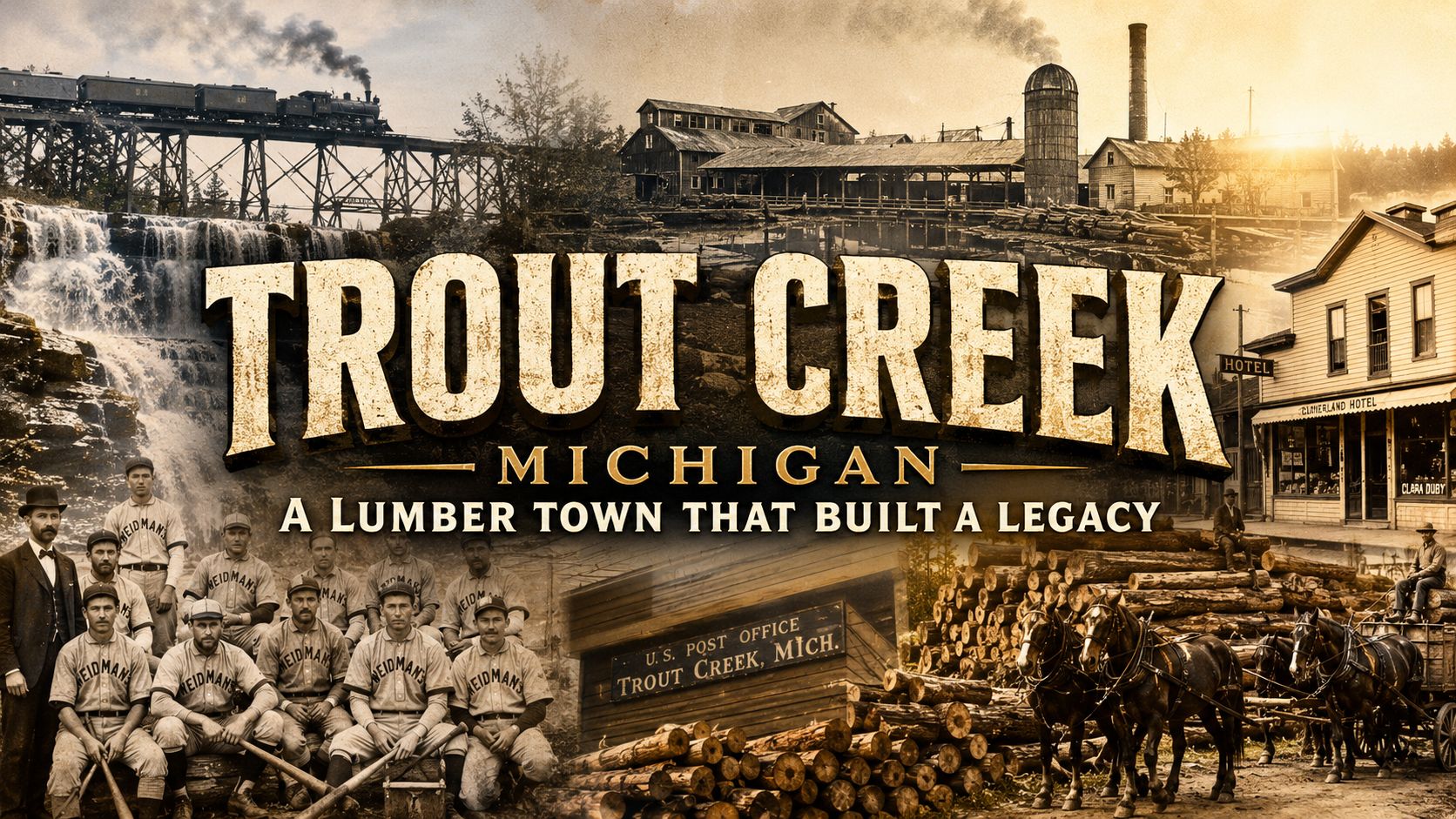
The History of Trout Creek Michigan – Sawmills, Railroads and Baseball
In 1912, Trout Creek had three operating sawmills. Each generated its own electricity. One company plant also supplied power to the town.
That surprising arrangement says much about early Trout Creek. The mills did not simply employ their residents. They powered the lights, shaped the streets, built the houses and supported the businesses that turned a remote railroad stop into a permanent Upper Peninsula community. Interior Township records identify the three operations as the Trout Creek Manufacturing Company, Weidman Lumber and DeLaittre, Anderson and Company.

The history of Trout Creek Michigan is often reduced to timber and trains. Those industries were central, but the surviving images reveal a more complete town. Trout Creek had hotels, stores, churches, schools, company neighborhoods and baseball teams. Its residents endured fires, mill closings and the eventual loss of rail service. They also built an athletic tradition that remains closely tied to the community.
History of Trout Creek Michigan Began Along the Railroad
Trout Creek developed in southern Ontonagon County along the Duluth, South Shore and Atlantic Railway. Settlement began about 1888, and a station was built on Garner Street around 1890. The depot stood roughly three miles east of Agate Falls.
The station gave logging companies something forest camps rarely had: dependable access to outside markets. Machinery, workers, food, and mail arrived by rail. Lumber left in loaded freight cars.
A 1915 image shows the Trout Creek depot beside a snow-covered street. A hotel and livery stable stand across from the tracks. An early automobile sits nearby, suggesting that the horse, train, and motorcar briefly shared the same town.

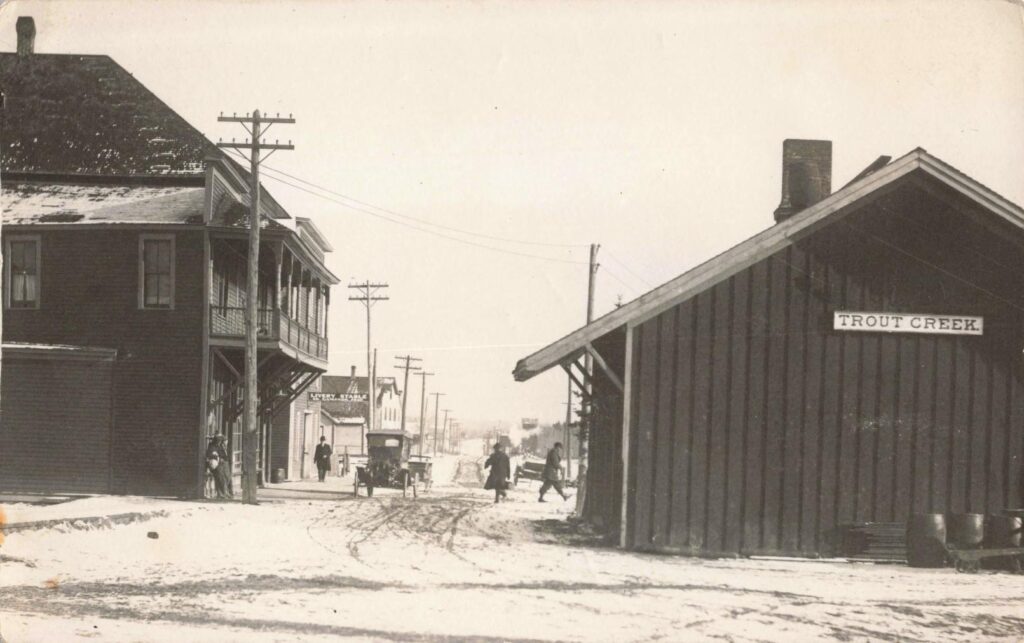
The railroad expanded its local facilities as traffic grew. It had a water tower and coal chute east of town by 1907, added a new coaling station in 1915 and built another station in 1916.
Trout Creek was no longer a temporary camp. It had become a shipping point, employment center and home.
Three Sawmills and a Town With Electric Lights
Interior Township’s first sawmill was operating by 1884. The W.D. Wing Company opened another mill in 1891. By 1912, three sawmills worked in or near Trout Creek, each with an electrical plant. George Hardes’ Trout Creek Manufacturing Company supplied electricity to the community.
That was unusual for a small and isolated Upper Peninsula settlement. Electric service arrived not through a regional utility, but as an extension of industrial production.
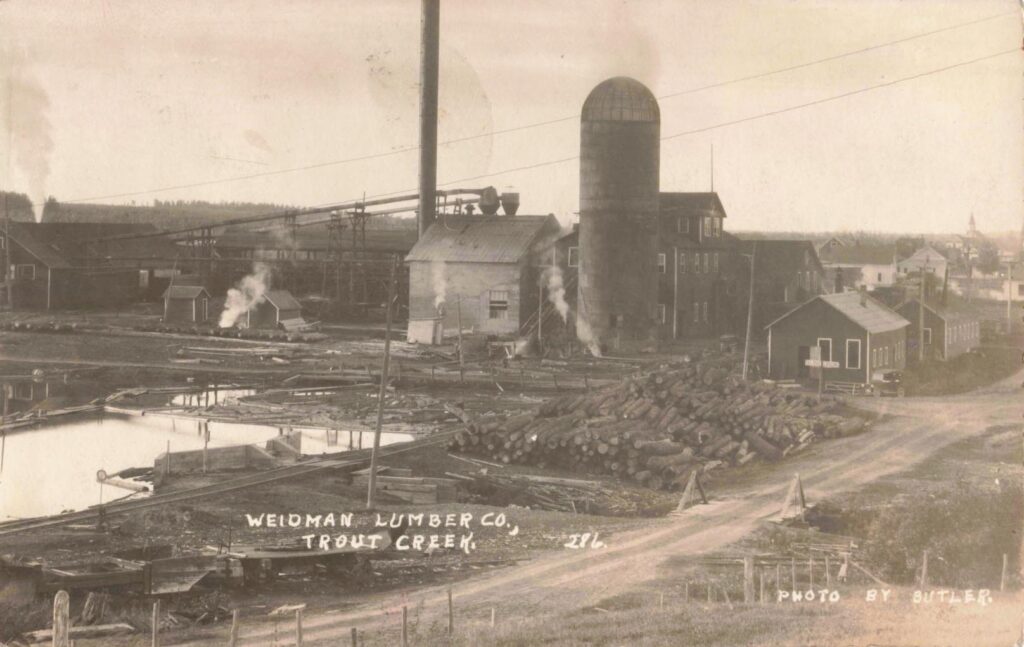
The surviving mill views show the size of the operation. Railroad tracks curve past a log pond filled with floating timber. A tall smokestack rises beside a large cylindrical structure. Logs are stacked along the tracks and beside the mill buildings.

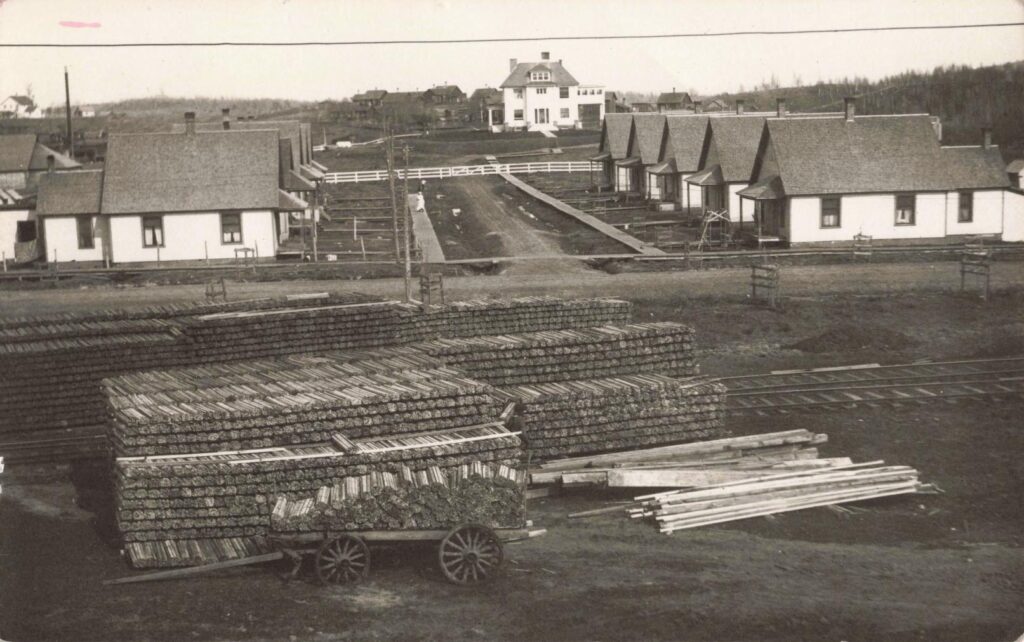
Another 1915 scene shows cut lumber stacked in long, squared piles. A wagon loaded with wood waits beside the yard. The nearby houses look small against the inventory.

The “Big Mill,” built in 1912, processed logs measuring 10 feet or longer. A smaller mill built around 1917 handled eight-foot logs. Together, the mills and woods operations employed more than 100 men.
Logging Required More Than Axes and Horses
Logging crews worked miles from town in wet, rocky and heavily wooded country. At various times, as many as 100 logging camps operated between Wakefield and Sidnaw. The camps required cutters, cooks, teamsters, mechanics, blacksmiths and railroad workers.
One supplied image shows men moving logs through a deep cut. Heavy timbers form a crib across the slope. Rail cars loaded with logs wait above while cables and wooden supports control the descent.

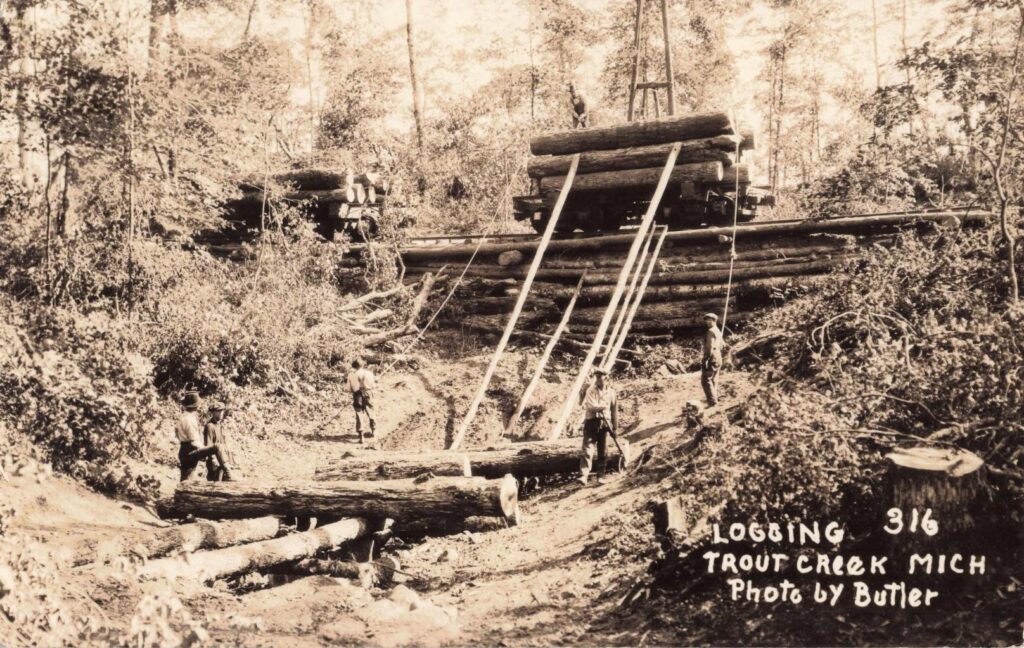
The work was organized, mechanical and dangerous. A broken cable or rolling log could injure several men in seconds. The system depended on timing. Trees had to be cut, trimmed, moved, loaded, milled and shipped without blocking the next crew.
Red Town Put Workers Beside the Mill
Company housing stood within walking distance of the mills. Rows of nearly identical cottages formed a neighborhood identified in period views as Red Town and Weidman Street.
The cottages had narrow yards and wooden walkways. Railroad tracks ran along the edge of the settlement. A larger building, likely associated with mill management, stood uphill from the workers’ homes.
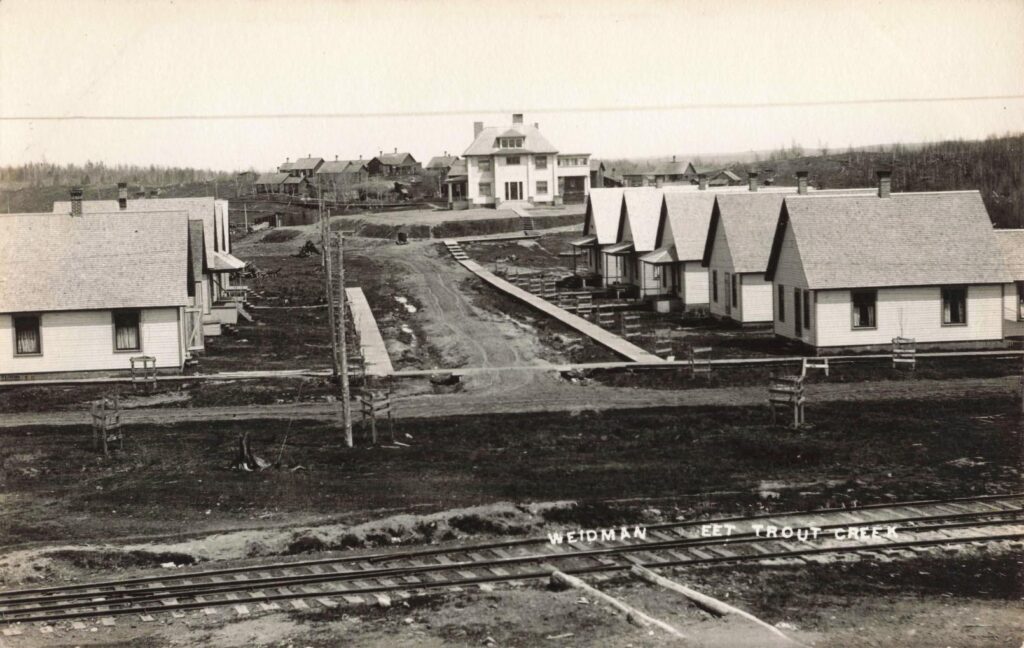
The layout reveals the company’s influence. A worker could leave his house, cross a boardwalk and report for a mill shift within minutes. His employer was also tied to the electricity, neighborhood and economic health of the town.
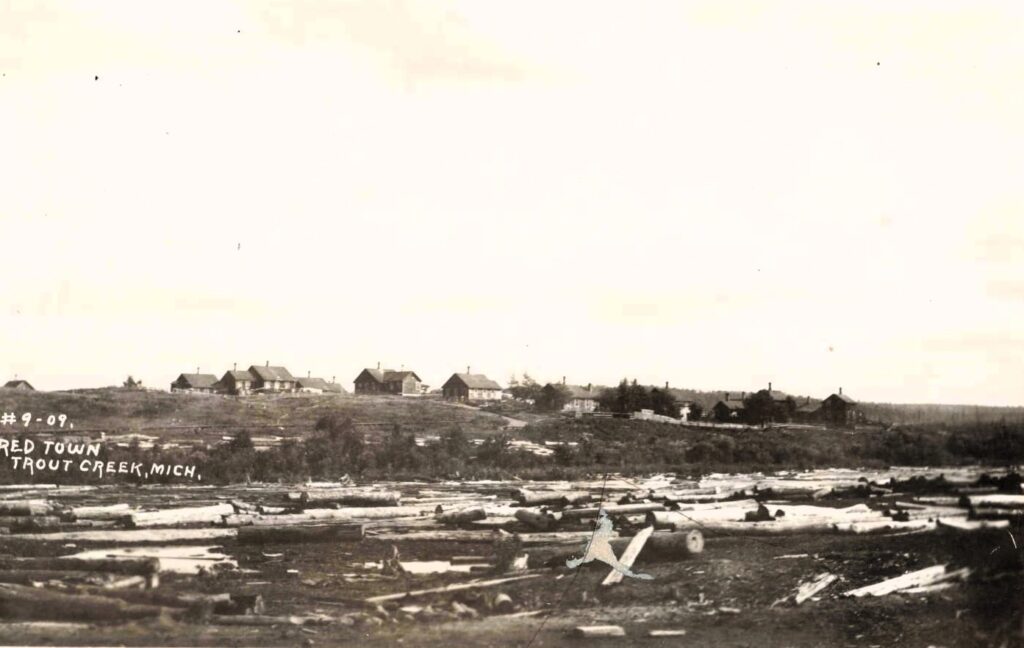
This arrangement made Trout Creek efficient. It also made the community vulnerable when a mill slowed, burned or closed.
The Trout Creek Fire of 1914
A surviving period card in this collection identifies a major fire as occurring on Jan. 21, 1914. The scene shows residents gathered beside burned foundations and frozen debris.

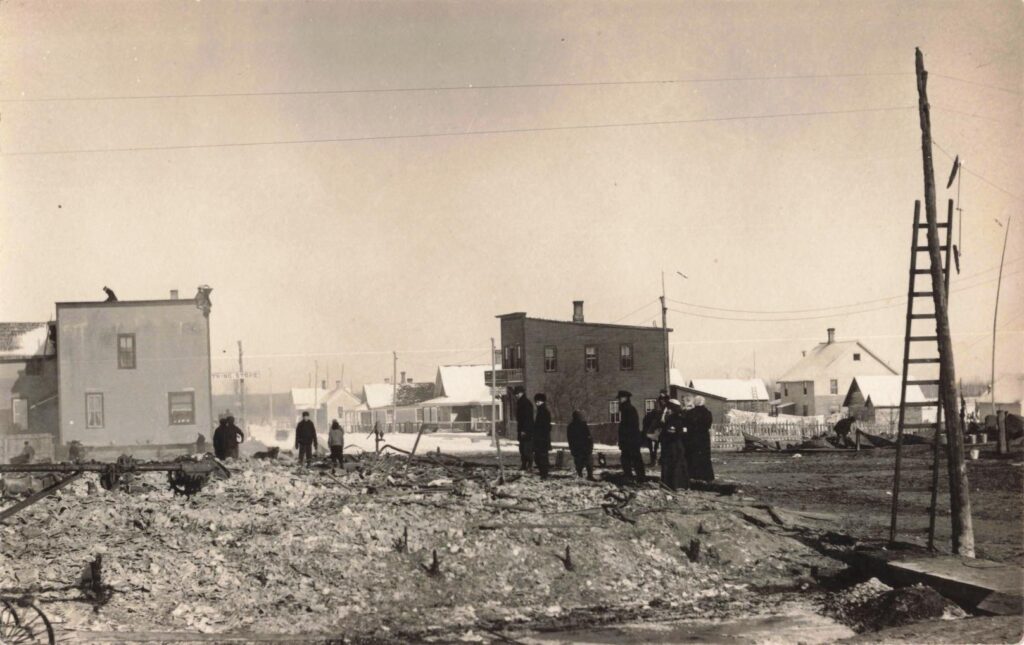
The image records the aftermath rather than the flames. Men and women stand in small groups. Utility poles remain, but much of the foreground has been reduced to rubble.
The exact list of destroyed buildings has not been confirmed through a strong independent record. The date comes from the period inscription. That distinction should remain in the published article rather than adding unsupported claims about specific businesses.
Fire was a constant threat in wooden mill towns. Homes, stores, sidewalks, sheds and fuel supplies could ignite quickly. Frozen wells and deep snow could slow a response.
Trout Creek rebuilt because the mills and railroad were still operating.
Main Street Showed That Trout Creek Intended to Last
The town’s commercial district included hotels, restaurants, grocery stores, barbershops, service stations, a bank, a theater, taverns and other businesses. Physicians and a veterinarian also served the township during the first half of the 20th century.
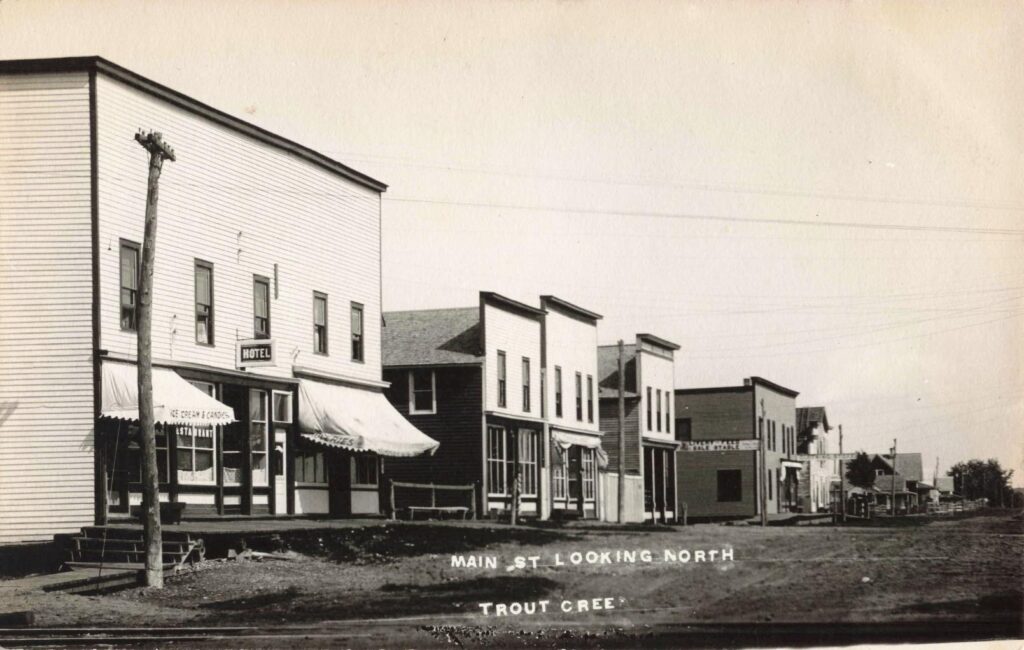
A Main Street view shows two-story false-front buildings, awnings, raised sidewalks and an unpaved road. One storefront advertises ice cream and candy. Farther down the street, a livery stable remained in business.

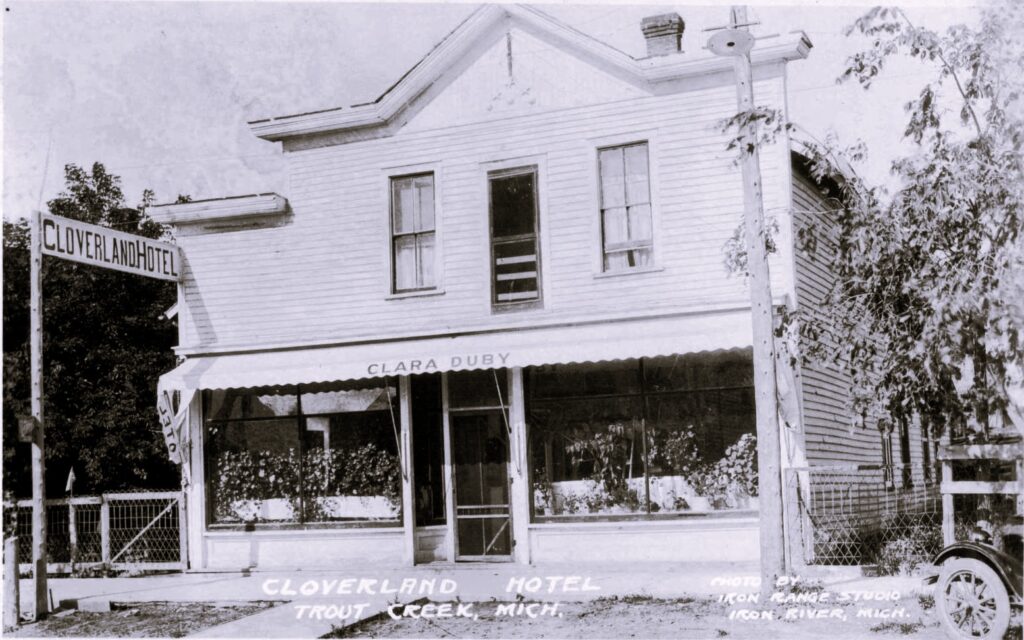
The Cloverland Hotel combined lodging with a storefront operated under the name Clara Duby. Part of an automobile appears at the edge of the image, placing the building at the point when highway travel began changing small-town commerce.

The post office, Rexall store, Presbyterian church and brick high school added stability. These were not the buildings of a disposable lumber camp. They represented families planning for another generation.
Baseball Gave Trout Creek a Second Identity
The history of Trout Creek Michigan took an unexpected turn on its ballfields.
Two early team images show players wearing Trout Creek, Brookston and Weidman uniforms. Bats, gloves, balls and a catcher’s mask are arranged in front of the teams. Company names appeared across several jerseys.
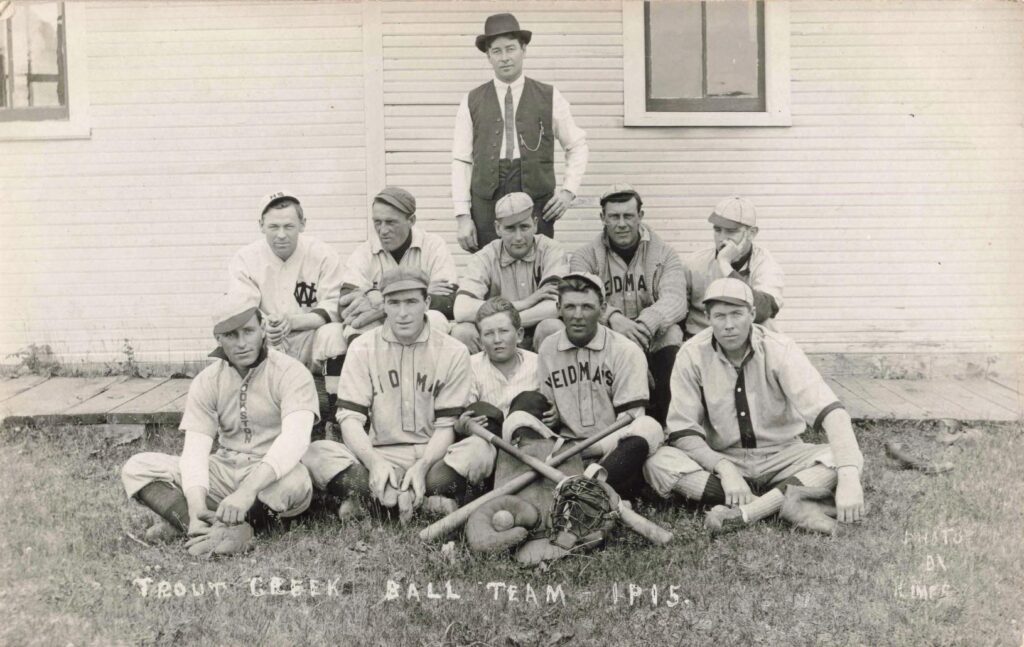
Company baseball was more than an afternoon diversion. Teams created pride among workers and gave neighboring towns a reason to gather. A good club could make a small lumber settlement known across the western Upper Peninsula.
That culture continued through basketball. The old Ewen-Trout Creek gym became known as “The Barn.” It was home to the 1972 Class D boys state champions, the 1973 Class D girls state champions and the 1982 boys state runners-up. The final Ewen-Trout Creek game there was played in 1998.
The tradition remains active. The Ewen-Trout Creek girls reached the Division 4 state final in March 2025, finishing as runner-up to Fowler.
Trout Creek Sent Two Pitchers to the Major Leagues
Jim Manning attended Trout Creek High School and signed with the Minnesota Twins after compiling a 15-2 high school pitching record. He reached the majors at age 18 in April 1962.
Dick Pole was born in Trout Creek in 1950. The right-handed pitcher debuted with the Boston Red Sox in 1973 and later worked for years as a professional pitching coach.
For such a small community, links to two major-league pitchers are remarkable. They also fit a town where company teams had been organizing players and building local rivalries decades earlier.
Agate Falls Carried the Railroad Over the River
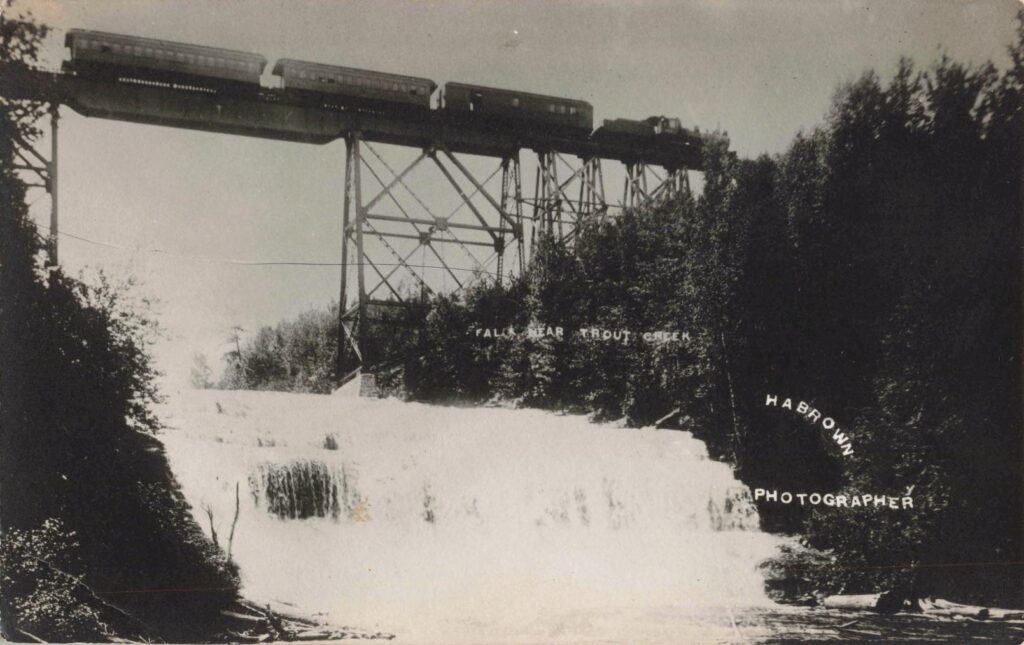
Agate Falls lies west of Trout Creek along the Middle Branch of the Ontonagon River. The water drops nearly 40 feet across terraced sandstone. Railroad trestles rise above the river corridor.
A period view shows a locomotive and passenger cars crossing high above the falls. The structure links two central parts of the Trout Creek story: natural force below and industrial engineering above.
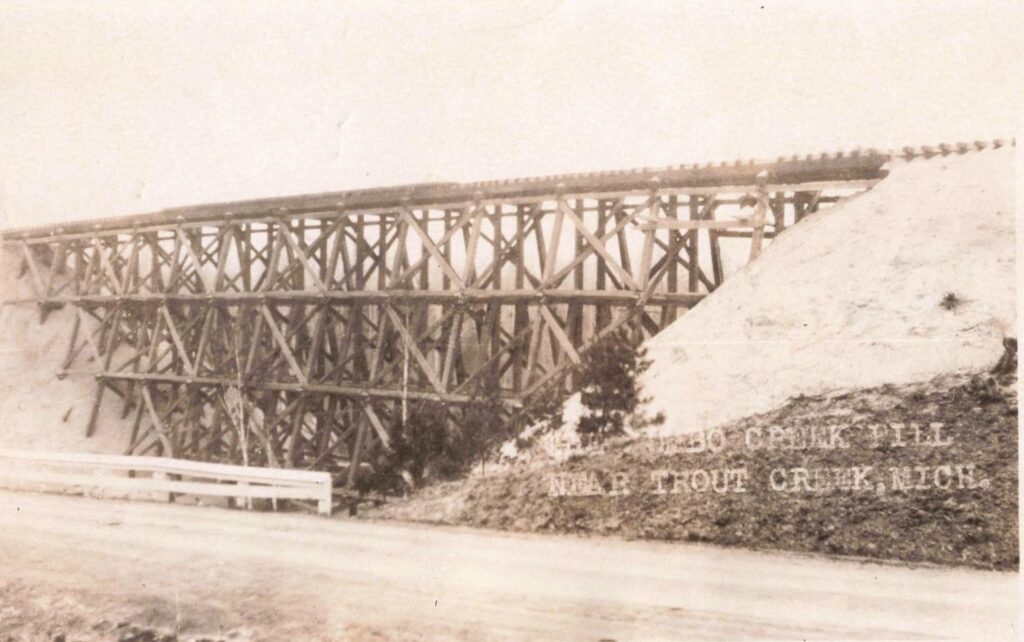
A second scene from 1926 shows an enormous timber fill near Trout Creek. Such structures required large amounts of lumber and constant maintenance before they were filled, reinforced or replaced.
When the Mills and Railroad Closed
The industrial system held together from about 1890 through 1950. Decline accelerated in the 1960s. The Big Mill closed in 1965 and was dismantled. The smaller mill burned in 1969 and was not rebuilt. Railroad service ended, and the line was abandoned during the 1970s.
Trout Creek High School consolidated with Ewen in 1967. The elementary school followed in 1998. Local volunteers later converted the old depot into a historical museum.
The history of Trout Creek Michigan is not simply a record of mills opening and closing. The town used its industrial years to build schools, churches, businesses, and sports traditions.
The sawmills produced lumber. One supplied the town with electricity. The teams gave people a name to cheer.
The machines eventually stopped. The name did not.
Research Note
This article was prepared from Interior Township planning records, Michigan railroad histories, state recreation records, organized sports archives, and the supplied historical image collection. The Jan. 21, 1914, fire date is taken from the inscription on the period image. Buildings lost in that fire have not been named unless supported by a reliable independent source.