


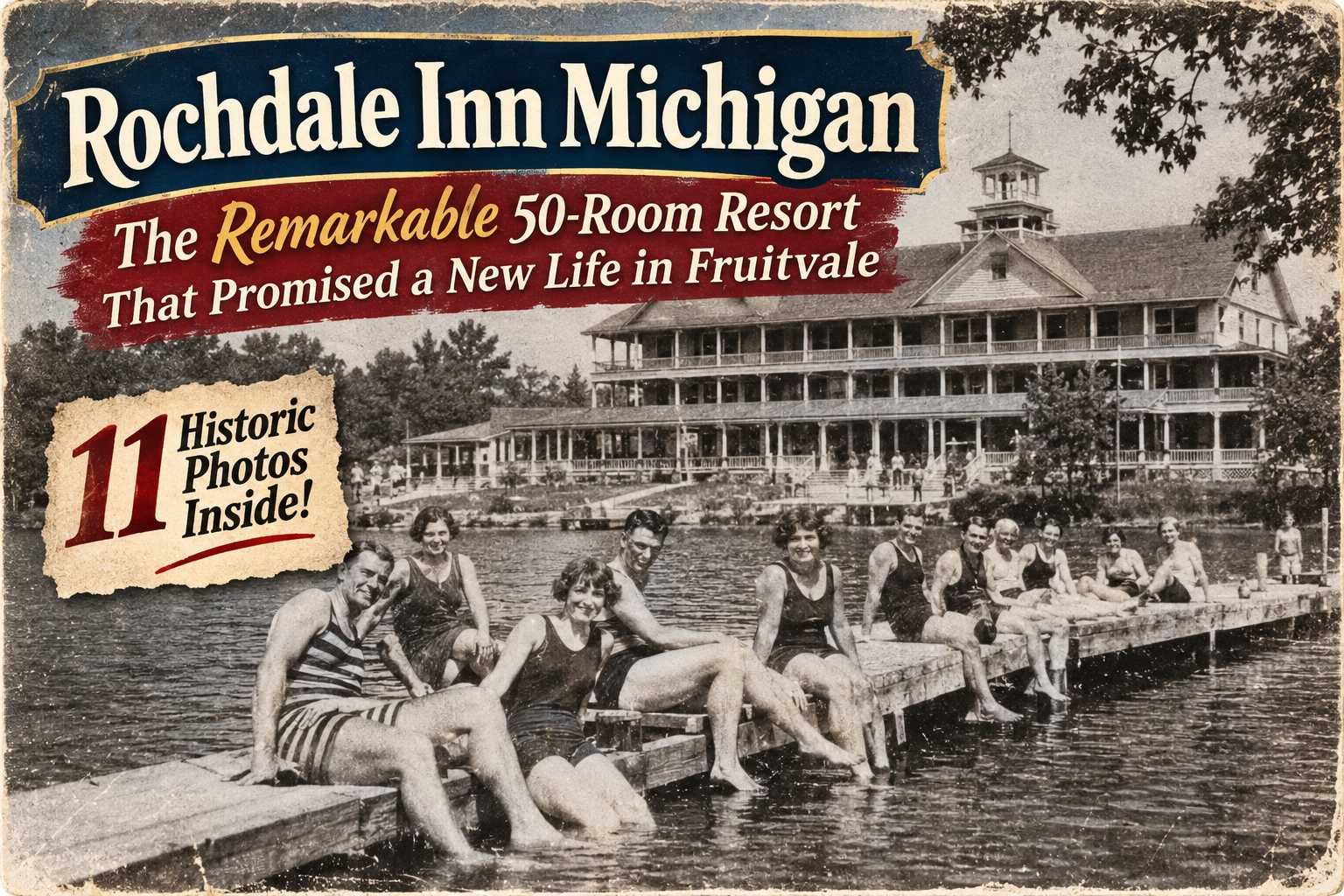
The Lost History of Rochdale Inn – A West Michigan Resort Dream (1912 – 1944)
In the early 1900s, a Chicago businessman named Harrison M. Parker offered city residents an unusual opportunity. They could acquire a small piece of Michigan land for little more than the cost of recording the deed. Better still, that land was part of a planned vacation community with farms, cottages and an elegant hotel beside the water.
The hotel was the Rochdale Inn, the centerpiece of a development known as Fruitvale in Muskegon County’s Blue Lake Township. Near Brown’s Pond and the White River, it drew summer visitors who came to swim, dance, play tennis, and escape Chicago’s crowded streets. Behind its pleasant surroundings stood a much larger experiment in real estate, agriculture, and cooperative living.

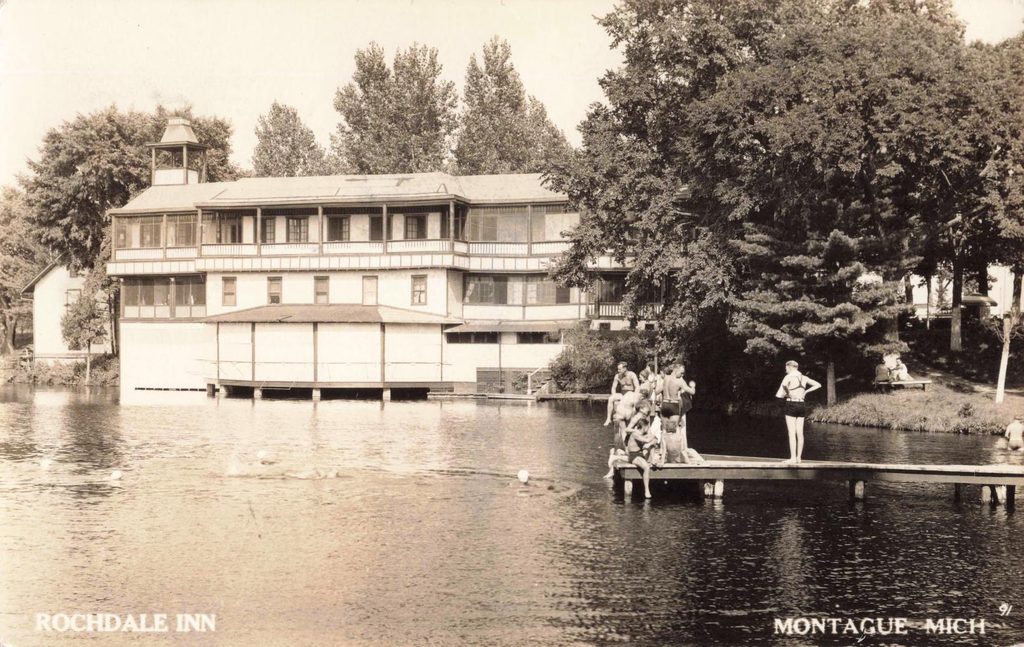
The history of Rochdale Inn Michigan begins with a remarkable sales pitch. Parker believed he could persuade people from Chicago and other Midwestern cities to buy rural land, grow food, and join a community whose farmers and visitors would support one another. He knew what city people wanted, and he had thousands of acres of inexpensive Michigan property to offer.
Before the Resort, There Were Lumbermen
Blue Lake Township looked considerably different before Parker arrived. During the mid-to-late 1800s, lumbering supplied much of the area’s employment. Pine forests, waterways, and sawmills supported an economy that depended on cutting trees and moving timber to market.

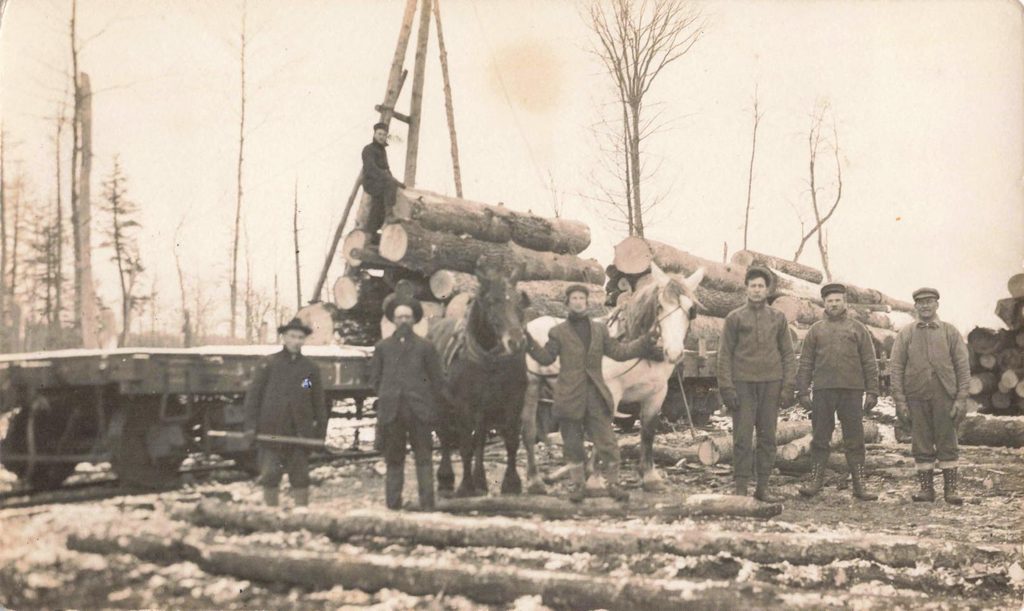
The township’s first sawmill was constructed in 1856. Other mills operated near local waterways, where water powered machinery and moved timber. The White River and its tributaries were important transportation routes in a region where roads were limited and frequently difficult to travel.
By the 1890s, the lumber boom was ending. Much of the valuable timber had already been removed, and workers followed the industry to other regions. Land that had once attracted lumber companies and settlers could now be purchased at remarkably low prices.
The decline created an opening for a different kind of businessman. Where lumbermen had valued the trees, Parker saw an opportunity to sell the land to people looking for summer cottages, small farms and a pleasant place to spend their vacations.
Harrison Parker’s Remarkable Offer to Chicago

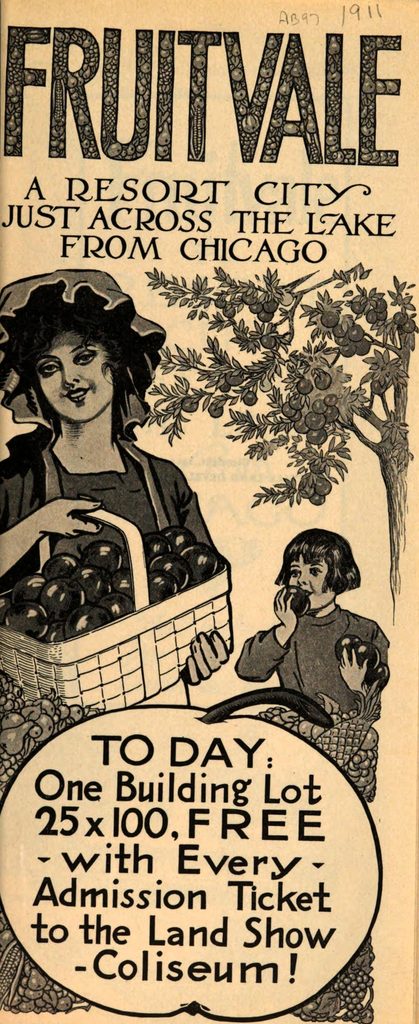
Harrison Parker had worked as a business manager for the Chicago Tribune. His experience in the newspaper business gave him a strong understanding of advertising and how to reach prospective buyers. Rather than selling expensive country estates, he promoted inexpensive ownership in a newly planned Michigan community.
According to the Blue Lake Township historical account, Parker’s Fruitvale Land Development Company offered 25-by-100-foot lots to people attending land expositions at Chicago’s Coliseum. The lots were advertised as free, although buyers had to pay a $3 recording fee. For the price of a few ordinary purchases, a person could become a Michigan landowner.
Another part of the plan followed. Parker also offered larger parcels of five and 10 acres, which could support gardens, orchards and poultry farms. These properties were intended to create an agricultural settlement that would produce food for the surrounding community and its resort visitors.
The appeal was understandable. A Chicago family accustomed to crowded streets and hot summer weather could consider owning property near lakes, rivers, and forests. Parker offered buyers a future that combined country living with an organized vacation community.

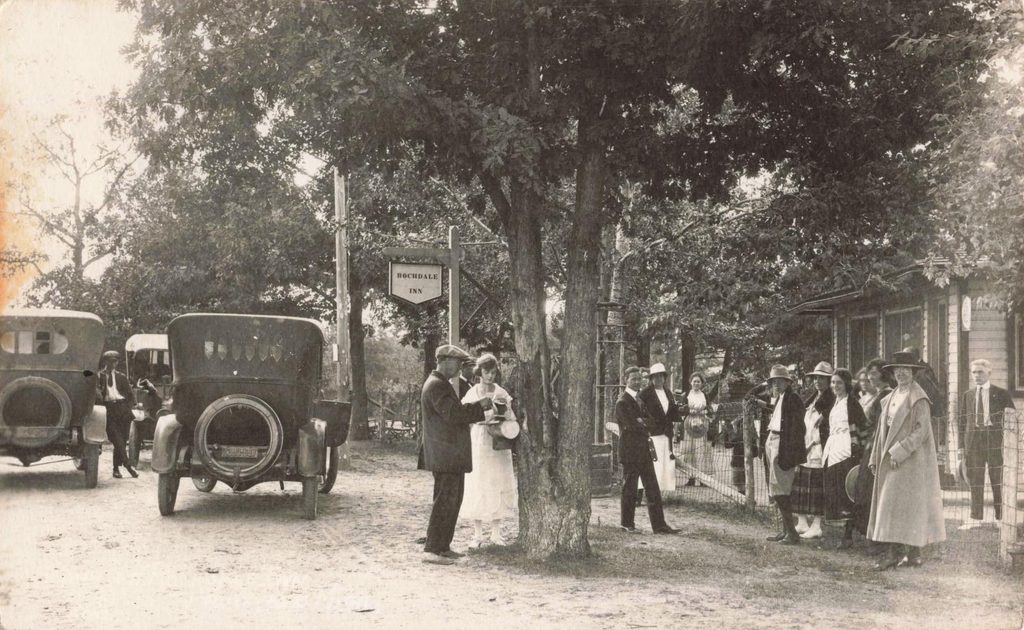
But the land itself was only part of the sales operation. Parker needed a destination that would persuade prospective buyers to visit, stay for a while, and see the possibilities for themselves. His answer was a growing hotel near Brown’s Pond.
History of Rochdale Inn Michigan: The Hotel at the Center of Fruitvale

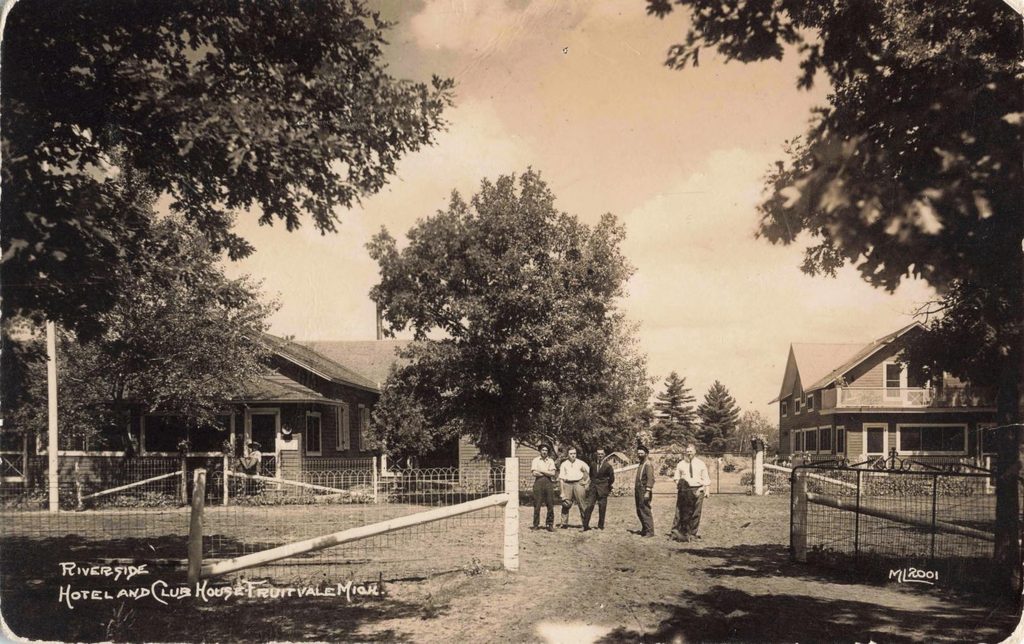
The resort began around 1912 as the Riverside Inn. As the development expanded, the property became known as the Rochdale Inn, named for the cooperative philosophy associated with Parker’s settlement. The hotel occupied a scenic location near Brown’s Pond and the White River.

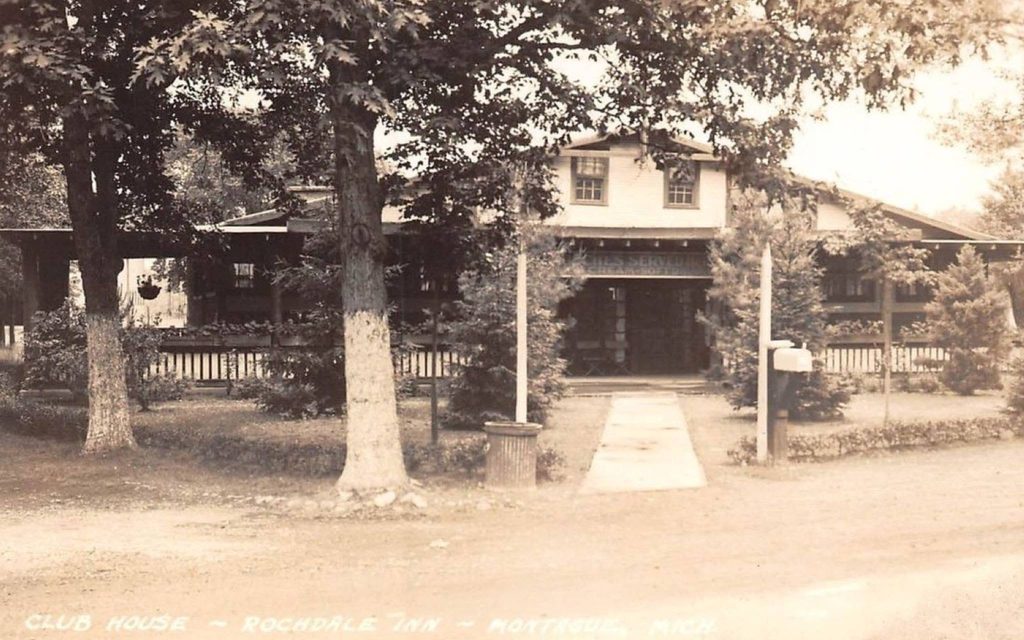
Over time, the inn grew into a substantial resort hotel. Blue Lake Township’s historical records describe a 50-room establishment that was considered elegant by the standards of the period. It offered a level of accommodation quite different from the small cabins and isolated farmhouses commonly associated with Michigan’s rural countryside.
Visitors could spend their summer days near the water, enjoy the wooded surroundings, and attend social events. Dances at the inn became part of its appeal, attracting people who wanted an evening out as well as those staying at the resort.

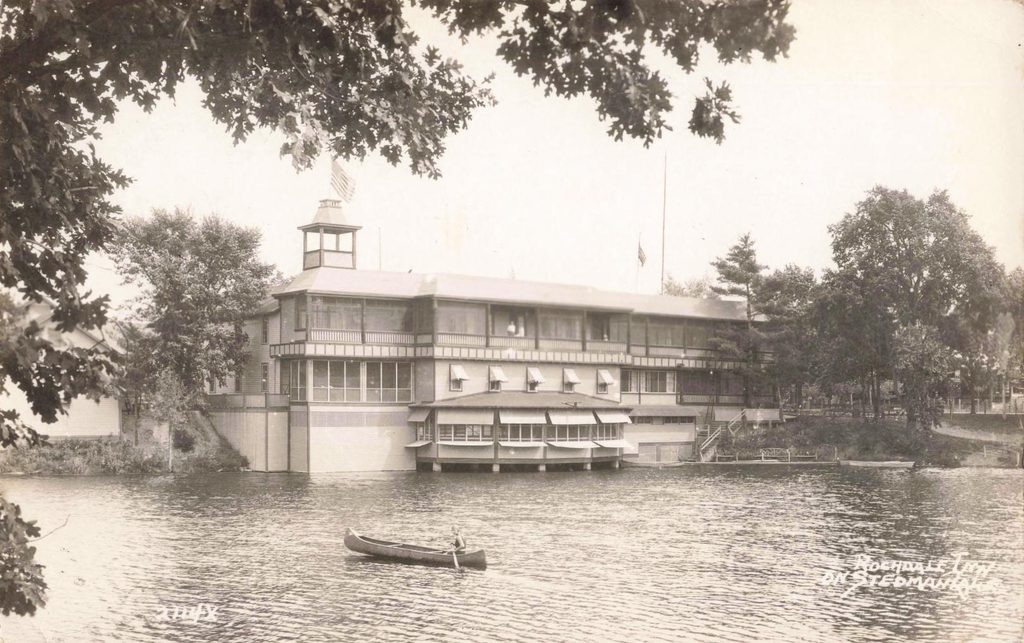
That social role helped the hotel reach beyond Parker’s land development. The Rochdale Inn offered local families a place for recreation and companionship, while summer guests could participate in the activities of the surrounding community.
A 50-room hotel also required considerable daily work. Guest accommodations needed cleaning, meals had to be prepared, and the property required ongoing maintenance. Although the surviving accounts do not identify every employee, operating an establishment of that size required work extending well beyond greeting visitors at the front desk.
Why the Resort Was Called Rochdale

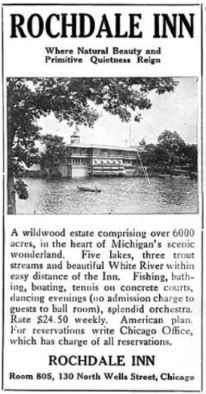
The name Rochdale had a meaning familiar to supporters of cooperative businesses. It referred to Rochdale, England, where 19th-century workers helped establish a model of consumer cooperation that influenced organizations throughout Britain and the United States.
Parker adapted the idea to his Michigan project. His plan called for farms and poultry operations around the resort to produce food to support the hotel and the settlement. The arrangement could give farmers a ready market while providing guests with locally produced supplies.
Fruit and poultry gardens were an important part of the proposal. Parker wanted people who bought larger parcels to participate in an agricultural economy rather than simply own recreational property. The program connected the promise of inexpensive land with the expectation that owners would put it to productive use.
There was a practical difficulty. Buyers who wanted an affordable summer retreat did not necessarily want the work of maintaining orchards or raising chickens. The interests of vacation property owners and those expected to operate farms did not always align.

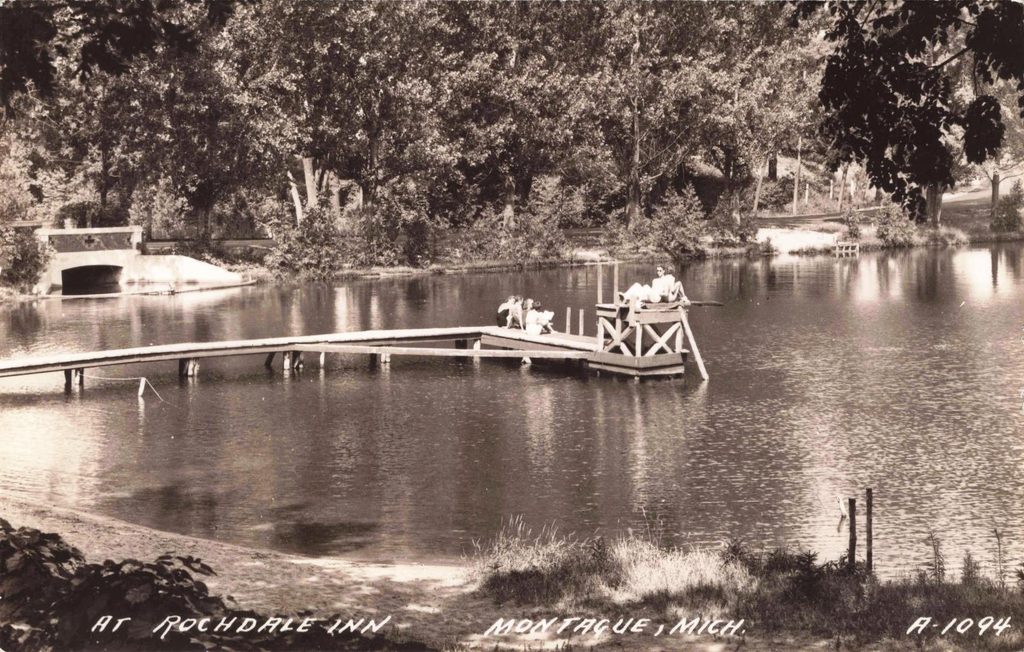
The name Rochdale survived in the hotel, but the broader farming scheme struggled to achieve the economic cooperation Parker had envisioned. Visitors nevertheless had plenty of opportunities to enjoy the recreational facilities surrounding the inn.
Swimming, Tennis and Summer Days at Fruitvale
Fruitvale eventually developed into a sizable seasonal community. Local historical accounts estimate that between 125 and 150 cottages existed during the resort’s most successful period. Those numbers suggest Parker’s sales campaign attracted considerable attention even if his agricultural plans proved harder to establish.
For seasonal residents, a cottage provided the opportunity to return to the same familiar place each summer. The inn supplied another form of accommodation, particularly for visitors who preferred a hotel stay or were considering property of their own.

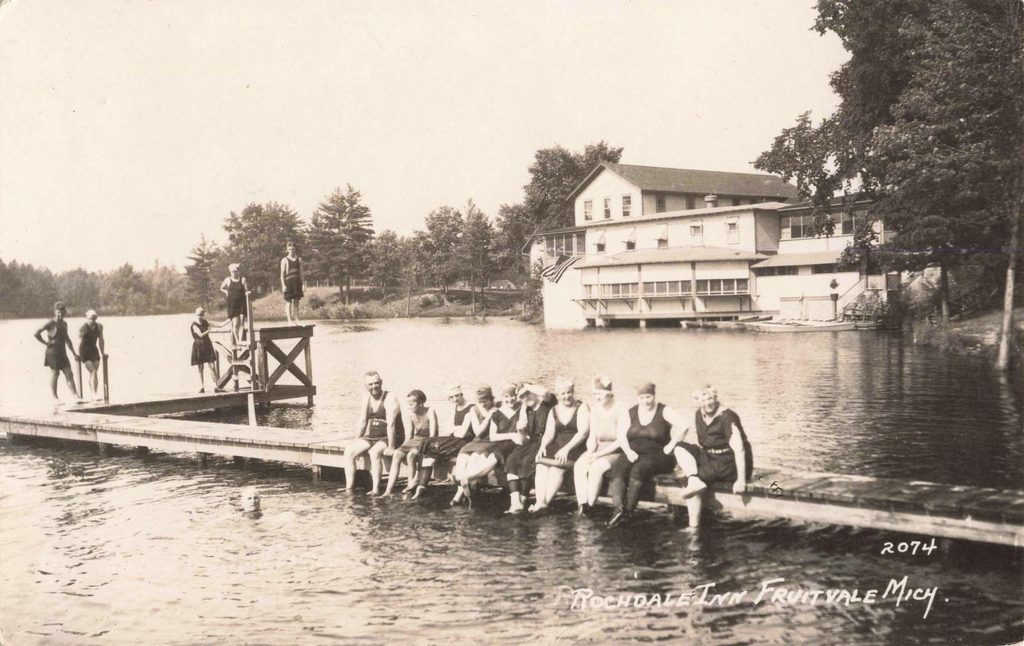
Swimming was clearly one of the resort’s important attractions. Historical postcards show guests gathering on docks, sitting beside the water and using the pond for recreation. The images offer a more personal account of Fruitvale than hotel advertisements or real estate records alone.
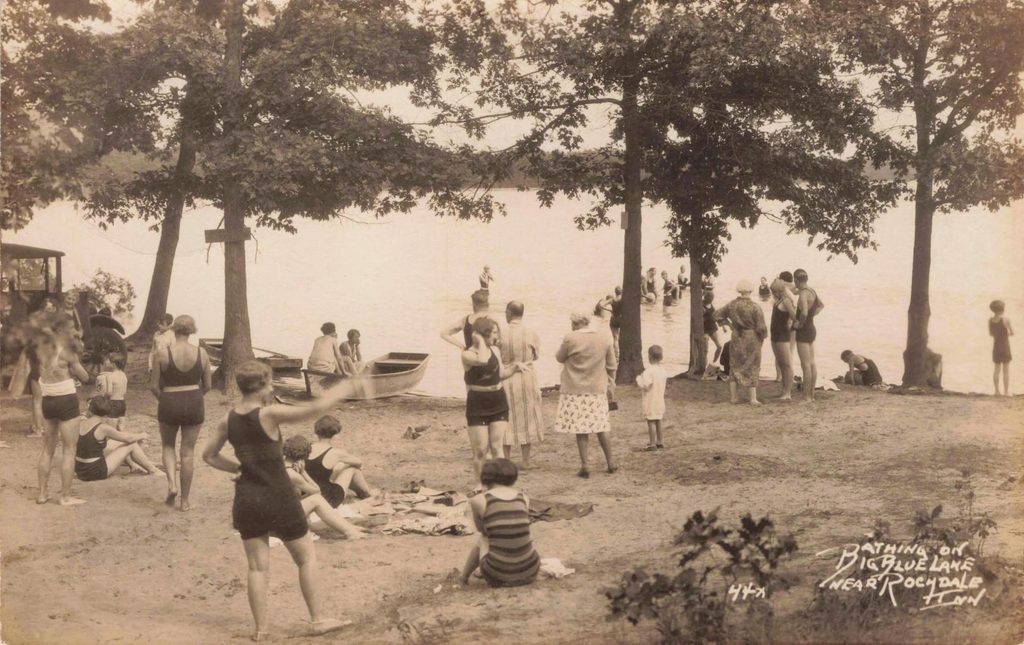
One postcard shows a crowded bathing area at Big Blue Lake near Rochdale Inn. Women and men wear the dark, full-coverage bathing suits common during the period, while children play along the shore. A small boat rests near the beach, and an early automobile appears among the trees.

The area also offered an organized tennis court. A surviving postcard shows two players standing on opposite sides of the net while a group of spectators watches from benches near a wooden building. Their clothing and equipment help place the scene within the era when tennis was becoming a popular resort pastime.

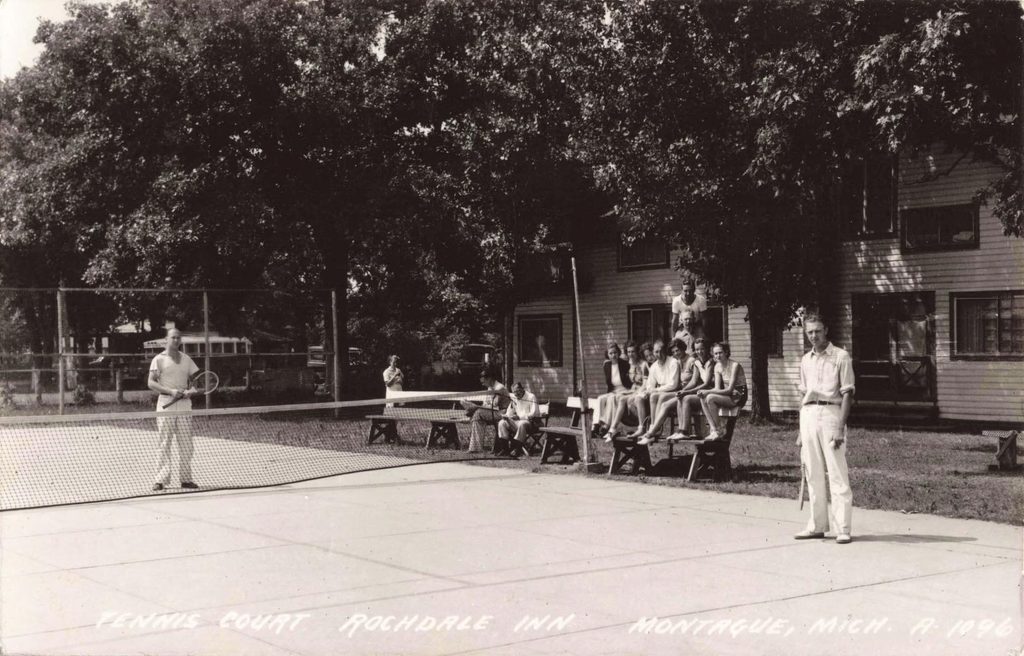
Swimming, tennis, dances, and cottage life gave Fruitvale its own identity. Visitors did not have to spend every day at the hotel. They could move between the resort, surrounding lakes, and seasonal homes, taking advantage of a community built around summer activities.
Brown’s Pond and the Water That Changed Its Purpose
The water played an important role in the development. Brown’s Pond had existed since the lumbering period, when its dam helped support industrial activity. With the arrival of summer visitors, the pond and surrounding property became part of the attraction rather than merely a working feature of the old timber economy.

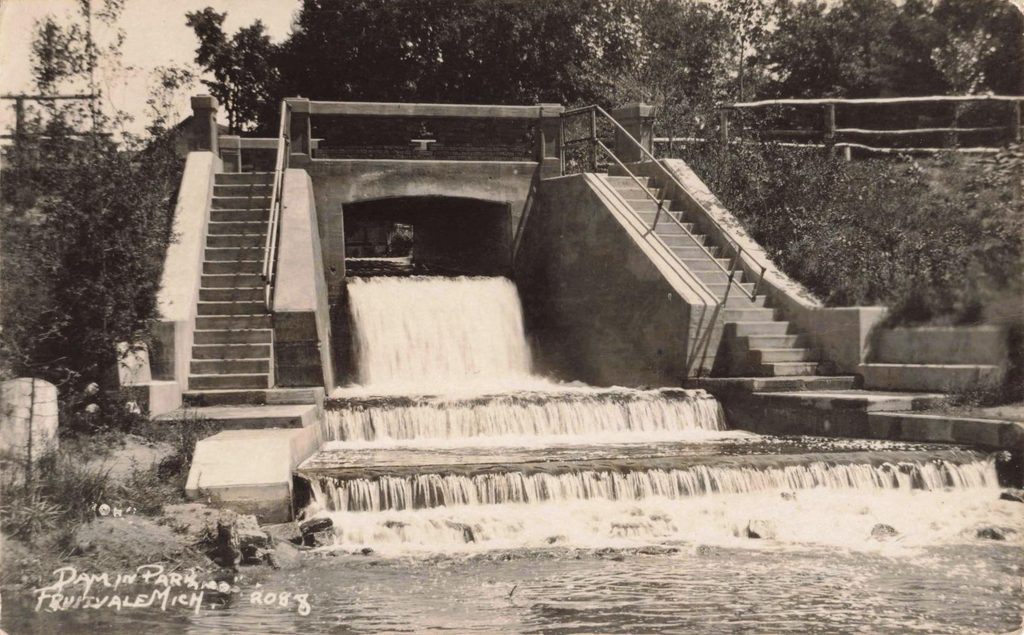
A Michigan dam-history report records that the original dam at Brown’s Pond dated to 1844, with the later structure built in 1914. The impounded water had served industrial purposes long before Parker began promoting cottages and recreational activities.
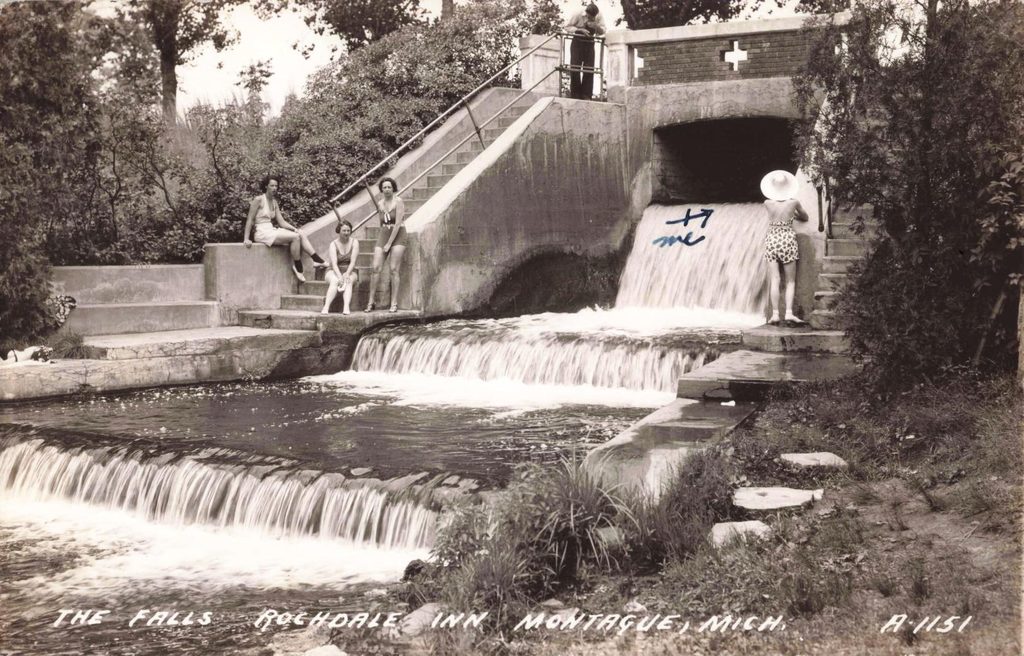
One of the resort’s more unusual features was how the flowing water became a place for recreation. Historical views show swimmers gathering at the stepped falls, sitting along the concrete edges and posing for group pictures. What had been designed to control water was also incorporated into the summer experience.
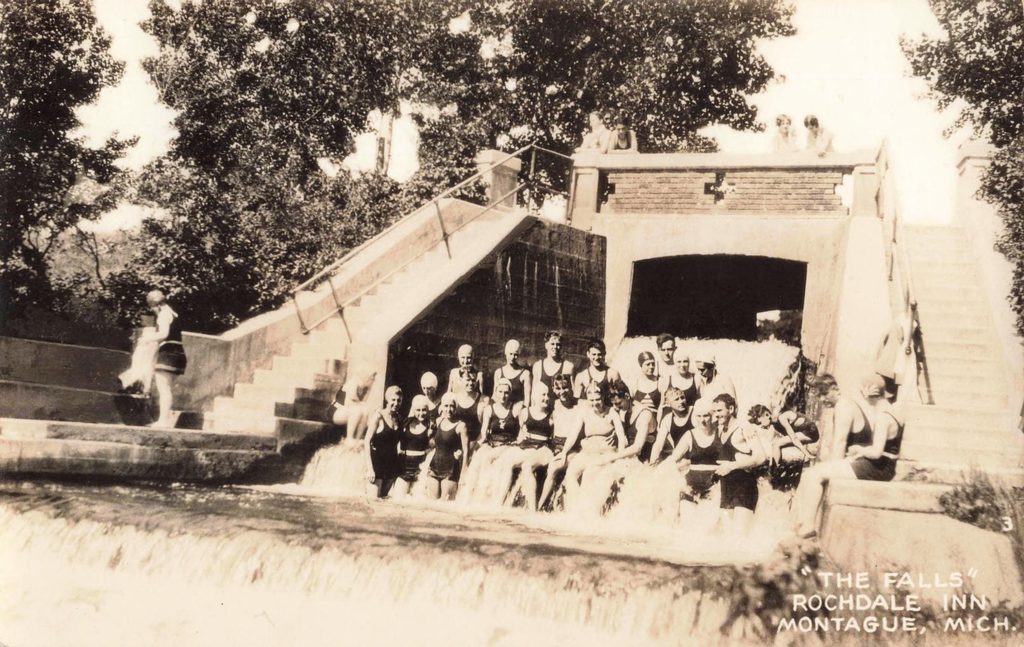
Another postcard shows visitors sitting on the steps and along the walls beside the water. The scene reminds us that Michigan’s early resorts often made imaginative use of existing natural and industrial features. Fruitvale’s waterways offered both scenery and recreation without requiring the expensive attractions of a large amusement park.
Travel to the area had its own complications. Michigan roads in the early 1900s were not always dependable, especially during wet weather. Visitors arriving from another city still needed a way to reach the resort from surrounding transportation routes.
A history of the nearby Owasippe region describes changes to a White River crossing around 1920 that let launches carry visitors from White Lake toward Fruitvale. The account illustrates how tourism could influence transportation decisions, even affecting roads that had served earlier generations.
Land Sales Bring Unwanted Attention
Fruitvale’s rapid promotion eventually drew attention from public officials. By 1912, the Muskegon County Board of Commissioners was investigating Parker’s land development company. Questions had emerged about the legality of his business practices.
The township’s later historical account records those concerns without presenting the resort itself as fraudulent. That distinction is important. Visitors could enjoy the hotel and surrounding recreational facilities while the wider land enterprise faced questions about its methods and obligations.
Parker’s plans also depended upon the continued sale and productive use of properties. A successful hotel could attract guests, but it could not guarantee that every buyer would settle in Fruitvale or that the agricultural community would develop as advertised.
Local history has preserved a complicated picture of the project. Fruitvale was an actual resort community that brought visitors and recreational activity to Blue Lake Township. It was also an ambitious land promotion that faced financial and legal difficulties beyond the hotel grounds.
When the Summer Crowds Began to Leave
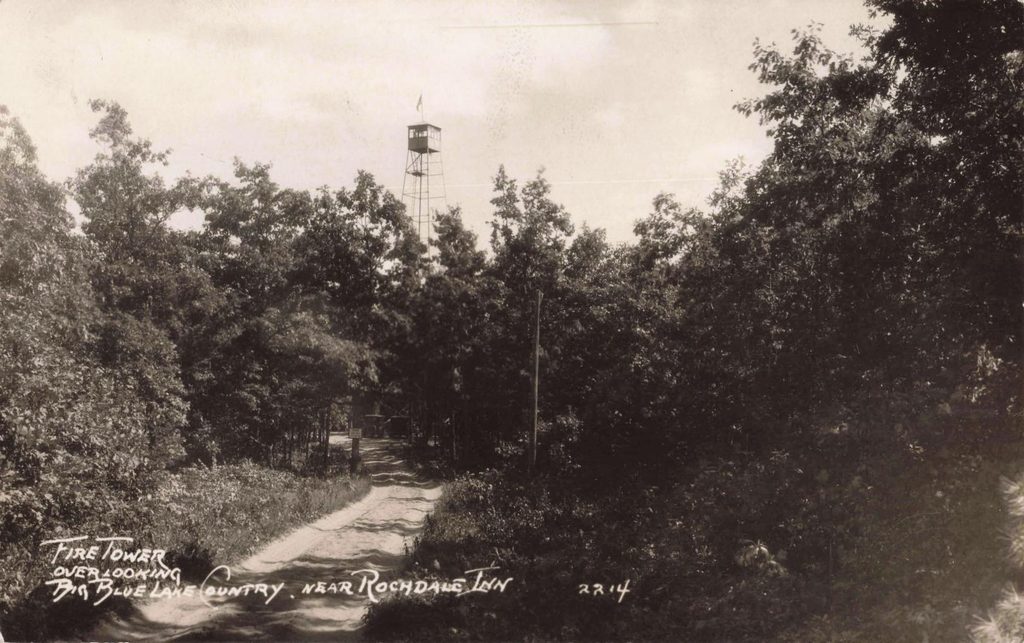
By the 1930s, Fruitvale’s fortunes were declining. According to the township’s historical account, easier travel and a growing choice of vacation destinations drew visitors elsewhere. The resort had to compete with changing habits as Americans increasingly traveled farther for recreation.
The economic pressures of the Great Depression added to the difficulties vacation property owners faced throughout Michigan. Fruitvale had been developed around discretionary spending, seasonal homes and the expectation that buyers would continue supporting the community.
As visitor numbers fell, neglected cottages became increasingly common. Some burned, while others deteriorated and eventually collapsed. The developments that once gave Fruitvale the appearance of an expanding summer settlement slowly disappeared.
The Rochdale Inn remained part of the area longer than the resort’s most prosperous period. A report on Michigan’s aging dams records that the hotel closed in 1941. The date places its final years after the major decline of the 1930s and well beyond the first enthusiasm for Parker’s cooperative project.
History of Rochdale Inn: The Fire That Ended an Era
The Rochdale Inn had welcomed vacationers to Brown’s Pond for nearly three decades before closing around 1941. What began as the Riverside Inn in August 1912 had grown into an imposing three-story resort hotel by the late 1920s. Its broad verandas, waterfront dance pavilion and recreational facilities made it one of the more elaborate summer destinations in Muskegon County.
During the 1920s, the hotel attracted substantial crowds. Charles Schierstadt, who managed the inn during part of that decade, reportedly counted about 100 guests in July 1920 and expected more before the summer ended. During the 1923 season, manager Mr. Lidke reported 1,198 guest registrations, an indication of the resort’s popularity during its most active years.
Efforts to improve the property continued even as its fortunes changed. According to a June 22, 1939, report in The Montague Observer, Norman J. Larson of Chicago had secured a 10-year lease on the hotel. Plans included electrical wiring improvements and building two tennis courts. Gustave Kopp, who represented the Chicago owners, was to continue managing the property and remain in charge of the clubhouse.
Those improvements could not secure the hotel’s future. The Rochdale Inn closed around 1941, and in 1943, John Strmic Sr., who also owned Glenn Villa on White Lake, purchased the property. The large wooden building remained standing, but its days as a summer resort had ended.
The December 1944 Fire

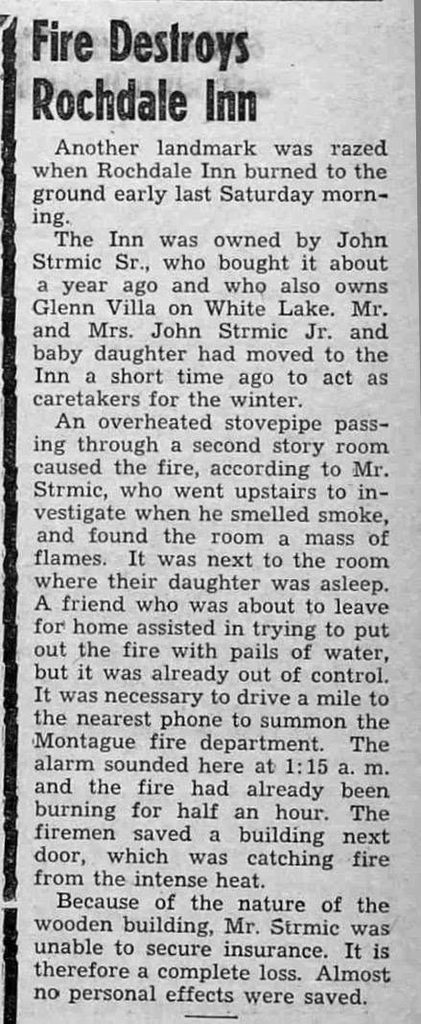
Early on Saturday morning, Dec. 23, 1944, a fire broke out inside the Rochdale Inn. John Strmic Jr., his wife and their baby daughter had recently moved into the building to serve as winter caretakers. According to a contemporary newspaper account titled “Fire Destroys Rochdale Inn,” the blaze began when a stovepipe overheated while passing through a second-floor room.
Strmic Jr. noticed the smell of smoke and went upstairs to investigate. He found the room engulfed in flames, dangerously close to the room where his young daughter was sleeping. A friend who was preparing to leave helped the family fight the fire with pails of water, but the flames were already spreading beyond their control.
There was no telephone nearby. Someone had to drive approximately a mile to summon the Montague Fire Department. By the time the alarm sounded at 1:15 a.m., the fire had already been burning for about half an hour.
Firefighters couldn’t save the hotel. The wooden building burned to the ground, though crews managed to protect a neighboring structure that had begun to catch fire from the intense heat. Nearly all the family’s personal belongings were lost, and the owner said he couldn’t insure the building because of its wooden construction.
The fire brought a permanent end to the Rochdale Inn. The hotel that had once welcomed hundreds of summer visitors, hosted dances, and served as the centerpiece of Harrison Parker’s Fruitvale development was gone. Its destruction came three years after the resort had closed, leaving only historical records, postcards and memories of the former vacation community.
What Remains of Rochdale Inn and Fruitvale?
The history of Rochdale Inn survives largely through historical postcards, newspaper accounts, and the physical traces of the former Fruitvale development. The original hotel disappeared in the December 1944 fire, while many surrounding summer cottages were abandoned or demolished as the resort community declined.
Brown’s Pond remains one of the clearest reminders of the area’s past. Its waters once supported lumber operations before becoming a setting for swimming, boating, and summer visitors. Fruitvale planning records also identify building foundations and portions of former tennis courts associated with Fruitvale.
The surviving photographs offer a particularly vivid record of the resort’s busiest years. They show visitors arriving in early automobiles, women and men swimming near the hotel, tennis matches beneath shade trees, and groups gathered at the stepped waterfall. Those ordinary summer activities help explain why so many people returned to Fruitvale during the resort’s prosperous decades.
Rochdale Inn and Fruitvale: Historical Timeline
Michigan Moments | 1844–2004
Rochdale Inn & Fruitvale
From Lumber Mills to Summer Holidays
Follow the unusual rise and decline of a Michigan resort community built around inexpensive land, cooperative farming and the 50-room Rochdale Inn.
13 Historical Milestones
Select any year to view its history and
related archival photographs.
1844 Brown’s Pond Supports Early Milling
The original Brown’s Pond dam dates to 1844, long before Fruitvale became a resort community. Waterpower helped support milling operations in western Michigan when the timber industry was expanding.
The same waterway would later become part of the Rochdale Inn’s recreational setting, changing from an industrial resource into a summer attraction.

1853 European Settlement Expands
Charles Hart is identified in local historical records as one of Blue Lake Township’s earliest European settlers. The community developed during a period when logging, farming and small mills were spreading through Muskegon County.
These early settlements preceded the vacation cottages and tourist accommodations that eventually characterized Fruitvale.
1856 Blue Lake Township’s First Sawmill
The township’s first sawmill was built in 1856, helping establish the lumber industry as an important part of the local economy. Forests, streams and growing transportation routes made the region attractive to timber operators.
Sawmills provided employment and helped establish the economic foundation of the area that Parker would later promote to city buyers.
1865 Blue Lake Township Is Organized
Blue Lake Township was formally organized in 1865 as western Muskegon County continued to develop. Lumber production and agriculture influenced settlement throughout the surrounding region.
By the early 20th century, the township would also become home to an ambitious vacation and cooperative farming experiment.
1890s The Lumber Industry Declines
By the 1890s, much of the region’s valuable timber had been harvested. Lumber companies moved to other areas, leaving large sections of cutover land available for development.
Inexpensive property helped make the Fruitvale proposal possible. The land that once supplied sawmills could now be marketed for gardens, cottages and summer recreation.
1900s Harrison Parker Promotes Fruitvale
Harrison M. Parker, a former Chicago Tribune business manager, promoted Fruitvale as an affordable Michigan community. His company advertised small lots at Chicago land expositions, with buyers paying a $3 recording fee.
Parker also promoted larger properties for fruit gardens and poultry farms. He hoped agriculture, cooperative business and summer tourism could support one another.
1912 Riverside Inn Anchors the Resort Plan
The Riverside Inn began operating around 1912 and became the centerpiece of Parker’s Fruitvale development. The property was later known as the Rochdale Inn, reflecting the cooperative ideas behind the proposed settlement.
Over the following years, the hotel grew into a substantial waterfront resort with approximately 50 guest rooms. Its porches, gathering spaces and recreational facilities attracted summer visitors to Blue Lake Township.

1912 Land Promotion Faces Official Scrutiny
Muskegon County officials investigated questions involving Parker’s land development company. The investigation concerned the business practices behind the Fruitvale property promotion.
The resort continued to develop, but its success depended on more than selling inexpensive property. The planned farms required sustained work and investment from owners whose interests often centered on seasonal recreation.
1914 A New Brown’s Pond Dam
A Michigan dam-history report identifies 1914 as the construction year of a later Brown’s Pond dam. The waterway had already served the area’s mills for decades.
During the resort era, the developed spillway and falls also became a recreational attraction. Visitors gathered beside the flowing water, and some posed for postcards while standing in the cascades.

1920s Fruitvale Becomes a Summer Destination
The Rochdale Inn attracted vacationers who came to swim, play tennis, attend dances and spend time near the water. The surrounding Fruitvale development reportedly included between 125 and 150 seasonal cottages at its height.
Automobiles helped visitors reach the resort, while its recreational facilities provided activities for both hotel guests and local residents.


1930s The Resort Community Begins to Decline
Changing travel habits and growing competition among Michigan vacation destinations reduced Fruitvale’s appeal. The Great Depression also placed financial pressure on seasonal property owners.
Cottages were abandoned, and some deteriorated or burned. The settlement that had grown around the inn gradually lost much of its seasonal activity.
1941 Rochdale Inn Closes After Nearly 30 Years
After nearly three decades as a summer resort, the Rochdale Inn closed around 1941. The hotel remained standing, although the surrounding Fruitvale vacation community had already experienced years of decline.
In 1943, John Strmic Sr., who also owned Glenn Villa on White Lake, purchased the former resort property.
1944 Fire Destroys the Historic Rochdale Inn
Early on Dec. 23, 1944, a fire caused by an overheated stovepipe spread through the wooden hotel. John Strmic Jr. and his family, who were serving as winter caretakers, were inside when the fire began.
The Montague Fire Department was summoned after someone drove approximately a mile to the nearest telephone. Firefighters could not save the hotel, but they prevented the destruction of a neighboring building. The Rochdale Inn was a total loss.
2004 Brown’s Pond Dam Is Repaired
Brown’s Pond dam underwent repairs in 2004 after concerns about its condition and responsibility for maintenance. The pond remained one of the most recognizable features associated with the former Fruitvale development.
Blue Lake Township historical records also identify surviving building foundations and portions of former tennis facilities associated with the resort period.
Do You Remember Rochdale Inn or Fruitvale?
Do you have family postcards, property records or memories connected with Fruitvale or Rochdale Inn? We would welcome details about former cottages, local businesses and people who worked at the resort. Such records can help establish a more complete account of this unusual part of Muskegon County history.
Works Cited for the History of Rochdale Inn Michigan
Chicago Area Council, Boy Scouts of America. History of Owasippe. Historical research compiled by Whit Lloyd, 1985.
Hansen, William. The Lost City of Fruitvale, Michigan. 100th Anniversary Edition. Book listing and publisher’s synopsis.
Michigan River Partnership. The Growing Crisis of Aging Dams in Michigan: Policy Considerations and Recommendations for Michigan Policy Makers. 2007.
University of Michigan, William L. Clements Library. David V. Tinder Collection of Michigan Photography. Historical real-photo postcards of Rochdale Inn, Fruitvale and Montague, Michigan.
West Michigan Shoreline Regional Development Commission. Blue Lake Township Comprehensive Development Plan: 2019 Update. Blue Lake Township, 2019.

