


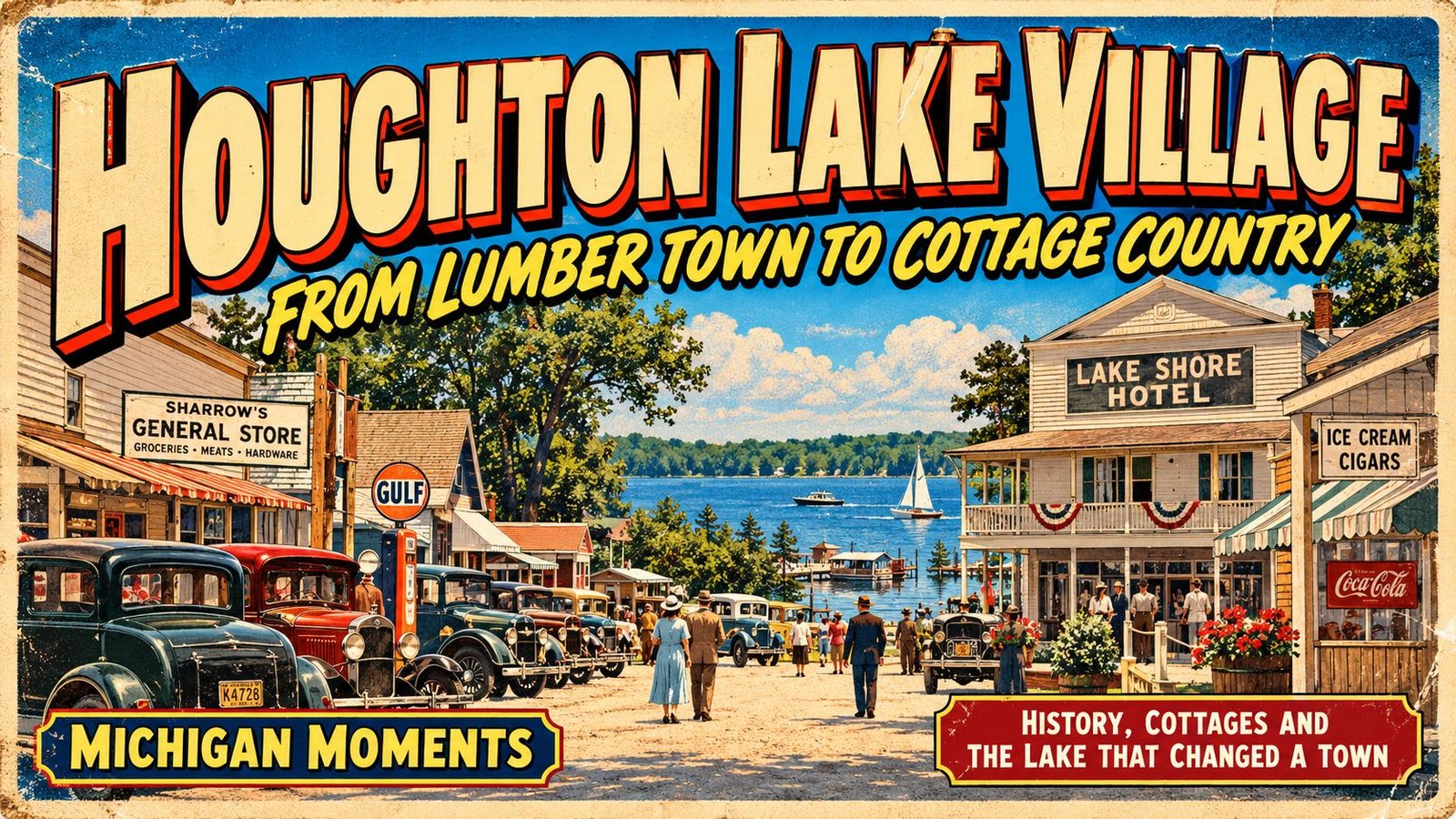
History of Houghton Lake Village – 7 Remarkable Forces That Transformed Michigan’s Cottage Country
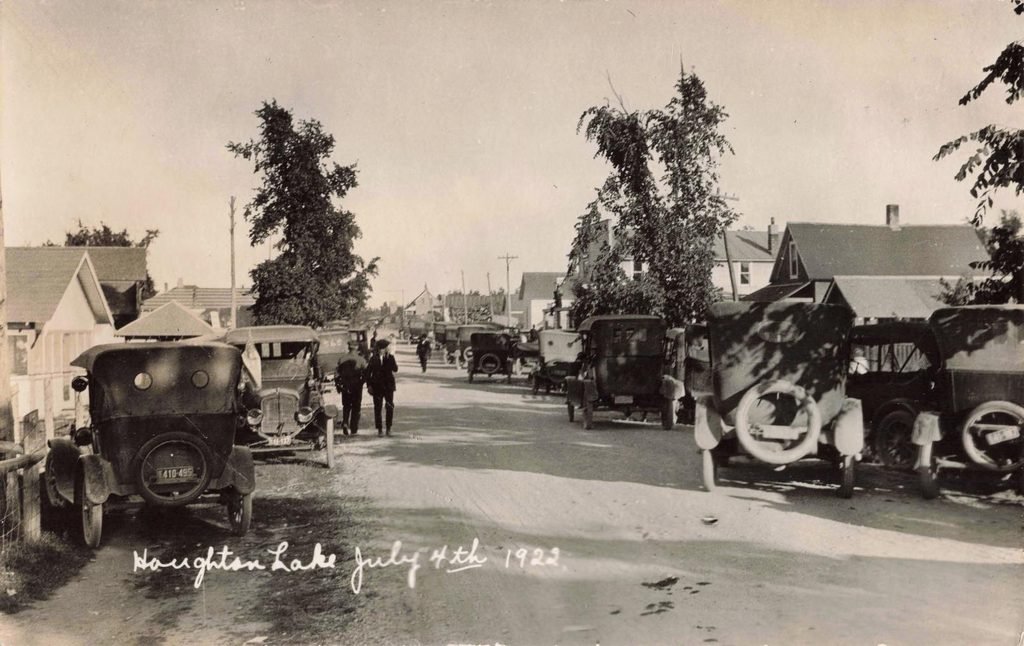
By the summer of 1923, something had changed in Houghton Lake Village. An image dated July 4 of that year shows automobiles parked along both sides of an unpaved street, with residents and visitors moving among houses and small businesses. The road was still rough, and the village still looked decidedly rural, but those cars signaled the community Houghton Lake was becoming.

The History of Houghton Lake Village Michigan is closely tied to the story of northern Michigan itself. Lumber helped establish the settlements around the lake, but the timber economy could not last forever. As the forests were cut and transportation improved, Houghton Lake began making a very different living from its natural surroundings. Instead of shipping timber south, local businesses increasingly encouraged people from southern Michigan to come north.
That transition did not happen overnight. The historic images of Houghton Lake Village show it unfolding over several decades, from dirt streets and horse-drawn transportation to cottage courts, automobile garages, restaurants, bars and roadside stores. By the 1930s and 1940s, the village was increasingly organized around visitors who arrived by car with fishing rods, hunting gear and a few days away from home.
Watch: History of Houghton Lake Village Michigan: How Cars Built a Cottage Town

Before Houghton Lake Was Vacation Country
The lake was originally known as Roscommon Lake, but Michigan renamed it Houghton Lake in 1852 after Douglass Houghton, the state’s first geologist. At the time, northern Michigan was still difficult country to reach. The vast forests surrounding the lake were economically valuable, but roads were primitive and permanent settlement remained limited.

That began changing rapidly during the great northern Michigan lumber boom. Logging operations moved through Roscommon County during the late 19th century, bringing workers, equipment and transportation improvements. On the southeast side of the lake, the Roscommon Lumber Co. built its own railroad in 1882 and constructed a long trestle over East Bay so logs could be dumped from railcars into Houghton Lake.
That arrangement sounds unusual now because modern visitors tend to think of the lake in recreational terms. In the lumber era, however, water could be part of the transportation network. Logs moved from forests to rail lines and waterways, then onward toward mills and markets.
The timber business left behind more than stumps. After the heaviest logging passed, roads, railroad connections, and small settlements remained. Those transportation improvements would eventually support another industry that depended on the same lake for a completely different reason.
A Village Built Along Dirt Roads
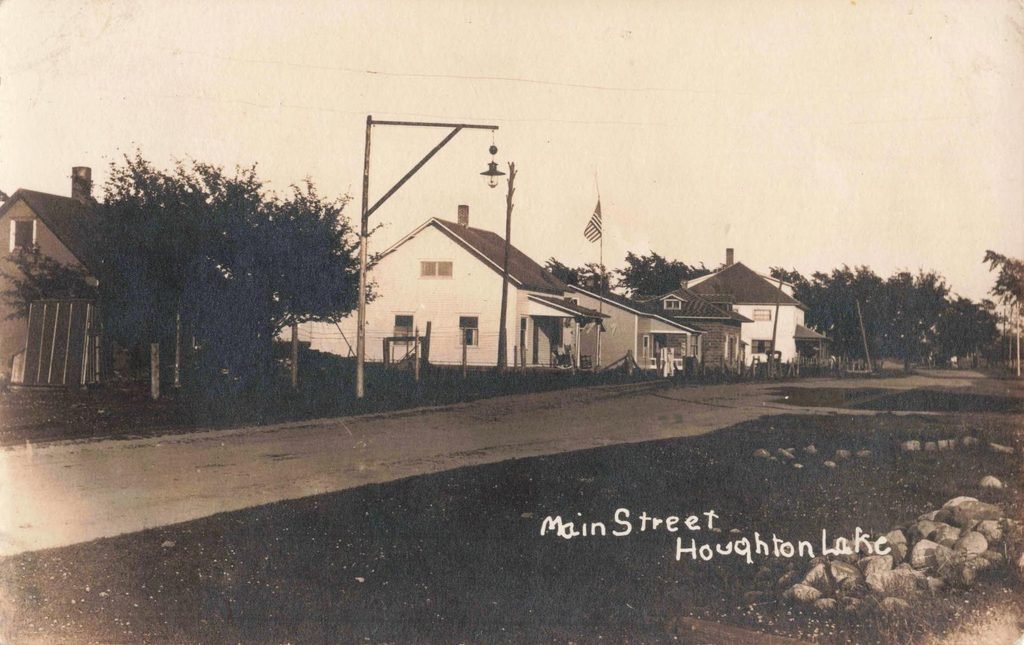
Early Houghton Lake Village was not a polished resort community. Several surviving views show sandy or muddy roads bordered by modest frame houses, commercial buildings, and fenced yards. Utility poles appear unevenly spaced along the streets, and horse-drawn vehicles remain part of ordinary daily life.

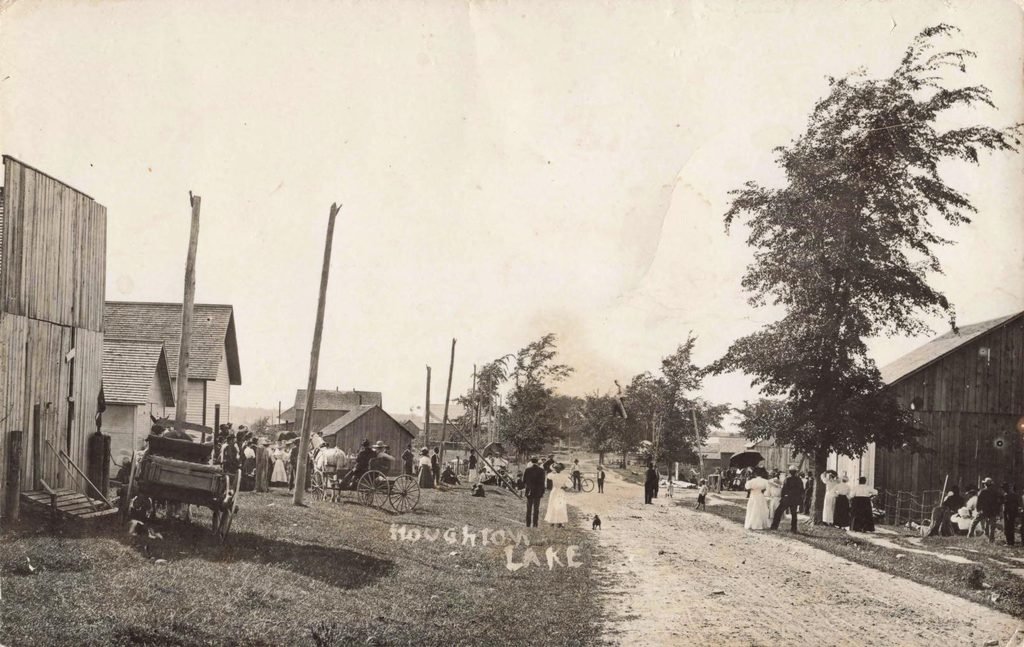
One especially early scene shows a sizeable crowd gathered along a dirt road. Men and women stand outside simple buildings while wagons and bicycles share the street. We aren’t sure who these people were or exactly what brought them together, but the image gives a good sense of the community’s scale before automobile tourism took hold.
These early streets were designed for slow-moving travelers. Store entrances faced pedestrians, horses and wagons rather than motorists moving through town. There was little reason for large parking areas, filling stations or oversized roadside signs.
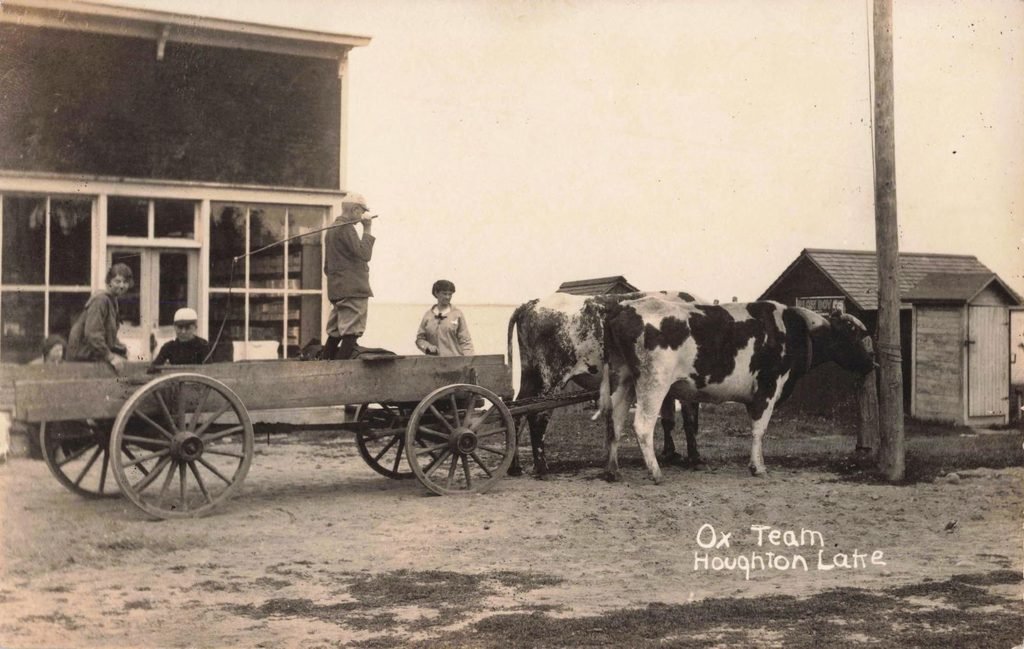
That would change quickly once the automobile became reliable enough for longer trips.
The Post Office Shows Two Eras at Once
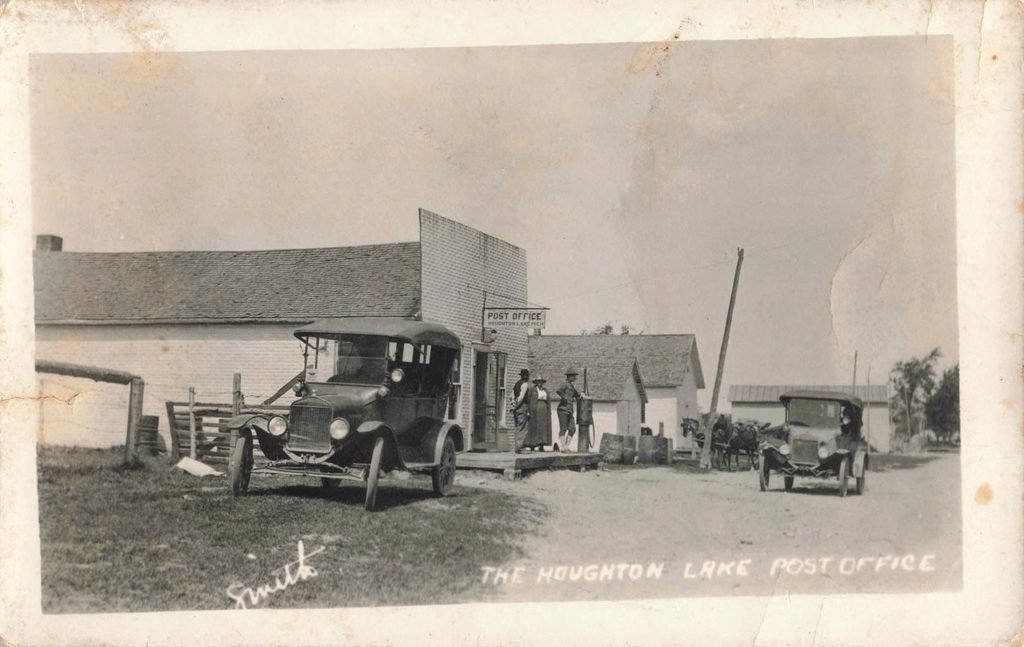
One of the more interesting views of early Houghton Lake Village centers on its post office. Several residents stand near the entrance while packages appear stacked around the porch. Parked nearby are two very different forms of transportation: an automobile and a horse-drawn vehicle.
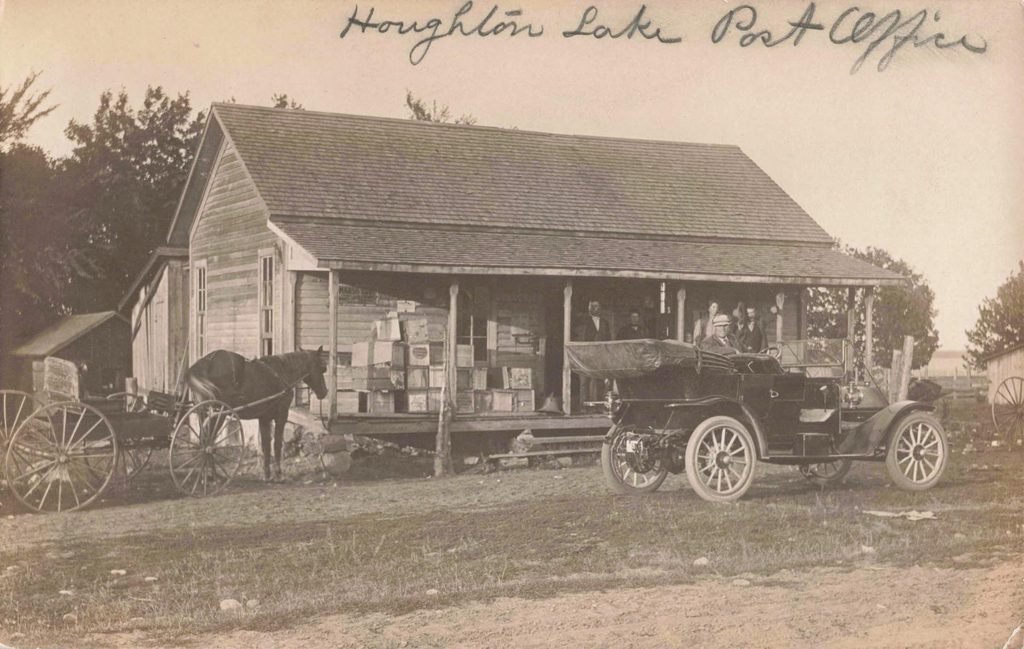
That combination was nothing unusual in the 1910s and early 1920s. Automobiles had arrived, but they had not immediately made horses obsolete. Rural roads could still be difficult for early cars, particularly after heavy rain or during spring thaw, and horses remained practical for local travel and hauling.
Yet the automobile offered a major advantage that would become crucial to Houghton Lake. It let individuals and families travel considerable distances without relying entirely on railroad schedules. A traveler could load fishing equipment, clothing, and groceries into a car and drive directly to a cottage or hotel.
For a community increasingly reliant on tourism, that freedom of movement was enormously valuable.
July 1922 Offers a Glimpse of What Was Coming
The dated July 4, 1922, street view makes clear that automobile traffic was no longer an occasional novelty. Cars line the roadway, and the village appears unusually busy for a community of its size. The holiday date strongly suggests that at least some of those vehicles belonged to visitors who had come to spend Independence Day near the lake.
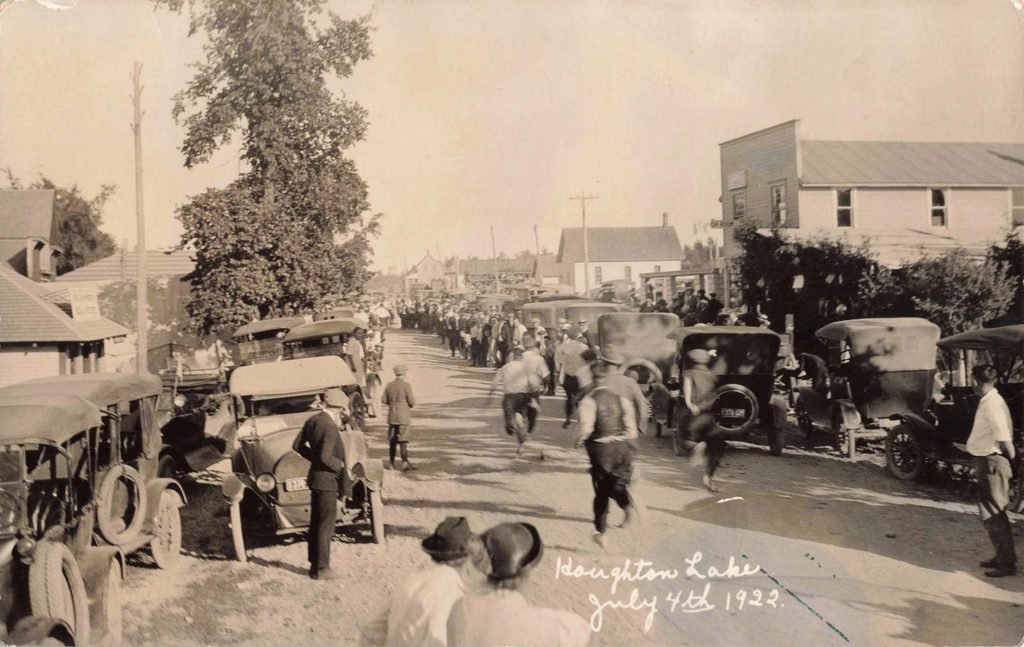
That traffic helped create a new local economy. Travelers needed meals, supplies, gasoline, and somewhere to sleep. Local merchants who once served primarily permanent residents increasingly found themselves serving people who might remain only a few days.
The automobile also let tourism spread beyond a central hotel or railroad stop. Visitors could rent a cottage farther along the shoreline and still reach stores and restaurants. Development around Houghton Lake could therefore spread outward rather than remaining concentrated around a single commercial center.
The old village was gradually becoming a roadside destination.
A Stone School Suggests a Permanent Community
It’s easy to look at the cottage and resort images and assume Houghton Lake existed mainly for visitors. The substantial stone school in Houghton Lake Village tells a different story. Built during the 1920s, the structure reflects a community that expected families to remain through winter as well as summer.

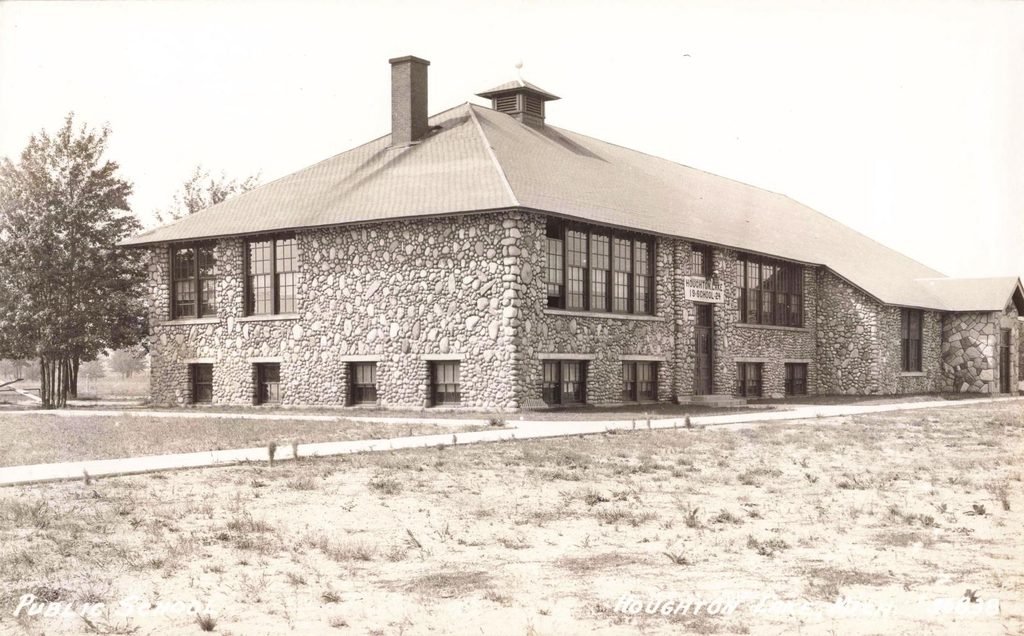
Its fieldstone exterior, large classroom windows, and broad hipped roof made it an unusually impressive building for a small northern settlement. It was clearly intended as a permanent civic institution rather than a temporary schoolhouse serving a handful of children.
The school also reminds us that tourism did not replace ordinary community life. Teachers, merchants, tradespeople, and families lived around Houghton Lake year-round. Their children needed classrooms whether tourists crowded the roads in July or snow piled along them in February.
The growing resort economy supported permanent residents, but it didn’t define every part of their lives.
Cottages Change the Way Visitors Stay
Early resort travel often centered on hotels and boarding houses. Houghton Lake had its share, including the Lake Shore Hotel shown in one early view. Such establishments made sense when travelers arrived by railroad and expecting meals, lodging, and other services in one place.
Automobile travel encouraged a different arrangement. By the 1930s, cottage courts and small cabin resorts were becoming a familiar sight around northern Michigan. Winslow Cottages at Houghton Lake offer a good example.

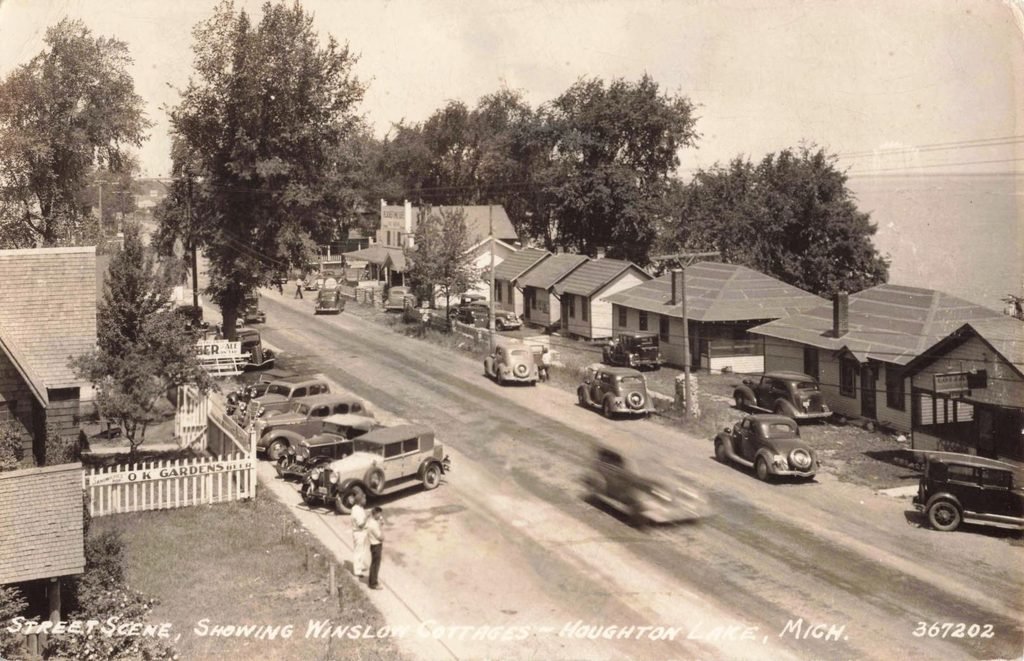
In the surviving street scene, individual cabins stand in a row beside the road, with automobiles parked nearby. Guests could drive almost to their front door, unload their belongings, and settle into a private little building for several days or perhaps several weeks.
The cottage gave visitors independence. Families could prepare some of their own meals, keep fishing equipment close at hand, and come and go without the formality of a large hotel. Owners could also add several modest cottages gradually as business increased.
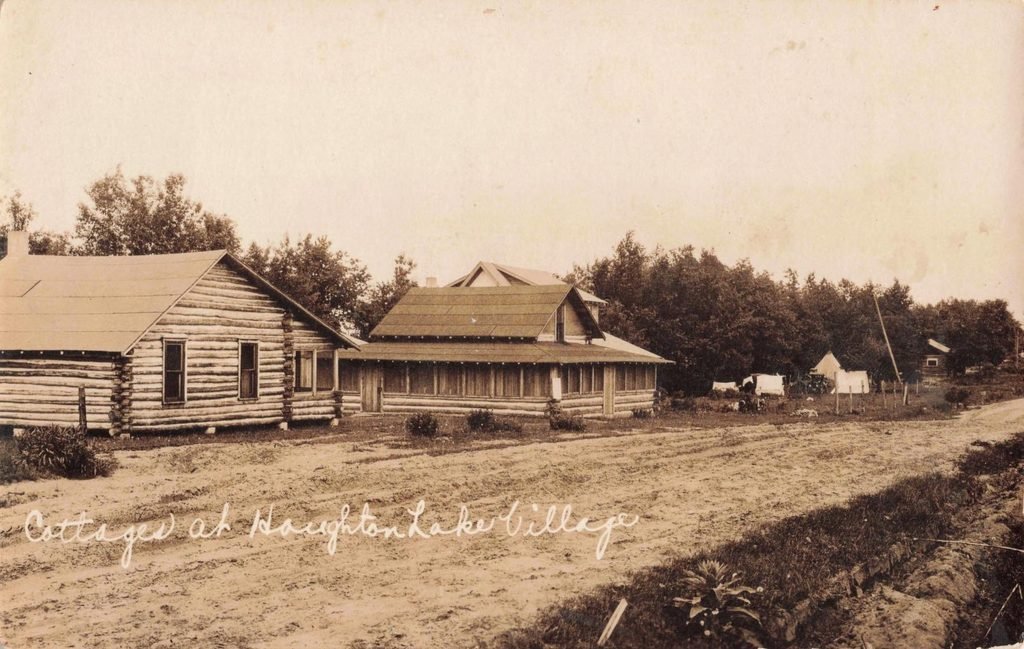
This type of roadside lodging would become a defining feature of Michigan vacation travel.
Hotels, Stores and the Business of Keeping Visitors Comfortable
The older Lake Shore Hotel belongs to an earlier era of tourism, but the image is valuable because it shows how hospitality businesses clustered with other commercial services. Nearby, a storefront sold items like ice cream, giving travelers a place to buy small comforts without a long trip.

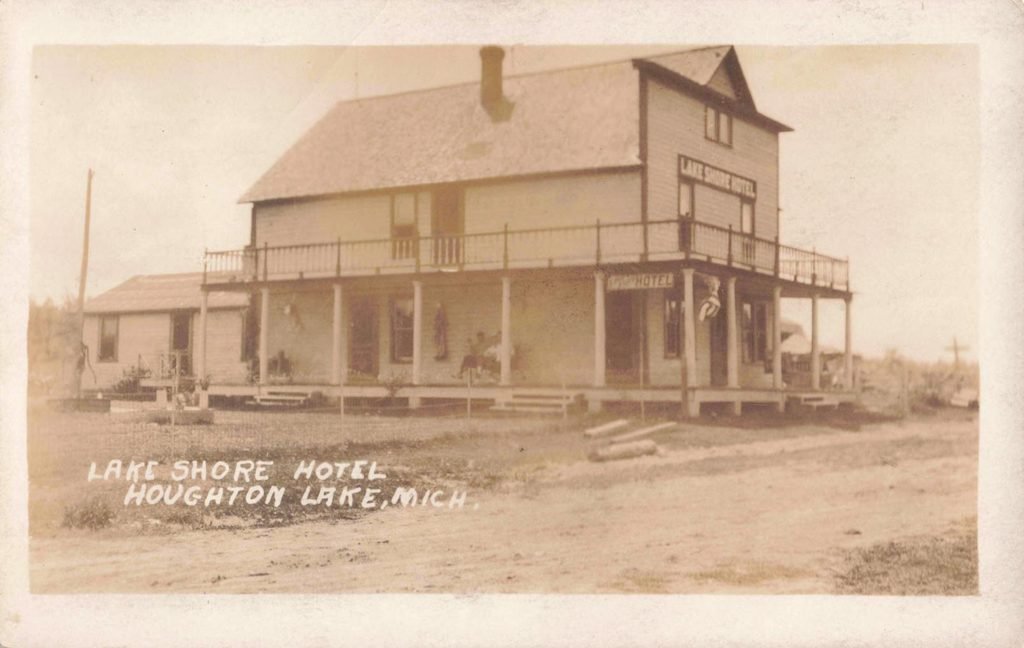
As automobile traffic increased, so did these services. General stores stocked food and supplies. Restaurants fed vacationers who did not want to cook. Garages repaired cars that had made long drives over roads far less dependable than today’s highways.

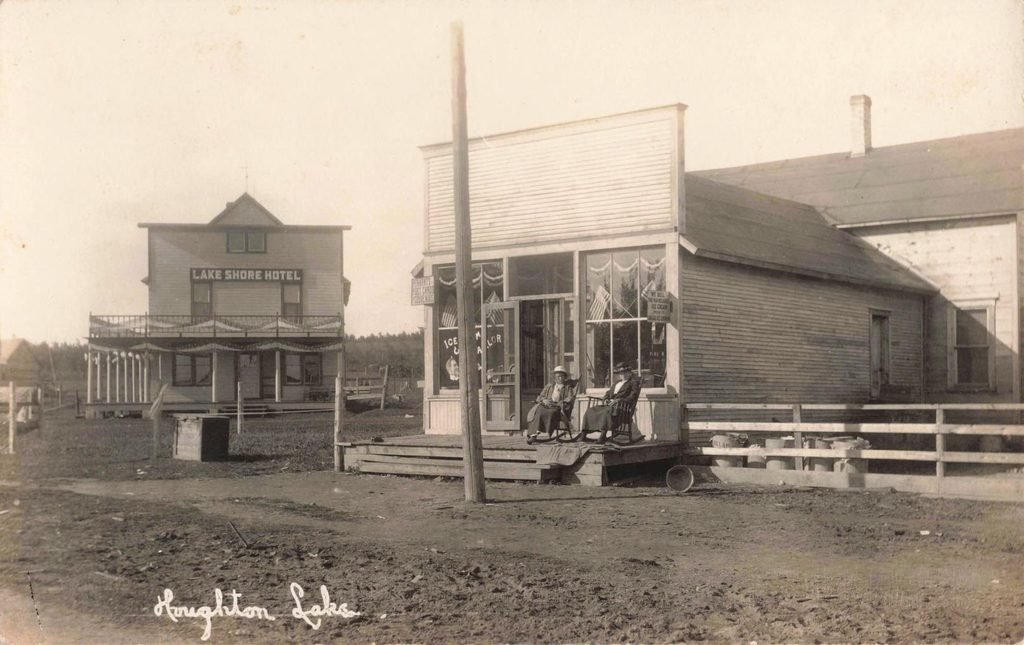
Visitors might come for the lake, but nearby businesses made an extended stay practical. A family could rent a cabin, buy groceries nearby, pick up fishing supplies, and eat a restaurant meal without returning to a larger city.
That pattern turned recreation into a broad local industry rather than a single line of business.
Hunters Were Part of the Economy Too
Houghton Lake’s tourism business was not limited to warm summer afternoons. Fishing drew visitors year-round, while fall brought hunters to Roscommon County. One street image makes that trade especially clear: a large sign advertises a local tavern as “Hunters Headquarters.”

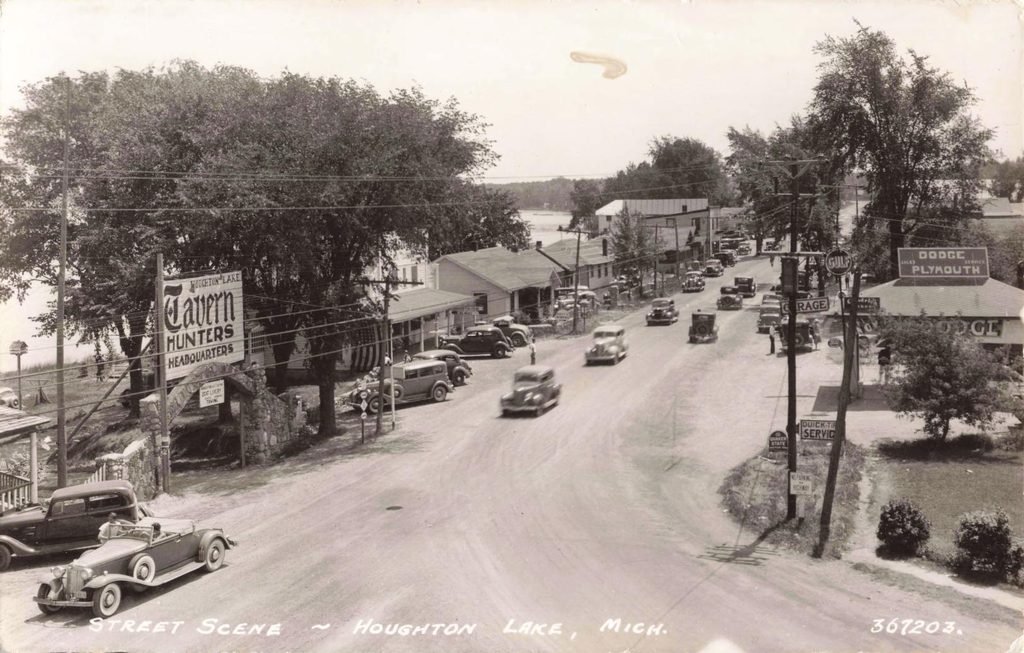
That sign is useful historical evidence because it tells us exactly whom the business wanted to reach. Sportsmen were not incidental customers; they were important enough to justify direct advertising along the road.
Combining fishing and hunting also helped extend the economic season. Summer families might leave after Labor Day, but deer season could fill cabins and restaurants again later in the year. Winter fishing eventually gave Houghton Lake another reason to draw visitors during months when many Michigan resort towns became quiet.
That year-round recreational pattern would later help produce Tip-Up Town, but the economic groundwork had been laid much earlier.
Howe’s Camp Offered Nearly Everything in One Place
Howe’s Camp on Houghton Lake’s north shore represents another step in the evolution of local tourism. One image shows cabins and recreational grounds among the trees, while another includes Howe’s General Store and a nearby building marked “Good Food.”

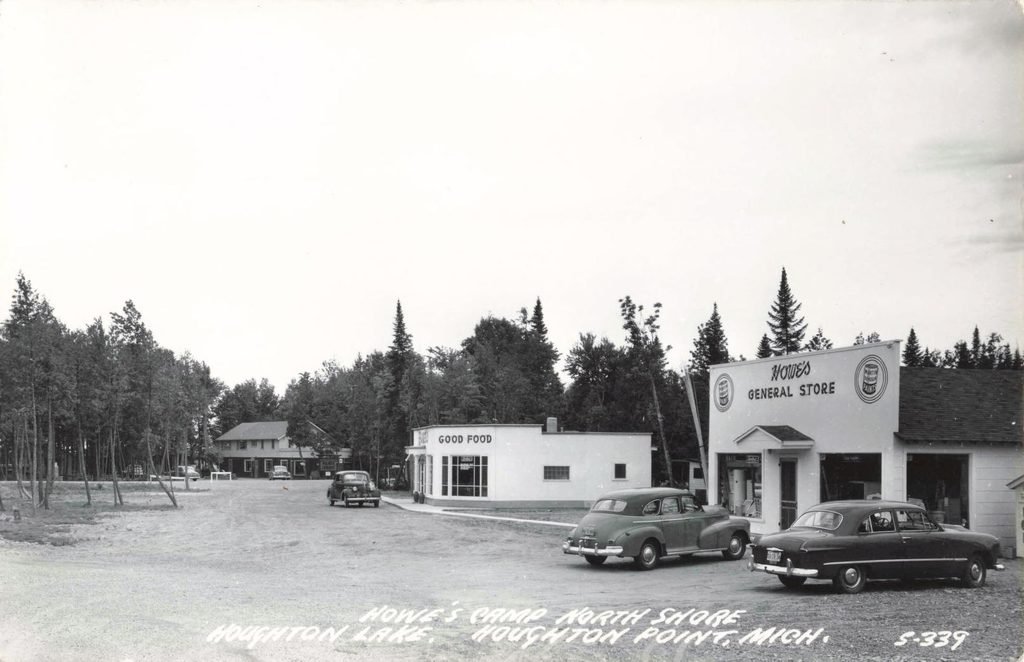
The word “camp” can mislead modern readers. Operations such as Howe’s could function more like compact resorts, bringing lodging, meals, supplies, and recreation together in one location. Visitors could arrive by automobile and find much of what they needed without traveling far.

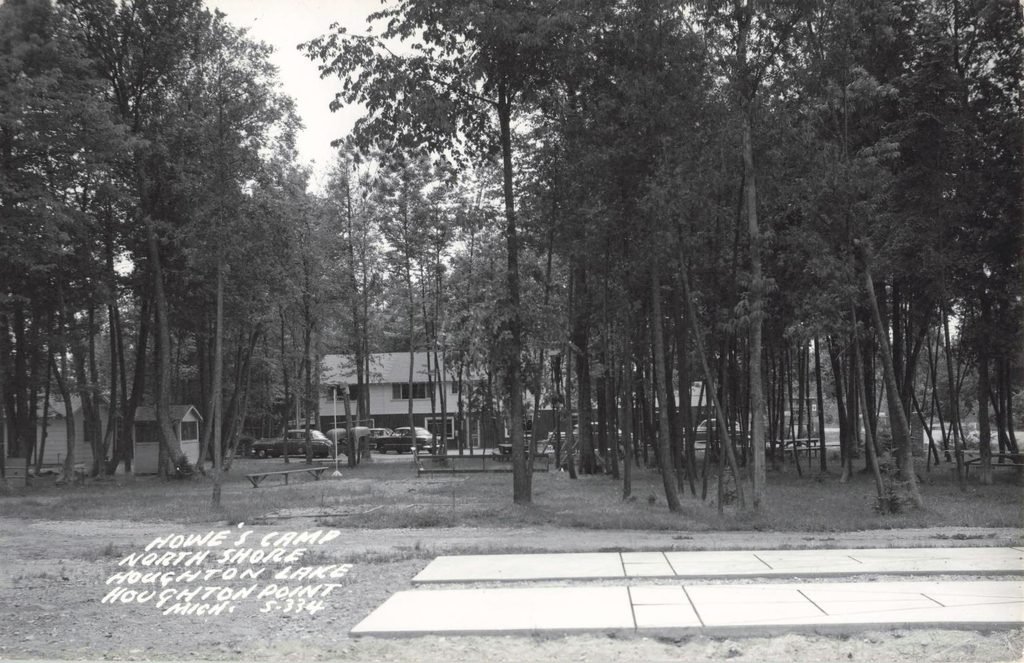
The setting also shows why Houghton Lake appealed to families. A wooded cottage property offered an informal vacation that was very different from staying in a downtown hotel. Children had room to play, adults had access to the lake, and the family car remained close by for trips into town.
This marked a shift in northern Michigan tourism toward something less formal and more personal.
The Automobile Rewrites Main Street
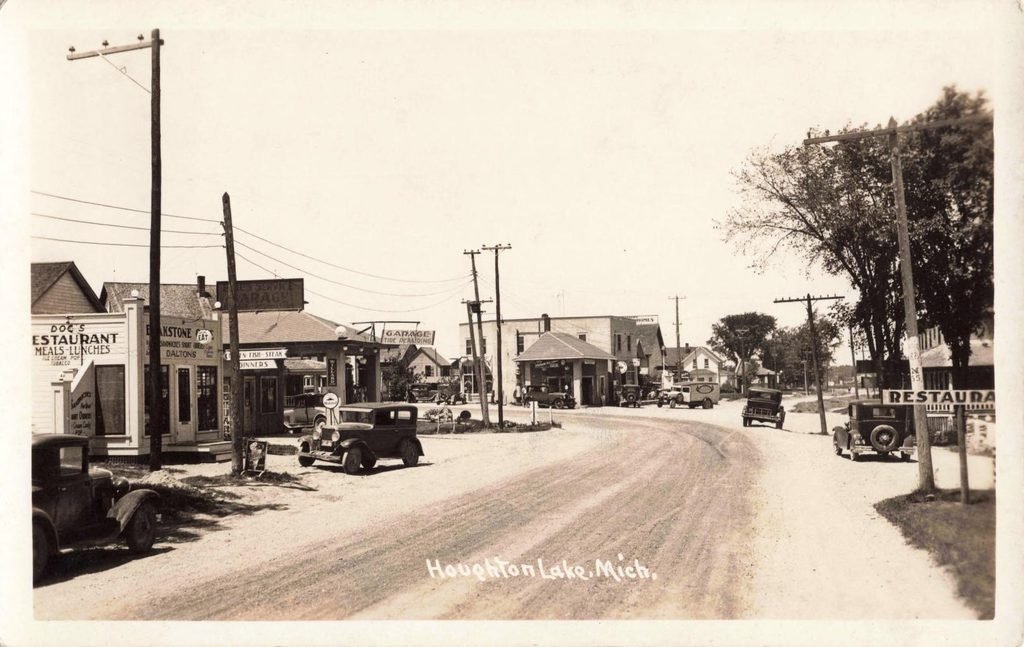
By the 1930s and 1940s, Houghton Lake’s commercial district looked increasingly familiar. The roads were wider, parking spaces were more obvious, and businesses advertised directly to passing motorists. A later view includes Proctor Cottages, Sharrow’s General Store and the Woodland Bar along a road lined with automobiles.

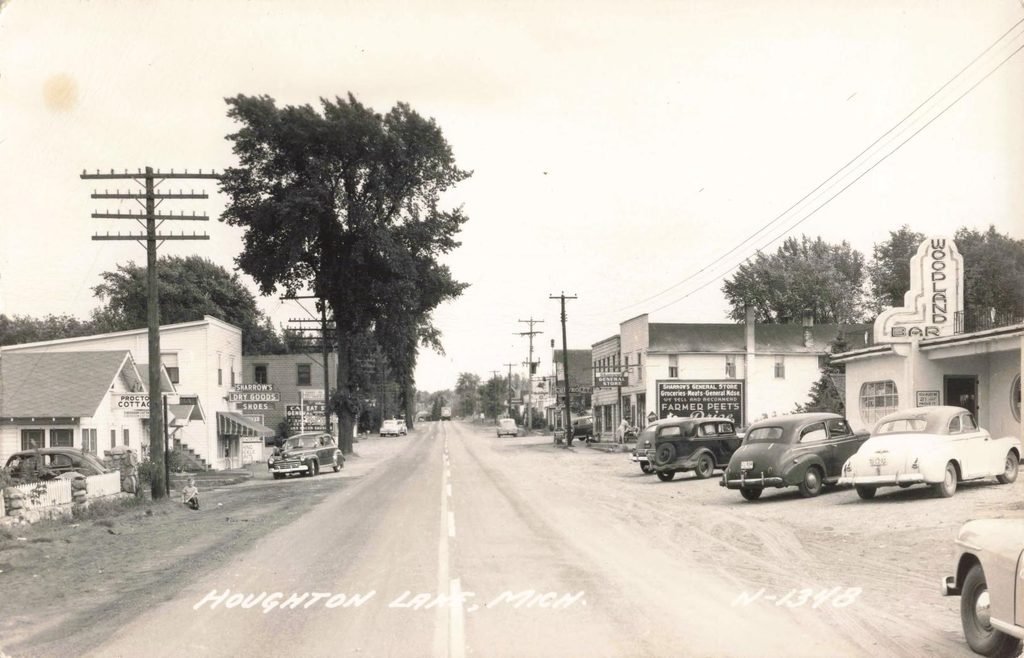
Compare that image with the early dirt streets, and the scale of the change becomes obvious. The earlier village had been designed around people who already lived nearby. The later business district increasingly depended on people moving through town.
Large signs became more valuable because motorists had only seconds to read them. Parking became an economic necessity. Gas stations, repair garages and automobile dealerships occupied places that would have had little purpose two decades earlier.
The History of Houghton Lake Village Michigan is therefore also part of a much broader American story. The automobile did not merely change how people traveled; it changed the physical arrangement of towns built along popular routes.
Even the Fire Department Entered the Motor Age
One of the sharpest later images shows a new Houghton Lake fire truck parked outside a garage carrying DeSoto and Plymouth signs. It is an appealing combination of civic improvement and automobile commerce.
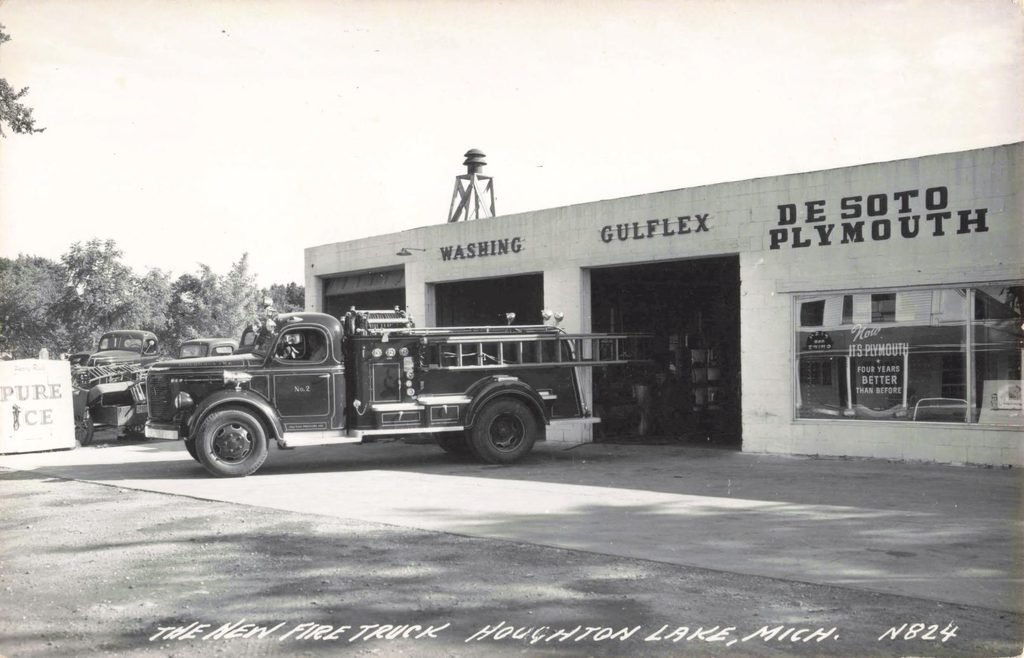
The fire truck represents a more organized community. As the number of homes, cottages, and commercial buildings increased, dependable fire protection became more important. Motorized equipment gave firefighters a speed and carrying capacity that earlier methods could not match.
The dealership signs behind the truck tell the same story. Automobile ownership had created permanent businesses devoted to sales, fuel, maintenance, and repair. The car was no longer merely transportation used by tourists; it had become part of Houghton Lake’s local economic structure.
A few decades earlier, the horse outside the post office had still made perfect sense. By this point, the town had clearly chosen the automobile.
Houghton Lake Was a Collection of Communities
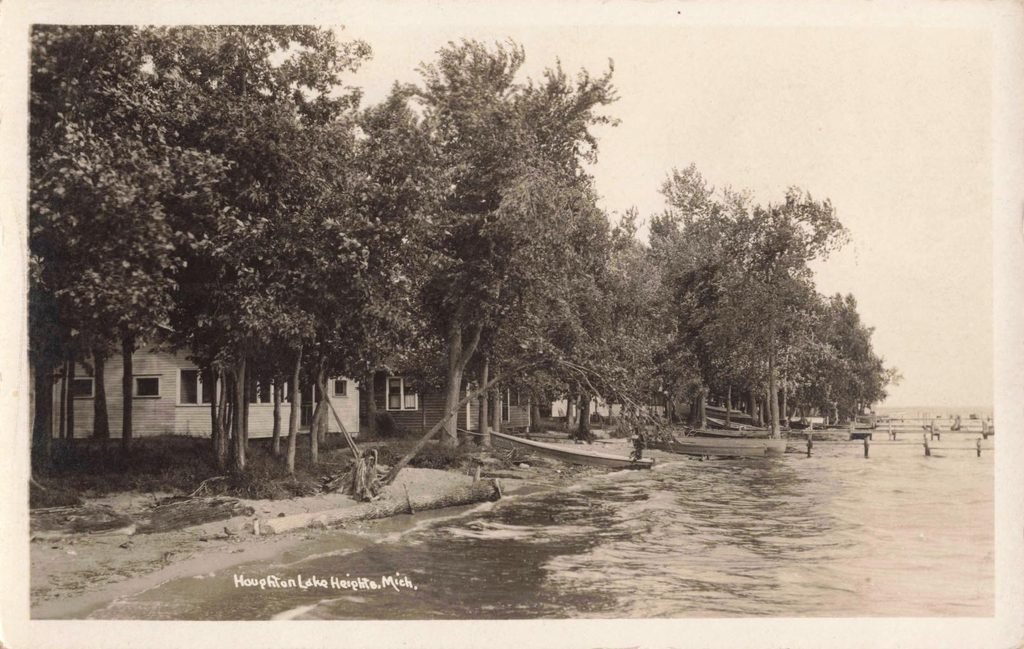
One detail can easily confuse anyone reading old postcards or local histories. “Houghton Lake” did not always refer to a single compact village. Several distinct communities developed around the shoreline, including Houghton Lake Village, Prudenville, and Houghton Lake Heights.
Those settlements shared an economic relationship with the lake but developed their own businesses and local identities. Resorts sometimes used “Houghton Lake” broadly in advertisements even when they were located some distance from the village itself.
The distinction became less troublesome as automobiles improved mobility. A visitor staying several miles away could easily drive into Houghton Lake Village for food, supplies, or entertainment. The shoreline increasingly functioned as one interconnected vacation area even though its communities retained separate names.
That helps explain why old postcard collections can appear to show several different “downtowns.” In a sense, they do.
From Sending Timber South to Bringing People North
There is a useful irony in the transformation of Houghton Lake. During the lumber era, local transportation systems were built partly to move natural resources out of northern Michigan. Trees were cut, loaded and moved toward markets elsewhere.
The recreation economy reversed that flow. Instead of sending northern Michigan’s value south, local businesses persuaded people from southern Michigan to bring their money north. The forest and lake became valuable not only for what people could take from them but for the experiences they offered visitors.
By the mid-20th century, that change was visible almost everywhere around Houghton Lake. Cottage courts stood beside highways, bars advertised to hunters, restaurants fed motorists, and stores supplied families who had temporarily traded city life for a cabin near the water.
Tip-Up Town would eventually give Houghton Lake a nationally recognizable winter identity, but its success didn’t come out of nowhere. The area’s businesses had already spent decades learning how to serve fishermen, hunters, and vacationing families in nearly every season.
What the Old Images Still Tell Us
The strongest record of the History of Houghton Lake Village , Michigan, may be the sequence preserved in these old images. In the earliest views, roads are sandy, homes are modest, and horses remain part of ordinary transportation. The post office sits where the old and new systems overlap, with horse power and horsepower sharing the same patch of ground.
A few years later, the automobile has clearly gained the advantage. Cars crowd the village during the Fourth of July holiday, while cottages and small resorts begin lining the roads around the lake. Businesses adapt by offering food, lodging, supplies, entertainment, and mechanical help to people who may have driven for hours to get there.
By the 1940s, Houghton Lake had taken on much of the form later generations would recognize. The road had become the community’s commercial spine, and businesses faced motorists with large signs and convenient parking. The transformation from lumber-era settlement to vacation community was not the result of one developer or a single boom year; it happened through hundreds of ordinary decisions by merchants, cottage owners, travelers and year-round residents.
The old Houghton Lake post office may best symbolize that transition. A horse-drawn vehicle and an early automobile appear together, neither yet looking completely out of place. Within a generation, scenes like that would disappear, replaced by streets filled with cars and roads leading toward cottage camps along the shoreline.
For families who later knew Houghton Lake through summer vacations, fishing weekends, or winter trips to Tip-Up Town, the 1920s and 1930s had already laid the foundation for that experience. The lake remained the attraction, but the automobile changed who could reach it, how long they stayed, and what kind of community developed around it.
That is what makes these old street scenes so useful. They don’t merely show what Houghton Lake Village once looked like. Seen in order, they show a Michigan town changing its entire way of making a living — one cottage, one storefront and one carload of visitors at a time.
? Works Cited
Denton Township. History. Denton Township, Roscommon County, Michigan. Denton Township history
Houghton Lake Area Historical Society. About. Houghton Lake Area Historical Society. Houghton Lake Area Historical Society history
Houghton Lake Historical Society. About Houghton Lake and Its History. Houghton Lake history
Michigan Department of Natural Resources / Michigan Historical Center. Prudenville / Roscommon Lumber Co. Historical Marker. Prudenville historical marker
Michigan State Board of Education. Rural School Organization. Special Bulletin No. 229, January 1933. The report records the Houghton Lake Village school as having been built in 1924.
Michigan State University. Railroad Logging. Michigan Geography. Michigan railroad logging history
Up North Voice. “Tip Up Town: Celebrating 76 Years on the Ice.” 2026. Tip-Up Town history
The strongest visual storyline from this group is “the horse-to-automobile transformation of Houghton Lake Village.” It gives the episode a clear beginning, middle and end while allowing nearly every image you supplied to serve a specific historical purpose.

