 by
by 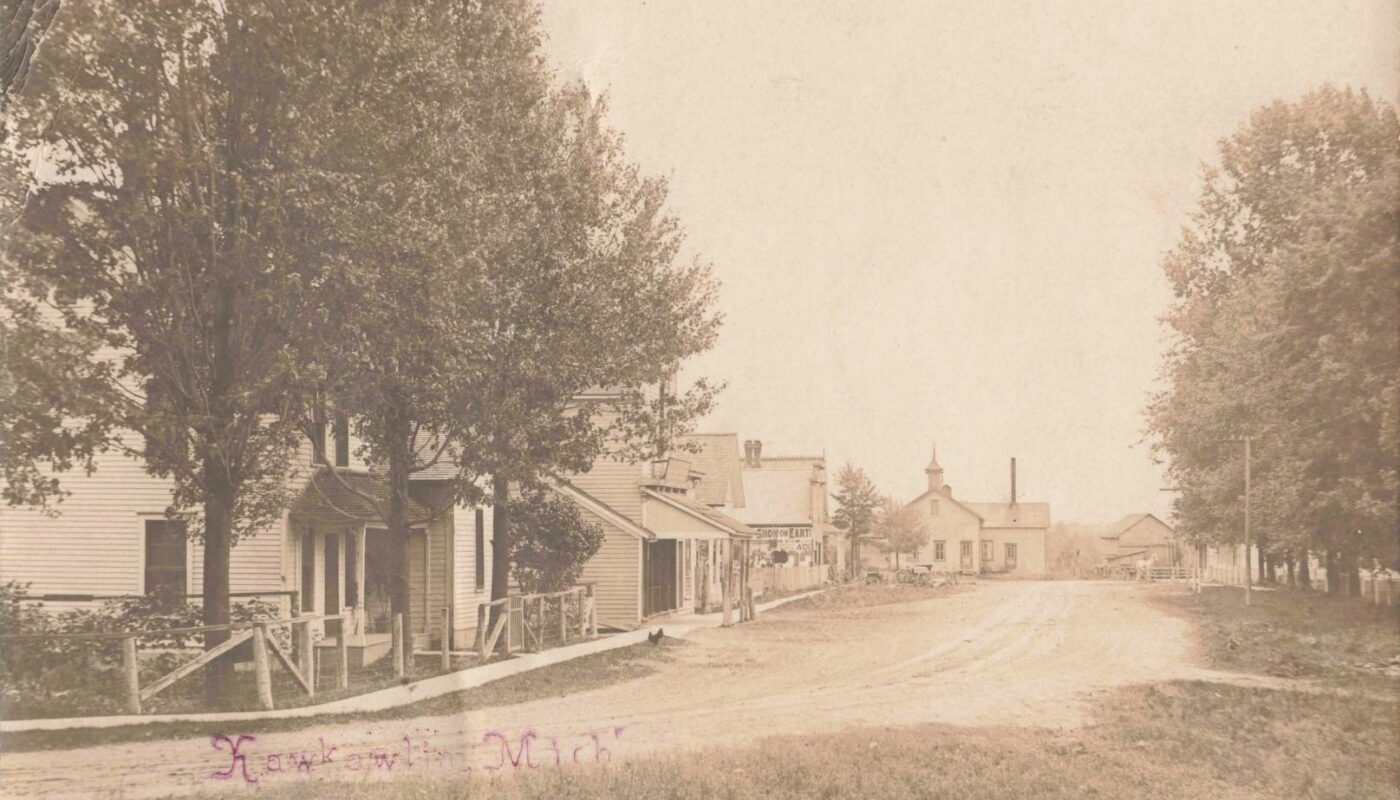
In the history of Kawkawlin Michigan, the tiny village began as a place of work—and nearly became a place of explosive risk.
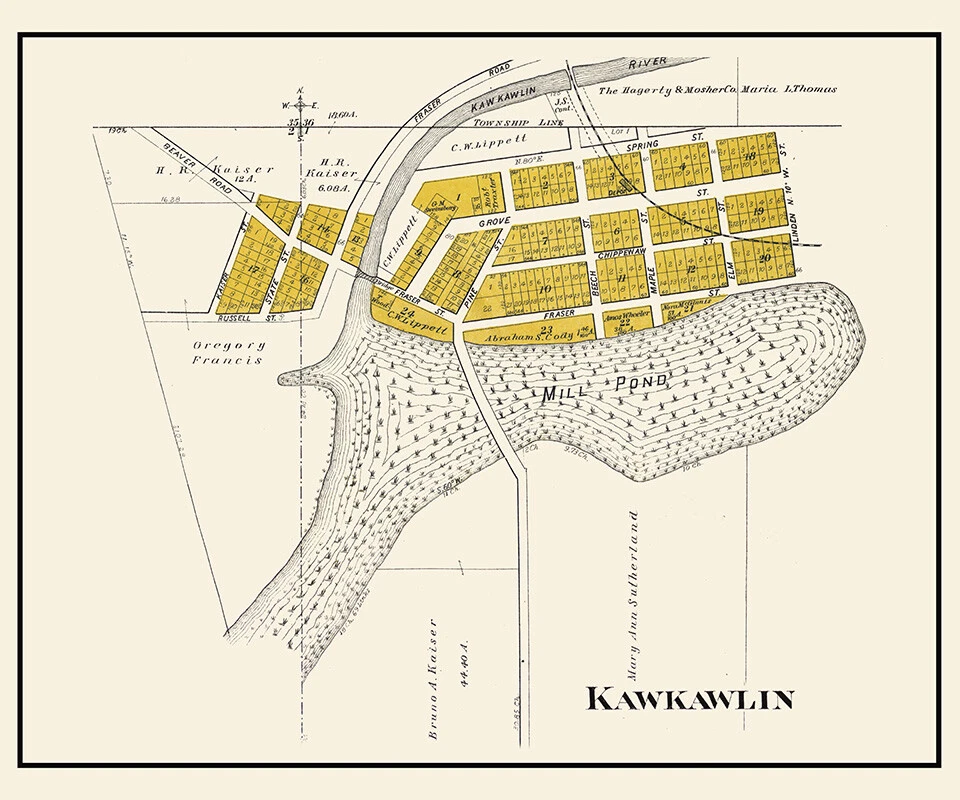
Set along the winding Kawkawlin River in Bay County, this community traces its roots to 1844, when a sawmill rose on the riverbank. That single decision set the course for everything that followed. Timber, railroads, farming, and even explosives all passed through this small town. Yet what stands out most is not how fast Kawkawlin grew—but how it held its ground.
A River Rich with Fish—and Opportunity
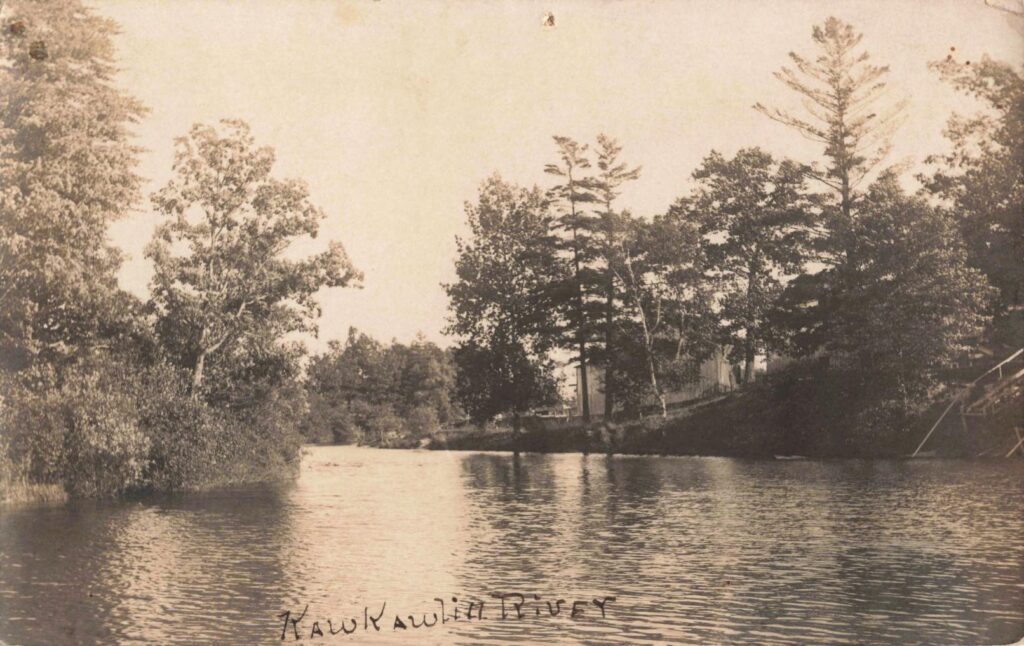
Long before sawmills and rail lines, the area carried a different identity. The name “Kawkawlin” comes from the Ojibwe word ogaakaaning, meaning “place of pike.” The river was known for its fish, and Native communities relied on it for food and travel.
That detail often gets overlooked. The earliest economy here was not lumber. It was water.
When settlers arrived in the 1840s, they saw something else in the same river—power. Water could turn saw blades. It could move logs. It could support a growing industry.
In 1844, James Fraser and his associates built one of the first sawmills in Bay County along the Kawkawlin River. It was only the second mill in the county, but it quickly drew workers and settlers.
Within a decade, a settlement had taken shape.
The First Community Takes Form
By 1855, Kawkawlin was still small, but it was no longer isolated. Records describe two mills, five cottages, two log huts, and several Indigenous wigwams. It was a mixed and working community, tied together by the river and the lumber trade.
At the same time, another institution took root.
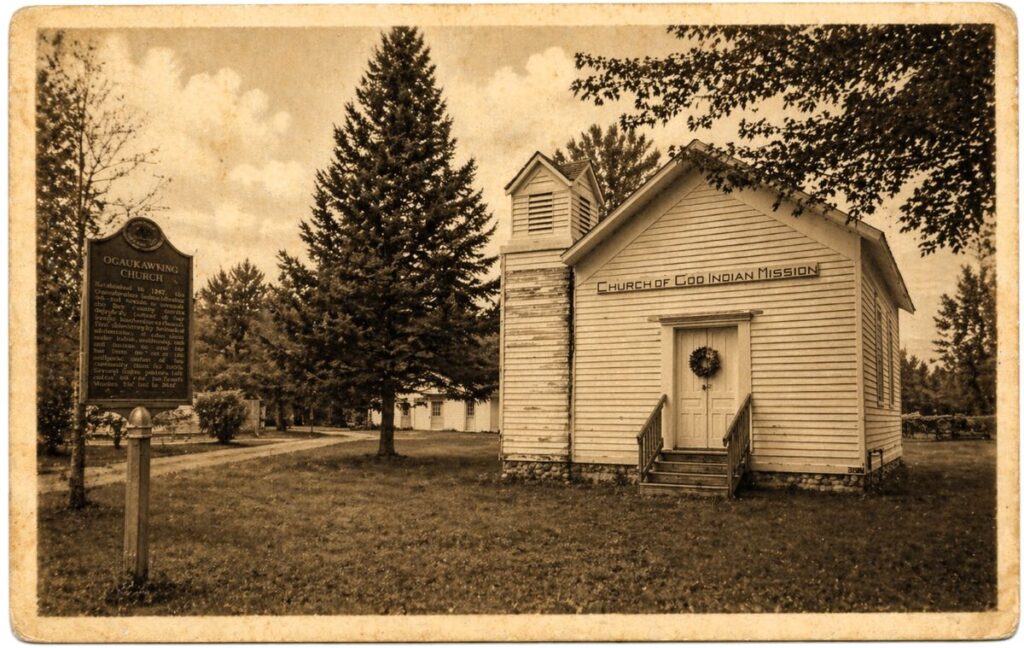
In 1847, the Methodist Indian Mission—known as the Ogaukawning Church—was established along what is now Euclid Avenue. It served as both a religious center and a meeting place. In a frontier setting, that mattered. It offered structure, education, and a place where different groups came into contact, sometimes uneasily, but regularly.
The presence of the mission reveals something important. Kawkawlin was not just an industrial outpost. It was also a social experiment, where cultures met under pressure from rapid change.
Lumber, Labor, and a Growing Township
Through the mid-1800s, lumber drove the local economy. Trees were cut, milled, and shipped toward Bay City, which was emerging as a major processing center. The settlement grew alongside that trade.
In 1868, Kawkawlin Township was officially organized, carved from the northern portion of Bangor Township. This step signaled permanence. The area was no longer just a cluster of mills. It was a recognized community with defined boundaries.
But change was already underway.
The Railroad Arrives—and Changes Everything
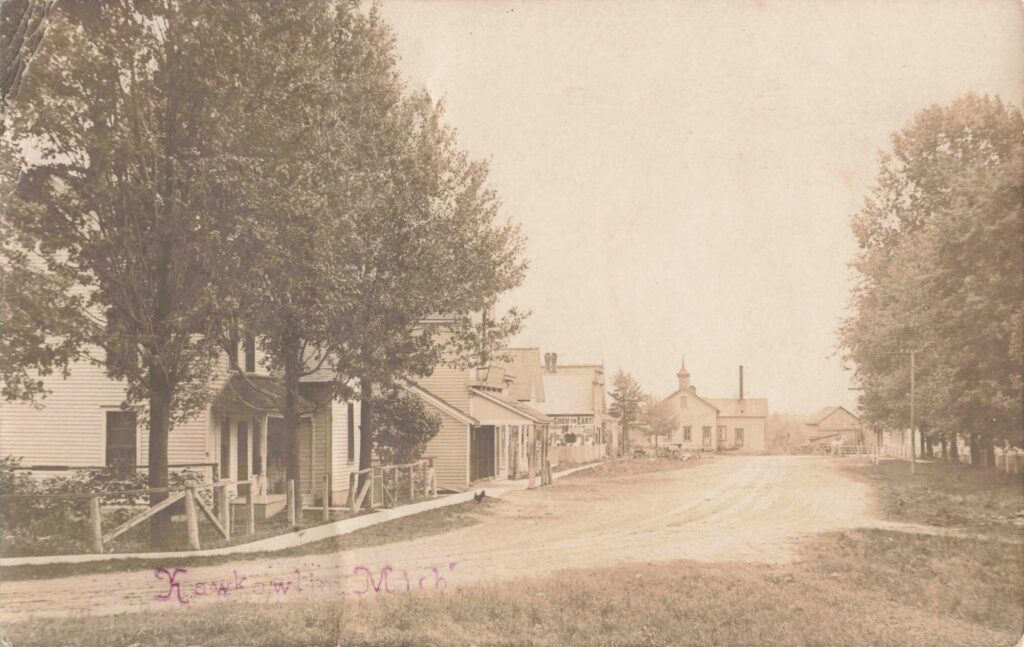
In 1871, the Jackson, Lansing & Saginaw Railroad reached Kawkawlin. The line included a drawbridge over the river, allowing trains and river traffic to coexist. That single addition reshaped the town.
Railroads reduced dependence on the river. Goods could move faster and in greater volume. Farmers gained access to broader markets. Supplies arrived more reliably. A new center of activity emerged along the tracks.
On the south bank of the river, a place known as Seidler’s Corner developed between the 1880s and early 1900s. It was not large, but it was busy. A hotel, saloon, livery stable, and even a cheese factory operated there. This was not the quiet farming community people often associate with Kawkawlin. It was active, social, and at times rough around the edges.
And then, another layer of industry arrived—one that few would expect in a place like this.
The Dynamite Factory That Shook the Region
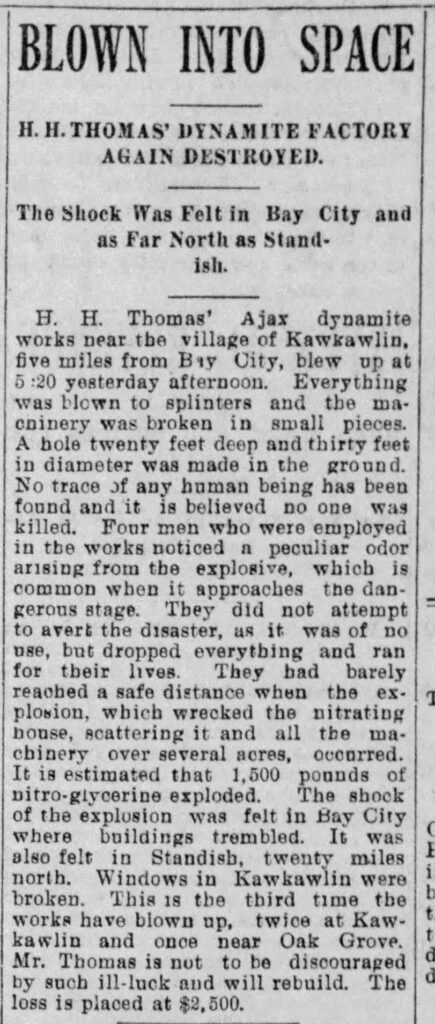
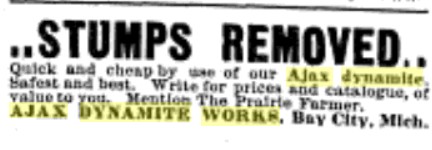
At one point in the history of Kawkawlin Michigan, it became home to a dynamite factory. It is a striking detail.
Dynamite production required careful handling, strict processes, and a degree of isolation. Small rural towns were sometimes chosen for such operations because they offered space and distance from dense populations.
One of the most striking chapters in the history of Kawkawlin Michigan came on June 11, 1898.
The H.H. Thomas Ajax dynamite works exploded with an estimated 1,500 pounds of nitroglycerin. The blast created a crater 20 feet deep and shook buildings from Bay City to Standish.
The financial loss from the explosion was estimated at $2,500—a significant sum in 1898. But the broader impact was harder to measure.
This Michigan dynamite factory incident remains one of the most dramatic events in the town’s past.
Here’s the surprising part: no lives were lost. Workers fled after noticing warning signs just moments before the explosion.
From Timber to Agriculture
As the 19th century turned into the 20th, the lumber supply declined. That pattern repeated across Michigan. What happened next often determined whether a town survived.
Kawkawlin transitioned.
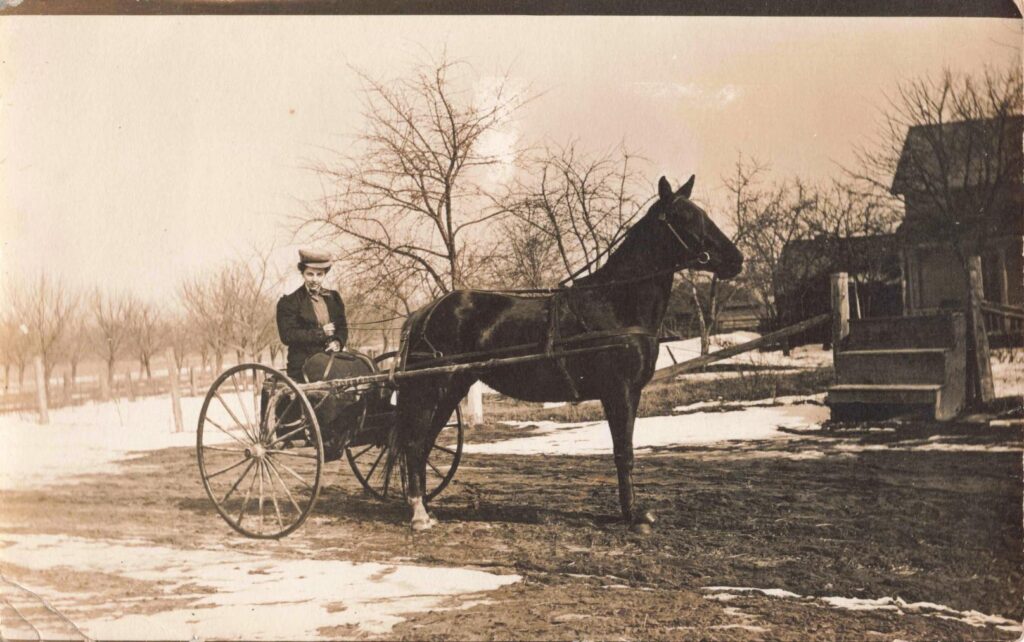
Cleared land became farmland. Orchards and fields spread across the area. The economy shifted from extraction to cultivation. Farming did not produce the same rapid growth as lumber, but it offered consistency. Families could plan from season to season. The town’s role became clear—it served the surrounding farms.
General stores supplied goods. Bridges connected roads. The rhythm of life slowed, but it held.
The Store, the Porch, and the Street
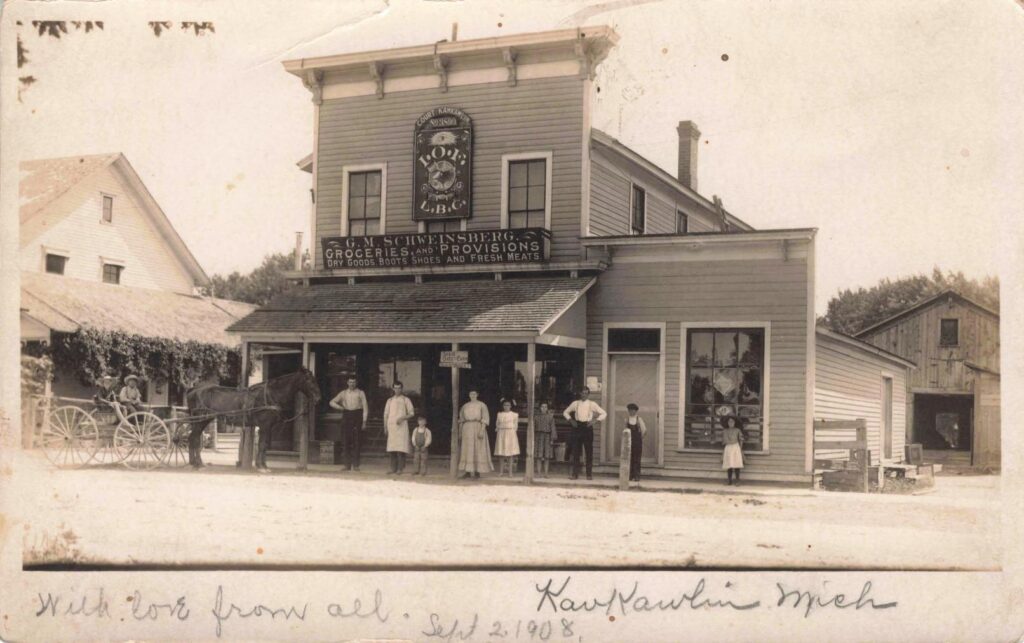
One early building in Kawkawlin carried a long, direct sign: G. M. Schweinsberg—Groceries and Provisions. Dry Goods, Boots, Shoes and Fresh Meats.
It reads today like a catalog. In 1908, it was a guarantee. A place like this was not just a store. It was where a town met its basic needs—food, clothing, and supplies—under one roof.
A smaller sign under the porch adds another layer: Post Office. That detail matters. In rural Michigan, the general store often doubled as the town’s link to the outside world. Mail, news, and conversation all passed through the same doorway.
Out front, people gathered. Men stand with hands at their sides or in their pockets. Women and children line up along the porch. A horse and wagon wait off to the left, hitched and still. The scene feels arranged, but not artificial. This is how daily life looked—public, shared, and visible.
Above it all hangs a lodge sign: Court Kawkawlin No. 3559, I.O.F. Not the Odd Fellows, but the Independent Order of Foresters, a fraternal group that offered insurance, aid, and a social network. In small towns, these organizations filled gaps left by the absence of formal institutions. They set expectations, offered support in hard times, and created a sense of belonging.
It is a small detail on the facade. But it points to something larger. The store sold goods. The post office carried information. The lodge held the community together.
Bridges, Roads, and Daily Life
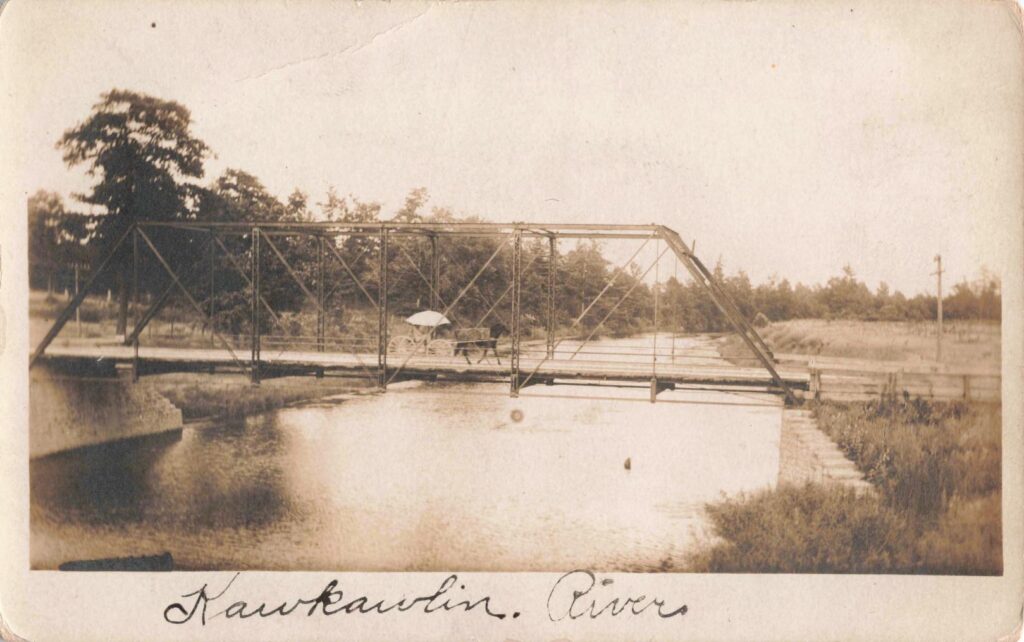
The river still shaped daily life. Crossing it remained essential.
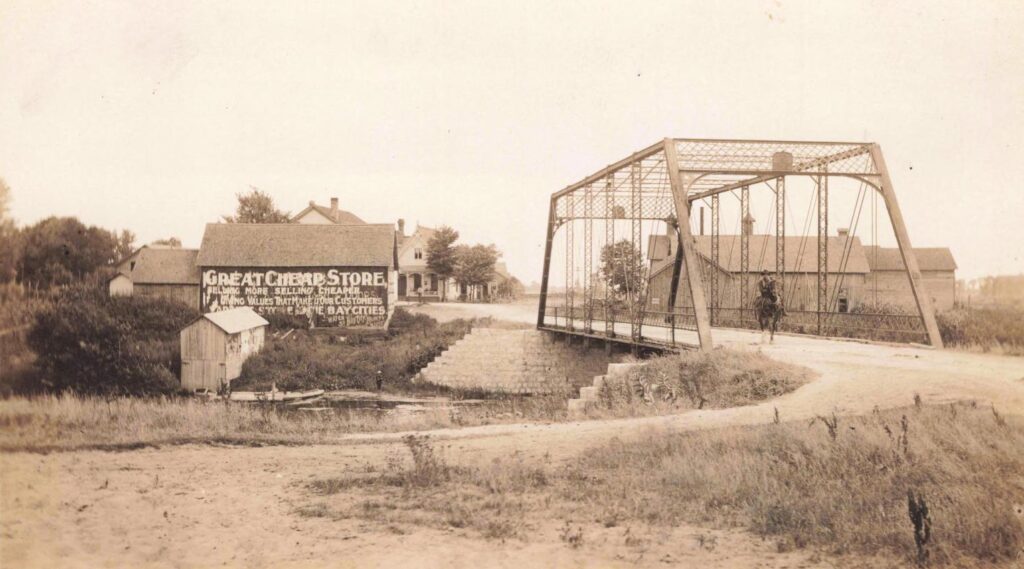
Early steel truss bridges carried wagons and later automobiles across the Kawkawlin River. These structures were practical and built to endure. They connected farms to markets and neighbors to each other.
Meanwhile, the railroad continued to play a role, though its dominance began to fade. By 1900, the original drawbridge had been replaced, reflecting changes in both rail and river traffic.
The town adjusted once again—this time to a world where movement was becoming faster and more flexible.
The Automobile Era and a New Kind of Traveler
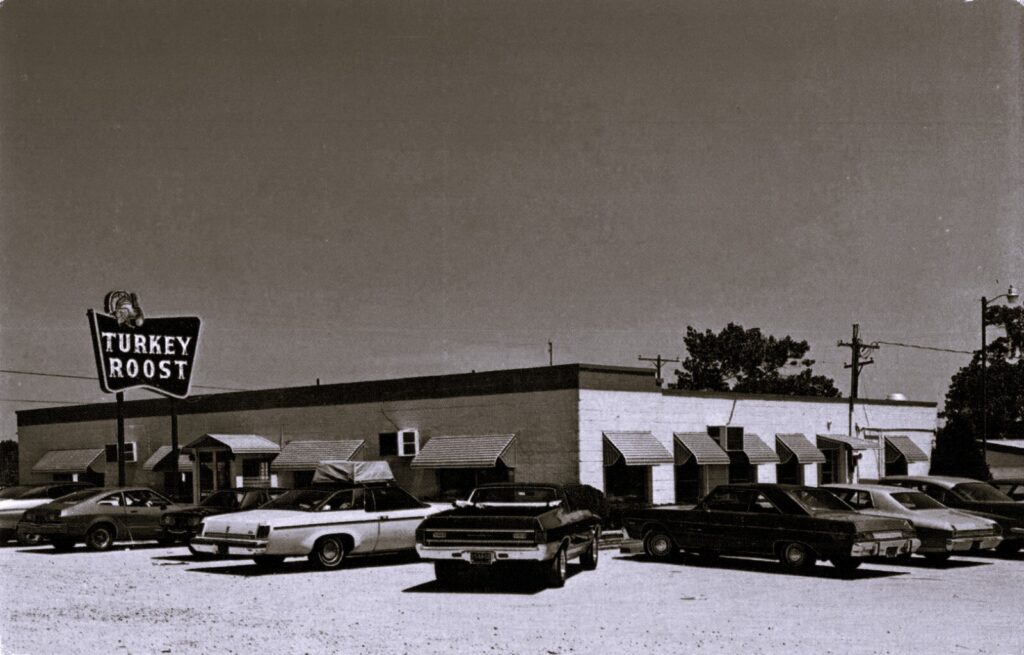
By the mid-20th century, cars replaced horses, and highways began to define movement across Michigan. Kawkawlin adapted without losing its identity.
Roadside businesses appeared, including places like the Turkey Roost restaurant. These establishments catered to travelers moving between Bay City and other regional destinations. It was a new kind of traffic.
Instead of logs or rail shipments, the town now served motorists. Yet the function remained the same. Kawkawlin provided what people needed as they passed through.
Rail Lines and a Changing Economy
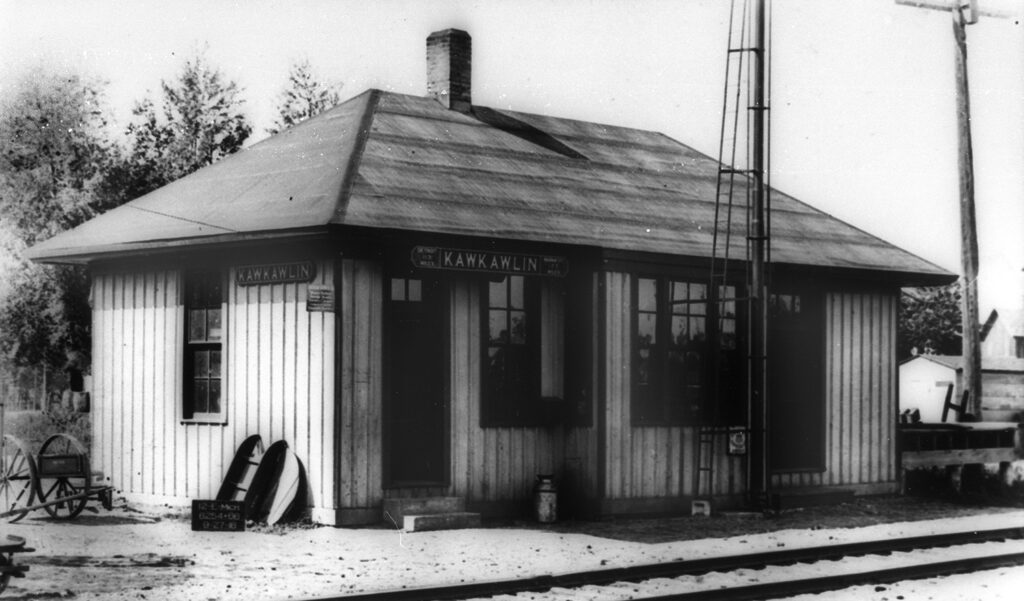
The railroad did not disappear entirely. In the late 20th century, the line through Kawkawlin was acquired by the Detroit and Mackinac Railway, later becoming part of the Lake State Railway system.
Kawkawlin’s small railroad depot served as a key connection point between this rural community and the broader rail network of Michigan. As trains replaced river transport, stations like this allowed farmers to ship products and residents to travel with greater speed, reinforcing Kawkawlin’s role as a steady service town rather than a booming industrial center.
A Town That Endured by Staying Grounded
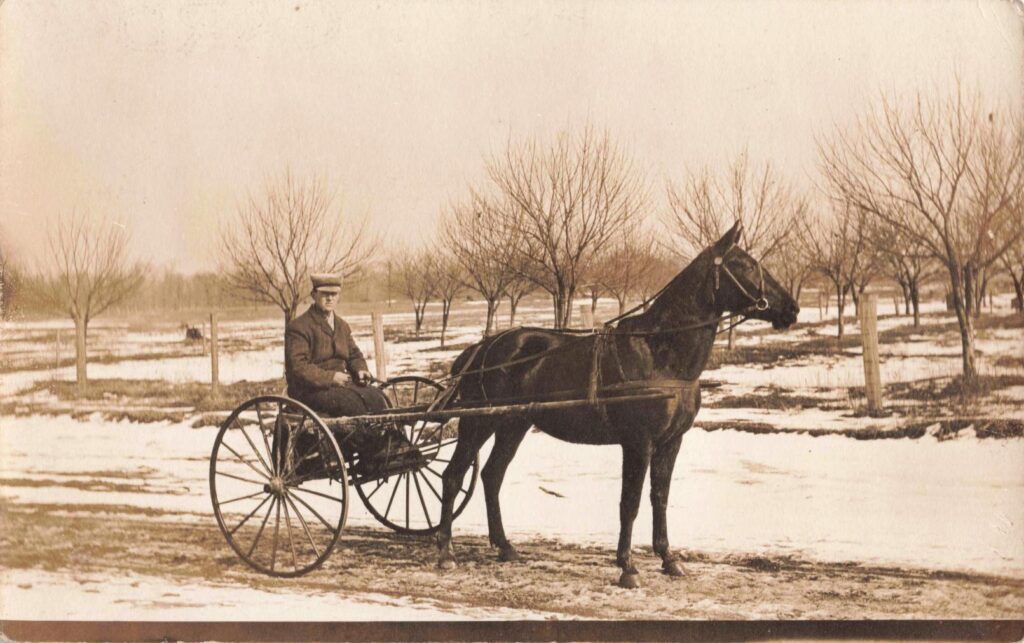
Today, Kawkawlin exists as a rural-residential community within the Bay City metropolitan area. It remains closely tied to the river that gave it its name and its start. The Kawkawlin River still flows into Saginaw Bay, carrying with it the history of the region.
Looking back, the town’s story stands apart for a simple reason. It did not depend on a single identity.
It began as a fishing area. It became a lumber settlement. It supported railroads and industry. It adapted to farming. It even housed a dynamite factory. And through each phase, it adjusted rather than collapsed. That pattern explains its longevity.
Kawkawlin did not grow large. It did not become famous. But it remained useful—to its residents, to travelers, and to the surrounding region.
And in Michigan history, that may be the most reliable path to survival.
Before you go: Try this quick 30-second history check.
Quick Kawkawlin History Check
What stood out in this river town’s story?
1. What natural feature shaped Kawkawlin’s early development?
2. What industry was common in early settlements here?
3. What does “Kawkawlin” refer to?